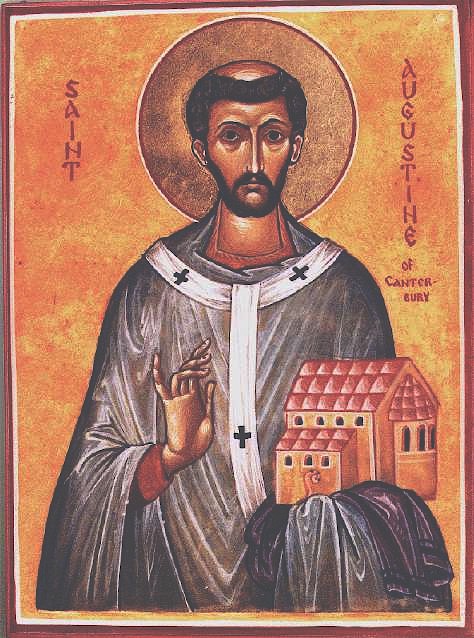
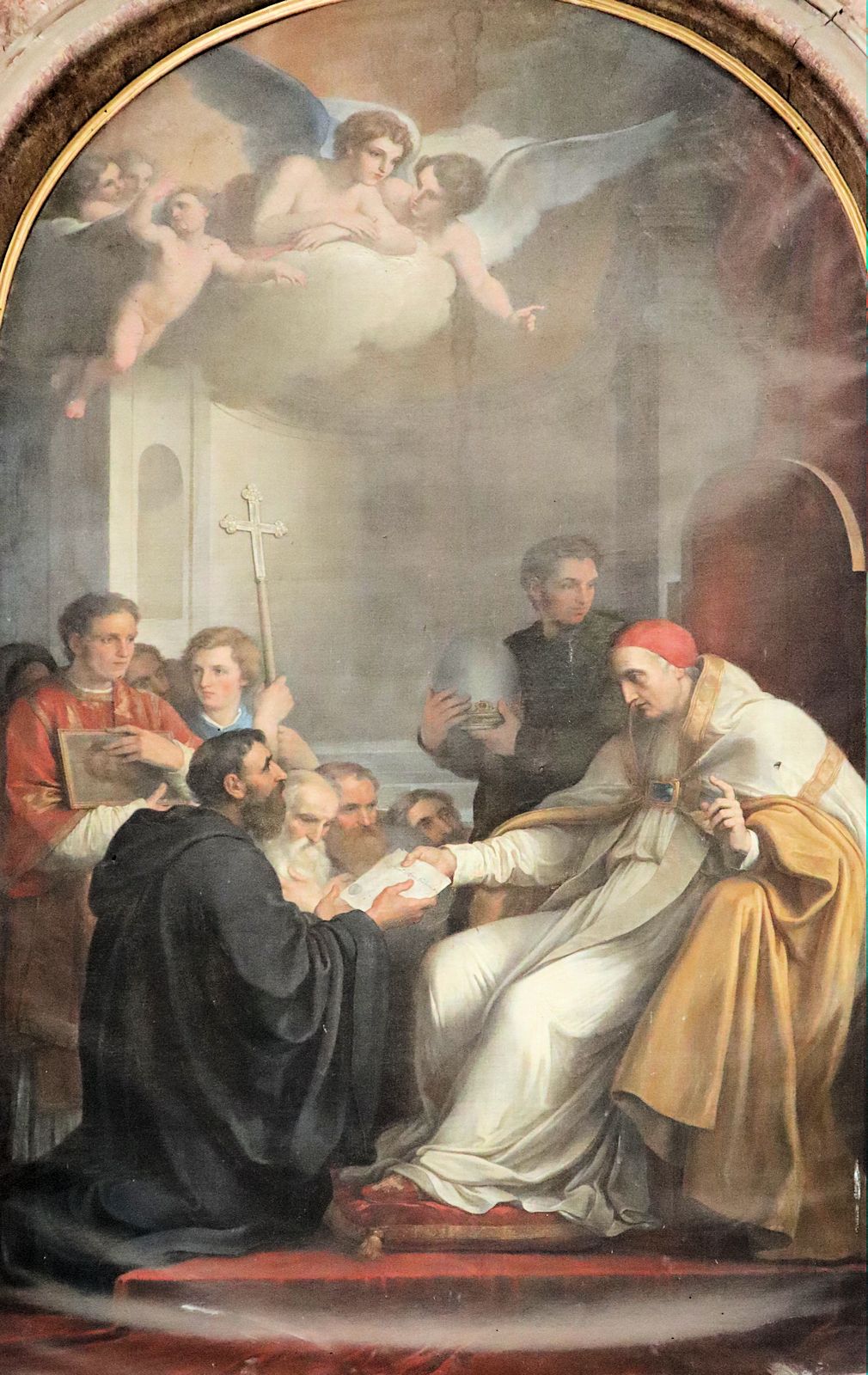
Augustine was a Benedictine monk before the monastery in Rome, which was then dedicated to Andrew, on the site of the present-day monastery of San Gregorio Magno al Celio in Rome, which had been founded by Pope Gregory the Great on the family property. In 596, he was sent to England on a mission together with forty monks.
When Augustine and his monks reached Aix-en-Provence , they were so horrified by the reports about the wild islanders in Britain that Augustine wanted to abandon the venture and return to Rome . But the Pope insisted on his orders, made Augustine abbot and gave him letters of recommendation to the Frankish princes and bishops, in which he asked them to take part in and support the mission. With that, Augustine and around 40 companions set out for the second time in the spring of 597. Their route took them – probably from the Roman port of Ostia across the sea – to the port of Marseille, then they went ashore along the Rhône via Vienne to Tours , where they wanted to ask Martin ‘s blessing for their mission at his grave. After Easter 597 they reached the English Channel coast and sailed across the North Sea.
The landing site was the then island of Thant – today the area around Rams gate and part of the mainland – in the Kingdom of Kent . Contrary to reports, Augustine and his companions found a flourishing peasant civilization in southern England. The Anglo-Saxons formed a warrior society under their chiefs or petty kings, lived in large wooden houses in which they ate and drank in abundance, were armed with magnificent knives and swords – from which they derived their name Saxons, Saxon Bertha, a granddaughter of King Clovis in France, the wife of King Ethelbert of Kent, was already a Christian. The Roman monks were warmly received by Ethelbert, the King of Kent liked Augustine, he was allowed to teach and preach in southern England and was assigned what is now Canterbury as a bishop’s seat. On June 2, 597, the king was baptized himself. The queen made her court chapel available to the missionaries: St. Martin’s Church, located in the east of Canterbury, of whose foundations there are still remains. On Christmas Day 597, the mass baptism of ten thousand new Christians took place in Canterbury.
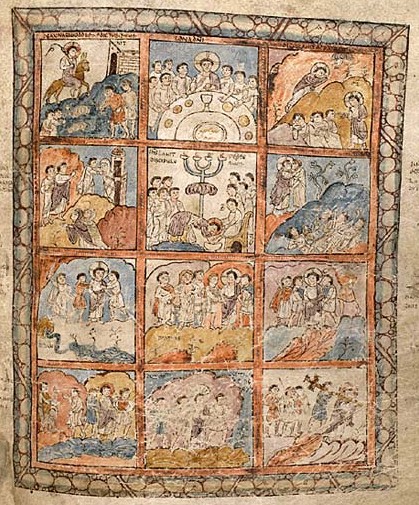
Illustrated Gospel, according to tradition brought to England by Augustine in 597, created in the 6th century in Italy or France. The sheet shows the Passion story: the entry into Jerusalem , the Last Supper, Jesus’ prayer in Gethsemane, the raising of Lazarus , the washing of feet, the betrayal of Judas through the brotherly kiss, the arrest of Jesus, the trial before the High Council, Jesus before Pilate , Pilate washing his hands in innocence, the mockery of Jesus and Jesus carrying the cross.
Saint Mark was a close collaborator of Saint Peter in Rome. In fact, he helped Peter so much that, in one of his letters, the Apostle refers to Mark as his son (cf. 1 Pet 5:13). Mark accompanied Peter … Continue reading → The post A Gospel rich in detail appeared first on predication.net.
April 24 reminder Position: religious priest and martyr OFMCap Death: 1622 Patron: lawyers, assistants, in judicial matters and in spreading the faith Attributes: Capuchin, club or mace and sword CURRICULUM VITAE He came from Sigmaringen in Swabia, which is now … Continue reading → The post St.Fidelis of Sigmaringen appeared first on predication.net.
Asking for the gift of gratitude, love, ideals, and humility… The fourth Sunday of Easter is traditionally called ‘Good Shepherd Sunday,’ so it is not surprising that the word ‘shepherd’ appears several times in biblical texts (in all cycles). So, … Continue reading → The post Fourth Sunday of Easter, Year A: John 10.1-10 appeared […]
This is the will of the one who sent me: that I should not lose any of those he has given me but raise them all on the last day.’ Jesus remains in the Eucharist so that our hearts may … Continue reading → The post Where is the definitive life? appeared first on predication.net.