

The view of the Vaticanism Leo XIV: Something ends, and something begins
By being baptized, Jesus reveals to us the righteousness of God, the righteousness that he was sent to bring to the world. We often have a narrow idea of righteousness and think that it means whoever does something wrong pays for it, thereby making amends for the wrong he has done. However, God’s righteousness, as the Scriptures teach, is much greater: its goal is not the condemnation of the guilty but their salvation and rebirth, which makes them righteous; the unjust become righteous. This justice originates from love and is rooted in the depths of compassion and mercy, which are the very essence of God as a Father who is moved by our suffering from evil, the burdens of sin, and the fragility of life.
God’s justice, therefore, does not want to hand out punishments and sanctions but, as the Apostle Paul states, consists in making us, his children, righteous (cf. Rom 3:22-31), freeing us from the snares of evil, healing us, and lifting us. God is not there to punish us, but with an outstretched hand to help us rise. And so we understand that on the banks of the Jordan, Jesus reveals to us the meaning of his mission: he arrived to fulfill God’s justice, which consists in saving sinners; he came to take on his shoulders the sin of the world and to descend into the waters of the abyss, into the waters of death, to save us and not drown us. Today, he shows us that the true justice of God is the mercy that saves. We are afraid to think that God is mercy, and God is mercy, because his justice is precisely the mercy that saves, and his justice is the love that shares our human condition. His justice is close to us; it sympathizes with our pain, and it enters our darkness to bring light.
Benedict XVI said, “God wanted to save us by descending himself to the bottom of the abyss of death, so that every person, even those who have sunk so low that they can no longer see heaven, may find the hand of God to hold on to and rise from the darkness to see the light for which they were created” (Homily, 13 January 2008).
Brothers and sisters, we are afraid to think of such merciful justice… But could we go further? God is merciful. His justice is merciful. Let us allow him to take us by the hand. As Jesus’ disciples, we must also apply justice in our relationships, the Church, and society. We must do so with mercy, not the severity of those who judge and condemn, dividing people into good and evil. I want to put it this way: not to divide, but to share. Not to divide, but to share.
Let us follow Jesus by sharing and bearing each other’s burdens with compassion, rather than slandering and destroying one another. Let us ask ourselves: Am I a person who divides or a person who shares? Let us reflect briefly: am I a disciple of the love of Jesus or a disciple of slander that divides? But slander is a deadly weapon: it kills, it kills love, it kills society, and it kills fraternity. Let us ask ourselves: am I a person who divides or a person who shares? And now let us pray to the Virgin Mary, who gave birth to Jesus and immersed him in our fragility so that we can receive life again.


| January 7, non-binding commemoration | |
| Position: | Lawyer, Dominican priest |
| Death: | 1275 |
| Patron: | Teachers of canon law and the city of Barcelona |
Attributes: |
Sea, Dominican habit, from the cloak a sail |
CURRICULUM VITAE
CV FOR MEDITATION
RESOLUTION, PRAYER
We do not know whether the story of the wise men who set out to honor the newborn King really happened as the evangelist describes it. Many assume that it did. They even try to calculate the exact date of Jesus’ birth based on the star that the magi observed. Biblical scholars generally believe that this was not the case. They assume that Matthew included this story in the account of Jesus’ birth to make it clear from the very beginning who he intends to discuss in the Gospel.
The pagan wise men came first…
A star announces the birth of the child. Although his arrival seems insignificant, taking place on the periphery, hidden from the crowds’ interest, it is so significant that even celestial phenomena testify to it. Those who ask, think, and dig deep will learn, not those who already know everything. The gifts brought by the wise men confess who the born child actually is. The gold refers to his royal dignity, the frankincense worships him as the Son of God, and the myrrh points to his death, the meaning of which the reader learns only at the end of the Gospel of Matthew.
The pagan wise men came to worship Jesus, so he is not here only for the Jews but for all nations. Similarly, in the Gospel of Luke, shepherds, poor, outcast, and somewhat despised people, come to honor the born Messiah. In the Gospel of Matthew, these are the pagans who do not know the true God. So the first people to see the newborn Jesus are the blind and deaf, not who we would expect.
The situation should make us somewhat uneasy, after all. Those who thought they knew God believed they were his good servants and felt they belonged to him, but they failed to stand up to the story; the pagans, who knew nothing about him, did. Only those who sought him found God, not those who already had him. This process of searching should never end. No one will ever know him well enough, understand him well enough, and love him well enough. In the breviary, we pray: We ask you for those who seek you to locate you, and for those who have found you to seek you even more diligently.
The star led the wise men to recognize the birth of the King of the Jews. Therefore, quite logically, they arrived in the central Jewish city and entered the royal palace. Where else, after all, should they look for the King of the Jews? And they discover that Herod’s palace is empty; the newborn king is not there. Apparently, there is a reason to be concerned that something similar might happen to those who seek God today.
What if, after a long search for God, someone decided to peek into a Catholic Church with the hope of meeting God here, and where else but here? Wouldn’t they discover the palace empty? Wouldn’t they find, where they were looking for God, only a few surviving customs? When they look for answers to their life’s questions, will they only discover empty phrases? When they seek acceptance, they find only coldness and disinterest; when they seek the gospel, they find only a few rules into which we have fitted our own lives. Wouldn’t they uncover kitsch instead of beauty, banality instead of depth, and empty words instead of silence?
A restlessness that keeps us awake…
Those tasked with advising the wise had all the resources at their disposal. They knew what the prophet Micah wrote about Bethlehem, they could even quote it precisely: “And you, Bethlehem, in the land of Judah, are by no means least among the rulers of Judah; for out of you will come a ruler who will rule my people Israel” (Micah 5:1). Yet the word of Scripture did not lead them to the born Messiah. It reminds them of the disciples on the road to Emmaus, who also knew everything. They learned about the women who were at the tomb and found it empty, about the angels who claimed that Jesus was alive, and about the additional witnesses who agreed to this (cf. Luke 24:22-24). And yet, instead of running to the tomb, they went to Emmaus—no one really knows why.
Faith in the resurrection of Jesus and faith in God’s coming into this world are apparently something else and something more than just knowing what the Scriptures and the tradition of the Church say about them. This faith is demonstrated through the search in Bethlehem and at the tomb, driven by a restlessness that compels a person to embark on a long journey and prevents them from resting until they have found the one they believe can provide meaning to everything.
Holiday: January 5th
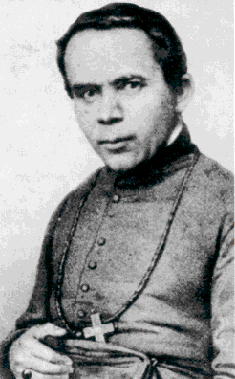
John Nepomuk Neumann
And now we can go one step further in silent reflection. In today’s Gospel, the Evangelist John writes that the Word became flesh and dwelt among us. This means that the Son of God became a man to dwell among us. And this is the most essential truth of today’s Gospel for our lives. Therefore, it is right when we ask, “Why did the Son of God become man?” John answers us with these words: “God so loved the world that he gave his only-begotten Son, that whoever believes in him should not perish but have eternal life (John 3:16). This means that the Son of God became man so that we could become children of God, happy here on earth and blessed in eternity. But this wonderful truth must not remain just information for us, as when someone tells us how people spend their vacations in Mallorca, Spain. This information may be intriguing, but its content is distant and unreal to us. But let us imagine that we actually managed to get to Mallorca and spend our vacation on a beautiful, sunny beach. That would no longer be information for us, but an authentic experience. Do we feel the difference between information and experience at this moment?
It follows that we must not remain just with information about the Word of God made flesh. This information is to be transformed into an experience for us. But how can this happen? Saint John Chrysostom gives us the answer. He says: Fill your heart with a desire for God.” Desire is the deepest act of the soul. Desire for God is a much more beautiful act than love for God, gratitude, piety, his praise, or worship of God. We should put the desire for God into our prayer, into our devotion, into our work, into our deeds, into our free moments, into our rest, and into our suffering. Here we can take as an example the Old Testament psalmist who prays as follows: As the deer longs for the water brook, so my soul longs for you, O God. And this desire for God will lead us to a fervent personal experience of the Son of God among us.
The famous writer Leo Tolstoy writes about a peasant named Ilya who, through hard work and skill, had amassed great wealth. After many years of hard work, he amassed an immense fortune: he owned many horses and cows and several thousand sheep. He became a large landowner. But when he grew old, one misfortune after another befell him. His elder son lost his life in battle, his younger son became addicted to alcohol, his sheep became sick so that he had not a single one left, a gang of robbers robbed him of his horses, another took his cows, so that when Ilya was 70 years old, he was no longer a large landowner but a poor man without property, living his simple life. And when his younger son drove him out of the house, he and his wife had to seek a living with strangers. A kind-hearted peasant took them in to work in his stable. They earned their bread and lived in a room next to the stable.
Once, a relative of a peasant came to visit him and asked who the people living in the barn were. The peasant said, “They were once the richest people in the whole region, and now they live with me as servants and work in the stable.” The relative was intrigued by the case and went to them, asking, “How could you have fallen from such happiness to such poverty?” Ilya answered him: “My wife tells us best about our happiness and misfortune.” And she told him this: “For fifty years, my husband and I have been looking for happiness, but we have only found it now. When we were accumulating wealth through hard work, we had significant worries about our servants and maids, calves and foals, and cattle and wolves; we were afraid of robbers, so we had no time to devote ourselves to each other and talk peacefully.
We were nervous, and we cursed each other; we were angry with each other, and the worst thing is that we never had time to pray to God. For us, God did not exist. Now my husband and I peacefully do our work in the stable, and then we have enough time for ourselves, we talk and love each other. Instead of heavy material worries, our hearts are filled with a desire for God, and now we experience immense joy when we pray fervently together and when we go to church. Only now do we understand that God became man to dwell among us and make us content. Only now are we satisfied. Do we feel how important this question is for us? After all, it is these days that we wish each other a happy New Year. Therefore, let us draw deep into our souls the truth of today’s Gospel, that the Word became flesh and dwelt among us. Let us remind ourselves of it every day by praying the “Angel of the Lord” prayer, so that in the new year we may experience much joy and happiness from this truth. ,
When we see the child in the Bethlehem manger, God redeems us with love.
Today, the Church celebrates the Feast of the Most Holy Name of Jesus. This celebration dates back to the 14th century, when Saint Bernardine of Siena, a Franciscan missionary, began spreading the veneration of the name of Jesus. He did this by carrying a tablet depicting the Eucharist with rays emanating from it, bearing the monogram “IHS,” meaning “Jesus the Savior of men.”
Today’s Gospel tells us that, according to the Law of Moses (Exodus 13:11-16), eight days after the birth of their firstborn son, his parents had to take him to the temple for circumcision. Forty days later, they returned to the temple for the mother to present the child to the Lord and to undergo purification.
It’s incredible to think that Jesus, our Redeemer, seems to be the one who is redeemed. It also tells us how Mary, who is pure, presents herself in the temple for purification. This Gospel tells us about the humility of both God and the Virgin Mary.
The Gospel teaches that Jesus and Mary fulfill God’s will, even though they don’t have to. They do so with joy. It often seems complicated to fulfill God’s will in our lives. How frequently do we rebel in the face of daily life’s difficulties and unforeseen events? So usually, we say no to God. We prefer our will to God’s. Jesus and Mary teach us true humility: fulfilling God’s will with joy. Saint Josemaría said that ‘prayer is the humility of a person who recognizes their profound poverty and the greatness of God and who turns to Him in love, expecting everything from Him and nothing from themselves.’ The Holy Family teaches us that it is worth doing God’s will because it is the path to our happiness.
The Gospel also illustrates the immense value that God places on sacrifice. According to the Jewish historian Flavius Josephus, the priests in the Temple sacrificed 256,500 lambs on the altar during the Passover of 70 AD alone. The sacrifices and offerings in the Old Testament were not intended to provide salvation, but rather to teach (cf. Gal 3:24). Through these sacrifices, the people of Israel learned to offer themselves freely to God and to embrace his will. This is the true meaning of sacrifice: making oneself available to God’s plans. As Christians, we take immense joy in the fact that we, too, can participate in Christ’s sacrifice during Holy Mass. This sacrifice is truly calcific.
The word ‘sacrifice’ comes from the Latin ‘sacrum facere,’ meaning ‘to make things sacred,’ ‘to honor,’ or ‘to give.’ Joseph and Mary sacrifice a pair of turtledoves and two young pigeons. By offering a sacrifice to God, they worship him and commit themselves to him, knowing that salvation comes from him. As Pope Francis says, ‘Salvation is in the name of Jesus.’ We must bear witness to this: He is the only Savior.”
We celebrate the Most Holy Name of Jesus on this day of remembrance because Jesus is our Savior. This means that we know God always looks at us with love. It is a mutual gaze. When we look at the child in the Bethlehem manger, God looks at us with love in that very moment. Let us turn to Mary to learn how to honor the name of Jesus throughout our day.
What does it mean to “know Jesus”? In all ancient and modern languages, including biblical Hebrew and Greek, the verb “to know” has a wide range of meanings. It can mean visual knowledge of a person, knowledge of everything or almost everything related to him, and sharing life, feelings, joys, and suffering. For us to know Jesus, human knowledge and experience are not enough. Such knowledge is why the evangelists speak of angels who announced the mysterious birth, and—as we will read in tomorrow’s Gospel—the heavens will be opened, from which the Holy Spirit will descend, confirming Jesus’ divine nature. Even if a person possessed all the knowledge found in the Gospels and other Scriptures about Jesus, they would still lack the gift of faith. Jesus will remain unknown.
In June 1994, the police found Brother Ettore, a Camillian who lived for and with the poor, during a check near the central station in Milan, where drug addicts and prostitutes meet. The policeman asked for his documents, checked them, and said, “Brother, you cannot stay here. What kind of religion is he to be here at this hour?” Someone shouted, “Leave him alone; he is Brother Ettore.” He said with a smile, “Mr. Policeman. Our Lady fulfilled her duties, but allow me to fulfill mine too.” The policeman objected, “What is duty? Please leave!” Although this episode did not occur on Christmas Eve, it convincingly shows that, for many Christians today, Christ remains someone and something unknown.
The Apostle Paul summarizes this mystery by stating that “God sent his Son, born of a woman” (Gal 4:4). These words—”born of a woman”—resonate in our hearts today and remind us that Jesus, our Savior, became flesh and is revealed in the fragility of the flesh.
He was born of a woman. This expression brings us back to Christmas above all: the Word became flesh. The Apostle Paul specifies that he was born of a woman, almost feeling the need to remind us that God truly became man through a human womb. There is a temptation that fascinates so many people today but which can also tempt many Christians: to imagine or manufacture an “abstract” God, linked to a vague religious idea, to some fleeting beautiful emotion. Instead, he is concrete; he is human: he was born of a woman, he has a face and a name, and he calls us to enter into a relationship with him. Jesus Christ, our Savior, was born of a woman; he has flesh and blood; he comes from the womb of the Father, but he was incarnated in the womb of the Virgin Mary; he went from the highest heaven, but he dwells in the depths of the earth; he is the Son of God, but he became the Son of man. He, the image of Almighty God, came in weakness, and though He was without blemish, “God made Him to be sin for us” (2 Cor. 5:21). He was born of a woman and is one of us. He is one of us. That is why He can save us.
He was born of a woman. This expression also speaks to us of Christ’s humanity, to tell us that he reveals himself in the fragility of the flesh. If he descended into the womb of a woman and was born like all creatures, here he reveals himself in the fragility of a child. That is why the shepherds who went to see with their own eyes what the angel had announced to them did not observe extraordinary signs or magnificent manifestations, but “they found Mary and Joseph, and the baby lying in a manger” (Lk 2:16). They found a helpless, fragile child who needed his mother’s care, needed swaddling clothes and milk, and needed caresses and love. Saint Louis Marie Grignion de Montfort says that divine Wisdom “did not want to give herself directly to men, even though she could have, but preferred to give herself through the Virgin Mary. Nor did she want to come into the world at the age of a perfect man, independent of others, but as a poor little child who required the care and nourishment of her mother” (Treatise on True Devotion to the Virgin Mary, 139). And so in the whole life of Jesus, we can see this choice of God, the choice of smallness and concealment; he never succumbs to the temptations of divine power to perform great signs and impose himself on others, as the devil suggested, but reveals God’s love in the beauty of his humanity, dwelling among us, sharing an ordinary life made up of work and dreams, showing compassion for the suffering of body and spirit, opening the eyes of the blind, and refreshing lost hearts. Compassion… The three attitudes of God are mercy, closeness, and compassion. God becomes close, merciful, and compassionate. Let us not forget this. Jesus shows us God through his fragile humanity and his care for the delicate.
Sisters and brothers, it is beautiful to think that Mary, the girl from Nazareth, always leads us back to the mystery of her Son, Jesus. She reminds us that Jesus comes in the flesh, and therefore the privileged place where we can encounter him is above all in our lives, in our fragile humanity, and in the humanity of those who pass us by every day. And by invoking her as the Mother of God, we affirm that Christ was begotten of the Father but truly born of the womb of a woman. We proclaim that He is the Lord; He is the Lord of time, but with His loving presence, He also inhabits this time of ours, even this new year. We admit that He is the world’s Savior, but we must seek Him in every person. And if he, who is the Son, made himself small to allow himself to be taken into the arms of his mother, to be cared for and nurtured by her, then this means that even today he comes in all those who need the same care: in every sister and brother we meet, who needs attention, listening, and kindness.
This new year that is opening, let us entrust to Mary, Mother of God, that we too may learn, like her, to find God’s greatness in the smallness of life; that we may learn to care for every creature born of woman and, above all, to protect the precious gift that is life, as Mary does: life in the womb, the life of children, the life of the suffering, the life of the poor, the life of the elderly, the lonely, and the dying. And today, on the World Day of Peace, it is precisely this invitation that flows from Mary’s maternal heart to which we are all called: we are called to care for life, to care for wounded life—so many wounded lives, so many—to restore the dignity of the life of every “born of woman”; it is the fundamental starting point for building a civilization of peace. Therefore, “I ask for a firm commitment to promote respect for the dignity of human life from conception to natural death, so that every person can love his or her life and look to the future with hope” (Message for the LVIII World Day of Peace, 1 January 2025).
Mary, Mother of God, and our mother await us right in the manger. She shows us, as she did to the shepherds, a God who always surprises us, who does not come in the splendor of heaven, but in the smallness of a manger. Let us entrust this new Jubilee Year to her, let us hand over to her our questions, our worries, our sufferings, our joys, and everything we carry in our hearts. She is a mother. Let us entrust the whole world to her so that hope may be reborn, so that peace may finally sprout for all the peoples of the earth.
History tells us that when the bishops entered the church in Ephesus, the faithful people, with staffs in their hands, cried out, “Mother of God!” Those sticks were surely a promise of what would happen if the “Mother of God” dogma were not proclaimed. Today, we do not have sticks, but we do have a child’s heart and a voice. Therefore, let us all together invoke the Holy Mother of God.
 predication.net