
-
Recent Posts
Recent Comments
Archives
- September 2026
- August 2026
- July 2026
- June 2026
- May 2026
- April 2026
- March 2026
- February 2026
- January 2026
- December 2025
- November 2025
- October 2025
- September 2025
- August 2025
- July 2025
- June 2025
- May 2025
- April 2025
- March 2025
- February 2025
- January 2025
- December 2024
- November 2024
- October 2024
- September 2024
- August 2024
- July 2024
- June 2024
- May 2024
- April 2024
- March 2024
- February 2024
- January 2024
- December 2023
- November 2023
- October 2023
- September 2023
- August 2023
- July 2023
- June 2023
- May 2023
- April 2023
- March 2023
- February 2023
- January 2023
- December 2022
- November 2022
- October 2022
- September 2022
- August 2022
- July 2022
- June 2022
- May 2022
- April 2022
- March 2022
- February 2022
- January 2022
- December 2021
- November 2021
- October 2021
- September 2021
- August 2021
- July 2021
- June 2021
- May 2021
- April 2021
- March 2021
- February 2021
- January 2021
- December 2020
- November 2020
- October 2020
- September 2020
- August 2020
- July 2020
- June 2020
- May 2020
- April 2020
- March 2020
- February 2020
- January 2020
- December 2019
- November 2019
- October 2019
- September 2019
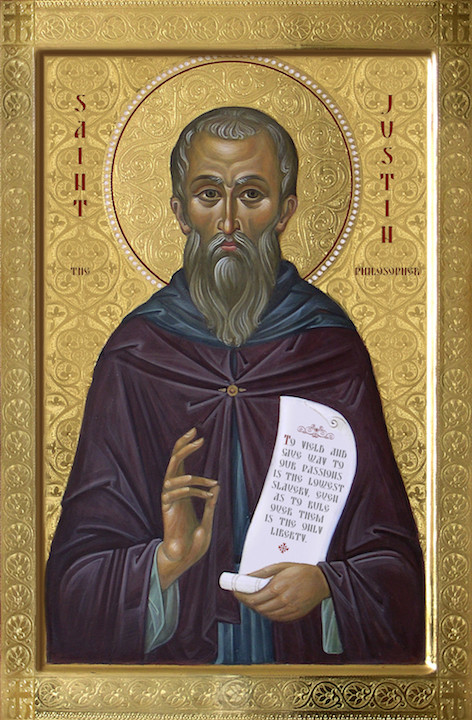
St. Justin
Justin, philosopher
| June 1, memorial | |
| Position: | philosopher and martyr |
| Death: | 165 |
| Patron: | philosophers |
| Attributes: | book, scholar’s cloak, sword |
CURRICULUM VITAE
He studied philosophy in Asia Minor. Seeking wisdom in the teachings of the Stoics, Aristotle, Pythagoras, and Plato, he was consumed by questions: What is my soul? What will happen to me after death? He sought the truth about God. An old man instructed him: ‘Pray fervently to God that he may open the gates of light for you, for understanding these things requires grace from God.’ Justin became acquainted with the Holy Scriptures, and it was through reading them and observing the lives of Christians that he was inspired to receive Holy Baptism. He was consumed by a desire to bring others to Christ, successfully defending the true doctrine. He laid down his life for his beliefs.
CV FOR MEDITATION
And to successfully defend
While he was meditating and walking along the seashore, an older man approached him and asked why he had come to this inhospitable solitude. Justin confided in him his search and desire to know the highest being. The older man replied with a smile that everything that the wise men teach is uncertain, erroneous, and foolish. And long before the Greek wise men, there were righteous men in the world who predicted things that came to pass. Filled with the Holy Spirit, they announced the truth to their people, proclaiming faith in the one true God, the Creator of all things, and in his Son Jesus Christ, whose coming they had predicted. He urged Justin to pray that God would give him the grace to know and understand these things and defend them.
Justin was moved and very much desired to know the books of the Bible, the contents of which he had learned from the older man. He then read them carefully and sought advice from Christian interpreters of the Scriptures. He observed the holy life of Christians, many of whom suffered martyrdom for their faith. Their love touched him and became one of them because he had found what he was looking for. It was probably between 130 and 137 that he was baptized in Ephesus. Later, in one of his writings, he stated that he had accepted the faith under the influence of Christians’ exemplary lives. He also heard many objections against them, but he realized that the accusations were not based on the truth. After accepting the faith, Justin devoted himself to defending and spreading Christian doctrine among educated Greeks and Romans. In Rome, he founded a philosophical school and wrote several philosophical writings in defense of Christian doctrine. Two works, entitled Apology and Dialogue with Trypho the Jew, have survived.
The pagan philosopher Crescentius, with whom Justin had heated discussions, accused him of preaching Christian doctrine, leading to his arrest and presentation before the Roman prefect Junius Rusticus. The records of the interrogation have been preserved, in which Justin’s words are recorded: “I tried to study all available philosophies, which finally convinced me that only one teaching is true. That which Christians profess, that God is the Creator and Lord of all creation, that Jesus Christ, according to prophecy, came into the world to save man and teach him the whole truth.”
He was flogged with other convicts and then beheaded, allegedly during the reign of Marcus Aurelius. It could have been after the year estimated by the martyrology. Justin significantly contributed to Christianity’s entry into Greco-Roman culture. His remains are kept at St. Lawrence outside the walls.
Posted in Nezaradené
Leave a comment
Cathesis on the Holy Trinity.
gods, but
The Mystery at the Heart of Our Faith
The Holy Trinity is the central mystery of the Christian faith. Every time we make the Sign of the Cross, we profess our belief in the Father, the Son, and the Holy Spirit. Christians do not believe in three gods but in one God who exists eternally as three distinct Persons.
The Catechism of the Catholic Church teaches that the mystery of the Trinity is the most fundamental and essential teaching about God. It is a mystery not because it is irrational, but because it is so profound that the human mind can never fully comprehend it.
One God in Three Personspersonsperson
The Church teaches that:
-
There is only one God.
-
God is three Persons: the Father, the Son, and the Holy Spirit.
-
Each Person is fully God.
-
The three Persons are distinct from one another, yet they share the same divine nature.
The Father is God.
The Son is God.
The Holy Spirit is God.
Yet there are not three gods, but one God.
This truth was revealed gradually in Sacred Scripture and fully through Jesus Christ.
The Trinity in the Bible
In the Old Testament, God revealed Himself as the one true God. The fullness of the Trinity, however, was revealed in the New Testament.
At the baptism of Jesus, we see all three Persons present:
-
Jesus, the Son, is baptized in the Jordan.
-
The Holy Spirit descends like a dove.
-
The Father’s voice is heard from heaven: “This is my beloved Son” (Mt 3:17).
Before ascending into heaven, Jesus commanded His disciples:
“Go therefore and make disciples of all nations, baptizing them in the name of the Father and of the Son and of the Holy Spirit” (Mt 28:19).
Notice that Jesus says “name,” not “names.” The three Persons share one divine nature.
The Father
The Father is the source of all creation. He created the world out of love and continually sustains it. He is the loving Father who desires the salvation of all people.
Jesus teaches us to address God as “Our Father,” inviting us into a personal relationship with Him.
The Son
The Son is eternally begotten of the Father. He is the eternal Word of God who became man in Jesus Christ.
Through His life, death, and resurrection, Jesus revealed the Father’s love and redeemed humanity from sin. Whoever sees Jesus sees the Father.
The Holy Spirit
The Holy Spirit proceeds from the Father and the Son. He is the Lord and Giver of Life.
The Holy Spirit dwells in the Church and in the hearts of believers. He guides us to truth, strengthens us with His gifts, and helps us grow in holiness.
At Pentecost, the Holy Spirit descended upon the apostles, empowering them to proclaim the Gospel to the world.
A Communion of Love
The Trinity is not a solitary God but a communion of love. The Father eternally loves the Son, the Son loves the Father, and the Holy Spirit is the bond of that divine love.
Because we are created in the image of God, we are also made for relationships, love, and communion. The family, the Church, and all authentic human relationships reflect something of the life of the Trinity.
Living the Mystery of the Trinity
The doctrine of the Trinity is not merely a theological concept. It has practical consequences for our daily lives.
We live the mystery of the Trinity when
-
We pray to the Father through the Son in the Holy Spirit.
-
We love others as God loves us.
-
We seek unity within our families and communities.
-
We participate in the life of the Church.
-
We receive the sacraments with faith.
Every Mass begins and ends in the name of the Father, and of the Son, and of the Holy Spirit. The entire Christian life is rooted in the Trinity.
Conclusion
The Holy Trinity is the greatest mystery of our faith and the source of our salvation. Though we cannot fully understand it, we can enter into its reality through prayer, worship, and love.
The Father created us.
The Son redeemed us.
The Holy Spirit sanctifies us.
One God, three Persons, a perfect communion of love. Through Baptism, we are invited to share in the very life of the Holy Trinity, both now and forever.
Glory be to the Father, the Son, and the Holy Spirit, as it was in the beginning, is now, and ever shall be, world without end. Amen.
Posted in Nezaradené
Leave a comment
Magnifica humanitas
“Artificial intelligence must be disarmed,” Leo XIV urged. His first encyclical also addresses war, work, and freedom

The Ombudsman is right. The conditions for registering churches need to be relaxed. And it’s not about Islam at all.
New priests 2025. Most will be in the East. See who will be ordained as a priest (+ photo)
Word of the priest. Peace be with you!
Lawyer Daniel Bartoň on abuse cases. If the church continues its current approach, raids on bishoprics may follow
“The magnificent humanity created by God today faces a crucial choice: to build a new Tower of Babel or to build a city in which God and humanity dwell together.”
With these words, Leo XIV begins his first encyclical, Magnifica humanitas – “on the protection of the human person in the age of artificial intelligence.”
The document was published on Monday, May 25, in eight languages. The Pope signed it on May 15, the 135th anniversary of the promulgation of Pope Leo XIII’s encyclical Rerum novarum.
Pope Prevost thus continues his predecessor’s legacy and presents a social encyclical addressing one of the greatest challenges of our time: artificial intelligence.
Pope Francis also addressed AI.
This encyclical is not the first Vatican document on artificial intelligence. In January 2025, the Dicastery for the Doctrine of the Faith, together with the Dicastery for Culture and Education, published the note Antiqua et nova on the relationship between artificial and human intelligence.
The importance of this document, now published in Slovak, increases because Pope Francis personally approved and ordered its publication. He has spoken on the topic of artificial intelligence and its humanitarian and peaceful uses on several occasions, including during the G7 meeting in Puglia, Italy, in June 2024.
However, Magnifica humanitas is the first encyclical, a pastoral letter primarily addressed to bishops but also to other Catholics and all people of goodwill.
“Encyclicals, along with homilies and apostolic exhortations, are part of the Pope’s daily teaching office, the ordinary magisterium,” EWTN News notes, adding that encyclicals “have significant doctrinal weight and are often cited because they are an important source of Catholic doctrine.”

The encyclical will be presented in the Vatican with the participation of the Pope on May 25, 2025.
As summarized by Vatican News, the encyclical Magnifica humanitas is divided into five chapters and is based on the conviction that technology is not “a force opposed to man” nor “evil in itself”. At the same time, however, “it is not neutral, because it bears the face of those who design, finance, regulate, and use it”. Therefore, the Pope calls for “building good” and “remaining human” according to the logic of courageous co-responsibility and communion.
The first chapter – Dynamic Thinking Faithful to the Gospel – presents the Church’s social teaching in the recent Magisterium and in the Second Vatican Council, emphasizing its “dynamic character” (17). Social teaching is not “a manual of principles and norms to be applied” but “a theology of community in history” (27), which helps to read events in the light of the Gospel.
In the second chapter, Leo XIV presents the foundations and principles of the Church’s social doctrine. Among the foundations, he mentions the dignity of the person created in the image of God; the inviolability of human rights, including the right to life “from conception to natural death”; and the recognition of the rights of minorities, especially women, so that they may be truly heard and valued.
Regarding the principles of social doctrine, the Pope lists five fundamental ones. The first is the common good, “the social form of the dignity granted to every person” (59).
Leo XIV is extremely clear on the question of nations: “The promotion of the common good can never be separated from respect for the right of nations to exist, to preserve their own identity, and to contribute their originality to the family of nations.” Therefore, “any attempt or project to eliminate or subjugate a nation is gravely immoral and therefore unacceptable”.
Technology must not be in the hands of a few
The second principle is the universal destination of goods. The Pope repeatedly emphasizes the necessity of technologies not being concentrated in the hands of a small group, thereby further widening the gap between those included in the digital revolution and those who remain excluded from it.
Next come the principles of subsidiarity, which require overcoming paternalism and passive dependence in favor of shared responsibility, and solidarity, a “principle and virtue” that opposes indifference.
The fifth principle of social science is social justice. In the digital era, the aim is to ensure equal access to opportunities, protect the most vulnerable, combat hate and misinformation, and maintain public control over the use of technology.
The Pope calls the attitude towards migrants a “crucial test”. The way they are treated shows “whether the idea of justice is guided by fear or by fraternity.” He therefore calls for protecting the “right to hope” of those forced to leave their country, ensuring safe and legal routes, dignified reception and integration, but also promoting the “right to remain” in their own country in peace and security by addressing the deep causes of migration..
The Pope also looks within the Church. He calls for an “examination of conscience” and listening to “victims of spiritual, economic, institutional, and sexual abuse and abuse of power and conscience” because such action is “an integral part of the path of justice” involving recognition of the harm, adequate reparation, and prevention.
Code of Ethics for Artificial Intelligence
Chapter Three – Technology and Domination. The Greatness of the Human Person Before the Promises of Artificial Intelligence – emphasizes the need to approach artificial intelligence with caution and with clear accountability at every stage of its operation. We need appropriate legal frameworks, independent oversight, and user education.
The Pope also calls for an ethical code based on principles of social justice because “we do not need a more moral artificial intelligence if only a few people decide on this morality.”
It also does not overlook the environmental impact of new technologies, which require enormous amounts of energy and water and interfere with creation.
It is necessary to “disarm artificial intelligence” – Leo XIV continues—to remove it from the logic of military, economic, and knowledge competition.
This disarmament, according to the Pope, does not mean giving up on technology but preventing it from dominating man. “It means freeing it from the hands of monopolies, making it questionable and therefore acceptable, and returning it to the plurality of human cultures and forms of life. Today’s task is not only ethical or technical: it is ecological in the most radical sense because it concerns a new dimension of our common home,” he wrote.

Leo XIV at the presentation of the encyclical in the Vatican on May 25, 2025.
The encyclical devotes considerable space to criticizing transhumanism and posthumanism, which understand progress as the overcoming of humanity’s limits. However, the limit is not a flaw to be removed but an essential part of the human person, as it is precisely in fragility and finitude that the relationship and openness towards God and others mature.
To develop technology by removing humanity’s limits is, therefore, to impoverish the human heart. Humanity, however magnificent and at the same time wounded, “must not be replaced or surpassed.” Technology can alleviate its suffering and open up new possibilities, but it must not deny what is proper to it: “the capacity for relationship and love.”
In the face of artificial intelligence, the real alternative is not between enthusiasm and fear, but between two ways of building progress: either in the service of man and nations or in the service of the logic of power.
In the fourth chapter, we will discuss how to protect humanity during the process of transformation. Truth, Work, Freedom—the encyclical calls for an “ecology of communication” based on truth.
The Pope, therefore, speaks of “disarmament” in communication as well. He calls for “disarmament of words,” thereby reducing aggression in the digital environment, which often serves as a prelude to real conflicts.
According to the Pope, it is essential that the rules by which AI systems select and disseminate information are publicly controllable and do not serve to create hostile narratives.
Leo XIV calls for transparency in content selection, protection of personal data, serious journalism grounded in argumentation and fact-checking, a new critical awareness in the use of artificial intelligence, and the integration of knowledge.
He also demands transparent and honest communication from the Church, especially in cases of injustice and abuse.
Another important point is the new educational alliance, so that the “desire to ask questions” of young people is not lost under the influence of perfect machines that create the impression that human thought is useless. Leo XIV also calls for a focus on school as a place where people learn to “seek and love the truth.”
Dignity of work, peace, and development
In the era of the “fourth industrial revolution,” marked by the digital transition, the Pope emphasizes the need to protect the dignity of work and to build systems centered on people, not just on performance.
Technology can free people from difficult and monotonous tasks, but it must not lead to unemployment in the name of reducing costs and increasing profits. The Pope, therefore, also supports the renewal of trade unions.
Leo XIV points out the need to move beyond GDP as the primary indicator of a country’s level of development and instead focus on the dignity of work, shared prosperity, reducing inequalities, and protecting the environment. Finances serving themselves are different from finances serving development.
Following Saint Paul VI, the encyclical stresses the interconnectedness of peace and development and calls for international cooperation to develop common strategies, especially for the benefit of the most vulnerable countries and populations, since prosperity contributes to peace “only if it is widespread, inclusive, and sustainable”.

Leo XIV and speakers at the presentation of the encyclical, from left: theologian Anna Rowlands and Christopher Olah of Anthropic.
The Pope also places strong emphasis on the family, based on the stable union of a man and a woman. The family is a “fundamental social good,” “the fundamental and irreplaceable cell of every social order,” which must also be supported through employment policies that strengthen stability and respect the human rhythm of life, to safeguard society’s capacity to “build the future.”
Finally, the encyclical addresses the theme of human freedom. In an era when digital platforms are designed to consume users’ time and exploit their weaknesses, it is necessary to strengthen each person’s inner freedom while confronting the risk of social control arising from the mass collection of data and the use of algorithmic systems.
Profiling, predicting, and directing behavior represent a “new power” that can discriminate against the weakest. The Pope specifically criticizes the “architecture of visibility,” which amplifies only what is visible, thereby shaping public opinion.
Overcoming the “just war” theory
Artificial intelligence is also creating new forms of slavery, such as the slavery of the “marked, mutilated, and exhausted bodies” of people working to extract the rare raw materials essential to the technology industry.
Therefore, the fight against new forms of slavery is another “crucial test of ethical discernment” of the digital transformation. Leo XIV emphasizes that “the Church renews her firm condemnation of every form of slavery, of human trafficking, and of the commercialization of persons.” At the same time, the Pope “sincerely asks for forgiveness” for the delay with which the Church has in the past condemned “the scourge of slavery” .
The encyclical also mentions the “new precious raw materials of power,” that is, vital information—such as health data or demographic data—that is used to direct economic strategies. This is a new form of colonialism that transforms personal lives into usable data and makes the digital environment “a space of plunder.”
In the fifth chapter—The Culture of Power and the Civilization of Love—Leo XIV turns his gaze on war: “The digital revolution is changing the grammar of conflict,” and without an ethical approach, decisions about people’s lives and deaths will become increasingly impersonal, with the use of force considered an “immediate and feasible option” .
Behind all these developments is a “culture of power” that normalizes war and re-legitimizes it as an “instrument of international politics,” thereby supporting armaments.
Public opinion today is also influenced by polarizing media narratives and a “disturbing loss of historical memory” that deprives society of a long-term vision.
As a result, peace today is not understood as a task to be built, but merely as a pause between conflicts.
Leo XIV also took a stance on the theory of “just war”.
“Today it is more important than ever to emphasize that the theory of the ‘just war,’ which is too often used to justify any war, is outdated, while the right to legitimate defense in the strictest sense of the word remains intact,” he wrote, noting that humanity has at its disposal much more effective means of resolving conflicts, such as dialogue, diplomacy, and forgiveness.
No algorithm will make war morally acceptable.
Pope Prevost also condemns the growth of the arms industry, the nuclear arms race, and the emergence of new armed actors—including jihadist groups—whose aim is to perpetuate conflicts as a source of power and profit.
His warning against the use of weapons based on artificial intelligence is also clear, because “there is no algorithm that can make war morally acceptable.”
Strict ethical rules adopted at the international level, based on personal responsibility and the protection of civilians, are needed because “any technology that makes it easier to intervene without seeing the face of the other lowers the moral threshold of conflict”.
The culture of power also stems from the crisis of multilateralism and the emergence of a “disordered and conflictual multipolarism.” The law of the stronger is replacing the rule of law; the logic of power prevails over peacebuilding, and the institutions created to protect the common destiny of nations are now weakened.
In this regard, the Pope expresses the wish that the United Nations undergo “profound reforms” to overcome the current crisis of values in favor of the common good.
The Christian is called to respond to the culture of power by building a “civilization of love” and by deciding whether to support the logic of force or to protect peace.
The Pope lists five “paths of responsibility”: disarming words by speaking the truth; building peace in justice; adopting the perspective of the victims and taking a stand, because there are conflicts in which “it is not right to remain neutral”; cultivating a “healthy realism” that seeks feasible paths to peace through deeds, not just words. Finally, he calls for a renewal of dialogue by moving from a culture of power to a culture of negotiation.
“Interreligious dialogue” is also crucial, carrying a message of peace. “Whoever uses the name of God to justify terrorism, violence, or war betrays his face,” warns Leo XIV.
At the end of the encyclical, the Pope invites believers to live with new technologies in the light of the Gospel and to follow the “moderate and demanding path of Christian life” so that even in the age of artificial intelligence, they can bear witness to the “beauty of the magnificent humanity inhabited by God.”
Leo XIV repeatedly returns to the topic of AI.
Pope Leo XIV has repeatedly addressed the challenges of artificial intelligence since the beginning of his pontificate. “This topic is very close to my heart, and it is also important to the Church,” he admitted a few days ago during a meeting with participants in an international conference on artificial intelligence held at the Pontifical Urbaniana University in Rome.
Vatican officials, academics, and representatives of The New York Times and The Washington Post attended the event.
The Vatican also recently established an Interdepartmental Commission for Artificial Intelligence, which is intended to coordinate the Holy See’s approach to AI, its use within the Vatican, and the ethical and anthropological issues associated with its development.

Before publishing his first encyclical, Leo XIV commissioned research into how the Vatican could use AI. His encyclical on artificial intelligence will be released on May 25.
Leo XIV spoke about artificial intelligence immediately after his election in May 2025 – whether in an address to the cardinals, during a meeting with journalists covering the funeral of Pope Francis and the subsequent conclave, or when receiving Italian bishops.
“Artificial intelligence, especially generative artificial intelligence, has opened up new horizons on many levels—including the development of healthcare research and scientific discoveries—but it also raises troubling questions about its possible impact on humanity’s openness to truth and beauty and on our unique capacity to understand and process reality,” Leo XIV wrote in a message to participants at the Second Rome Conference on Artificial Intelligence in June 2025.
Posted in Nezaradené
Leave a comment
Solemnity of the Most Holy Trinity, Year A, John 3:16-18
Dear brothers and sisters, today we celebrate one of the greatest and at the same time deepest truths of our faith – the feast of the Most Holy Trinity. Today’s feast is not just a theological lesson, it is not a mathematical puzzle: “how can there be three and at the same time one?” Today, we stand before the mystery of the very Heart of God. The mystery of God, who is not solitude, but love. God, who is Father, Son, and Holy Spirit – three Divine Persons in perfect unity.
When a person goes out into nature on a beautiful morning, he can glimpse traces of this mystery. Let us look around us. The sun rises over the landscape, its rays warm the earth, and a gentle wind moves the trees, carrying the scent of blooming meadows. We see three different realities: the sun, its light, and its heat. They are different, and yet they belong together. The sun without light and heat would not be what it is. Thus God is one, but not alone.
He is a community of love. And today’s beautiful psalm cries out: “Praise be to you, Lord, God of our fathers, glorious and exalted forever.” Today, all of creation seems to be singing this song. The sky, the forests, the rivers, the mountains, the birds, and the human heart. Everything points to the greatness of God. When we look at the beauty of the world, we do not see just the work of chance. We see the signature of the Creator.
The first reading from the Book of Exodus (Ex 34:4b-6.8-9) leads us to Mount Sinai. Moses ascends to God. The mountain is shrouded in clouds, silence, wind, and sacred fear. And there the Lord reveals his name: “The Lord, the Lord, a God merciful and gracious, long-suffering, abounding in kindness and faithfulness.” This is extremely important. God does not present himself as a distant ruler. He does not say: “I am powerful.” He does not say: “Fear me.” He says, “I am merciful.” This is the first face of the Trinity – God the Father.
What does the Father do? The Father creates. He gives life. He thinks about each person before they are born. As a parent, He watches over the child. He gives the sun, rain, fields, air, and our days. The Father is the source of everything. But man departed from God. Sin disrupted the relationship. And then the second of the Divine Persons acted – the Son.
The Gospel of Saint John today brings some of the most beautiful words of Scripture: “God so loved the world that he gave his only begotten Son”. God did not send the Son to condemn the world. This is incredible. Man often judges. He divides, condemns. But God comes to save.
What does the Son do? The Son of God became man. He was born in Bethlehem. He walked the dusty roads of Galilee, healed the sick, forgave sinners, hugged children, and wept over human pain. And finally, he took up the cross. Jesus shows us the face of the Father. Whoever sees Jesus sees the Father. And then comes the third Divine Person – the Holy Spirit. The Holy Spirit does not work noisily. He is like the wind. We cannot see the wind, but we can see its effects. It moves a leaf, stirs the grain, brings the scent of the forest after the rain. This is how the Holy Spirit works.
What does the Holy Spirit do? It comforts, strengthens, reminds us of God’s words, gives us courage, awakens faith, and brings peace. How many times does a person not know what to do? He is tired, lost, and helpless. And suddenly light comes into the heart. A quiet peace, a thought, the power to forgive. This is the work of the Holy Spirit. The Father creates, the Son saves, the Holy Spirit sanctifies. And yet there are not three gods. They are one.
Today’s second reading from the Second Letter to the Corinthians conveys to us the beautiful words of the Apostle Paul: “The grace of our Lord Jesus Christ, the love of God, and the communion of the Holy Spirit be with you all” (2 Cor 13:13). Let us note: the grace of the Son, the love of the Father, and the communion of the Spirit. This is the Trinity in everyday life. Perhaps someone asks, “What does this mean for today’s man?” Very much. Today’s world can connect computers, connect continents, and send a message to the other side of the world in a second. But we are still learning to connect human hearts. Families are falling apart; people live side by side but not together, and many are lonely. And the Trinity tells us: true life is born where there is unity and love.
One beautiful example: Let us imagine a family. The father works, the mother cares, the children bring joy. Each has a different task. Each is different. But when they love each other, they form one home. In a way, God shows us his secret. Not sameness, but unity in love. Brothers
And sisters, when we bless ourselves today with the sign of the cross and say: “In the name of the Father and of the Son and of the Holy Spirit”, we often say it quickly and without thinking. But at that moment, we enter into the greatest mystery of the universe, into the life of God himself. Let us ask today that the Father protect our families, that the Son guide our steps, and that the Holy Spirit transform our hearts. Most Holy Trinity, Father, Son, and Holy Spirit, we worship You and thank You for Your infinite love. Father, we thank You for the gift of life and for Your care. Jesus, we thank You for redemption and for Your cross. Holy Spirit, we thank You for light, strength, and peace. Teach us to live in unity, to forgive, to love, and to seek the way to You. May our families reflect the beauty of Your love, and our hearts become a place for You to dwell. Most Holy Trinity, one God, guide us now and forever. Amen.
Posted in Nezaradené
Leave a comment
Paul VI,Pope
Today, in memory of Pope Paul VI, we lift up our souls in double gratitude. We thank the Lord Jesus for having kept his word to remain with us until the end of the world (cf. Mt 28:20). God fulfills this promise through his Church, through his Eucharistic presence… But he does so in a very special way through the pope. Paul VI’s contemporaries could sense the clear vision of things and the firmness with which this holy shepherd defended the Church in “turbulent” times.
Thanks to this humble shepherd who, too, was sometimes alone – like Jesus in Gethsemane – suffered and wept for the Church. He embodied the “rock” on which Christ always builds his Church without the gates of hell being able to overcome it. Saint Pope Paul VI took on the enormous task of leading, concluding and applying the Second Vatican Council. Times are changing and the Church – is not falling behind in the face of new challenges. For this reason, the Pope of the Council oversaw a remarkable and courageous “update” of the Church.
To some it seemed that he had failed, to others that he had gone too far… During his life he was a martyr for the Church entrusted to him… In his simplicity he even said: “Perhaps the Lord has called me and kept me for this ministry not because I am particularly suited to it, or so that I can guide and save the Church from its present difficulties, but so that I can suffer something for the Church, and thus it will be clear that he, and not someone else, is its leader and savior”. Yes, he is Christ, but he counts on us. Perhaps we too should pray more and make sacrifices for the Roman Pontiff, our “holy father”…
Posted in Nezaradené
Leave a comment
Are we behaving like Jesus?
We are in Moscow during the last years of the Soviet Union. And teenager Boris Fishkin, the hero of the film My Father is Baryshnikov (2011), is studying at a ballet school. He grew up with only his mother, who had kept his father a secret from him.
One day, Boris begins to think that his birth father is the famous ballet dancer Mikhail Baryshnikov. A worn-out videotape is to blame, which gives him confidence in front of his friends. To prove it, he starts training more and is even willing to fill in for an injured classmate.
Meanwhile, he also succeeds in selling Russian souvenirs to Western tourists until Soviet secret agents discover him. The film ends with the discovery of his birth father, who has been in prison for financial crimes. And the economic genes eventually prevail over ballet in Fishkin as well.
The Russian comedy pleases the viewer with a good choice of a small actor who does not behave at all like a victim of the system and a single mother who always brings home a new guy. Boris is inventive on several levels.
We also see this attitude in Jesus’ activity when he decides to go to Jerusalem at the end of his life. He does not plead fate, the stars, or the bad luck that people bring him. He does not solve the genes. He himself decided on the trap that awaits him in Jerusalem. At one point, he says that no one takes his life; he gives it himself…
A wonderful activity and immense freedom radiate from this. This feeling is also conveyed in the story of the man who was blind from birth. Man was created from the earth and from the breath of God, that is, the active participation of God. If man closes himself off from the Spirit, it is as if matter remains immersed in darkness.
Christ heals such humanity with mud made of clay and his saliva, as if he were imitating the Father’s act when he created man on the sixth day. The blind man is not forced to believe in this miracle. Jesus does not offer him salvation by force.
He leaves it to him to decide whether to step out to the Pool of Siloam to wash there. The free man calls others to freedom as well.
The water of Siloam was used to wash proselytes—people who were joining the chosen Jews. The blind man, having fallen in love with the words of Jesus, decided to step out to the water. He preferred the Spirit, which is why his final gesture is a bow before Christ, his Savior.
Because Jesus warms us with his breath, the Holy Spirit, our bodies can also join in the celebration of Jesus, as we have tangibly come to know God’s love. This method does not work with the scribes. They are grafted against Jesus’ medicine. The blind man today experiences the sweetness that the papal preacher recently spoke about in the Vatican. In Francis of Assisi, he noticed that what at first seemed bitter became sweet. If this taste were missing, “a person would build a life with someone for whom he had never felt true love, and such a relationship could easily become a form of coercion.
And if a consecrated person wore a religious habit, made certain gestures and uttered words in the name of a God whom he knew only by hearsay, without any real personal experience, he would soon experience a deep inner unrest—and this could also be transmitted to the people entrusted to him,” observed Capuchin Pasolini.
We are not victims of life, like a sick person in bed. Although it has its advantages, others are more interested in us; they bring us good things, and we don’t have to do anything for others—we are not well. We can even sleep whenever we want. How many people around us are comfortable with that?
I’m stupid because my genes won’t let me. I’m stingy because I was raised that way. I’m passive because the stars aren’t in my favor today.
For Jesus, this is a false tone for Boris Fishkin, too. They do not support such victim-playing. That is why Jesus would perhaps say to some of us today: “Whoever wants to come after me, let him renounce false clothes…”
Posted in Nezaradené
Leave a comment
St. Augustine of Canterbury
´
May 27, non-binding commemoration Position: Archbishop, Prelate of England OSB Death: 604/605 CURRICULUM VITAE
He was sent as a missionary to England with 40 Benedictine monks from the peace of the Roman monastery. En route, he received episcopal ordination. Following the Pope’s instructions, he was successful in England, laying the foundations for the organizational structure of the Church. He won over a significant proportion of the population and educated local priests.
THE BASIS OF SUCCESS, OBEYING GOD’S WILL The first reports of Augustine date back to 596, when he was the prior of the Benedictine monastery of St. Andrew in Rome. From there, Pope Gregory the Great sent him with 40 monks to England. There, after the collapse of the Roman Empire and the occupation by the pagan English and the Saxons at the end of the 5th century, Christianity almost disappeared. However, the pagan king Ethelbert had a Christian Frankish princess, Bertha, as his wife. This gave some hope, for which Augustine was sent to England with the monks. He obeyed and went.
Their missionary expedition stopped in Gaul, where it was slowed down by bad rumors about the place they were headed to. They heard that the people there were wild, hostile, and that it was impossible to communicate with them, not least because of the language barrier. Augustine therefore apparently returned himself to consult with the Pope. At his insistence that he not give up on his original plan, he set off back with Gregory’s recommendations to the Gallic bishops through whose dioceses his journey led. It was also a matter of obtaining capable Frankish priests to act as interpreters. Before leaving Gaul, he received episcopal ordination.
He is said to have landed with his monks and interpreters at the mouth of the Thames on ththen wase island of Thauet. From there he sent a message to the King of Kent that they wanted to preach the Gospel in his territory. The King came to them and requested a conversation with them under an oak tree that he considered sacred. He had the foundations of the faith explained to him and then allowed them to settle in the seat of the city of Canterbury, even to live in the palace and to preach religion without hindrance. Augustine and the monks probably settled on the outskirts of the city, where the small church of St. Martin stood, in which the queen’s devotions used to be held. There he began his apostolic work. The King had the old church rebuilt into a cathedral and also built for them the Benedictine monastery of Peter and Paul.
Through his exemplary life of preaching the word of God, Augustine gradually gained the favor of the people, and within the first year, a large number of the king’s people accepted baptism, and King Ethelbert also accepted it. After hearing of Augustine’s success, the Pope sent another group of missionaries to him in 601. With them, he sent Augustine the pallium – the badge of metropolitan rank – and the task of founding two archbishoprics, each with twelve subordinate bishoprics.
The first archbishopric was in Canterbury at Christ Church Cathedral, from where Augustine served as archbishop until his death. For the second, he chose the city of York, where the bishopric began to operate only after his death. In his missionary work, he heeded the instructions of the Pope and respected the local culture, he did not destroy even pagan temples, but converted them into Christian ones. He only gave national customs a Christian character. Instead of pagan feasts, the Anglo-Saxons held love feasts, at which the poor were especially remembered. In these ways, Augustine won everyone over, because the top is more safely reached by slow growth rather than by reckless action.over because
The basis of success was initial obedience, submission to God’s will. Where a person submits his will, he gives space to God’s action. Whoever acts against the gospel acts against himself. Augustine also tried to unite the old British Christians with the new English Church, but he failed. There was too much hostility between the original inhabitants of the island, who had been pushed mostly in the western mountainous regions, and the Anglo-Saxons, who had come to the island as conquerors. King Ethelbert also wanted peace, and Augustine summoned the bishops of both sides to help achieve harmony, and he wanted the old Britons to give up their wrong customs. This also involved a different time for celebrating Easter and baptismal ceremonies. However, the old Britons were reluctant, and Augustine predicted to them that if they did not reconcile, bloody wars would break out, which would be the cause of their deaths. The prediction was sadly fulfilled.
Before that, Augustine focused on his work in the Kingdom of Kent, which soon became Christian. Until his last days, despite his high rank, he lived as a monk and missionary. Before his death, he ordained his successor.
Posted in Nezaradené
Leave a comment
Philipp Neri
Philip’s concern for the salvation of souls… When he was a young priest and had gathered around him a certain number of spiritual people, his first desire was to go with them all to proclaim the Gospel to the pagans in India, where the wonderful life of St. Francis Xavier was taking place. However, he wanted to subordinate this idea of going to India in obedience to the opinion of the holy men with whom he consulted. As for the bad Christians at home, he had such a great desire for their conversion that even in his advanced age he severely mortified himself for them and wept for their sins as if they were his own. When he was still a layman, he converted thirty dissolute young people with one speech. By the working of God’s grace, he successfully brought back to the path of holiness an innumerable number of sinners. Many of them exclaimed at the hour of their death: “Blessed is the day when I first appeared to Father Philip to know him!” Others said: “Father Philip draws souls to himself as a magnet draws iron.” He concentrated on fulfilling what he considered his special mission, and he devoted himself entirely to the ministry of confession, which occupied him especially and above all. Before sunrise, he usually confessed a considerable number of penitents in his room. He went to church at dawn and never left until noon, except when he celebrated Holy Mass. If no penitents came, he remained near the confessional and read, prayed the breviary or said the rosary. Whether he found himself praying or eating, he always interrupted when penitents arrived. He never interrupted the ministry of confession because of illness, unless the doctor forbade him to do so. For the same reason, he kept his room open, so that anyone who passed by could see him. He took special care of boys and young men. He was always concerned to keep them busy, for he knew well that idleness was the origin of all evil. Sometimes he himself kept them busy when he could find no employment for them. He allowed them to make as much noise around him as they pleased, only in this way to protect them from temptation. When a friend of his protested against allowing them to annoy him in this way, he replied: “As long as they do not sin, they may even chop wood on my back.” He had permission from the Dominican fathers to take their novices for recreation. He was fond of inviting them to a festive dinner. He would say: “Eat, my sons, and do not feel guilty about it, for I am gaining weight while I look at you.” And then, after the meal was over, he would seat them around him and tell them the secrets of his heart, give them good advice, and encourage them to virtue. He had remarkable power to comfort the sick and deliver them from the temptations with which the evil spirit assailed them. To his zeal for the conversion of souls, Philip added the performance of corporal works of mercy. He visited the sick in hospitals, ministered to their needs, made their beds, washed the floor around them, and brought them food. Prayer:
Philip, my holy Patron, who cared so much for the souls of your brothers and sisters, and especially for your own people, when you were here on earth, do not cease to care for them now that you are in heaven. Be with us, who are your children and your clients. And by the great power of God and your intimate view of our needs and dangers, guide us on the path that leads to God and to you. Be our good father. Keep our priests undefiled and protect them from reproach and scandal. Make your children obedient, our youth prudent and pure, the heads of our families wise and kind, the elderly cheerful and zealous, and strengthen us by your powerful intercession in faith, love and all virtues.
Homily evaluation:
Posted in Nezaradené
Leave a comment

