
-
Recent Posts
Recent Comments
Archives
- September 2026
- August 2026
- July 2026
- June 2026
- May 2026
- April 2026
- March 2026
- February 2026
- January 2026
- December 2025
- November 2025
- October 2025
- September 2025
- August 2025
- July 2025
- June 2025
- May 2025
- April 2025
- March 2025
- February 2025
- January 2025
- December 2024
- November 2024
- October 2024
- September 2024
- August 2024
- July 2024
- June 2024
- May 2024
- April 2024
- March 2024
- February 2024
- January 2024
- December 2023
- November 2023
- October 2023
- September 2023
- August 2023
- July 2023
- June 2023
- May 2023
- April 2023
- March 2023
- February 2023
- January 2023
- December 2022
- November 2022
- October 2022
- September 2022
- August 2022
- July 2022
- June 2022
- May 2022
- April 2022
- March 2022
- February 2022
- January 2022
- December 2021
- November 2021
- October 2021
- September 2021
- August 2021
- July 2021
- June 2021
- May 2021
- April 2021
- March 2021
- February 2021
- January 2021
- December 2020
- November 2020
- October 2020
- September 2020
- August 2020
- July 2020
- June 2020
- May 2020
- April 2020
- March 2020
- February 2020
- January 2020
- December 2019
- November 2019
- October 2019
- September 2019
St.Norbert of Xanten
| Position: | founder of the order, Archbishop OPraem |
| Death: | 1134 |
| Patron: | Bohemia; Premonstratensians; invoked as an aid for a good birth |
| Attributes: | bishop, devil, chalice or monstrance, spider, premonstrate |
CURRICULUM VITAE
He came from the Middle Rhine. Awakened from a frivolous life, he began to live in strict austerity, prayer, and study. Devoted to the apostolate, he brought people to Christ, reconciled hostile cities, and excelled in reverence for the Blessed Sacrament. In France, in the Premontré Valley, he founded a Premonstratensian monastery. He became the Archbishop of Magdeburg, a reformer of spiritual life. His poverty, humility, zeal, and fearlessness made him enemies. He called for the spread of faith among the Slavs. When his remains were placed in Prague, he was included among the Czech patrons.
CV FOR MEDITATION
THE SAINT OF THE EUCHARIST
He was born in the German city of Xanten, near the Dutch border. He belonged to the noble family of the Lords of Gennep. His parents, Herbert and Hedwig, intended him for a spiritual career, as the family inheritance was destined for his older brother.
His father is mentioned as the administrator of Xanten Castle, the region and the property of the Cologne Archbishopric. There is talk of his activities in the archbishop’s service. At a very young age, Norbert received a canon position in the chapter of Saint Victor in Xanten, associated with a larger pension, then called a benefice in church law. He also soon ranked among the educated of his time. He had talent, excelled in public speaking, and is said to have applied it particularly in diplomacy. The path of the priesthood did not appeal to him. As a canon, he accepted subdeacon ordination but lived the secular life of the rich. He left the archbishop’s curia for the court of Emperor Henry V, who appreciated his skillful conduct and appointed him his secretary and, probably, also his chaplain. For 9 years, he traveled everywhere with the emperor. In 1111, they went to Rome. The emperor decided to force the Pope to confirm the investiture of bishops. Pope Paschal II. was captured, released, and crowned Henry according to his wishes. Norbert was displeased with the emperor’s actions and immediately begged the pope for forgiveness. The following year, the pope himself condemned his actions as an act of weakness. Norbert remained with the emperor until he was about 30 years old, although their relationship cooled because his conscience troubled him. Therefore, in 1113, he also refused the emperor’s offer of the bishopric of Cambrai. After leaving the emperor, who had been excommunicated for his actions, Norbert began to change.
In 1115, he was traveling on horseback to Wreden in Westphalia and was caught in a storm. Stunned by lightning, he fell from his horse. When he woke up, he perceived it as God’s call to complete conversion. He accepted the call, renounced comfort and worldly interests, and went to the Benedictine monastery of St. Michael in Siegburg. There, he decided to live a life of penance and priestly service. After the necessary preparation, he received priestly ordination in December and returned to the monastery for further preparation. On Holmdun 1116, he celebrated his primogeniture in Cologne. At it, he said: “What blindness to desire fame that will pass, to seek wealth that impoverishes the soul, and to love a world in which there is no joy without thorns and in which the soul finds no peace.” He also called on secular clergy to convert and was called a hypocrite. He spoke to his fellow canons, calling them to the apostolate. However, they despised him so much that they hired a cleric who spat in his face.
Norbert lived in seclusion for three more years, with deep reverence for the Eucharist, and received formation for his future apostolate. He renounced his canonry and distributed his property. Pope Gelasius II, who was in exile in France, sought approval and blessing for his work as an apostolic missionary. His annual mission was in France, Belgium, and the Rhineland. He tried to lead his listeners to reconciliation with God and with all people. He taught about the need for the sacraments, about Christian love, and about the hope of eternal salvation. Some disciples joined him, and the need for a residence became ever greater.
After the death of Gelasius II, Calixtus II ascended the throne, and during his visit to Reims, Norbert asked him to reconfirm his activities. The Pope, at the instigation of the Bishop of Laon, recommended that he work in his diocese in the north of France. Norbert therefore wanted to reform Laon Abbey, but he was unsuccessful. In the spring of 1120, he settled with his followers in the Premontré Valley and founded a new community there. He thus gave rise to a new order of religious canons, who began to be called Premonstratensians after the place of their origin. They took over the religious statutes from St. Augustine, who, according to legend, appeared to Norbert. The main focus of the order was on the most perfect pastoral service in parishes, with an emphasis on the dignified celebration of divine services and the liturgical education of the faithful. The Premonstratensian garment became a white tunic with a scapular and a cingulum.
Christmas Eve 1121, when Norbert took his famous religious vows, is often cited as the date of the order’s founding. Perhaps that is why the oldest depiction of St. Norbert shows him with the Virgin Mary holding the baby Jesus. The paintings in which the Virgin Mary hands over the vows to the Child Jesus do not deviate from this theme either. We find the Marian journey to Jesus and the extraordinary reverence for the Eucharist in the lives of important saints to be a clear foundation for the holiness we should follow them.
For the new church that they built in Premontré, Norbert went to Cologne to obtain the relics of the holy martyrs. There, after a night prayer, he announced where one of the companions of St. Ursula and St. Gereon, a fellow soldier of St. Maurice, was buried. The unexpectedly found relics were solemnly transferred to Premontré.
According to the oldest biography, a woman came to Norbert for advice because of infertility with her husband, from whom she would rather separate than be childless. Norbert freed her from wrong desires, encouraged her with the word of God, and predicted to her the imminent birth of a son and then other children, which came true. This story is connected to the effective invocation of St. Norbert, requesting his intercession for mothers expecting a child. The Premonstratensian sisters of Doksan also include expectant mothers in their contemporary intercessory prayers.
In 1124, the Bishop of Cambrai summoned Norbert to Antwerp, Belgium, to help combat the heretical teachings of Tanchelm, who presented himself as a zealous reformer. While criticizing the disorderly life of the clergy, he denied the church hierarchy and the sacraments, especially the Eucharist. This led to painful disputes. Norbert was able to convince them of the church’s true teachings and establish peace.
Caring for the community that Norbert founded was not the goal of his life, even when he returned to Premontré from his apostolic journeys. In 1126, during a visit to Rome, he achieved confirmation of the Premonstratensian order. In the same year, he was appointed Archbishop of Magdeburg in what is now Germany. At the insistence of his superiors, he accepted the service in July, after his episcopal ordination. He entered his new cathedral, where he was solemnly welcomed, barefoot and in monastic garb. He retained his humility and ascetic lifestyle; therefore, he did not lead a court, as was customary for episcopal dignitaries. He began the renewal of spiritual life with the priests and by renovating the monasteries. To fully utilize his new position, he handed over leadership of the monastery at Premontré to Hugo de Fosses.
Norbert also reclaimed church property seized by the nobility. The unauthorized holders joined forces with rebellious priests. They incited the people against Norbert, who believed that he wanted to steal the relics of saints from the church altars for his order. He was attacked right in the cathedral, and the servant who tried to protect him was seriously wounded. The imperial administrator of the city intervened to protect Norbert, while the orthodox priests displayed the supposedly stolen relics to the rebels. The curse supposedly cooled the rebels’ heads, and they then begged for forgiveness.
Norbert also invited his spiritual sons to promote the reforms. As a zealous archbishop, he supported the spread of the Gospel in the eastern regions, where Christianity was not yet rooted. The movement he spread and his lifelong apostolic work are described as Eucharistic in nature.
In 1130-32, he advocated recognizing Pope Innocent II against the illegitimate Anacletus, especially at the court of Emperor Lothair II, whom he accompanied to Rome, where he was instrumental in resolving some delicate matters.
The hard life and excessive effort exhausted the 50-year-old archbishop, and on Maundy Thursday in 1134, he celebrated his last Holy Mass with great fervor. He then fell seriously ill, and he succumbed on June 6.
The cathedral chapter and the Premonstratensians were interested in his body, and the emperor decided in their favor. They buried him in the Church of the Virgin Mary. He was canonized by Gregory XIII in 1582. At that time, Protestantism was spreading throughout northern Europe, and Protestants occupied the Premonstratensian church. Catholic monasteries, therefore, sought the saint’s remains. After difficult negotiations, at the beginning of 1627, Abbot Questenberg managed to obtain precious relics for the Strahov Monastery in Prague.
Posted in Nezaradené
Leave a comment
Ten Sunday in Ordinary Time, Year A Mt 9,9-13
God sees even what people do—for the youth … It is very easy to judge people, to recognize someone as bad, as unworthy. It is very easy to look down on someone because we consider ourselves better, holier, or more religious. In fact, attitudes are also criticized by Jesus in today’s Gospel.
The year is 1907. Klodzko. A young girl, Mária, gave birth to an illegitimate child. She named him Gerard. The girl is extremely brave. Mária heard disparaging remarks more than once. She felt unspeakably alone. She avoided public places for fear of being scorned. His son was his whole world, his whole strength. Hope. When Gerard was little, a neighbor stopped him in the street and said, “You will be nothing. You are the fruit of sin…” Gerard was too young to understand. When he returned home, he asked, “Mom, what does it mean that I am the fruit of sin?” The woman hugged the child and said, “All people are the fruit of God’s love. Everyone! Without exception. My little Gerard is also the fruit of God’s love. Love is the hardest of all the arts in the world. But it is the only right way. Remember! Love people. Love them despite everything…”
Years passed, and the boy developed. The people around him, consciously or unconsciously, tried to make him a second-class person. It was difficult for him to love people, but he knew and felt that his mother loved him, and he trusted her words to love above all else. He felt in his heart that God was calling him to the priesthood. He enrolled in a seminary in Wrocław. And then the terrible blow—Father Rector, a very good-hearted person, tells him that according to the then Code of Canon Law, candidates of non-marital origin cannot even be admitted to the seminary. That, according to the Law, he is actually of illegitimate origin. And then a broken Gerard asked: “According to the Law, yes. And according to God and you, Father Rector?” The rector decided to give him a chance.
Before the ordination, the Rector wrote a letter to Rome requesting that Gerard be ordained. The Apostolic See gave its consent. After his ordination, he was sent to the parish of Czermna near Kudlow Zdroj. They quickly recognized him as a sacrificial priest. The year 1933 came. Hitler came to power. Priest Gerard was banned from meeting young people. In 1939, in one sermon, he said: “He who tears faith in Christ from the hearts of the youth is a criminal”. A few hours later, he was arrested and put in prison in Kłodzko. They beat him, tortured him, and humiliated him. In prison, he wrote: “They took everything from me, all my rank, my health, but they didn’t take the fact that I’m a child of God and that I’m His priest, no one will take that away from me.” He was taken to the Dachau concentration camp. There he wrote, “The Lord God put me here as a shepherd, because the sheep are here, that’s why I’m here. It’s not by chance that I’m here. The shepherd does not leave the lost sheep in the camp”. He died of hunger and exhaustion in 1942.
And it might seem that with the end of his life, his mission has ended. We might have the impression that evil has managed to sanctify the 35-year-old priest. And yet no. During the resettlement of the civilian population from Silesia to Germany, several German mercenaries enter the house of a young woman. They want to throw her out to take up residence and resettle her in the depths of Germany. But before that, they intend to hurt her, rape her, and humiliate her. And suddenly, one of the soldiers stops, looks at the wall in amazement, and asks, “Where did you get that picture?” Frightened, she replies: “That’s our chaplain, Priest Gerard”. The German, clearly excited, says: “I saw him in the Dachau camp. I have never met such a man, such a man of such faith and such love…” Telling his colleagues to let the girl go, he takes a picture from the wall and gives it to the girl, saying, “Take it, let it guard you”. He pushes the image into the girl’s hands and says, “The good shepherd does not abandon his sheep even after death. Pack your things and run quickly from the flock.” 14. IX. In 2010, Pope Benedict XVI proclaimed priest Gerhard Hirschfelder blessed.
This is the true story of a boy who was despised by others, like the Pharisees in today’s Gospel. And Jesus looks at it completely differently. His vision penetrates a person to the bone; he sees what is best hidden in the heart. And actually, that boy very realistically puts the Gospel teaching of Jesus into his life: “I want mercy rather than sacrifice.” Mercy was a defining characteristic of his life and ministry as a priest. Mercy permeated everything he did. And that counted most with God.
Lord Jesus shows once again that there are no lost people for God, that there are no less important people for God. Everyone, even the smallest, invisible one, has a wonderful value to Him. That value is determined by the rank we have received from God as His children. And that rank is independent of us. She is simply in us. God always recognizes his child in us. And the second thing that determines our rank is mercy, because God wants mercy rather than sacrifice. And that mercy is already our role, which the Lord God has entrusted to us for the rest of our lives. Some nice people sometimes can’t deal with a kind of weakness, a kind of sin that brings them down again and again and makes them dirty. And suffering for that sin, they immediately do some act of mercy. The Church gives us several such deeds for the soul and the body. A few vitamins to get your fill of. That is a nice and wise attitude. After the fall, immediately perform some act of mercy, because God wants mercy rather than sacrifice.
God has inscribed in us an amazing dignity independent of how others see us. Let us add mercy to that rank, because God prefers mercy to sacrifice…
Posted in Nezaradené
Leave a comment
This I command you. That you love one another.
Let’s call her Kveta. She felt very distressed at work. The feeling of loneliness stemmed from being the only believer at work. She often had to defend her faith and justify her positions, which differed from the opinions of her colleagues. She slowly lost the courage and strength to face these struggles and thought about changing jobs. She met a priest. After listening to her complaints, he asked, “Mrs. Kveta, where do people usually put a lamp?” She answered, “Where it is dark”. She immediately understood the question. She understood that her workplace was “darkness,” where it was necessary to bring in, to place “light”.
This idea strengthened her greatly. She stayed at her workplace. She prayed for strength and tried to bear witness to the Light mainly through kindness and goodness. However, she was abused and mocked. After some time, more than ten of her co-workers returned to the faith of Jesus Christ. Let us remember that “dark places” need “light,” especially through acts of love. Love. A word. It has many meanings depending on who uses it and the context in which it is used. It is a word that some people understand very well from experience, while others only have the message others have told them about it. Some have it in abundance and share it freely, others have little and keep it to themselves.
Love is often associated with romance. The Greeks used eros to describe this love. The feelings associated with it have been described in various ways. Someone wrote that love is “hearing bells ringing, feeling butterflies in your stomach, and acting as if you had bees on your bonnet.” Another joked: “Love doesn’t really move the world, it just makes people strangely strange, so it seems that way.” Another defined it as “something that makes you feel funny and act stupid,” while another added: “Love is something other than delirium, but it’s hard to tell which is which.” Many people said that love is blind, and someone added that it is also deaf and dumb. And something like this was said: “Love makes a man think about a woman almost as much as he thinks about himself.” Someone else wrote, “A dog is the only thing in the world that loves you more than himself,” and then added, “If dogs can think, how can we explain their love for humans? But love is much broader than the emotions of romance.”
Love is the glue that holds friendships together. The Greeks used philia for this kind of love. It is sunlight that kills the seeds of jealousy and hatred. It oils the gears of the household, making it run smoothly. It covers up a multitude of sins. It influences all our actions. As someone once said, “You can give without loving, but you cannot love without giving.” One might agree with the one who said, “Love is the most beautiful of the flowers in God’s garden.” And one might also agree with this: One of the tragedies of the contemporary Western lifestyle is that love is defined by those who have experienced so little of it. We don’t want to be that. We want to be those who understand love and extend it to others.
St. Francis de Sales wrote, “Where there is no love, put love, and you will find love.” There is no place where God’s love cannot reach.
Perhaps one of the most eloquent passages in the Creed, the profession of faith we pray every Sunday, is: “He descended into hell,” which we translate today as “he descended to the dead.” Even in hell, God’s presence and mercy can be found. And as one survivor of one of Hitler’s death camps said, “I have already been to hell.” It is the Hebrew God of Moses who sees the suffering of the people of Israel. Israel means “to wrestle with God,” and God, seeing these wrestlers in the hell of slavery, calls Moses to lead them to their liberation. For Christians, Christ is the personification of God’s loving descent into the hell of our lives, those moments when there is only a sense of extreme separation. God comes there too.
Evelyn Underhill tells the story of a holy man who, when asked if Christ could be in hell, remarked: I would rather be with Christ in hell than in heaven without Him.”
The Apostle John speaks of a constant flow of love: from the Father’s love, into Christ, through Christ to the Spirit, and from the Spirit to us. This descent is the self-emptying love of Christ for the poor, the forgotten, and the suffering. It is there, in the hell of Auschwitz, in the hell of a racist society, in the suffering of the earthquake, in the hell of famine, in the hell of violence… that love is found.
This process is a constant movement of flow and exchange, in which the power and energy of love are maintained and grow. It is this energy that Albert Einstein’s daughter shared in a letter from her father. In it, she wrote that the true spiritual energy of the universe is not E=MC2, but, in her father’s last letter to humanity, it is: E=LOVE. And it flows, it spills into the universe, a force that builds, renews, and reevaluates what it means to be human.
Through the intercession of the Queen of May, let us ask for the grace to participate in Christ’s love here on earth and throughout eternity.
Homily evaluation:
Posted in Nezaradené
Leave a comment
Solemnity of Body and Blood Christ-Corpus Christi Joh 6,51-58
Eucharist—the Body of God, Holy Mass are things that are fundamentally, perfectly known to everyone and present daily in the life of the Church; they are the foundation of our faith. These are the truths that we live as Christians. If today we are celebrating the Most Holy Body and Blood of Christ, we would rather remind you of something that is the natural rhythm of a believer’s life. Perhaps that is why it will remind some people of things like “don’t forget to breathe if you don’t want to suffocate” or “you have to eat something so you don’t lose strength”. More or less, it seems like this.
The Eucharist should be our everyday life. Maybe that everyday life is understood in most cases as Sunday, but it should always create the fullest dimension of God’s presence, even physical presence, in our lives. There is nothing greater and more important in the Church than the Eucharist, which contains everything, the Church is built on: it makes present the passion, death and resurrection of Christ, it is the sacrament of his exaltation and mercy, a sign of unity and a paschal feast in which our human soul is filled with grace and receives a foretaste and a pledge of future glory (cf. CL 47).
On the one hand, the Eucharist is extraordinary, to be experienced with complete concentration and on one’s knees; on the other hand, it calls for an ordinary, everyday character. On the one hand, it reminds us of the festive nature of food we do not prepare daily; on the other, it speaks of the everydayness of bread, our daily food. However, if it were only festive food, it could not be festive bread. And yet we do not live by what we eat on holidays, but by what we eat daily. And therefore, the ordinariness of the Eucharist determines its exceptional character and perfectly conveys its mystery. The presence of Christ in the bread allows Him to be a daily feast in the hearts of hundreds of millions of Christians throughout the world.
During a dispute, Jesus said the words after which many left and no longer walked with Him: that whoever eats His Body and drinks His Blood abides in Him, and He in us (cf. Jn 6:56). But these were not empty words. Shortly afterward, in the Upper Room, Jesus will say very clearly: Take and eat, this is My Body… Take and drink, this is My Blood. These are the words that Christ speaks, and thanks to them, they have such power, the power to perform the miracle of the transformation of bread and wine into His true Body and Blood. Faith in the presence of Christ in the bread and wine is difficult, but for faith, there are no impossible things. It must be our effort of spirit and effort of heart to believe Christ that when He said, holding the bread in His hands, that it is His Body and His Blood – when He handed over the cup of wine, it is truly and truly so.
The Solemnity of the Body and Blood of the Lord Jesus thus introduces us to the house called the Cenacle to this day. A building which, despite being in the hands of the Mohammedans in old Jerusalem, is a place of veneration for both Christians and Jews. On the ground floor is the symbolic tomb of David, the most famous ruler of Israel, who ruled Palestine for 40 years. On the first floor of that building is a large room in which, according to tradition, the Lord Jesus celebrated the Last Supper with his disciples. That place is the source and beginning of every Eucharist, which is celebrated in the most remote corner of the world, but also here, in our midst, in our sanctuary. So we do not have to look far. That is why, perhaps, we often face greater spiritual or physical effort to reach that source and to see Christ here in the Eucharist, in the same way as he sat at the table in the Cenacle with the Apostles.
Today, on this feast day, we need to remember two special attitudes that we should adopt towards the Eucharist. The first of these is the Blessed Sacrament. When we consider all the interventions that accompany parents as their children receive the Blessed Sacrament for the first time, we can rightly conclude that this is truly a great matter. It would be good if such efforts for a solemn Sunday and the Eucharist did not end with May or June, but became a good habit, so that there was no Sunday without the Eucharist. If someone regularly goes to confession, if his conscience does not reproach him with grave sin, if he is aware of his daily, everyday weaknesses and seeks strength not to succumb to evil, then he must seek help and grace in frequent reception of the Eucharist, in that celebrated every Sunday, and perhaps even in daily reception of the Blessed Sacrament. Only grave, conscious, voluntary, and serious sin closes the way to that sacrament. Receiving the Blessed Sacrament is our wonderful privilege. Let us not look at it as a gift for holidays, but as our daily bread. The purpose of the Holy Mass, and of our personal and full participation, is actually to receive the Blessed Sacrament. This cannot be done over the radio or television.
In the celebration of the Eucharist, everything is directed towards the union of the faithful in the Blessed Sacrament. It is our personal, even intimate, way of glorifying Christ, of expressing our gratitude to Christ, and of encountering Him. It is an encounter so close that God becomes the Food to be as close to us as possible. Even if we are unable to receive the Blessed Sacrament sacramentally, we still desire spiritual communion. Even those who have obstacles and cannot receive the sacraments can express a deep and sincere desire to encounter the Eucharistic Christ. The Congregation for the Doctrine of the Faith, in a document from 1983, affirmed that a Christian can receive the fruits of the sacrament through the very desire for the Eucharist (see Congregation for the Doctrine of the Faith, “Sacerdotium ministeriale”, 6.VIII.1983, 4). Pope Benedict XVI expressed this desire in similar words when he recalled that even when sacramental reception of the Blessed Sacrament is not possible, participation in the Holy Mass remains necessary, important, significant, and fruitful. In this situation, it is good to nourish the desire for full union with Christ, for example, through the practice of spiritual reception of the Blessed Sacrament (Sacramentum caritatis, 55). Even those among us who live in an objective obstacle to receiving the sacraments must be aware of the interior transformation that takes place in them, even through the very desire to encounter Jesus in the Blessed Sacrament. Today, we must ask ourselves about our personal approach to the Blessed Sacrament. Am I not neglecting this gift, even by postponing Holy Confession, which in many cases also means renouncing the Blessed Sacrament? Is it possible that we do not have sin and do not receive the Blessed Sacrament, or are we determined to receive it only on feast days? Do parents make sure their children receive the Blessed Sacrament, even on First Fridays? The Blessed Sacrament is a gift from God. God gave Himself entirely as food in the Eucharist.
There is also a second way we glorify Christ in the Eucharist. This is adoration, that is, remaining and being present before the Blessed Sacrament, sometimes solemnly displayed in a monstrance, sometimes hidden in a tabernacle locked with a key. This form of prayer is one of the most beautiful and fruitful. Adoration shows our art of sacrificing our time to be before God, to offer Him our thoughts, our desires, our worries. Adoration is telling God that we love Him, coming to Him with what we have encountered. Ultimately, it is listening to what God says. Ten or fifteen minutes of adoration a day can make a big difference. Although it seems like a difficult form of prayer, we mustn’t get discouraged and discouraged from adoration. What will we do for 15 minutes before the tabernacle? We don’t need to do anything. Adoration is the abiding in and glorifying God, and is often the best use of 15 minutes during the day. It does not take much effort, except for the decision to sacrifice a moment for such prayer, to enter the church. One can enter, walk around, plan to go to adoration, and adore Jesus in the Eucharist during devotions when He is solemnly exposed in the monstrance. We have May and June devotions, the rosary, and increasingly “perpetual adoration,” sometimes all day and sometimes at night. Adoration can become a good religious habit. If we choose even one day a week to come to adoration, that will be a lot.
Understanding the Eucharist rests on the conviction that without the Eucharist, there is no life, for He is the Food. The physical, temporal life will continue to exist within us; no one dies without receiving the Holy Eucharist, but faith cannot be lived then. Faith will weaken and disappear until it disappears completely, and the need for God will be moved to another place, and then to another. The idea of eternal life will be replaced by the idea of only today. The values of the commandments and the Gospel will prove unnecessary in such a world; we will have to invent our own. Everything that makes up the soul of man will die. It will die without the Eucharist.
The Eucharist gives life. It allows us to experience what is called the sense today and tomorrow, which carries us beyond death. The Eucharist is the pledge of eternal life, because in it is present the living and true God, our Lord Jesus Christ. St. Paul wrote in the Letter to the Ephesians about Christ. Who is the pledge of our inheritance for the redemption of those whom he has acquired, to the praise of his glory (Eph 1:14). A pledge is a part of what we are to receive in the future, but it is a part of what we are to receive with the guarantee that we will receive it. God guarantees us that we will have life forever and live with Christ forever. But that life of the soul must be maintained here on earth. Therefore, the Most Holy Sacrament is the food for eternal life, because without it there is no life.
Today is truly a good opportunity for us to make such a bold decision and be with Christ both in the Blessed Sacrament and in adoration. Today and throughout the week, we will magnify the Eucharist. Let us choose at least once or twice to go to the procession of the octave of Corpus Christi. Let us enter the church in the morning or afternoon for adoration. Let us take care of the state of sanctifying grace if someone has not been to confession.
May Christ be glorified in the signs of Bread and wine. May He be greeted in every tabernacle and every monstrance in the world carried out today into the streets and among the people. May He be glorified in every human heart that receives You in the Blessed Sacrament. You, in the Host – carried by the priest, I am Lord and God. There is no other. Before You – sooner or later – every knee will bow. May my knee bow today, too.
Posted in Nezaradené
1 Comment
Charles Lwanga and companions,Ungandan martyrs
Karol Lwanga and companions, Ugandan martyrs
Saints
Holiday: June 3
19th century
St. Charles Lwanga and his twelve companions, whose memory we celebrate on June 3, are among the Ugandan martyrs who gave their lives for the faith at the end of the 19th century. At that time, Uganda was part of the Buganda kingdom, ruled by the young King Mwanga. The first Catholic missionaries arrived in this kingdom.  from France in June 1879. Two years earlier, at the invitation of Mwanga’s father, King Mtesa, English Protestant missionaries had arrived in the country. However, rifts began to emerge between the two Christian churches, and in 1882, the Catholic missionaries decided to leave the kingdom temporarily. However, the Catholic faith continued to spread through the newly baptized. In July 1885, King Mwanga called the missionaries back. He even called on his pagan subjects to accept the Catholic faith. He gave some of the high offices and ranks of his court to the best of the Catholics. Two of these high-ranking believers uncovered a plot against the king by the katikiro, a chancellor who hated Catholics. However, the king forgave the katikiro and kept him in office. The katikiro began to rail against the Catholics. He constantly incited the king against them and falsely accused them. The young, inexperienced king was impressed. He began to persecute them. Among other things, he was annoyed that his pages, who were Christians, rejected the homosexuality he was trying to impose on them. First, he issued an absolute ban on accepting and professing the faith, and later, he began to persecute them openly. He even killed several with his own hand. The exact number of those killed is unknown. There were probably over a hundred of them. Twenty-two of them are venerated as saints today. Among them is Joseph Mukasa Balikuddembe, one of the king’s best advisers, who was beheaded at the age of twenty-five on November 15, 1885, in Nakivubo. The following year, Dionysius Ssebieggwawa (a sixteen-year-old page), Ponzián Ngondwe (a royal guard, forty years old), Andrei Kaggwa (a thirty-year-old commander of the king’s personal guard), Athanasius Bazzekuketta (a twenty-year-old page), Matthew Kalemba (a fifty-year-old chief of several villages and a judge), and Noah Mwaggali (thirty-five years old) were martyred. Most of them were beheaded and cut into pieces. Matthew was mutilated and killed. Noah was torn to pieces by dogs.
On May 25, 1886, the king declared that he would have anyone who “prayed” killed. Charles Lwanga was the representative of the pages. When he noticed the danger, he immediately gathered the catechumens and his faithful for a night of prayer. He tested and baptized the catechumens. In the morning, the king called a large court meeting. He gathered all the pages and the royal guards. He called on those who were praying to come out. Charles Lwanga came out first, followed by fifteen pages. The king had everyone shackled and led away. They then waited in the dungeon until they were taken to the execution ground in Namugongo, which was sixty kilometers away. The condemned walked there for two days. Some of them were killed on the way. Among them was the son of the chief executioner. The executioner tried his best to persuade him to renounce his faith, but in vain. On the morning of June 3, the prisoners were taken out of the huts in Namugongo and placed on a large pyre to be burned. Karol Lwanga was burned first. They hoped to intimidate the others in this way. Three of them – as was customary – were pardoned. They remained sad. But their task was later to bear witness to their comrades’ martyrdom. After Karol, twelve more pages were burned. They were: Lukáš Banabakinta, Jakub Buzabaliawo, Ambroz Kibuka, Anatol Kriggwajjo, Achilles Kiwanuka, Mbaga Tuzinde, Mukasa Kiriwawanva, Adolf Mukasa Ludigo, Bruno Serankuma, Gyavira, Mugagga, and Kizito, who was the youngest, only thirteen years old.
The last of the twenty-two to be killed was John Mary Muzeyi. He was beheaded and thrown into a pond on January 27, 1887. All the martyrs were beatified by Pope Benedict XV in 1920 and canonized by Pope Paul VI on October 18, 1964. Charles Lwanga was declared the patron saint of black youth. A magnificent shrine was built in their honor in Namugonga, near the capital, Kampala, and its altar was consecrated during Pope Paul VI’s visit to Uganda in July 1969. In 1979, during the celebration of the Church’s centenary in Uganda, there were already 4.5 million Catholics, more than a third of the total population.
Posted in Nezaradené
Leave a comment
St, Marcelinus and Peter
June 2, non-binding commemoration
Position: martyrs
Death: 304
CURRICULUM VITAE
Marcellinus was a priest, and Peter an exorcist in Rome. Under Emperor Diocletian, they were thrown into prison together, where they helped their fellow prisoners both spiritually and materially. By their actions, they converted pagans to the faith and encouraged Christians to be courageous. They were beheaded for their faith. They are named in the Roman canon of the Mass.
CV FOR MEDITATION
MISSIONS HELD IN THE DUNGEON
After their capture, the priest Marcellinus and the exorcist Peter became prison missionaries. The importance of these martyrs is underlined by their inclusion in the first Eucharistic prayer of the Holy Mass. Perhaps the oldest report about them comes from Pope Damasus, who, as a boy, spoke with the executioner who carried out the execution and later became a Christian himself. Damasus also mentioned this when composing the epitaph for the monument to the martyrs.
Marcellinus and Peter were imprisoned during the bloodiest persecution of the Church during the reign of Emperor Diocletian, which began on February 23, 303, on the feast of the god Therma. He was incited to persecute Christians by his co-emperor, Galerius, who was incited against them by his mother and the devil. Historians Eusebius and Lactantius recorded about that time: “Whoever does not want to worship the gods is condemned and handed over to the executioner. The prisons are crowded. The roads are full of disabled men… Whips, iron hooks, crosses, and wild beasts tear apart tender children with their mothers… If I had a hundred tongues, a hundred speeches, and an iron voice, even then I would not be able to describe all the vile things that judges do to innocent and just people or to enumerate the names of all the martyrs.”
Christians drew strength to endure everything from the Eucharist, prayer, the Bible, and mutual encouragement. Marcellin and Peter are said to have excelled in this. According to historical sources, as M. Liptovská states, “they tried to strengthen their brothers and sisters, forgetting themselves, as if they had forgotten that they themselves were walking to death. They spoke of the glorious resurrection of Christ, with whom they were to meet and remain forever.” As a result, hymns and psalms resounded through the dungeon, transforming it into a temple full of God’s presence. Pagan jailers and executioners became witnesses to the miracle of faith and love, and today’s two celebrants were baptized in the dungeon until they were led to execution.
Their apostolic zeal for their fellow prisoners reminds many of the priests from concentration camps. And what about my apostolic zeal? What would I do if I were taken to prison for my faith, as some were under totalitarian regimes? Even if I did not deny my relationship with God, would I be able to draw strength from it for others? There is little possibility that I would be different from what I am now.
According to the executioner’s story, Marcellinus and Peter had to be beheaded in a remote place in a forest thicket by order so that the Christians would not know about their bodies. They had to dig their own graves before they died. However, the location did not remain a complete secret. The Roman woman Lucilla learned of it soon after and arranged a dignified burial. The grave was located at the third milestone of the Roman road Via Labicana, and Emperor Constantine the Great had a basilica built over it in honor of the martyrs. He also had his mother, St. Helena, buried in the tomb in the basilica.
RESOLUTION, PRAYER
I reflect on the strength of my relationship with God and the need for a zealous apostolate in my community. I pray to the Holy Spirit for the strength needed to bear witness as God expects of me, and to understand my role as a Christian in contemporary society.
O God, who leads your Church to draw strength and courage from the glorious witness of the martyrs; help us, guided by the example of Saints Marcellinus and Peter, to live by faith and to be supported by their intercession. We ask this through your Son, Jesus Christ, our Lord, who lives and reigns with you in the unity of the Holy Spirit, world without end. Amen.
Posted in Nezaradené
Leave a comment
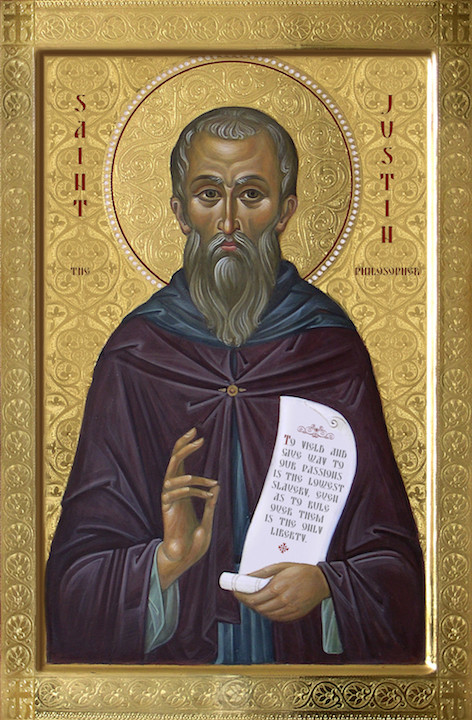
St. Justin
Justin, philosopher
| June 1, memorial | |
| Position: | philosopher and martyr |
| Death: | 165 |
| Patron: | philosophers |
| Attributes: | book, scholar’s cloak, sword |
CURRICULUM VITAE
He studied philosophy in Asia Minor. Seeking wisdom in the teachings of the Stoics, Aristotle, Pythagoras, and Plato, he was consumed by questions: What is my soul? What will happen to me after death? He sought the truth about God. An old man instructed him: ‘Pray fervently to God that he may open the gates of light for you, for understanding these things requires grace from God.’ Justin became acquainted with the Holy Scriptures, and it was through reading them and observing the lives of Christians that he was inspired to receive Holy Baptism. He was consumed by a desire to bring others to Christ, successfully defending the true doctrine. He laid down his life for his beliefs.
CV FOR MEDITATION
And to successfully defend
While he was meditating and walking along the seashore, an older man approached him and asked why he had come to this inhospitable solitude. Justin confided in him his search and desire to know the highest being. The older man replied with a smile that everything that the wise men teach is uncertain, erroneous, and foolish. And long before the Greek wise men, there were righteous men in the world who predicted things that came to pass. Filled with the Holy Spirit, they announced the truth to their people, proclaiming faith in the one true God, the Creator of all things, and in his Son Jesus Christ, whose coming they had predicted. He urged Justin to pray that God would give him the grace to know and understand these things and defend them.
Justin was moved and very much desired to know the books of the Bible, the contents of which he had learned from the older man. He then read them carefully and sought advice from Christian interpreters of the Scriptures. He observed the holy life of Christians, many of whom suffered martyrdom for their faith. Their love touched him and became one of them because he had found what he was looking for. It was probably between 130 and 137 that he was baptized in Ephesus. Later, in one of his writings, he stated that he had accepted the faith under the influence of Christians’ exemplary lives. He also heard many objections against them, but he realized that the accusations were not based on the truth. After accepting the faith, Justin devoted himself to defending and spreading Christian doctrine among educated Greeks and Romans. In Rome, he founded a philosophical school and wrote several philosophical writings in defense of Christian doctrine. Two works, entitled Apology and Dialogue with Trypho the Jew, have survived.
The pagan philosopher Crescentius, with whom Justin had heated discussions, accused him of preaching Christian doctrine, leading to his arrest and presentation before the Roman prefect Junius Rusticus. The records of the interrogation have been preserved, in which Justin’s words are recorded: “I tried to study all available philosophies, which finally convinced me that only one teaching is true. That which Christians profess, that God is the Creator and Lord of all creation, that Jesus Christ, according to prophecy, came into the world to save man and teach him the whole truth.”
He was flogged with other convicts and then beheaded, allegedly during the reign of Marcus Aurelius. It could have been after the year estimated by the martyrology. Justin significantly contributed to Christianity’s entry into Greco-Roman culture. His remains are kept at St. Lawrence outside the walls.
Posted in Nezaradené
Leave a comment
Cathesis on the Holy Trinity.
gods, but
The Mystery at the Heart of Our Faith
The Holy Trinity is the central mystery of the Christian faith. Every time we make the Sign of the Cross, we profess our belief in the Father, the Son, and the Holy Spirit. Christians do not believe in three gods but in one God who exists eternally as three distinct Persons.
The Catechism of the Catholic Church teaches that the mystery of the Trinity is the most fundamental and essential teaching about God. It is a mystery not because it is irrational, but because it is so profound that the human mind can never fully comprehend it.
One God in Three Personspersonsperson
The Church teaches that:
-
There is only one God.
-
God is three Persons: the Father, the Son, and the Holy Spirit.
-
Each Person is fully God.
-
The three Persons are distinct from one another, yet they share the same divine nature.
The Father is God.
The Son is God.
The Holy Spirit is God.
Yet there are not three gods, but one God.
This truth was revealed gradually in Sacred Scripture and fully through Jesus Christ.
The Trinity in the Bible
In the Old Testament, God revealed Himself as the one true God. The fullness of the Trinity, however, was revealed in the New Testament.
At the baptism of Jesus, we see all three Persons present:
-
Jesus, the Son, is baptized in the Jordan.
-
The Holy Spirit descends like a dove.
-
The Father’s voice is heard from heaven: “This is my beloved Son” (Mt 3:17).
Before ascending into heaven, Jesus commanded His disciples:
“Go therefore and make disciples of all nations, baptizing them in the name of the Father and of the Son and of the Holy Spirit” (Mt 28:19).
Notice that Jesus says “name,” not “names.” The three Persons share one divine nature.
The Father
The Father is the source of all creation. He created the world out of love and continually sustains it. He is the loving Father who desires the salvation of all people.
Jesus teaches us to address God as “Our Father,” inviting us into a personal relationship with Him.
The Son
The Son is eternally begotten of the Father. He is the eternal Word of God who became man in Jesus Christ.
Through His life, death, and resurrection, Jesus revealed the Father’s love and redeemed humanity from sin. Whoever sees Jesus sees the Father.
The Holy Spirit
The Holy Spirit proceeds from the Father and the Son. He is the Lord and Giver of Life.
The Holy Spirit dwells in the Church and in the hearts of believers. He guides us to truth, strengthens us with His gifts, and helps us grow in holiness.
At Pentecost, the Holy Spirit descended upon the apostles, empowering them to proclaim the Gospel to the world.
A Communion of Love
The Trinity is not a solitary God but a communion of love. The Father eternally loves the Son, the Son loves the Father, and the Holy Spirit is the bond of that divine love.
Because we are created in the image of God, we are also made for relationships, love, and communion. The family, the Church, and all authentic human relationships reflect something of the life of the Trinity.
Living the Mystery of the Trinity
The doctrine of the Trinity is not merely a theological concept. It has practical consequences for our daily lives.
We live the mystery of the Trinity when
-
We pray to the Father through the Son in the Holy Spirit.
-
We love others as God loves us.
-
We seek unity within our families and communities.
-
We participate in the life of the Church.
-
We receive the sacraments with faith.
Every Mass begins and ends in the name of the Father, and of the Son, and of the Holy Spirit. The entire Christian life is rooted in the Trinity.
Conclusion
The Holy Trinity is the greatest mystery of our faith and the source of our salvation. Though we cannot fully understand it, we can enter into its reality through prayer, worship, and love.
The Father created us.
The Son redeemed us.
The Holy Spirit sanctifies us.
One God, three Persons, a perfect communion of love. Through Baptism, we are invited to share in the very life of the Holy Trinity, both now and forever.
Glory be to the Father, the Son, and the Holy Spirit, as it was in the beginning, is now, and ever shall be, world without end. Amen.
Posted in Nezaradené
Leave a comment