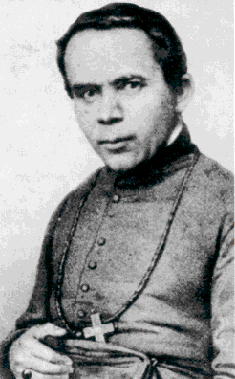
| January 7, non-binding commemoration | |
| Position: | Lawyer, Dominican priest |
| Death: | 1275 |
| Patron: | Teachers of canon law and the city of Barcelona |
Attributes: |
Sea, Dominican habit, from the cloak a sail |
CURRICULUM VITAE
He was born in Spain near Barcelona. He soon became a philosophy teacher. Furthermore, he studied law in Italy and became a public defender for people on low incomes. The bishop of his birthplace persuaded him to return and made him a canon of the Barcelona Cathedral. He was a renowned preacher, confessor, and scholar. At around 46, he entered the Dominican Order. He was the Superior General of the Order from 1238 to 1240. He reorganized the Order’s statutes. At the behest of Pope Gregory IX., he prepared for publication the regulations of church law, which he compiled into a collection called the Decretals. His writings resulted in the “Summa of Cases for the Correct and Useful Administration of the Sacraments of Penance.” In the 1770s, he also founded Hebrew schools. In Catalonia, he then devoted himself to missionary work, established dialogue with Muslims, and lived a pious penitential life for about a hundred years.
CV FOR MEDITATION
ON A COAT OVER THE SEA
His birth name is associated with the castle of his ancestors in Pena fort in Catalonia, the capital of which is Barcelona. There, he successfully studied at the cathedral school, where he also worked as a chorister. At the age of 20, he became a philosophy teacher, and for 9 years, he instilled in his students the principles of true Christian wisdom and was an example of a life of faith. Then, in 1205, he decided to continue his studies in Bononia (today’s Bologna), Italy. After obtaining his doctorate, he lectured on church law as a public teacher. People with low incomes used to have an excellent defender in court.
During his journey from Rome, the Bishop of Barcelona, Berengar, persuaded him to return to his homeland, and after his ordination, made him a canon, later a provost and vicar general. At around 46, he entered the Dominican order, which was only approved in 1216. He stood out as a renowned preacher, confessor, and excellent counselor. As general of the order, he was entrusted, among other things, with writing theological writings. After consultations with Peter Nolasco and King James I of Aragon, who chose him as their confessor, all three, on the advice of the Virgin Mary, decided to ransom Christian prisoners from the captivity of the Muslim Moors. For this purpose, the Order of Mercedarians was founded, whose religious rules were written by Raymond and confirmed by Pope Gregory IX. Peter Nolasco became the first general superior of this merciful order.
Pope Gregory IX summoned Raymond to Rome in 1230 to make him his confessor, advisor, and domestic chaplain. It is known that Gregory IX once received from him a penance to care for people in poverty and to provide them with assistance. This was the moment Raymond saw that a group of poor people had come to the papal palace and received nothing. The pope then diligently ensured that the poor were cared for.
At the behest of the Pope, Raymond compiled the canons of church law into a collection of five volumes known as the Decretals. These became the primary source of legal doctrine and the basis of the code of church law.
Around the beginning of 1235, the Pope offered Raymond the Archbishopric of Tarragona in Spain, but he humbly declined the position, preferring to remain a humble monk. Due to his exhaustion from an active life, doctors advised him to leave Rome. Gregory IX was reluctant to grant him permission. Raymond was joyfully welcomed in his birthplace, where he began working to foster the flourishing of his order. After the tragic death of the order’s general, Jordan of Saxony, he was elected the new general of the Dominican order, the third since its foundation. He reorganized the order’s statutes and demonstrated himself to be an experienced, careful, and kind father when he visited the order’s individual communities. He also published a manual for confessors, “Summa casuum.” After two years, when he was about 70 years old, for health reasons, he resigned the rank he had received out of obedience to continue living as a simple brother, dedicating himself to missionary work for the conversion of Muslims and Jews. Therefore, he established schools in several monasteries where Arabic and Hebrew were taught. From there, capable missionaries emerged.
Raymond was not demonstrating his superiority; rather, his actions were a manifestation of God’s power and an emphasis on the validity of God’s law, which he held dear. It was a sign that it is easier to cross the sea on a mere cloak than to willfully remain in sin while trying to secure one’s salvation.
As the Lord Jesus said to his disciples, “Amen, I say to you, if you have faith as a grain of mustard seed … nothing will be impossible for you.” (Matthew 17:20) We should consider Raymond’s behavior more normal than the king’s. Of course, we should consider the Word of God as the norm for us. For those who think sin is normal in life, the norm is the opposite. It is very dangerous to succumb to illusions that shape the conscience, according to King James’s rules on his way to Mallorca. Not everyone will receive the grace of the experience that Raymond’s actions in this story provoked.
RESOLUTION, PRAYER