

-
Recent Posts
Recent Comments
Archives
- September 2026
- August 2026
- July 2026
- June 2026
- May 2026
- April 2026
- March 2026
- February 2026
- January 2026
- December 2025
- November 2025
- October 2025
- September 2025
- August 2025
- July 2025
- June 2025
- May 2025
- April 2025
- March 2025
- February 2025
- January 2025
- December 2024
- November 2024
- October 2024
- September 2024
- August 2024
- July 2024
- June 2024
- May 2024
- April 2024
- March 2024
- February 2024
- January 2024
- December 2023
- November 2023
- October 2023
- September 2023
- August 2023
- July 2023
- June 2023
- May 2023
- April 2023
- March 2023
- February 2023
- January 2023
- December 2022
- November 2022
- October 2022
- September 2022
- August 2022
- July 2022
- June 2022
- May 2022
- April 2022
- March 2022
- February 2022
- January 2022
- December 2021
- November 2021
- October 2021
- September 2021
- August 2021
- July 2021
- June 2021
- May 2021
- April 2021
- March 2021
- February 2021
- January 2021
- December 2020
- November 2020
- October 2020
- September 2020
- August 2020
- July 2020
- June 2020
- May 2020
- April 2020
- March 2020
- February 2020
- January 2020
- December 2019
- November 2019
- October 2019
- September 2019
Prioress Gassmann receives honorary doctorate: “I am totally overwhelmed”
Posted in Nezaradené
1 Comment
Therefore be as shrewd as snakes and as innocent as doves
Jesus, our Lord, sends his followers like sheep among wolves and tells them: Be cautious as snakes and simple as doves… Even though Saint Francis de Sales claims that he would not give one dove for a hundred snakes, that is, one simplicity for a hundred cautions, he still admits that he likes to obey the Lord when he tells him to love and be careful. And so it is all right… It is worth noting that the Lord recommends first the serpent, then the dove. First, caution, then simplicity. And by this, he seems to be telling us: Be careful not to fall into the clutches of human beasts and predators, but if this happens to you, remain uncomplicated. Both are necessary, but this order must be maintained out of obedience to my word.
But what is the serpent’s wisdom to be seen? The wagon walls of King Saul and the military camps of the Czech “Warriors of God” give us the answer to this question… The head is in the middle, covered by the body and the tail, without which it is possible to live and defend only at the end. From the beginning, Jesus Christ formed a community of his followers, which had a head – Peter, protected by the most trusted and surrounded by the most informed for the good of the whole. The snake, as a symbol of prudence, sacrifices everything and exposes the whole body to wounds to protect the head, which is attacked in the Lord’s Church not only with a deadly weapon but also with moral beatings with the help of pamphlets, slander, and slander…
In addition, it can be harmed from within through disobedience of the body, overloading with unnecessary worries, or inaccurate or even distorted information. We are wise when we act like snakes that always defend their heads. And we are simple when some of us, despite caution, are caught and brought before rulers, where we are not to worry about what we will say but leave this concern in the simplicity of a dove to the Holy Spirit.
Posted in Nezaradené
Leave a comment
Benedict of Nursia, founder of the Benedictines.
Holiday: July 11
* about 480 Nursia, today Norcia, Umbria, Italy
† March 21, 547 (or 560 ?) Montecassino monastery, Italy
The meaning of the name is the one who blesses and wishes well (lat.)
Attributes: cup, pastoral (bishop’s staff), raven
Patron of Europe, monks, speleologists, architects, engineers
Saint Benedict, the founder of Western monasticism and the foremost patron saint of Europe, was born in Nursia (now Norcia in Umbria, Italy) around 480 in a noble family. However, only a few historical documents regarding his person have been preserved. He was sent to Rome to study. The main subject of his studies was rhetoric – the art of persuasion through the spoken word. The successful speaker could have had better arguments or expressed the truth but used rhythm, eloquence, and technique to persuade without involving the heart. This philosophy was also reflected in the students’ lives.
Seeing the moral and intellectual decay, he fled from his studies in Rome with the thought of a monastic life. He renounced his inheritance and began to live in the small village of Subiaco in the Sabine mountains. There, he lived as a hermit under the leadership of another hermit named Romanus. In the following years, he founded twelve monasteries in the Sabine Mountains, where the monks lived in separate communities of twelve monks, each according to the number of apostles. Later, however, he suddenly left these monasteries when the envious attacks of another hermit prevented him from continuing the spiritual leadership of these monks. Subsequently, he became superior to the nearby monastery in Vicocaro, where – when part of the community rebelled against him and even wanted to poison him – he left with a group of faithful disciples to find his monastery. After many difficulties, he settled in Monte Cassino, which was dedicated to him by the Roman rich man Terculius, the father of St. Placid. Benedict, Placidus, and others, in 529, began the construction of a massive monastery. The building was already completed in 532, and in 536, the monastery became a refuge for monks and the surrounding people during the war. At that time, the Ostrogothic king Totila was preparing for an expedition against Rome. In 542, Totilo visited Benedict on Monte Cassino. As a follower of the Arians, he was deeply moved by the meeting with the founder of the Benedictine order. Benedikt predicts his future fate – r. In 546, he conquered Rome, in 549, then Sicily; in 552, he was defeated by the Byzantine duke Narzes and died.
Regula Benedicti, which he wrote shortly before his death, was the fruit of his lifelong search. It draws a lot from the results of the monastic movement of that time, from the rules and principles that were already created then. He skillfully composes and modifies them to correspond to his vision of man and the path by which he comes to the depth of knowledge of God and spiritual love. It was a view – as it turned out – far beyond the time frame in which Benedict lived. The rule became the cornerstone of the European monastic tradition.
Instead of establishing small, separate communities, he gathered his followers into a large community. His own sister st-Scholastica, settled nearby and lived her religious life here. After almost 1,500 years of monastic tradition, it seems obvious to us that Benedict was an innovator in his time. No one else before him had attempted to create such communities and to create some rules for them. What is now only a part of history for us was then a bold and risky step into the future.
Benedict valued ancient literature and had it described in his monastery, thus laying the foundations for developing post-antique literature in Europe.
In the time of St. Benedict, monastic life was already extended to the entire eastern part of the Mediterranean Sea, especially Egypt and Syria. It was characterized by a multifaceted departure from civilization – to the desert, to uninhabited territories, unencumbered by complicated administrative management. The monks here had great freedom, their organization, and at the same time, the choice of various forms of life – from giant monasteries (e.g., the community of five thousand St. Pachomius) to the respectable performances of individual ascetics. Precisely at the border of civilization, when antiquity was already formally Christian but constantly carried in its bosom much of the ancient pagan nature, its way of life became a suitable ground for the fiery zeal of the early Church, in which it found ideal conditions for its spiritual development. At that time, almost all prominent figures of the Church and theologians went through the monastic life. In the West during this period, the situation was completely different – it was necessary to consider the presence of warlike tribes. Building a monastery in these conditions was a significant risk.
The regulation was not a collection of legal tricks or principles for life. With its excellent internal organization, it opened space for the presence of the mystery of Christ both in man and in the community through the performance of the Office (Eucharist and Liturgy of the Hours), work and personal study of the Holy Scriptures (Lectio Divina). Organized this way, the monastery did not become a closed, elitist world. As it were, it became a miniature of the Church, which for the first Christians was not only a community of the baptized but, above all, a solid school of initiation under the guidance of the Supreme Shepherd himself. Sv. Benedict reserved the name School of the Lord’s Service for the monastery, in which he lays down the individual elements so that the monk, adhering firmly to them, gets to know himself and develops the graces and gifts acquired in baptism. He should find Christ’s presence in the community more and more deeply and consciously participate in His paschal mystery, made present in the sacraments and the liturgy. Loyalty to the Rule thus inevitably leads to an encounter in truth with Christ, as the Master is the King and the only High Priest.
A monk’s primary task has always been – as Regula says – the search for God and unity with him. This individual dimension of opening to grace and obedience to God’s will was transformed by God himself into a larger dimension, into the history of the Church, culture, and civilization. Therefore, every true monk was always a person of the Church in the complete sense of the word, even when he lived alone, as a hermit (hermit). The Benedictine monastery realized life in community (cenobitic), forming at the same time also those who wished to go to the hermitage when they were mature enough to combat evil even alone. A universal way of monastic life emerged in which people of different temperaments and life stories could be found. This miniature nature of the Church determined the special relationship between the monastery and the world. The community of monks was not directed to the outside, to various initiatives in the Church, or the world, but to the inside, in such a way as to reveal the very supernatural nature of the Church in the given common and historical conditions. In this way, it wants to be its visible sign and help people immersed in the reality of the present time. The task of the monks of St. So Benedict became, so to speak – not entering the world but living in a monastery so that the world could come to it to meet the Benedictine community and, in this way, find the ways of God for themselves.
All the initiatives, including pastoral ones, that the Benedictine monasteries undertook were always subordinated to this style and thinking in their actions.
There were at least 30 different rules in the 5th-7th centuries, but the Benedictine rule still needs to be achieved more successfully. Unlike most, it was not just a calculation of individual regulations, prohibitions, and punishments. Its advantage was systematicity, thanks to which it became a practical guide for organizing and managing all areas of monastic life, and a balance between strictness and moderation, the authority of the abbot and respect for the peculiarities of individual monks, pious acts and spiritual and physical activity.
Abandoning worldly society, choosing individual asceticism and obedience, and searching for God in prayer and meditation were essential prerequisites of the monastic life, which in St. Benedict by the School of the Lord’s Service (schola Domini servitii). The fundamental pillars of Benedictine monasticism were daily glorification of God (opus Dei), vows of obedience (oboedientia), change of morals (conversatio morum), poverty (paupertas sancta), binding stay in the monastery until death (stabilitas loci).
In these small but mighty rules, Benedict incorporated everything he had learned about the power of spoken language and the rhythm of speaking in the ministry of the Gospel. He compared rhetoric to a hammer that can be used to build a house but can also be used to hit someone over the head. Rhetoric can also be used for the sake of evil… but also for the sake of God. Benedict did not avoid rhetoric because it helps evil; he wanted to reform it and use it in the interest of God. Benedict did not want to give up the power of the word just because others used it for their destruction.
Benedict realized that God’s word is the most robust and factual basis for the power of words: Which words from the Bible are not perfect rules for contemporary life? He had experience with the power of God’s word expressed in the Scriptures: Just as rain and snow fall from heaven and do not return until they have watered the earth to make it fertile and able to bear fruit so that the world will yield to the one who sows so that it will yield bread to him that needs to eat, so is it with my word that proceeds from my mouth; He does not return to me empty, but accomplishes my will, accomplishing what I sent him to do (Isaiah 55:10-11).
Benedict chose Psalms, the most beautiful songs of the Jewish liturgy, for his prayer, which Jesus himself prayed. Benedict believed with Jesus that “man does not live by bread alone, but by every word that comes from God.” (Matthew 4:4)
But just speaking words is not enough. Benedict urged his followers to read sacred texts to study the Scriptures. In his Lectio Divina, he and his monks memorized Scripture, studied it, and contemplated it until it became part of their being. They sat beside each other for four to six hours daily and read like this. If the monks had free time, the brothers had to read psalms. They had to know parts of the Scriptures by heart. Such sacred reading was meant to study love, not reason. It was not just an exercise of the mind; it was an exercise of contemplation so that “our hearts and voices harmonize.” Every word that has entered their mind, heart, and soul must then spring forth, not from memory, but from the interior of the being. “We realize that we will be heard for our pure and contrite heart, not for the number of words spoken.” The heart is pure when it is empty and filled only by God’s word and our desire to remain in God’s word.
Lectio Divina begins by reading the Scriptures until we find a place that inspires us and stops. We reread it, think about what it might mean, and then move on. But this is not sacred reading. His method is memorizing a specific phrase from Scripture. Repetition over and over memorizes without further reading, without thinking, just simple repetition, until it seems to come not from the mind but directly from the heart until the power of God’s word enters us. Only when the phrase has lost all meaning and only that power remains does a person shut up, remain silent without thinking, and let himself be inspired by the Holy Spirit, who will speak to us about the meaning in our hearts. And finally, one should plunge into contemplation, continue without speaking, without thinking, just sitting in the presence of the living God and God’s word.
An incident from Benedict’s life has been preserved, such as when a beggar came to the monastery and asked for some oil. The administrator refused because they had little left. Nothing would have been acceptable for the monastery if he had given these alms. Benedict was angry at the administrator’s lack of trust in God. He knelt and prayed. As he prayed, a bubbling sound came from the oil jar. The monks watched in fascination as God filled the vessel, and the oil overflowed, broke the lid, and poured onto the ground. In Benedictine prayer, our hearts are empty vessels in which there are no thoughts or intellectual struggles. Trust in God is the only thing that remains there and fills our hearts. Emptying our hearts brings us the overflowing contemplative love of our God.
Benedict founded Western European monastery-type monasticism (monasticism), which prevailed over its older hermit form. In 543, St. died. Scholasticism. Six days before his death, he had a prepared grave opened next to his sister, and on March 21, 547, at 9 a.m., he died standing in prayer before God.
Posted in Nezaradené
Leave a comment
Fifteenth Sunday in Ordinary Time Year B Mr 6,7-13
Take nothing but yourself!
Today’s Gospel raises one problem. That is, not only the evangelist Mark writes about the sending out of the apostles, but also Matthew and Luke. And there is a difference in these three texts. The list of things that disciples can take with them on the journey varies. What is permitted by one evangelist is not allowed by another. So what can you take with you and what can’t you? What was the actual list of things that the disciples should or should not take with them? However, looking deeper at the matter, we find that the problem is elsewhere. Jesus was not at all concerned with what his disciples were not to take with them. I was primarily concerned with what they must not forget to take on their mission trip. What was that? Well, they. All of them should have remembered to take themselves with them on the mission trip.
Today, Jesus would expand the list of things we should not take. For example, he would say: don’t take your cell phone, laptop, projector, or car… Well, we know that many missionaries take all of this with them. So, are they sinning? In the time of Jesus, did those who took sandals, a stick, or a dress sin? Should they go naked or barefoot? Probably hardly. So the bottom line is this: “Take what you want if you need it, but please don’t replace yourself with anything you take. Above all, take yourself as you became when you encountered the Gospel. God’s word changed him.
Self-degassed by the Gospel. Other things may benefit you, but they must not overshadow you…” Let us look at the list of things Jesus mentions in the Gospels of Mark, Matthew, and Luke and investigate what Jesus could have had in mind when he told us so we don’t take these things with us on a mission trip. However, I have one suggestion! Since we are all young people at UPC, let’s look at the mission more narrowly: for example, as a trip to another person, let’s say to your girl would you like to create a relationship, or to your friends, etc.
What does the stick symbolize? Jesus says, “Don’t take the stick if you don’t have a stick.” Don’t support yourself. Go alone without her. The stick symbolizes things outside us that many rely on titles, statuses, positions, and functions. Many of us would only know who we are if we had titles. People call us Mr. Doctor, Mr. Pastor, Mr. Engineer. If we didn’t have this, what would we be? What would I be without my degree? What would I offer people? Would I still be valuable to them? Many of us like newspaper reports about ourselves or other propaganda. What would I be without them? However, I have a price even without a stick. If the Gospel transforms me, this is a great value.
So, let’s not take the stick. Let’s take ourselves. Sv. Philip Neri came from Florence, an impoverished noble family. When he left home for the world, it is said that his father gave him the family tree of his ancestors written on paper. He came from an impoverished noble family. He advised him to show it at the right moment and place, which would surely help him. Although Philip took it out of respect for his father, he eventually threw it from the bridge into the Arno River, which passes through Florence. You said: “After all, I have to prove that I have something in me.” I don’t need papers or a family tree for that!” In other words, I don’t need a stick. When you have to go without a stick, it means that although you will strive for titles and positions… you will never replace yourself with all of these. If you are of no use, a title neither position nor rank. You have to go to the people.
A pocket is a storehouse of things. But he doesn’t know how much he will need, so he becomes self-sufficient. Don’t depend on others. They will be happy when they can give you something because it is humbling . People will receive you with more love when they see that you need them, not just you. If you were self-sufficient, you would sit at the table set for you, but you would eat your food because I have mine!” We can imagine what that could cause. Another aspect is not even having plans in your pocket.
I have plans in this sense: I am going to people with a finished thing. I am going to give them things that I have already prepared and planned in advance. I am not prepared for any surprises or modifications to my plans. Everything is fixed in advance. No, I don’t have plans. Meet people halfway somewhere. And meeting another person will turn not only them but also you. Get ready for it. Get ready to modify your plans…
No money: Money is a symbol of hidden wealth. Wealth like fields, houses, and cars is visible. But the money needs to be visible. Some have money as a reserve; they can buy everything with it. Really? Can money buy friendship, closeness, and relationships with people? Money is also a symbol of power. Could you not take them? Go alone, without money.
Without pairs of clothes: They say, “Clothes make the man.” That’s what the proverb says. Really? Many of us wear clothes or use cosmetics not as a sign of need but to cover something up. To put on a mask. Today’s fashion industry does tricks; for example, you shouldn’t wear white clothes or horizontal stripes. They can cover what should be exposed, but don’t wear a mask! The truth. Just be yourself. Be “naked” what you are. Offer that to people.
Without sandals: In the Scriptures, there is a mention of how Jacob took off his shoes at the place he was going to. It was a sign that he respected the place as holy. This should also be the attitude of a missionary who goes to other people or to another person. When you approach other people, you have to take off your shoes because this place is holy… and there is a danger that he will trample the dreams of another person with his boots. Approach others with respect and gentleness.
A missionary has accepted God’s kingdom and desires to pass it on without a price tag, directly, and without delay. More precisely, a missionary is a person who gives himself to others, himself transformed by the message of the kingdom of God. In other words, giving only yourself is sometimes what people want from you. We know many people who give themselves to others as they are, who are unhappy about it. Many people are a nuisance and a burden to others. When we talk about surrendering ourselves, we mean here – as we said in the introduction – about ourselves, who are transformed by God’s word: in whose presence others feel good, who radiate love, holiness, joy, and peace. A saying goes: “People forget what you told them.” They will forget what you did for them. Well, they’ll never forget how they felt in your presence.” And that’s precisely the point.
Posted in sermons
Leave a comment
The knowledge of the Father surpasses words
Jesus said to the disciples: “I have revealed your name to the people you gave me out of the world. They were yours and you gave them to me and they kept your word. Now they knew that everything you gave me was from you, because the words you gave me, I gave them. And they received them and truly recognized that I came from you, and they believed that you sent me” (Jn 17, 6-8).

Clinging to Jesus leads to a knowledge of the Father that surpasses words. Illustration image: unsplash.com/Marc Olivier Jodoin Last time we thought about our Father’s house, how we should imagine it and what it means to us. But who is our Father? We certainly do not imagine him as an old man with a long gray beard that we saw in pious pictures as children. So who is the Father whom Jesus reveals to us? Who is it actually telling us about? What is his name?
THE REVELATION OF THE FATHER
The name in the biblical meaning means the essential center of the person, our essence, or according to tradition, the heart. The revelation of God’s name is the revelation of his presence to us. God surpasses our ability to express him in words, because he is not a figure, an object that we can grasp and imagine with our mind and senses. That is why the apostle Philip was very surprised when, to the request he made to Jesus: “Lord, show us the Father and that will be enough”, he received a rebuke rather than an answer: “Philip, I have been with you for so long, and you do not know me?!” Whoever sees me sees the Father. How can you say, ‘Show us the Father?!’ Don’t you believe that I am in the Father and the Father in me?” (Jn 14, 8-10).The revelation of the Father by Jesus is not the revelation of his appearance, but the revelation of his life. When God appears to Moses, he pronounces his name – “I am that I am” (Ex 3, 14). What is the difference between this Old Testament name and what Jesus reveals to us? “I am that I am” was an expression of the eternal being of God, who is the fullness of all, and at the same time expressed his presence on the way of the wandering people.
THE PRESENCE OF GOD
However, Jesus develops this dynamic of God’s life even more. It does not represent the Father as a separate ruler, but as one who is part of our life experience. Clinging to Jesus leads to a knowledge of the Father that surpasses words. It comes from our life, from our life practice, from our actions that we do every day, whether it is sweeping the room, managing a company, walking with a loved one. Our experience of God will not take place like in some movie, which will be shown to us in a dream or in some special experience. If that were the case, the vast majority of people would never meet God. How then is God present for us? We are not expected to do anything special. It is enough to simply realize that whatever we do, we should do it in the awareness of his presence in us and in what we do. Our task is to give it free rein – to do what we do in the given situation, knowing our eternal immersion in God’s life. Without him we could do nothing (cf. Jn 14:5). This is how simply the Father is in each of us through the Son, and he created us so that he could reveal himself to us and give us gifts.
GENEROUS WEALTH
Finally, the very word God (Slavic Bog) is derived from the word rich. This reveals its essence, which is also represented in Sanskrit by the word Bhaga, which means bountiful divine giving, bountiful wealth. God is truly a rich giver of life, who says: “It is good that you are, because you are my good.” For we are of him, says Paul (cf. 1 Cor 3:16). Let’s try to think about the secret that our good is also God’s good. In this way, we will better understand Jesus, who says that God does not want to give just some gifts, but first and foremost himself. The gift is for us to reach the Giver through it, but we must be careful not to cling to the gift and elevate it above the Giver.
A TRUE SACRIFICE
Let us believe that Jesus with the Father and the Spirit is in us immeasurably simply by creating and enabling us in everything we do. Let us believe that God is so great that no man is small to him. Therefore, it is enough for us to be immediate to God, without calculating, following the benefits that feed our ego. This is where our true sacrifice lies – I do not give God something I have or some words about sacrifice, but myself by giving myself in a given situation. Our Father does the same, who gives himself to us and to all creation in every situation of our life. With every act of kindness, we participate in the life of God. And that is why each of us is capable of God.
Posted in Nezaradené
Leave a comment
When he saw the multitudes, he felt sorry for them because they were downcast and depressed like sheep without a shepherd » Mt 9, 36.
This is not just an event, but a profound revelation. It is Matthew’s narrative amidst miracles. The masses encircle Lord Jesus. He heals and heals. His love extends in two directions. One reaches physical wounds, the other, less visible but equally perilous, spiritual anguish. My own fervor also requires two directions to embrace the world’s suffering. Word and deed. To teach and to heal. Or heal and teach. The sequence is often crucial. For the ‘healing of the body’ can be the precursor to the ‘healing of the soul ‘. Lord, let both arms of love grow in harmony and in proportion to the suffering I encounter, for the transformative power of compassion is boundless.
But in that crowd that swallowed the Savior, not only the sick were not suffering from bleeding. Only one’s daughter died. Two blind gods, one dumb. The vast majority of them were healthy on the outside. But Jesus’ gaze went deeper. He sees a “broken and scattered flock.” Everyone is looking. Everyone is tired. Everyone is wandering. A herd with no one to lead, no one to protect it, no one to sacrifice for it. And the Lord was seized with deep compassion. “He felt sorry for them…” And that compassion turned into tireless journeys and finally into the Way of the Cross and a redemptive death. Because a good shepherd “lays down even his life for his sheep.”
Fruitful compassion has never died out in the Church. Even Don Bosco saw the multitudes worn out and scattered. Crowds of abandoned boys were beginning to be swept away by the current of crime and destruction. Others saw it too. But with different eyes. They saw a bunch of suspicious, future criminals. Perhaps they themselves stood proudly in front of the altar: ‘I thank you, God, that I am not (I, nor my children!) like those’. Don Bosco did not succumb to indignation, but to compassion. ‘He felt sorry for them.’ From the first dream, he renounced the solution with his fists. Even his compassion turned into a life full of sacrifices and efforts. ‘I have promised God that till my last breath I will belong to my poor boys…’ His enduring compassion is a reassuring thread that connects us all in the Church.
Lord, give me a compassionate heart. And good seeing eyes and seeing deeper and further. I move among the multitudes of well-fed yet starving, modernly dressed and yet shamefully exposed, educated and unwise. I am asking you, let me not betray my place among the “worn and broken” so that I do not deviate from the path to the lost sheep so that I do not succumb to the temptation of an easier, more sympathetic, and outwardly more successful apostolate. Don Bosco showed me where to look. Let pity trouble me. Let compassion stretch out both arms of my love: word and deed. And where neither word nor deed can reach, prayer can—a prayer of living faith. If I won’t be able to touch you with either word or deed, I will help the “weary and broken” from afar by prayer.
Posted in Nezaradené
Leave a comment
The Resurrection of Jairus’ Daughter and the Healing of the Woman
Lord, what should I notice in this passage? » I realize with what faith Jairus came to me. He came asking me to heal his dying daughter. He believed I could do it. I could not remain oblivious to such faith and trust in my help, so I immediately went to his house.
What were you doing when Jairus came with a request? » I was just standing on the shore teaching the multitudes. Everyone wanted to hear my words and everyone was pressing me.
You healed someone in that stampede. How did that happen? » When I went with Jairus to his daughter and made my way through the crowd, I suddenly found that a power came out of me that healed someone. I stopped and asked who touched me.
Did you see the healed one? » A woman pushed her way to me from among a crowd, fell at my feet and told everyone how thanks to my power she was cured of the disease that was bothering her. With faith she touched my garment and this faith of hers found an answer. Don’t be afraid to push yourself with faith among the crowd that only wants sensations and touch me. I will heal you.
Immediately after this event, he went to heal Jairus’ daughter. How did this healing go? » When I was on my way to Jairus’ house, the servants came from there and reported that the girl had died. I saw that a greater miracle than healing would need to be performed here. But it is not a problem for me to give someone life, so I encouraged Jairus to trust me.
How were you welcomed in Jairus’ house? » There was a lot of crying and wailing waiting for us there. When a young person dies, it always shakes everyone. The girl was dead and, in their opinion, there was nothing more that could be done. I knew that the girl could be brought back to life. I did it as easily as if I woke someone up, so I told them the girl was just sleeping.
How did the residents of the house look after the girl’s resurrection? They were shocked at what they saw. Even the parents were completely beside themselves with amazement and joy, so I had to remind them not to forget to give the girl something to eat.
Lord, what do you want to challenge me to do today? » To greater faith. Trust me more. I can help you even when it seems that there is no more hope. I will help you in the fight against the enemies that are around you and in yourself.
Posted in Nezaradené
Leave a comment
Our tradition also includes dynamism.
The Catholic Church stands on solid foundations, from which it draws and from which it must not deviate. Historian and Catholic priest Branislav Dado, SJ, says that on the other hand, as the world and society develops, so does the Church. “We can’t stand still, we church leaders and lay people have to react to many things as well.”
For example, the doctrine of the Holy Trinity, which forms one of the pillars of the Catholic faith, built on the sacred Tradition and the Holy Scriptures, remains unchanged. They spring from the same divine source and lead to the same goal – to lead people to salvation, to the eternal goal, as taught by the Second Vatican Council in the Dei Verbum constitutions ( DV , 9).
THE TRANSMITTED TREASURE OF FAITH
First , we need to understand the term Tradition of the Church correctly. “We are familiar with terms such as folklore traditions or national tradition and the like. When we talk about the Tradition of the Church, we mean something quite different,” explains the historian.
Tradition in the Church is all faith handed down from generation to generation in a living way. In our understanding, the word tradition (tradó, tradere) does not denote folklore, but content, objective facts, treasures of faith.
In sociology, Tradition represents the sum of customs, rules inherited from generation to generation. In theology, Tradition means the teaching of faith of a religious community, which is transmitted in writing or orally. This contrast the written, canonical revelation in the Bible, which is “God’s word, God’s revelation”.
The written Tradition also includes the writings of the church fathers, theological doctrine and the content of the teaching office of the Church. “It is primarily about spiritual and moral values, legal norms, guidelines for the life of the Church. Also about the liturgical and moral side,” adds Branislav Dado.
FROM CHRIST THROUGH THE APOSTLES
The entire revelation of God is completed in Jesus Christ. “He commissioned the apostles to preach the gospel that was promised through the prophets. Christ built his Church on St. Peter as on a rock.
“The apostles fulfilled this mission and proclaimed the Gospel as a source of spiritual truth and moral standards, thus conveying God’s gifts to people. The Gospel was transmitted first orally, then in writing. To keep it intact and alive in the Church, the apostles appointed bishops as their successors.”
We call this living transmission of faith, carried out in the Holy Spirit, Tradition, because through it the treasure of living faith is passed on intact from generation to generation. “Tradition is therefore the place of action of the Holy Spirit in the Catholic Church and through it in the world.”
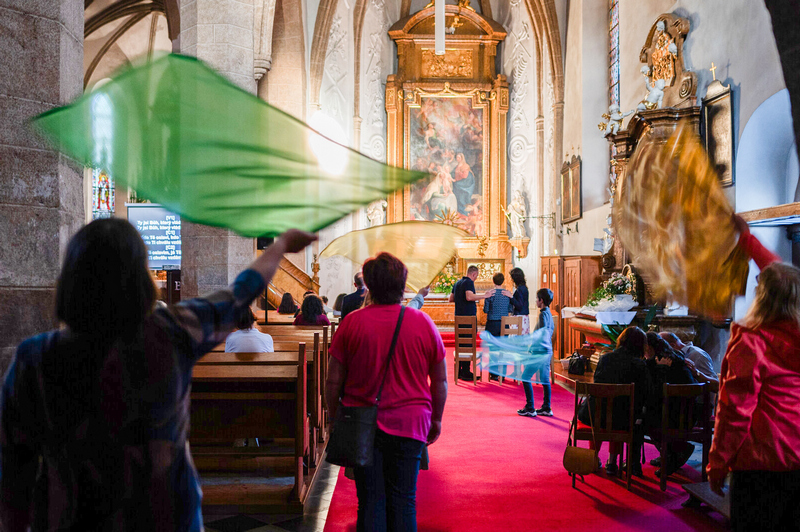 In the Church, communities are a manifestation of the action of the Holy Spirit and a sign of its dynamic life. Illustration picture:
DYNAMIC CATHOLICISM
At the same time, however, Catholicism is developing and forming as a spiritual direction. Different currents in the Church have always been a response to the current needs of the times. “However, we must distinguish whether the direction that is being formed is guided by God’s Spirit, or whether it is Catholic. The Church has always distinguished in this area in the light of the Holy Spirit.”
Healthy currents got their specific name. These are religious orders, secular institutes, movements, societies of apostolic life. At the time of its creation, each of them was the response of a specific person or group of people to the current problems of the time and the needs of the Church.
“In addition to official movements, various prayer, charitable or educational communities are also established within parishes or dioceses. All of them are a manifestation of the action of the Holy Spirit and a sign of the dynamic life of the Church.”
SPIRITUAL DISCERNMENT
It is natural that this development and movement within the Church also brings with it certain tensions. According to Branislav Dada, it is important that potential tension becomes a space for spiritual discernment. In humility and openness to the Holy Spirit and under the guidance of the competent authorities of the Church, we should know where and how to move forward.
However, if this distinction replaces the promotion of one’s own opinions and attitudes, conflicts occur. “The history of the Church is full of them. However, they are also a manifestation of the fact that the Church is a living organism, that it is a community of weak people marked by sins.”
As for the liturgical-legal regulations, they are also evolving, also often under tension. “It is important not to exclude anyone from the range of love. The only thing that can and should truly appeal to people is unadulterated, sincere love, open to dialogue and respectful discussion while preserving Catholic teaching and fidelity to the Magisterium of the Church.”
We see such a procedure, for example, with Saint Dominic (1170 – 1221), Francis of Assisi (1181 – 1226) or Francis of Sales (1567 – 1622).
WHEN YOU SHOULD BE AWARE
Today, however, we are offered some directions and more liberal views that also affect the Church, so you have to be careful. “A faithful Catholic cannot wait for the Church to dictate to him a list of permitted and prohibited opinions, trends or groups. In today’s pluralistic society, this is not even possible. If only because there are many different directions and currents within the spiritual life.”
However, there is, for example, a developed ecumenical dialogue, within which we also get to know other, non-Catholic Christian traditions and communities. According to the historian, this dialogue has its positives, but also its risks. Therefore, it is necessary for faithful Catholics to know the official documents, to have them explained by competent authorities and to discern based on this knowledge, guided by the Holy Spirit.
“However, the basic approach still remains – unadulterated humility. It does not mean servility or submissive behavior. I therefore encourage the faithful to find time to study church documents, and I also encourage the priests to know them well and in their pastoral service to help the faithful in the communities to find their way,” adds the Jesuit.
The Church distinguishes according to Tradition
“Perhaps readers will notice that we use two ways of writing – Tradition with a capital T and Tradition with a small t. It’s not a typo. The tradition of the Church with a capital T is, together with the Holy Scriptures, a source of apostolic teaching. He transmits what the apostles received from Jesus Christ and what the Holy Spirit taught them.
Theological, disciplinary (legal norms and morality), liturgical and similar traditions must be distinguished from this Tradition. These are also closely related to the teaching office of the Church, that is, to Tradition, but it is possible to modify them, of course, in accordance with and in the light of the faith that is contained in God’s word and Tradition.”
Church historian Branislav Dado also gives examples when tradition and Tradition show us the direction. The first concerns the possibility of human life arising outside the mother’s body, i.e. so-called artificial insemination. “Although science gives us rich possibilities, we do not have the right to manipulate and play with life. We are not its creators, but its receivers and bearers.” In this regard, tradition shows us what is moral and what is not.
It is similar in the case of artificial intelligence currently being addressed. “First of all, it is necessary to think about whether we can talk about artificial intelligence at all, because intelligence is a natural property of a person, not a machine. A machine, computer or drone will always only be programmed by someone intelligent – a human.”
Thus, with current topics, we ask to what extent the given facts are moral, and “the Church, guided by the Word of God and Tradition, thinks about these modern questions and examines them in the light of the Holy Spirit”, concludes the historian.
Posted in Nezaradené
Leave a comment
Focusing on Christ.
MATTHEW DESCRIBES his reaction to the Master’s call: “He got up and followed him” (Mt 9, 9). From this moment on, his life will be completely different from the one he led before. He meets him when he sits and collects taxes. Perhaps his goal was primarily to enjoy the wealth he had earned. But with Jesus, the priorities of his life will be different. It is true that until now, he had not enjoyed great fame among his fellow citizens. Still, money and the respect of the Roman authorities compensated him for the rejection of many of his people. Looking at Jesus and his words, Matthew gave up these certainties and embarked on an adventurous journey to find the Messiah.
“He stood up”. One needs to stand in front of everyone. It is a gesture that shows recognition of a significant person; it means interrupting what one was doing to give it one’s full attention. When a person stands up, he is alert and ready to go in one direction or another. Matthew shows himself to be prepared to do anything for Jesus because his ranking of values has changed thanks to God and his dispositions: the most important thing is no longer wealth or a comfortable life, but to dedicate all his strength to Christ.
Saint Matthew was probably aware of the risks associated with this decision. However, he also leaves behind the attitude of a person who calculates. Every disciple’s life consists of opening oneself to a divine adventure, often full of surprises and uncertainties. Following Jesus means walking in his footsteps, not always knowing exactly where they will lead, but realizing that the happiness he can bring us is much greater than our predictions. “It is necessary to trust him and take a step to meet him and eliminate the fear of thinking that if we do this, we will miss out on many good things in life. His ability to surprise us is far greater than our expectations”
Matthew’s ANSWER to Jesus needs to focus on himself. He needs to think about whether he’s ready or not or whether he’ll be better positioned to decide later. Perhaps, mysteriously, he was waiting for the call addressed to him by the Master. And to discover him in all his brilliance, he had to look and listen carefully to him rather than to himself. There can always be a temptation to stop following Jesus and sit down and count the costs and benefits, especially when the going gets tough, and it can seem like it’s not worth the effort.
This is what happened to Peter when he walked on the water. He could stand and move forward as long as his eyes were fixed on Jesus. However, as soon as he paid attention to his fragility and the strength of the wind, fear and uncertainty entered his heart, almost sinking him. At his cry: “Lord, save me” (Mt 14, 30), “Jesus immediately put out his hand, caught him and said to him: You of little faith, why did you doubt?” (Mt 14, 31).
Following a vocation has something of walking on water, from overcoming one’s abilities with the certainty that the Lord does things and keeps accounts. On this journey, the spiritual guidance of someone who can always advise or help us discern is essential, not only in the first stages of discovering a vocation. “Serve your God sincerely,” writes Saint Josemaría, “be faithful to him… and do not worry about anything: because it is a great truth that if you seek the kingdom of God and His justice, He will give you everything else – material, means – in addition .
IN HONOR OF THE ANSWER to Jesus’ invitation, St. Matthew decides to prepare a feast in his house. Some publicans like him and others were present, but they were also considered public sinners in the eyes of the people. Therefore, when the Pharisees saw the Lord eating with Matthew’s friends, they asked the disciples: “Why does your teacher eat with tax collectors and sinners?” (Mt 9, 11). But when Christ heard these words, he replied: “It is not the healthy who need a doctor, but the sick. Go and learn what it means: I want mercy and not sacrifice. I did not come to call the righteous, but sinners” (Mt 9, 12-13).
“The first thing we have to do is realize this: none of us, none of us here can say: I am not a sinner. The Pharisees did it, and Jesus condemns them” [3]. Accepting ourselves as we are, with our virtues and faults, draws us to the Lord. He comes to us not because we have done things right but because we are sinners who need his mercy. The first step in receiving the Lord is recognizing that we need Him. In this way, we will face our personal sufferings hand in hand with Christ, knowing that the experience of sin will not make us doubt our mission. “God’s power manifests itself in our weakness,” says Saint Josemaría, “and calls us to fight, to struggle with our mistakes, even though we know that we will never achieve complete victory in this earthly pilgrimage. The Christian life means starting over and over again, constantly renewing oneself every day”.
Mary is the mother of mercy. She can help us recognize our sins with a motherly, non-judgmental eye. And from his son, he will also give us the grace to fight with hope because he knows that Jesus reveals himself to us in that “we want to be better, in the desire for pure love, in suppressing selfishness, in completely giving ourselves to other people, doing so from our constant service of life.”
Posted in Nezaradené
Leave a comment