
-
Recent Posts
Recent Comments
Archives
- September 2026
- August 2026
- July 2026
- June 2026
- May 2026
- April 2026
- March 2026
- February 2026
- January 2026
- December 2025
- November 2025
- October 2025
- September 2025
- August 2025
- July 2025
- June 2025
- May 2025
- April 2025
- March 2025
- February 2025
- January 2025
- December 2024
- November 2024
- October 2024
- September 2024
- August 2024
- July 2024
- June 2024
- May 2024
- April 2024
- March 2024
- February 2024
- January 2024
- December 2023
- November 2023
- October 2023
- September 2023
- August 2023
- July 2023
- June 2023
- May 2023
- April 2023
- March 2023
- February 2023
- January 2023
- December 2022
- November 2022
- October 2022
- September 2022
- August 2022
- July 2022
- June 2022
- May 2022
- April 2022
- March 2022
- February 2022
- January 2022
- December 2021
- November 2021
- October 2021
- September 2021
- August 2021
- July 2021
- June 2021
- May 2021
- April 2021
- March 2021
- February 2021
- January 2021
- December 2020
- November 2020
- October 2020
- September 2020
- August 2020
- July 2020
- June 2020
- May 2020
- April 2020
- March 2020
- February 2020
- January 2020
- December 2019
- November 2019
- October 2019
- September 2019
The warning not to server mammon is not a denial od temporall values.
By mammon we can understand all created things to which man devotes so much attention, time and effort. Such things as wealth, status, power, health, beauty – are very good and useful, even necessary in certain circumstances. And it is good if one can get money or education, fix one’s health, dress nicely, etc. The sense of the value of a thing is something positive and promotes man’s creative relationship to the world (J. Pietraszko). But only as long as it does not turn into greed and blindness. With too much care, man becomes a servant of those created things, their slave: his money, his success, his popularity – while they are supposed to serve us, not the other way around! If man subdues the created things, if he has dominion over them – he can do with them what he likes, and therefore he can put themat the service of God.
And to serve God means to give God our intelligence, our health, our energy, our talents and abilities, so that through us He may reveal His Providence, accomplish His will and carry out His plans, so that through us He may continually create the world, sanctify it and bring it salvation. And this is the true benefit of created things. As Bertold Brecht said, Every thing belongs to him who makes it better. And this is the realization of the kingdom of God, which today is said to be sought first. Then God will “add” to us all that we will need for the building of that kingdom. To the man who puts everything at God’s disposal – God, for His part, also puts everything at his dispos
Posted in Nezaradené
Leave a comment
Where’s your heart?
Where your treasure is, there will your heart be also.” The secret of happiness lies in the accumulation of wealth that comes from a loving heart. Jesus’ teaching many times shows the human wisdom that is characteristic of the wisdom tradition of Israel. Already in Proverbs we read, “Do not be anxious to be rich and restrain your ingenuity” (Prov 23:4).
In another place, when a young man asks him what he must do to be perfect, Jesus replies, “If you want to be perfect, go and sell your possessions and give to the poor, and you will have treasure in heaven” (Mt 19:21). The only wealth that will never be lost is the love that each of us has invested during the time we have been given. St. John of the Cross said that at the end of our lives we will be judged by our love, that is, by our concrete commitment to love and service to God and our neighbors.In this Gospel passage, however, the Lord does not call us to give up the natural human tendency to accumulate wealth in order to prepare wisely for the future by saving some money for a time when we will need it. Rather, he insists on the kind of wealth we are to accumulate: heavenly treasures.If it is true that “where your treasure is, there will your heart be also”, the opposite statement is also true: “where your heart is, there you lay up your treasure”. Therefore, from time to time it helps to reflect on where our heart is, how we spend our time, what our concerns are. We become aware of whether we are only in our own things, or whether there is room in them for others. Whether the reason for our existence is generous service to God and people. This is how St. Josemaría explained the secret of happiness: ‘What is needed to achieve happiness is not a comfortable life, but a heart in love’ (Beard, para. 795).
Posted in Nezaradené
Leave a comment
12- Sunday B Mk 4,35-41
Let’s learn that we are the best critics when we take other people “for a show”. We can perhaps find faults in them that they don’t even have. Today we again feel like criticizing, of course, not ourselves, but the apostles. We will point out their weakness, wavering faith, or better said, unbelief. But only Christ has the right to do that, and we have the duty to subject our personal faith to criticism. What is our faith? Are we not acting like apostles? Don’t we wish that Christ would miraculously intervene in our favor, calm the waves of violently beating life, and make it easier for us? We only want the Lord’s intervention, but not his help, to weather the waves. His presence in the Eucharist is not enough for us, but it seems to us that he is asleep and knows nothing of our suffering and the danger that lies in wait for us.
Overcoming life’s difficulties fills us with joy that we love to share with others. It is actually a story about our heroic deeds, the joy of overcoming evil, defeating it and getting out of it. However, the difficult trial that God led us through does not have to be a one-time trial, but He can lead us through it again and again. How do we behave? We often lose faith in his power, strength and love, which guides us, and thus with our fear we make life’s journey more difficult for our neighbors. Our fear is sometimes even panicky, which has nothing to do with caution, because it springs from our little faith, even unbelief.
That is why it is important to have confidence in suffering. Are we not ashamed of the Old Testament Job, who suffered so much, which the Church gives us as an example in today’s 1st reading? He did not whine, he did not grumble, he was and remained a man of firm faith even in the most difficult life situations. He was able to accept from God’s hands and with firm faith to safely go through what today’s world calls a stressful situation, thus clearly confirming that where there is no faith, there is no life. Let’s not be surprised that the apostles had a “little soul” on the stormy sea and called out to Jesus: Teacher, don’t you care that we are perishing? They did not understand that it was he who cared about their lives, because they had not yet seen him suffer and die. They could not even imagine that in their apostolic life they would have to sail through many stormy seas at his command, while the terrible waves of human passions, ignorance, hatred, and enmity would rise against them.
Such were the apostles of yesterday. And today? Through Christ’s blood and resurrection, they became a new creation, which, together with the apostle Paul, asks: Who will separate us from Christ’s love? Perhaps distress, or persecution, hunger, or nakedness, danger or sword?
We are also a new creation after baptism. That’s when the Lord entered the boat of our life, and we have to sail with him to the other shore to the port of salvation. We don’t swim alone, but with him! But what are we like? Timid, unbelieving, scared, maybe even ashamed of him for dating us. But let’s not forget that we are Christians of a new type who should ask: Who will separate us from Christ? Storms, discomforts of life, troubles, difficulties or bad people?
A group of tourists was climbing a high mountain to spend the night there. They wanted to see the sunrise in the morning. As they laboriously ascended, before they reached the top, they noticed that a storm was approaching. One of the tourists immediately said to the guide: Look, there will be a storm. Take us back! The mountain guide smiled and calmly said: I think we will soon be after the storm. We have to go higher. That’s the best and fastest way to escape from her. So they ascended higher, and indeed in a little while they came to a place where it was clear and calm as in any other summer weather. A storm roared below them, they heard the rumble of thunder and flashes of lightning, but on top it was calm and clear. Once they believed the guide, they avoided the storm.
How do we believe in Christ? What is my faith? Don’t I only need it when I need something? Am I not one of those people who pull Jesus from heaven only when things are bad? We are not ashamed to pray always and under all circumstances, but not to cry desperately: Lord, save us, help us! And he calms the storm on the sea of our life and calms its turbulent surface. We just have to trust him!
Posted in sermons
Leave a comment
Jesus calls and frees.
Jesus calls and frees S writer Karl Zuchart wrote the novel Die, a fool, in which he describes the life of a philosopher, scholar, teacher, and adviser to King Henry VIII, also a saint – Thomas Morus. The writer puts the words in the king’s mouth addressed to Thomas: Die, fool! Why crazy? He was smarter than the king! Tomas was a religious person. He was aware that he must not agree to the king’s sin, even at the cost of his life. Therefore, he was a fool in the eyes of the king, but he is a darling in the eyes of God. Tomáš Morus believed Christ’s words and proved with his own life the truth of the words from today’s Gospel. If anyone comes to me and does not hate his father, mother, wife, children, brothers, sisters, even his life, he cannot be my disciple. And whoever follows me and does not carry his cross cannot be my disciple » Lk 14, 26-27. In fact, these are two very close, although different teachings, on the basis of which a person becomes a disciple of the Lord Jesus. More clearly, Jesus addresses each of us if we want to count ourselves as his followers. Above all, the Lord Jesus points out the relationships that should arise between the members of our family, between us and our environment, how we should understand these relationships if we want to belong to Jesus. He also discusses our relationship with material goods so that we can remain faithful to the Lord Jesus. The words of the Lord Jesus, which touch on relationships with other people, amaze us, if not offend us at all: “If anyone comes to me and does not hate his father, mother, wife, children, brothers, sisters, even his own life, he cannot be mine disciples” (Luke 14:26). Strange words. Should we doubt that they were spoken by Jesus, who tells us that children should love their parents, that spouses should live in love and forgiveness? yes, Jesus says so. This statement seems to have struck fear into numerous groups of believers, and therefore the exegetes explain that the term “hate” must not be taken in the sense of our colloquial speech, because it does not refer to aggression. In reality, however, the Lord Jesus teaches us to love God and our neighbor.
Only the Lord Jesus can free us from the state of sin, which means that we cannot show love, nor can we maintain it in our relationship with sinners when sin separates us from God, because then it also separates us from our brothers. A sinner cannot love as he should. It would be wrong to admit that the Lord Jesus tells us to hate someone, on the contrary, Jesus wants to strengthen love in us. With his help, we can learn love and show it appropriately to others.
Jesus said: “Greater love has no one than to lay down one’s life for one’s friends” (John 15:13). After committing sin, we are also his enemies. Lord Jesus also died for our sins, and that is why he wants to work with us when he says: “Whoever wants to come after me, let him deny himself, take up his cross and follow me” (Mt 13:24). This means experiencing again and again the mystery of death and resurrection with the Lord Jesus, and thus overcoming the evil way of love in ourselves, so that we can learn true love from the Lord Jesus through a change in ourselves. Saint Paul writes to Philemon, who has a slave, Onesimus. The slave runs away from him. Onezim meets Paul, who is in prison and accepts the teachings of the Lord Jesus there. Paul baptizes him and he becomes, as it were, Paul’s son. In this spirit, Paul writes a letter to Philemon, which he sends after Onesimus. In the letter, he points to love, that is, to the teaching of Christ, which Philemon and Onesimus also believed. So love must change everything. Therefore, Philemon should realize that although Onesimus is still his slave, but in the teaching he received from him, they are both brothers. Slave and master. Paul writes these words very psychologically, which is a wonderful thought for this time. Paul could have kept Onesimus with him as a helper in prison, but he sends him back to Philemon with the belief that this is how Philemon will truly show his love for the Lord Jesus.
Jesus also points out our correct relationship to material things, with two stories – parables about a man who wants to build a tower and a king who wants to wage war. Both make the same mistake. They lack responsible preparation for events. After all, common sense says that if you want to build something, first calculate whether you have it, whether you will be able to cover the costs you will need for the construction. Similarly, even if you want to start a fight against a stronger one, it is better to choose an agreement instead. With these words, the Lord Jesus confirms how it is necessary to have money for construction and the power of weapons for war, so it is necessary to renounce one’s desires and wishes, which could harm the soul, and thus I could not become a friend of Christ. This is not just a kind of partial, but a total friendship with the Lord Jesus. These words of the Gospel tell us that the multitudes who follow Jesus, which includes us, Jesus does not want to lie. Whoever wants to follow him must realize that it will cost him something. Therefore, a person must make a decision freely and voluntarily.
God on the cross is defeated before the world. But on the third day he is the biggest winner. Let’s realize that the student is not above the teacher. So, if we want to be disciples of Jesus, we must be able to take a proper attitude towards our own life. We often get caught up in nice words. Then we will make many things easier for ourselves. But let’s look a little further than the end of the nose! What will happen when we have to leave this world? Do we want to experience disappointment? He who began to build and could not finish will be laughed at. Do we also want to know ridicule at the end of our lives? He who wanted to go against the odds will be defeated. Do we also want to feel the most terrible defeat when we meet Jesus, our Judge? These words speak to us because no things, whether material or spiritual, no person, even the sweetest, no career and power of the disciple must prevail over the true love that is God! Therefore, let us not be afraid, let us try to control ourselves, to command ourselves when it comes to things beneficial for the salvation of the immortal soul. On the other hand, if we keep what God requires of us, He will repay us a hundredfold here on earth and once in eternity.
When the famous pagan teacher of rhetoric – Libanius – was dying, the students asked: Whom do you recommend as your successor? John of Antioch of Syria, if the Christians had not won him! John was baptized at the age of 20. He sat with this pagan teacher, but he also studied with Bishop Meletios, who also initiated him into the Holy Scriptures. He was amazingly humble. He was ordained as a preacher in Constantinople in the Church of Hagia Sophia, in the Temple of Wisdom. He soon earned the nickname “Goldilocks” for his eloquence in proclaiming God’s word. The emperor wanted to have him with him. However, John was faithful to Christ. He admonished, reprimanded, encouraged without exception, whether it was the common people or the emperor. He preached the living Gospel. Empress Eudoxia hated John because his sermons interfered with her plans. John could not be bought or intimidated. He was not afraid of the cross he carried as a preacher. Eudoxia banished him from the city. The people cried, the empress cheered. But not for long. On the night that John left Constantinople, there was a strong earthquake. Everyone saw the finger of God in this for the exiled John. The emperor called him back. John always put God first. He feared God more than men. He considered it more an honor to fulfill the will of God than the will of people. This is a lesson for us as well. Let us not make God sad by sin! Every sin is a betrayal of God’s love. Let’s realize that what made John great can make us, too. He was not afraid of intimidation, threats, oppression, because that’s when we announce our baptism. Then we are leaven, salt, light for this world. John was still in exile twice. There, too, he proved his faithfulness and devotion to God. He wasn’t afraid. On the way to exile, he fell exhausted in the town of Komane in Little Armenia.
Did we understand? The greater the sacrifice, the greater the reward. The reward in the case of the Lord Jesus awaits us, partly already here on earth with a clear conscience, but especially in eternity. Let us examine our conscience if we are not preferring something else, someone else, before God, so we are setting ourselves up for ridicule when we will not be able to finish our tower here on earth, because we will be called away, and maybe soon. Or do we want to oppose God who called us to this world and want to fight against him, stomp, insult, not fulfill our duties?! Tomáš Morus did not betray his convictions. He didn’t sign. And the king’s words: – Die, fool! – he said not to Tomáš, but to himself! Tomas lives…
Posted in Nezaradené
1 Comment
Jesus commands us to love our enemies.
“LOVE your enemies and pray for those who persecute you” (Mt 5, 44); these words of Christ belong to the most distinctive features of his preaching. Perhaps they often contrast with our most immediate reactions. We realize that these are not words that require a superficial response, as if we are being asked to yield to those who do us wrong; it is much more: we must love and pray.
“Jesus’ words are clear (…). And it is not an option, and it is a command (…) He knows very well that loving our enemies is beyond our ability, so he became a man: not to leave us as we are, but to transform us into men and women capable of greater love, the love of theirs and our Father (…). This command to respond to insults and evil with love, created a new culture in the world: the culture of mercy (…). It is a revolution of love, the protagonists of which are the martyrs of all times”[1].
To achieve this, we place all our hope in grace. “I want to keep your precepts, never leave me” (Ps 119, 8), we pray in the psalm. God’s help works not only in our will but also in our minds and hearts. “I believe that I have no enemies,” wrote St. Josemaría at the time of the persecution. “In my life, I met people who hurt me, positively harmed me. I don’t think they’re enemies: I’m too small to have them. However, from now on they are included in the category of my benefactors, so I can entrust them to our Lord every day”[2].
God sends rain on the good and the bad…
“WHAT REASON DO YOU HAVE not to love?” asks St. John Chrysostom. “That’s the other answered your kindness with insults? That he wanted to shed your blood in gratitude for your favors? But if you love for Christ, these are reasons to love all the more. Because what destroys the friendships of this world strengthens the love of Christ. How? First, that ungrateful person is the cause of a greater reward for you. Secondly, this one needs more help and more intensive care”[3]. How gray the world would be if all people were the same and all were equally pleasant to us! This is not the reality, and Jesus asks us to love, pray for and serve everyone. To think otherwise reminds us of Cain’s words burning with envy and hatred: “Am I my brother’s keeper?” (Gn 4:9).
If we turn our gaze to Christ, his love for all people will be heard in our soul: “That you may be sons of your Father who is in heaven. After all, he makes the sun rise on the bad and the good, and sends rain on the just and the unjust” (Mt 5, 45). “Today it will do us good to remember an enemy – I think each of us has one – who has done us wrong, or who wants to do us wrong, or who is trying to do us wrong. Let’s pray for him. Let us ask the Lord to give us the grace to love him”[4]. However, we don’t have to think about distant places, battlefields, or powerful enemies. Maybe even at home, we must fight to understand, forgive, and not hold grudges against our brother, daughter, or husband. How often have we seen grace make possible what we could not imagine before?
To bring the battlefield into our own lives…
“PEOPLE WITHOUT THE DESIRE TO CORRECT themselves are those who cease to pay attention to their own sins to focus on the sins of others,” writes St. Augustine. “They are not looking for what needs to be fixed, but what they can bite. And since they cannot justify themselves, they are always ready to accuse others”[5]. Accepting the task of loving our enemies means that we also learn to focus on our weaknesses, mistakes, and everything that has yet to be identified with Christ. This attitude is imbued with a much greater practical realism because what we can change with God’s help is what we have in our hearts. We leave the imaginary battlefield – the lives of others – to fill the world with the good of a much closer struggle. We let God change the course of history while we fix the one we have.
“We must be able to excuse everyone, and we must be able to forgive everyone. We will not call the unjust righteous, we will not say that insulting God is not an insult to God, and we will not call evil good. However, we will not respond to evil with other evil, but with clear teaching and good deeds: we will drown evil in the abundance of good (cf. Rom 12, 21)”[6]. It’s not that we don’t correct ourselves when circumstances call for it. It’s not about naivety but quite the opposite: acquiring God’s wisdom. A mature, generous, prudent love can forget wrongs, ignore errors of appreciation, gain courage, and imitate Christ on the cross: “Father, forgive them, for they know not what they do” (Lk 23, 34). We can ask Our Lady, Queen of Peace, to teach us to love all her children, to pray for those who may have harmed us, and to help us transfer the battlefield to our souls: to fight against ourselves and not against others.
Posted in Nezaradené
Leave a comment
Pope Francis allegedly hinted at ecumenical concessions.
The years of the synodal pilgrimage 2023-2024 will undoubtedly go down in the history of the Church. One innovation succeeds the other in such a fast staccato that the faithful cannot digest the innovation properly, and the next batch is already coming. After last year’s Fiduccia supplicants declaration, “the masculinization of the Church,” and the announcement of various other innovations, such as the ordination of deaconesses, the abolition of celibacy, the Vatican has announced the publication of a document tomorrow, the description of which does not bode well.

According to the portal Katholisch.de, it will be a document concerning the function and primacy of the Roman bishop (pope), and in it, allegedly, ” the pope wants to reduce his supremacy. ” According to the aforementioned liberal and certainly well-informed portal, the text ” could have far-reaching consequences – and Francis indicated a major concession “
The text was prepared by the Vatican Dicastery for Christian Unity, under the leadership of Swiss Cardinal Kurt Koch. I think the fact that in his presence, they gave Holy Communion to Protestants and calls for the involvement of both Protestants and Orthodox in the synodal journey is sufficient evidence of his views and attitudes:
According to Katholisch.de, the document “could fundamentally change the relationship between the Christian churches in the East and the West “.
The document will be titled “Bishop of Rome” and subtitled “Primacy and synodality in ecumenical conversations and responses to the encyclical UT unarm saint.”
The project received broad support from Pope Francis, and the portal Katholisch.de, in line with the expected innovations, emphasizes that from the beginning of his pontificate, he referred to himself primarily as the ” Bishop of Rome ” and ordered the revival of the title “Patriarch of the West “.
These indications of the localization of papal power are, of course, unassailable and legitimate on paper. The Pope is really, like St. Peter, the bishop of Rome, and is also the patriarch of the West. In addition to being the patriarch of the East, North and South. However, the fact that only certain historical signs are emphasized and others are silenced or diminished does not bode well. Combined with the deluge of ecumenical phraseology and, even worse, uncontrolled, arbitrary, chaotic and self-destructive practice, the expected text may become another nail in the coffin in which they have been trying for more than 60 years to deposit the exclusivity of the Catholic Church.
The portal Katholisch.de, with an infallible and years-cultivated sense of smell of everything that is pleasing heterodox for them, is already hotly asking:
However, the central question still remains open: Does the Pope continue to claim a superior position among the representatives of the Christian Church? ( Katholisch.de probably has in mind here some abstract church, i.e. a compound of all churches, within which the Catholic Church is only one of many and together with them creates the mentioned Christian church; ed. note) The Catholic Church considers this supremacy, known as the “primacy of the Pope” has been maintained since the early Middle Ages. (But, but, so the Catholic media doesn’t believe in the dogma of papal primacy? Doesn’t it believe Jesus commissioned St. Peter and gave him the keys? And they are obedient, vaccinated and accompanying; editor’s note) The last time, in 1870, The First Vatican Council supported and expanded this universal claim to power in dogma and canon law.”
Well, it seems that for some highly “obedient” Catholics, these ” questions of dogmatics and canon law ” obviously mean nothing. Paradoxically, on the one hand, they question the authority and exclusivity of the papal office as such, but on the other, they constantly call for obedience to Pope Francis and send anyone who dares to criticize his heterodox statements straight to schism, even though they do not argue for it. On the contrary, such an argument about schism can be a denial of the dogmatically binding teaching about the primacy of the Roman bishop.
But Katholisch.de eloquently explains these dogmas: “These decisions, as such, which arose in the crunch of time, should now be relativized and reinterpreted. “
Boom, and there it is. Nothing less and nothing more: the First Vatican Council, because it was interrupted by the demise of the Papal State (and never completed), according to liberals, took place in a ” time crunch ” and therefore its dogmatic statements will now be ” relativized and reinterpreted “.
Fortunately, something like that in II. The Vatican Council is not possible. He had a wide field of time at his disposal and thus could thoroughly work on his comprehensive documents so that they no longer need to be relativized because they are so nebulous and ambiguous that any interpretation clings to them like a glove.
According to official Vatican statements, the new document, as Katholisch.de writes,” aims to present a proposal for a renewed form of the papal office that could be recognized by other churches .” The portal even adds:
” Some in the Vatican believe that it is possible that, under the proposal, the pope will meet with other patriarchs and church leaders of the same level to consult with them.
The first meeting of this kind could take place in 2025 on the 1,700th anniversary of the Council of Nicaea, which is still recognized today by almost all Christian churches. At that time, it was also possible to agree on a common procedure for determining the date of Easter between the Eastern churches and Rome, which was abandoned only later. According to information from the Vatican, Pope Francis is ready to meet the Eastern churches on this symbolically important issue. “
Posted in Nezaradené
Leave a comment
Love with a free heart.
“If your right eye causes you to sin, pluck it out and throw it away from you, for it is better for you that one of your members should perish than that your whole body should go to hell. ” Let’s ask Jesus for grace, so that we always have a heart ready to love God and neighbor, free from sin’s bonds.
The Gospel is part of the Sermon on the Mount, the first of the great speeches in which Saint Matthew summarizes Jesus’ teaching about the Kingdom of God. Jesus describes in detail the attitudes we should maintain about the Law, to God, to our neighbor, and prayer. At the beginning of the talk, he describes in detail the Beatitudes, which depict the face of Jesus Christ and show his love. Here, Jesus teaches us the fullness of the Law and invites us to go one step further, to live the Christian life not as commandments to be fulfilled but as attitudes to be achieved. Blessed means blessed. The Beatitudes are our path to happiness.
In this context, we should understand today’s gospel. Jesus descends to specific details to achieve the fullness of the Law.
On the occasion of the provision on adultery (cf. Ex 20:14; Deut 5:18), Jesus calls for high respect for others, which is the basis of the Law. If adultery consists in seizing a married person for personal gratification, it must not be done internally either, where the same sin is committed, even if not externally: “he has committed adultery in his heart” (v. 28). A teaching that calls for the surrender of the fullness of the heart. To be blessed and to achieve greater happiness, we must have a pure heart, a heart in love, where there is no place for selfishness, for the impure thoughts of the human heart.
Jesus also talks about the ancient practice of letting go. The law of Moses established the obligation of repudiation: a document signed by the husband authorizing the wife to be taken by another man. However, to emphasize the greatness and dignity of the marriage union with a woman, Jesus makes all rejections invalid because they still expose the woman and the one who received her to adultery.
Master urges us always to look within. Sin is not only an external but also an internal act. It harms us because it distances us from God and our neighbor. Therefore, the ability to overcome internal temptation predisposes us to be freer people because we have room for God, and for others, we are more able to love.
Jesus calls us to always look at the inner roots of our sins. Let’s ask him for grace so that we always have a heart ready to love God and neighbor, freed from the bonds of sin.
Posted in Nezaradené
Leave a comment
11. All -Year B Sunday Mk 4,26-34
Mortal, and show… You know it: It doesn’t work out if something goes wrong at work or in the family; no one is to blame. If something goes well, everyone signs up for it. Haven’t we also put it about the Creator? If everything is fine, we are happy and healthy; we like to take credit for it. We say or think: We take care of our health, we take care of it, and we live as a Christian should. That is why we are doing well, of course. If we get sick, we are unhappy and immediately prone to blame God for it. All of today’s readings teach us an important, fundamental truth. Fruit, the result of our life, is the result of two activities: human activity – work and God’s gift from man’s sowing and from God’s care for the harvest. Cooperation between man and God – that’s our life! For centuries there have been disputes about what is more significant, whether the first impulse comes from God, or whether there must first be a human effort to which the Creator will give success. These disputes are named after Pelagius, who came from Britain to Rome around 384. Pelagius preached the moral omnipotence of the will: even if a person does not do good, he can do it. He is not burdened with original sin, and Adam (who was created mortal and with lust) harmed us only by his example. So baptism is unnecessary, and sanctifying grace is unnecessary for supernatural life (supernatural and natural life are the same thing; man has what we call supernatural). Perhaps this was a reaction against those who believed that prayer was enough! Such a doctrinal system emptied religion of everything supernatural and made it bare moralism, denied the need for Christ’s sacrifice, and declared prayer unnecessary. This teaching did not deceive Augustine. He himself experienced the weakness of the human will and the constant need for God’s grace. Against Pelagian moralism, St. Augustine, what is proper to Christianity – grace (God’s help). Grace itself, good works, faith, and everything else exist only thanks to God’s gift and his help. It is God who works in us the good we do; everything depends on him. Until the fall of Adam, God could have left mankind to damnation, but his undeserved mercy gives salvation without merit from justice. The correctly understood doctrine of St. Augustine on grace does not reduce human freedom and will, which are a response to grace. We can only laugh at such disputes and explain with the following observation: Let’s imagine going outside the city to a fragrant meadow and forest. The very existence of nature is a gift from God, who preceded all my actions. Pelagius recognizes that everything around is from God, but he forgets that the ability to admire nature and cultivate it is also a gift from God. God always precedes man in his love. Man adds his own to what God has given. – Be in harmony with that gift of God; then it is good, and the result is goodness, joy, joy, and peace. – Because suddenly, despite and from that stupidity, a cross will arise, suffering, confusion, uncertainty, evil. As mentioned, God always precedes man in his love – like a mother who teaches a child to walk. He takes the first step for us, but man must take the second step in the direction of God’s guidance. Otherwise, he will fall and be wrecked. God then takes all the other steps; he lets the seed grow into a rich, good harvest.
God will not save us without us – we will not save ourselves without God – this is an unchangeable connection. A person can be a person only as a co-worker of God – a sower of good grain. If he refuses God’s cooperation, i.e., he begins to sow evil instead of good, becomes an animal, and cooperates only in the destruction of humanity. WARNING. The fallacy of Pelagianism is not just a theory, it is ancient history! That’s why I devoted myself to him. The communists of earlier times told us something similar, and the liberals of today tell us. According to them, a person is already good by nature, and it is enough to teach him to read a newspaper, and he will become an intelligent and positive type. But people without God – and not illiterate fools – caused two world wars in the last century, and that should be enough experimental proof for everyone that without God’s order of love, it does not lead to good. And how is it now? No better! Man’s true greatness is in cooperation with the work of God’s creation, helping to sow the seeds of goodness in the surrounding soil. The next things, germination, growth, and harvest, are already done by God.
Aren’t we also infected with the delusion of Pelagic and the liberals? Don’t we think that we are enough to live alone? How often do we remember God, and how often are we grateful to him? Do we realize that we can only build a life with him? Do we take prayer for granted? Did you understand how encouraging the glad tidings of today’s gospel are for the days of our lives? – Don’t worry that you can’t do great things; your task is always to be just that sower of God – nothing more. Sow the seeds of goodness, small, unobtrusive, that fit in, are not seen. And that is why we are typically tempted to think that everything we do is in vain, for nothing. But it isn’t. The next thing that happens in the seeds is the growth, the germination, the work of God that is invisible – but it is the beginning of the harvest that will be. And it will be rich, manifold. So, let’s be optimistic. Let’s be willing to sow tiny grains of goodness into the surrounding soil: grains of peace, trust in God, – grains of patience even with hostile neighbors, – grains of kindness and love, – grains of all the good we can do. The Farmer – the Creator – will take care of the harvest – our task is to sow. So, what is our experience? Everyone reports good results. To the bad nobody! Let’s not stop at just declaring for the good. Let’s do good.
Posted in sermons
Leave a comment
Anton from Padua, priest, teacher of Church.
* around 1195 Lisbon, Portugal
† June 13, 1231, Arcella, today part of the city of Padua, Italy
Name meaning: firstborn; fighting at the head against enemies (lat.)
Attributes: Baby Jesus, lily, fish, donkey, monstrance, guests, flame
Patron of the poor, social workers, husbands, women, children, bakers, miners, travelers, swineherds; in search of lost things, before the sea, fever; before the power of the devil
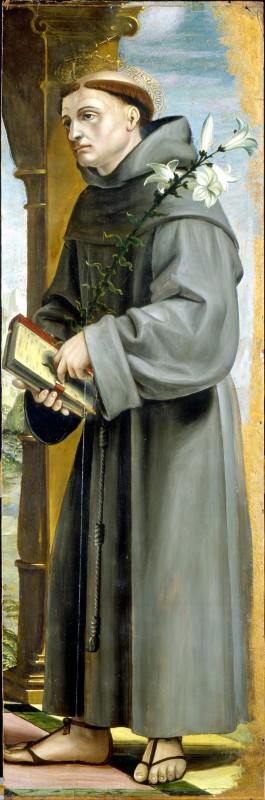
Bernardo Zenale: St. Anton of Padua, 1500-1510
St. Anton of Padua was born around 1195 in Lisbon into a pious noble family. His first name was Ferdinand. At the age of fifteen, he began to think seriously about the profession in which he would best serve God. To the joy of his parents, he decided to enter the Augustinian monastery near Lisbon. However, he did not find complete peace here, he was disturbed by the visits of relatives and friends. After about two years, with the consent of the superiors, he went to the monastery of St. Cross in Coimbra. He was probably ordained a priest there in 1219. A Franciscan monastery was established near Coimbra at that time. Ferdinand admired this order and desired to enter it, and thus strive even more for perfection. At first, his prior did not want to let him go, but after a while, he agreed. In 1220, Ferdinand put on the robes of St. Franziska and took the name Anton. Soon after, the superiors sent him on missions to Africa among the Saracens and to Morocco. However, Anton developed a severe fever that troubled him throughout the winter. When they heard about the performance, they ordered him to return home. However, the storm drove the ship to Sicily. There, Anton heard that St. Francis convenes on Pentecost r. 1221, all the brothers of his order went to Assisi. He made up his mind to go there. There was probably only one Portuguese among them. After the meeting ended, he reached the Roman province. Brother Gracián, the superior, sent him to the small monastery of St. Paul near Forli. There, he lived in a hermitage, doing menial jobs and living an austere life. He was happy that no one knew his origin or education.
But once, God’s providence intervened. When the bishop ordained new Dominican and Franciscan brothers as priests, he invited them to have one of them preach. No one wanted to, everyone argued. Finally, the superior of the monastery ordered Anton. He also resisted, but then, out of obedience, unprepared, he stepped onto the pulpit. Everyone was amazed to hear the fiery words of wisdom. Anton was then appointed as a teacher of future priests in the Franciscan order. He was appointed preacher in his province. He served in the pulpit for nine years and did much good for the salvation of souls. Not only that, but he had an excellent memory and talent. He completed his theological education. He spoke fluent French and Italian. In 1223, he became a professor of theology in Bologna and later in Toulouse, Montpellier, and Padua. Even as a professor, he remained a humble religious and did not miss prayer and meditation. He also led his students to this.
However, he did not stay at the department for longer. St. Francis ordered him to devote himself fully to the preaching office. Anton became a very well-known and sought-after preacher. Sometimes, he had up to thirty thousand listeners. At that time, he also preached in the squares or meadows.
In 1227, at the general chapter, he was appointed provincial of the entire territory of northern Italy. In 1230, he resigned and returned to Padua. There, in 1231, he continued preaching and writing sermons.
On June 13, 1231, he fainted unexpectedly. He felt that his last hour was approaching. He confessed and received the sacrament of the anointing of the sick. Then he sang the song O, gloriosa Domina (O, Glorious Lady), which he composed himself. Full of joy, looking at the sky, he said: “I see my Lord.” He prayed penitential psalms, and during this prayer, he died at the age of thirty-six. He was buried on June 17 in the Cathedral of Our Lady in Padua. Thanks to numerous miracles that began to happen at his grave, less than a year after his death, on May 30, 1232, Pope Gregory IX. declared a saint.
Reverence for him has spread greatly; few churches do not have his statue. It is traditionally invoked when searching for lost things.
Posted in Nezaradené
1 Comment