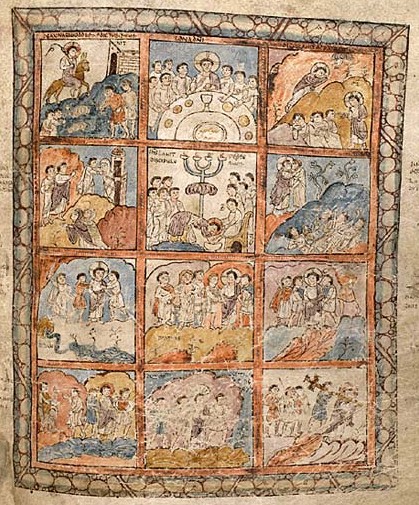
Jesus told his disciples that they should prepare a boat for him so that the crowd would not press him › Mk 3, 9.

The news about the healings in Capernaum attracted a large crowd – so large that people threatened to trample Jesus. Without newspapers, e-mails, telephones or television, the news about Jesus spreads to Tire and Sidon, eighty kilometers away in the north, to Idumea, a hundred and twenty kilometers away in the south. How could the news about Jesus spread so quickly? Suppose one person told another, another person, another person, and so on. It was almost as simple as that. And so powerful. When God acts, one is amazed. Imagine that you are there too: you have heard of the healing of the sick, of the revival of paralyzed limbs, of the disappearance of despair and despondency. You have already heard about so many healings that you finally dare to think that a miracle could happen to you too. Hunger and hope are born in you. Hearing about “small miracles” – the easing of hardships, unexpected kindnesses, a good night’s sleep after many sleepless nights – could have the same effect. A simple spoken word is powerful, and you can share this good news with others. Tell someone about what God has already done in your life, how he manifests himself in prayer, how he speaks to you in the sacred readings at Holy Mass, and what from all this still resonates in your heart. Maybe thanks to that, you will ignite a spark of hope or faith in someone. You don’t have to dramatize anything or say it to the whole crowd; it is enough if you simply and truthfully tell at least one person how God works in your life. Then leave room for the Holy Spirit, who will deepen faith in the person in question. You don’t even have to convince anyone. God can do this because his words and actions have power in themselves. The world hungers for God, whether consciously or unconsciously, and it is you who can show him how and where you have seen him act. However, if you think you have nothing to talk about, ask him to give you the opportunity today. Always watch carefully how God acts – by word, encouragement, healing.

Posted in Nezaradené | 2 Comments

Memorial of Saint Anthony, Abbot, Mk 3,1-6

Saint Anton the Hermit, also called the Abbot, came from a rich Christian family. He was born around 251/52 in North African Coma, Egypt. When he was 20 years old, both his parents died. Anton took care of the family property and the younger sister.

But that didn’t last long. When Anton once heard the words of the Gospel while visiting a church service: “If you want to be perfect, sell everything you have and give to the poor…” (Mt 19:21), he decided to accept this challenge from Jesus. He gave some property to religious women with the request that they take care of his sister, and gave away everything else. He began to lead a strict ascetic life in prayer, self-denial, and physical labor. At first, he lived near his hometown. Later, the desire for greater solitude led him to a rock cave in the Libyan desert and finally to the desolate mountains between the Nile River and the Red Sea.

Anton’s contemporaries, especially simple people, did not know such comforts as are taken for granted in our times. They lived simply and hard. How must the hermit Anton live, when his way of life caused general admiration and respect? In addition to voluntary hunger, thirst, and a stone bed, Anton endured the harsh desert climate with admirable contentment, and in such conditions, he worked, prayed, and pondered over the words he read in the Holy Scriptures. But that was not enough. For many years he was tormented by severe temptations. Biographers mention that the devil appeared to him in various animal and human forms. Sometimes he tempted him with enticing seductions, other times he tortured him so much that Anton was often completely beaten up.

It is certain that many extraordinary events mentioned in Anton’s old biographies have too much fantasy in them and belong rather to legends. But even these, in their way, help to better realize the historical fact that Saint Anthony the Hermit chose a very difficult path of following Christ, from which he was not led away by any seductions or threats or debilitating suffering.

Anton sought solitude, but he did not always manage to keep it. His admirable way of life did not remain a secret. He was sought out by the curious and people who asked for advice and help. Not only ordinary people came to him, but also monks, priests, and bishops, even Emperor Constantine the Great and his sons addressed him by letter. Since Anton also had a reputation as a miracle worker, many sick people came to him to achieve healing with his help. Several of the visitors decided to stay close to him and follow his way of life. That is why Anton is sometimes referred to as the founder of monastic life. However, he did not organize any monastic communities; only his younger contemporary Pachomius did that.

Despite his great desire for solitude, Anton did not despise human company. When there was a serious reason, he was willing to leave his heritage and go to help those who needed him. Thus, in the persecution under Emperor Maxi minus Daza (around 310), he set off on a long journey to Alexandria to strengthen the persecuted and imprisoned Christians there. Towards the end of his long life, he left solitude once again, at the request of the Alexandrian bishop St. Athanasius. He asked Anton to help him defend his true faith against the error of Arianism. It was already a very arduous journey for Anton, over a century old, but he went. When he returned, he felt that he was about to die. He warned his disciples of his impending death and ordered them to bury him in such a way that no one would know about the place of his grave.

Anton died at the advanced age of about 105 years. Biographies give the date of his death as January 17, 356. His grave remained unknown for a long time. It was only discovered during the reign of Emperor Justinian I in 561. At that time, his remains were transferred to Alexandria. Well, not for long. When the Muslims conquered Egypt, the remains of Saint Anthony were transported (in 635) to Constantinople. From there, around the year 1000, a large part of the remains reached France, where they have been kept in the church of St. since 1491. Julien in Arles.

St. Anthony Abbot had a surprisingly strong influence on his generation and subsequent periods. Under the influence of his example, thousands of Christians left their homes and chose a strict ascetic life. Even in the West, hermit communities were formed according to his model (Rome, Milan, …). St. Anthony himself did not establish any monastic institution and did not write any rules for his disciples. He was their living rule, which they strove to realize in their lives. What was later referred to as the rules of St. Anthony, was only a summary of advice and instructions, mostly taken from the biography of St. Anthony, written around 370 by St. Athanasius. After the saint’s remains were transferred to France, his veneration spread greatly in this country as well. A special knightly order of St. Anton and several fraternities for caring for the sick.

Anthony’s institutions, especially hospitals, had a good name and great privileges in France. Among them was the permission to raise pigs where other residents were not allowed to do so. From there, some derive the custom of depicting St. Anton Pustovník with a pig. Perhaps the veneration of this saint as the protector of domestic animals is related to this. Others explain the depiction of St. Anton with the pig so that it is an allusion to his temptations, during which the devil appeared to him in the form of animals. There is also a legend, according to which the defeated devil had to accompany the holy hermit in the form of a bravo as punishment.

Although these are mostly folk and legendary ideas, these also help – especially simple people – to understand the great spiritual power with which the great holy hermit Anthony surpassed everything that was animal and diabolical.

 
Posted in Nezaradené | Leave a comment

The contradiction between the spirit, the body.

From the moment we receive the Holy Spirit into our hearts, we can no longer live “after the flesh.”
Do you know the Holy Spirit? St. Paul still teaches, “Those who live as he wills the flesh, seek only the things of the flesh; but those who live as the flesh wills the Spirit, after spiritual things. The efforts of men of the flesh lead to death and the efforts of spiritual men to life and peace. Therefore, the strivings of carnal men stand at enmity with God, for they are not subject to the law of God, yea nor can they be. Those who live to their flesh cannot please, God. But you do not live after the flesh, but according to the Spirit, if indeed the Spirit dwells in you. God” (Am 8:5-9).
The habit of pitting the spirit against the flesh is an ancient one, though it is not always clear how this is to be understood. The origin of this language seems to be found in the Indian sages. In Greek Platonic philosophy, it was understood as a radical distinction between the material body and the immaterial soul, which was therefore considered spiritual. This implies the moral necessity to renounce material values, to reduce to the smallest degree the needs of the body, and to follow the path of asceticism. Exhortations (exhortations), taken from Greek literature, were often repeated by the Church Fathers. But we must be careful to understand their proper meaning in a Christian setting. The word “spirit” in the new meaning is reserved for the Holy Spirit, and only the person we can call “spiritual” in whom the Holy Spirit works Holy Spirit. Then the term “body” also takes on a new meaning. It does not only mean the material element of our person and therefore created by God as good.

 One spirit with the Lord’s “flesh” according to St. Paul refers to all centrifugal, sinful inclinations that oppose the work of the Holy Spirit both in the inner man and in the world. This resistance to the Spirit, a consequence of sin, is not only in the body but above all in the soul. Hence, we are not surprised at the statement of Origin, which says that the souls of sinners are “carnal” and that the first “carnal” is the devil himself, even though he has nobody. It is important to realize the meaning of this terminology to understand the texts of Scripture and the Fathers properly, and to avoid the misunderstanding that Christianity seems to be the enemy of the human body. On the contrary, even the body must participate in the ideal of “progressive virtualization” of the human person.

Posted in Nezaradené | Leave a comment

Invitation to get to know each other.

Many ask, “Teacher, where do you live?” they don’t ask because they don’t see the reason. But in every life, there will be situations with painful phenomena.

When I visited houses and apartments in the parish during the Christmas season to bless them, I had the opportunity, if only for a few minutes, to enter the personal zone of many parishioners. Few things give you such a picture of a person as their living situation.

It is not only a question of whether he is surrounded by expensive or inexpensive things, but what he surrounds himself with, whether he likes order, and how the various items in his home are arranged. This is how you get clues as to what is important to the person or family.

At the same time, you don’t just invite anyone into your home. We have many acquaintances and friends, but we meet them at work, at school, on the street or in the shop. At home, we welcome family and close friends. Inviting someone home is, in a sense, a marking out. As long as we “only” meet, we can claim anything about ourselves. In the abode, however, things and surroundings speak about us. It’s where others get to know who we are, what we like, or where our favorite corner is.

If I’m meeting someone and our communication or relationship shouldn’t be formal, I’ll invite them home or accept the invitation. Walking into a stranger’s home is an invitation to get to know each other better.

In a home environment where I feel comfortable, I don’t have to act macho, I can open up more and show who I am. We know this pattern well. Every marriage starts with dating together, then we get to know where the other person lives and their family, and at the end we decide to live our lives together under the same roof.

This rule, so well known in everyday life, is also present in the Gospel. At the beginning of his public appearances, Jesus is only just being recognized by many. So two potential disciples approach him and ask him a question: “Teacher, where do you live?” His direct answer is also an invitation: “Come and see.” Behind Jesus’ words is not a desire to satisfy their curiosity, but to bring them to know him. One can only desire what one knows, at least in part.

We are invited into his “dwelling place” to get to know him better.
When a person desires to know God, he is one of the lucky ones and is on the right path. Those who desire to know the Lord more and open their hearts to Him will be given opportunities for their desire to be gradually fulfilled. Our culture does not help people to mature into such a question, which is why many never even ask it.

To state that we are surrounded by a superficial commercial culture, overwhelmed by platitudes, is carrying wood into the forest. Many of us are aware of this. It’s so easy to drown in the endless entertainment of short videos, never-ending information, and notifications from our messengers.

Many wonder, “Teacher, where do you live?” they don’t ask because they don’t see the point. Inevitably, in every life, a situation will arise in which our existence is confronted with painful phenomena. We are not immune to setbacks, wrongs, frustrations, sickness, or death.

In such a moment, every human being seeks a clue. If he has even a germ of Christian faith in him, he intuitively seeks spirituality with its answers or God directly, to regather the shards of his own life in conversation with him.

It is good that this is so. Jesus’ redemptive mission is for all. God can find an original way for each person during his or her lifetime so that he or she cannot help but notice it. Only if everyone takes courage and has the goodwill to respond.

In any case, we are indeed called to a deeper touch with the transcendent, to open ourselves to the God who transcends us. We are invited into his “dwelling place” to get to know him better. He calls us because we are God’s children for whom he sacrificed himself, and he does not want us to trudge around the world like lonely runners with our limitations, but to find peace of mind and a fixed point, which for human beings is only him. The sooner we understand that, the better.

Posted in Nezaradené | Leave a comment

The journey to the land of faith.

Is God just a mirror image of our desire?

Critics claim that God did not create people in his image, but on the contrary – man creates a god in his image. Is it so?

Is God just a mirror image of our desire?

A thought once occurred to me: “Aren’t the images we create of God a mirror image of our dreams, desires, and anxieties?” Religious critics, such as philosopher Ludwig Feuerbach, that’s what they say. They are fundamentally suspicious of references to God. They say that God is just a figment of imagination, a wishful thinking of people.

To support this thesis, they argue as follows: because man cannot be good, he longs for God’s goodness. Because there is injustice here on earth, there arises a desire for heavenly justice, which will settle everything. Because we humans lack certainty, we dream of a saving “heavenly Father”.

Regarding this point, they claim: that God did not create people in his image, as it is written in the biblical account of creation, but on the contrary – man creates a god in his image. So to speak, he projects his desire for the heavens – like a projector projects an image on a wall. And then he prays to this projection and calls it “god”.

Reality versus illusion

Undeniably, all our images of God also contain projections. But is God himself an illusion? When you are hungry, your body sends a signal and you start thinking about food. Images of delicious food flash through your head. You dream about him. Your dream image is unrealistic. But is food, the food itself an illusion? After all, your hunger is clear evidence that there must be food somewhere.

There is a “hunger for God” all over the world. It is not possible to explain the phenomenon of religion otherwise. Where does the “hunger of people for God” come from in a thousand variants? Why have people of all eras, cultures, nations, and religions dreamed up to this day, in countless images and again and again, the dream of “God”?

You may have heard this phrase as a child: “Dreams are like foam.” A silly phrase that you should forget right away. Today, thanks to psychoanalysis, we know that dreams are the language of our soul. As a rule, what appears in dreams is what we suppress in the waking state or what we do not admit to ourselves at all. They often contain messages that we should listen to.

Food that satiates

God’s word is a signpost and a source of strength, healing, and critical commentary on what we do daily.

I read once about a woman who claimed to be an atheist and who turned to psychotherapists with the following question: “Can you please help me? I have been a convinced atheist for many years. I do not believe in god. My only problem is that I dream about him every night. Please explain it to me!”

I don’t know how the therapists responded. But could it not be that this woman’s recurring dream is related to her pushing God out of her life?

Could it not be that it is God himself who, in our longing for him, speaks to the word to remind us again?

Couldn’t the desire for God be the right impulse for the fact that God is here – an image of hunger for him?

God as a mirage?

What fills us up? What bread of life? The fact that we form false ideas about the Bread of Life is no reason to suspect it of being an illusion.

I would like to ask you not to prematurely suspect God of illusion. Because then something similar to those “modern people” who got lost in the desert can happen to you. Completely exhausted, they see an oasis in front of them. “Ah, a mirage,” they think, “a reflection of the air that wants to drive us crazy.” They are approaching the oasis. But she will not be lost.

They can see the date palms and the spring more and more clearly. “Of course, it’s a fantasy of hunger,” they say to themselves, “that shot our half-mad wits. Now we can even hear the water gurgling. An auditory hallucination!’

A little later, two Bedouins find them – but dead. “Do you understand it? Dates grow almost in front of their noses and they perished. They lay very close to the spring and died of thirst. How is that possible?” The other answer: “They were modern people.”

Posted in Nezaradené | Leave a comment

Meeting with a doctor.

It is not the healthy who need a doctor, but the sick. The Lord Jesus enters the environment of sinners in the role of a physician. This healing role is to become our lot as well. The Christian is to go boldly into the world to transform it, to sanctify it by his prayer, his work, his example, and his life. This entry of the Christian into the world has been defined by Christians as consecration, or the sanctification of the world. As the priest takes ordinary bread in his hands at Mass and, with words of consecration, transforms it into the body of Christ, so we too are to transform, to direct to God, all the things of this world that our vocation in life encounters. In this way, we can heal many human ills if people feel the presence of Christ in our presence. But the problem of Christ as a physician has yet another aspect that should interest us. Perhaps we like to take on the role of physician of other people’s sins. But who do we consider ourselves to be? As righteous and perfectly healthy? We often encounter Christ at Mass, for example, where he offers himself for the sick. We encounter Jesus through his word and sacrament. Do we think of him as a physician in these encounters? Or rather as a reward for our righteousness? It might be better not to overdo it with our righteousness. It is certainly better to turn to Christ than to a doctor. Not a few sicknesses have hidden in our souls, various paralyzes, deformities. We may not be hurt by anything, but we are not hurting others. Perhaps one of us is a wound on the organism of the community. Either way, we always need some healing, because there are no people one hundred percent healthy. But the first condition of healing is to acknowledge that we are sick. As we see the Pharisees reject the Lord Jesus, but the humble tax collectors who consider themselves sinners are justified in his sight.

Posted in Nezaradené | Leave a comment

Second Sunday in Ordinary Time Year B

Let’s pay attention to the encounter with Jesus.

Have you already thought about whether to bring your children to church? When? From which year? Alternatively, how to enable teenagers or adults to have a first, perhaps deeper contact with Jesus?
There are certainly many paths to God, faith, or fulfilling the duties of a Catholic Christian.
Today’s Gospel describes only one of them. It is the most frequent and closest path, close to our circumstances, which reveals a new perspective on life, its content, mission, and goal. God does not stand at the beginning of this journey, we do not hear the voice of God, we do not long for God, and often people are indifferent or even hostile towards him. At the beginning of the journey is a person.

In today’s Gospel, it is John the Baptist who, when he was standing with two of his disciples and saw Jesus walking by, said: “Behold, the Lamb of God. The two disciples heard what he said and followed Jesus.” (Jn 1:35)

Evangelist St. John describes one way man can find God. Someone sends him, shows him an example of life, a person hears about something that is connected with God, or he in a certain life situation seeking him out. And also the first meeting at the beginning is understood by a person as a coincidence, something unexpected and unforeseen, and it becomes the beginning of a new life.
One can talk about the mystery of the Christian vocation. Understanding the meaning of this mystery and trying to realize it in our lives is our task as Christians, and this event of the Gospel wants to tell us a lot.
At the beginning of the new liturgical season, which we call the Yearlong Season and is the longest of all, and which begins with the baptism of the Lord Jesus, then we follow his public life for three years when he teaches the multitude, we must realize the need and importance of our contact and commitment to Jesus.
John the Baptist is the one who becomes a kind of bridge through which the first disciples come to Jesus. The event took place shortly after the baptism of the Lord Jesus when he came again to the Jordan. Jesus begins public activity. The era of the Old Testament, the preparation for the coming of the Messiah, is ending. Jesus does not call his first disciples himself, but John the Baptist sends them to him when, in the presence of two disciples, he says about Jesus: “Behold, the Lamb of God.” (Jn 1:35) One is Andrew and the other is deliberately not mentioned by name, but it is certain St. himself John the apostle, who writes about it in the Gospel, must have been so impressed by this meeting with Jesus that he remembers it well even years later, that “it was about four o’clock in the afternoon.” (Jn 1:39) Following Jesus does not mean to be called. Andrew and John will be called apostles by Jesus later. This will happen on the shore of the Sea of ​​Galilee (cf. Mt 4:18-22).
Even the first meeting in the life of their faith does not remain without an answer. It can be seen in the example of Ondrej. Sv. John the Apostle mentions Andrew’s name three times in the Gospel always in connection with the fact that he shares his faith with someone. First, after the first meeting with Jesus, he “looked for his brother Simon and said to him: “We have found the Messiah” (Jn 1:41), secondly during the multiplication of loaves and fishes, Andrew said to Jesus: “There is a boy who has five barley loaves and two fish” (Jn 6:9), and we know that it was enough and Jesus fed the large crowd. In the third mention of Andrew in his Gospel, John tells how Andrew brings the Greeks to Jesus (cf. John 12:22).
When Ján writes about the fact that at the first meeting, “they stayed with him that day”, it is the beginning of everything he experienced, got to know Jesus, and also the whole of his next life. There is a seed that was sown then and that will grow into a tree in the very life of St. John.
The beginning of the Church can also be traced back to this event.

What can we observe in the history of the Church? Even though at the beginning God addresses exceptionally directly, as in the case of St. Paul at the gate of Damascus (cf. Acts 9:3), yet even then God uses other people to complete the process of calling and strengthening in faith on his behalf. God takes the first step to faith in God in each person in different ways. Most often, in our conditions after birth, it is parents, godparents, family, and parish, but then each person must express himself, and prove his faith. In everyone’s life, there are moments of decisions, struggles, victories, and defeats. Because we are created as a rational and free being, even God respects our decisions. Often, however, God seems to be waiting, waiting for our consent to live with him. Many after wandering and searching as St. Augustin, St. Margita Kortonská, Frossárd, and others find their way to God. Many people, whom God puts in their way, play an important role in their lives as well. However, it is mainly the grace of God that God gives and it depends only on the person when and how much he accepts it.

We all have our history of faith, discovery, and finding our way to Jesus. We realize that we also must show others the way to God. It is not only the parents and those closest to the child. Priest to parish, but brother to brother and sister to sister. Our faith, example, and life can be used by God so that others find the way to God. In the beginning, it can be just curiosity, and desire, and finally, it will grow into enthusiasm, and admiration of God in life.

Helena Mišovičová was a pioneer and member of the Society of Jehovah’s Witnesses. After eight years of full-time work in this company, the example of a believing Christian woman, a neighbor in the boarding house, helped her to look at her life from a different perspective. She, for 90 hours a month with enthusiasm, no one forced her, only influenced her, performed the service of Jehovah’s servant. At least three times a week, she participated in Kingdom Halls, where she devoted herself to the study of the Watchtower magazine, where she prepared and trained for different reactions and attitudes of people in the preaching service. She informed me about her activities, showed her activities: where, when, whom she visited, how she was received, whether she recommends visiting them again… She heard from older leaders that she should be happy when she has to suffer for her beliefs.
With her neighbor, she realized that she lives in fear. The teaching is based on psychological blackmail that on the day of Armageddon she will be expelled from the earthly paradise with other unbelievers. She began to realize that her surroundings were changing. At meetings, although they smile at each other, it is still not quite true. They too are just weak people. After all, there is a difference when a person himself acknowledges his guilt, repents of it, and confesses it, as Jesus teaches, unlike them, where one pays attention to the other, they watch each other and then report it to the Council of Elders.
“When I began to realize the logic and contradictions in the teachings, the doubts and they did not help me explain them, nor humanly refute them, they suggested a psychiatrist. I became possessed in their eyes. I realized that their “Faithful and Discreet Slave” is not led by the Spirit of God, because he would not commit so many errors and illegalities that are contained in their publications. I wanted to explain things, and they stupidly excluded me. They know that those who do not have support elsewhere among the people, and there are many such among the witnesses because they have been away from people for years, will beg to be accepted back. They told everyone not to meet me. They forbade me to greet them. They even forbid my daughter and son and their families, who are also witnesses, to have contact with me.
Today I know what peace of mind is, who Jesus is, that his teaching is the teaching of love, and that he gives strength and hope to the weak. I opened myself to the Holy Spirit and I know what it means to live without sin. I am a child of God and I no longer need a “Faithful and discreet slave”. Jesus assured me of eternal life.

The Church teaches that faith is also born from a personal encounter with Jesus. We can talk about the gift of faith, about the call to faith. It can be said that at a certain moment, in a certain place, a person experienced his faith, met God, and got to know God and that changed his life. But even those strong experiences and knowledge of God must be developed further. Prayer, sacramental life, participation in St. masses, and others are irreplaceable. Yes, I can meet God even outside the church. I can also pray in nature, but a church is simply a church. The experience of the Church, as well as ours, is proof of this. I can repent of my sins and gain friendship with God, but the sacrament of reconciliation is a gift where a priest authorized by God, not by his power, confirms that my sins are forgiven.
John the Baptist simply said: “Behold the Lamb of God,” (John 1:35) and the two disciples did not leave him but continued what he had started. He was the voice calling in the wilderness and they became disciples of the Jesus announced by him. These two are among the Twelve whom Jesus will send into the whole world to teach and baptize all people. Today, God also addresses us through us to each other, so that we continue in our time, today, in the activity of St. John and said to themselves and others: “Behold, the Lamb of God.” (Jn 1:35)

It is right for parents, according to their best judgment, to start teaching their children about God and to lead them to God. Perhaps start with St. Masses during the summer and on working days. When they have already adequately explained to them what the church is they already know some prayers. Don’t wait until they are 18 and then let them decide for themselves. For example: Don’t parents decide about the health of their bodies when they are young? About their profession? And so on.
And it is also right when an older man knows how to hold a younger man, a boy, even though they are not family. An example is a role model, we do not want to underestimate our Christian behavior. Today’s Gospel also leads us to this.

Posted in sermons | Leave a comment

Providence.

Prudence, or discernment, prudence, which is the first prerequisite for spiritual and moral growth, is the quality of understanding the nature of things, situations, events, and plans as a whole, and about its parts or aspects, and to act accordingly. Specifically, it consists of a trained, refined, and alert rational control of human activity on all levels of life – spiritual, moral, political, economic, scientific, etc. The sphere of action of this virtue is thus concrete life and its ever-new problems.
As such, it was already recognized by the ancient Greek philosophers, who called it ‘knowledge of knowledge’ (Plato), the fundamental principle of morality, the “yardstick” or measure of human action (Socrates), and the indispensable prerequisite of all virtues. Plato, in his Politeia, regarded prudence as the professional virtue of philosophical kings, and or rulers of the state, who must, like every politician or public official, be philosophers.
Aristotle understands sagacity as the summit of the dianoetic, intellectual virtues (Nicomachean Ethics, 6, 5), and the Stoics speak of it as a mediator between the divine world order and the human sphere. They regarded her as the presupposition and guardian of all virtues. Especially thanks to Aristotle, who can be considered a theorist of prudence and all virtues in general, the ancients and after them Christian philosophers that the danger of corruption of moral action, and step by step also of the moral life, threatens a man if, for lack of foresight, he moves away from the center in which virtue is always found. As we have already indicated, if a virtuous act is driven to one side or the other from the center, virtue is transformed into vice.
In the recent past, many people around us, both educated and less educated, have confused tolerance, forbearance, caution, or the virtue of prudence and prudence with cowardice. Others have deliberately lied and called it permissible and justified self-defense. And nearly all stole where they could, and flattered their consciences that it was just compensation. But let’s leave the past behind and look back around us to see what we can learn from the examples of everyday life to see as accurately as possible what this virtue is all about, for here we decide the whole moral life.
Providence
Everyone knows how many children, pupils, and subordinates suffer when parents, teachers, or superiors think that their strictness, intransigence, and perseverance are the fruit of the virtue of fortitude – even though it is often rather a manifestation of unyielding hardness, stubbornness, intransigence, obstinacy, even fanaticism. To the sternness of a boss or father or teacher who demands order, justice, punctuality, responsibility, and consistency, people get used to it over time and only the foolish and lazy continue to reject them. To a hard, harsh, rude person, ruthless, however, no one has a good word, not even when it comes to his just demands. The same can be said of people who confuse the virtue of orderliness with pedantry, querulousness, arbitrariness, etc.
Among the most antipathetic social phenomena are undoubtedly ambition, egoism, egocentrism, arrogance, laziness, recklessness, falsity, envy, contempt for others, etc. In conversation with people who are preoccupied with these vices, it comes out that an arrogant person smugly considers himself a gentleman, who supposedly has pride and a sense of honor and is therefore perfectly “o.k.”. The lazy excuse is that everything must be done with calm and in moderation and that everything has its time – and it doesn’t even cross their minds, that others are paying the price for their carelessness, convenience, and forgetfulness. Reckless people will never admit fault but will declare that they are among those who go firmly to their goal and realize the values that the “dullards who can’t see further than their noses” envy.
False people will find an acceptable explanation for their attitude to their surroundings. They are said to have a right to privacy, to their lifestyle, and their personal affairs; and yet they don’t mind at all that
it’s misleading people. And who doesn’t know those zealots for all that is “holy and good” – people are envious! How inventive this vice is, and how often it cloaks itself under the cloak of virtue! The envious man is incapable of calm reflection, enjoyment, or even sleep. He is everywhere haunted by visions of people who he thinks are more fortunate or more successful than he. Day and night he forges plans to “tear off their masks” and show the whole world what they are …what monsters they are. His speeches are at times full of sanctimony, at others of prophetic pathos and zeal for justice. The only thing he is incapable of recognizing is that his apparent zeal is not the fruit of virtue but of vice – envy.

Posted in Nezaradené | Leave a comment

What will come next? Does the Vatican have a prison? Can the Pope grant a pardon?

Which court will deal with the case of financial machinations next? Where would Cardinal Becciu go to sit if the verdict is confirmed?

“I want to shout to the world that I am innocent through the legal authorities and by all means,” Cardinal Angelo Becciu declared in mid-December after the first instance court in the Vatican sent him to prison for five and a half years.

In the Cinque Minuti show on Rai 1 television, the 75-year-old cardinal was asked by the moderator whether the Pope believes in his innocence: “I believe and I hope so. And in any case, I will work to do it,” added Becciu.

He appealed the verdict, and according to assumptions, the other eight co-defendants, who were found guilty by the Vatican City State Tribunal in a historic trial, mostly of economic crimes.

The court process is also groundbreaking in that for the first time the cardinal was convicted by lay judges. However, after the December judgment, several questions arose, which are also related to the specific system of the Vatican.

American Vaticanist John Allen Jr. after the verdict, summarized what the next procedure should look like.

The parties involved had only three days, including Sunday (which is a bit bizarre considering the Vatican) to file an appeal.

The appeal of Cardinal Becciu and the others will likely be heard by the Court of Appeal for the Vatican City State, which is made up of six judges – three clerics and three laymen. The chairman is the Spanish Archbishop Alejandro Arellano Cedillo, while the promoter of justice, i.e., the prosecutor, is the Italian lay lawyer Raffaele Coppola.

If the appeals court comes to different conclusions than the first-instance verdict, it is possible that the “supreme court” of the Vatican, known as the Court of Cassation of the Vatican City State, will also be asked for a decision.

It is currently headed by the American Cardinal Kevin Farrell and its members include Italian Cardinals Matteo Zuppi from Bologna, Paolo Lojudice from Siena, and Mauro Gambetti, Vicar General of the Vatican City State, along with two lay law

The Italian Vaticanist Andrea Gagliarducci points out that the second-degree proceedings in the Vatican are mainly of a documentary nature, the discussion itself is very small. “Since these are financial crimes, the last instance could be the European Court of Auditors in Luxembourg,” thinks the journalist ACI Stampa.

How does the Vatican want to enforce financial penalties? A rather interesting area concerns the intention of the Vatican Court, which as part of the judgment also ordered the confiscation of the assets of the defendants for about 180 million dollars and the payment of compensation for about 220 million dollars.

“If the Vatican wants to get its hands on some of this money, it will probably have to request that its verdicts be recognized by other states where these funds are deposited, such as Switzerland and the United Kingdom,” writes John Allen.

When it comes to applications to other courts, the Vatican tribunal’s record is varied.

In January 2022, a Swiss court rejected financier and defendant Raffaele Mincione’s appeal to unfreeze approximately $70 million worth of assets that had been frozen in 2021 at the request of the Vatican. At the same time, the court rejected Mincione’s claim that he did not receive a fair trial in the Vatican.

However, the Vatican was negative in the courts in Britain, reminds Allen.#In March 2021, a judge at Southwark Crown Court lifted the seizure of the assets of Italian financier and co-defendant Gianluigi Torzi, criticizing the Vatican’s submissions. In addition, proceedings are still ongoing in London on a claim for damage to reputation, filed by the aforementioned Raffaele Mincione against the Vatican Secretariat of State. In this case, a delicate issue arose – the British court granted Mincione’s request for access to confidential messages and e-mails between Cardinal Pietro Parolin and Venezuelan Archbishop Edgar Peña Parra, the two highest officials of the Secretariat of State.

By the way, the problem may not be only with the enforcement of the financial part of the punishment. As the AP noted, some of the defendants in the Vatican trial are located abroad, including one of the main characters of the trial, the financier Torzi. It is questionable how and whether other countries will extradite defendants to serve their possible sentences.

Will the cardinal sit behind bars? Even in the case of a valid conviction, Cardinal Becciu (and others) do not have to go to prison. From the recent past, we know of cases where the convicted did not finally start serving their sentence – thanks to the granted pardon.

In 2012, the former chamberlain of Benedict XVI was sentenced to 18 months in prison. Paolo Gabriele was the central figure in the Vatileaks I case. It was related to the publication of confidential documents that Gabriele brought out of the papal office. Benedict XVI, however, decided to pardon him.

The sentence of the same amount was also given to the Spanish priest Lucio Ángel Vallejo Baldo, who was convicted in 2016 in the Vatileaks II case. In this case, too, it was a question of bringing out confidential documents, which were subsequently published in their books by journalists Gianluigi Nuzzi and Emiliano Fittipaldi. Pope Francis, however, is just like Benedict XVI. decided to grant a pardon.

Two bestsellers show why Pope Francis’ financial reforms were so necessary.

Does the Vatican have its prison?

There is no classical prison in the Vatican. Based on the Lateran Agreements, which were concluded between Italy and the Holy See in 1929, persons convicted in the Vatican can be sent to serve their sentences in one of the Italian prisons.

However, the barracks of the Vatican gendarmerie have several rooms used as pre-trial detention cells – with reinforced steel bars and doors, according to Reuters.

In addition to the butler Gabriele, the former archbishop and apostolic nuncio in the Dominican Republic, Józef Wesołowski, who was accused of using child prostitution and possessing child pornography, also spent several months there. He died before the trial began in 2015.

Much more often than prominent guests, petty pickpockets or vandals detained on the territory of the Vatican find themselves in these cells. They are then handed over to the Italian police or directly expelled from the country.

Who are the Vatican judges and how much do they earn? Let’s stop at the judges, which is also specific in the case of the Vatican. On December 4, 2023, just before the conclusion of the historic process, Pope Francis issued a motu proprio concerning the labor law matters of judges and prosecutors in the Vatican City State.

The ACI stamp approximates that Vatican judges and promoters of justice (prosecutors) work at the tribunal only part-time, despite the Council of Europe’s requirement that at least one of the members of the tribunal and promoters work full-time, i.e. fully devote themselves to the Vatican system. However, there is a kind of hybrid situation in the Vatican tribunal, where promoters of justice also work as lawyers in Italy, with former prosecutors turned judges in the Vatican.

The new motu proprio also deals with salaries and pensions.

The president of the tribunal and the promoter of justice have a monthly salary of 3,649.50 euros. The deputy president of the tribunal is entitled to 3,138.57 euros per month, while ordinary judges and members of the office of the promoter of justice are entitled to 2,919.60 euros per month.

“In practice, it does not matter that judges may have other jobs, the Vatican always considers them full-time judges, and therefore they are always guaranteed severance pay and a pension,” states Vaticanist Gagliarducci, adding that judges’ pensions are calculated at 80 percent of their last salary and is paid if the person has worked for at least 15 years.

Posted in Nezaradené | Leave a comment

Sent to be a saint Your mission?

 Saint. A prophet. Vessel of the Spirit, the mouth of God, the hand of Christ. And every single day that you contradict that brings harm, pain, suffering,… death. To others. To you. And no, it’s not conceit! For this is God’s plan for every single person, this is what is normal! Don’t waste your time wondering what people somewhere far away should be doing. Do what you have to do yourself, here and now – and leave the rest to the Lord! Thou shalt be holy, here and now – and it is up to God to be glorified through you in the way He wills and fits into His Great Plan, in which you are but one particle, one moment of it. Here and now. Here is the place. Now is the time – to be holy. Here and now is where the struggle for holiness is waged, just here. Here is God, here is Home, here is that place. Be here, be perfect now, be holy right here and in this. Here, the whole and all of the world is present. Here is Reality, the Universe itself, Heaven, everything. Discover it, see it! Learn not to run away. Learn to live here – and you will find a wide, spacious house, a world! It is a world in a nutshell, all in a Cinderella nut! Evil cannot be overcome by evil, only by sound. Sin cannot be removed by sin, only by holiness. Being holy, here and now, is the most critical thing in the world. The only thing that matters. And God Himself is there, present and acting. Just be holy, rely on Him alone, and expect everything from Him alone! To act with all our heart, but to predict the result to be small or none, as it would be if it were only a matter of our slight deed, but great and glorious.

Posted in Nezaradené | Leave a comment