
Peace is that precious gift from God.


We live in troubled times. There are many wars in the world. Pope Francis said that we are already in a fragmented third world war. Pope Leo XIV also consistently calls for weapons to fall silent and for warring parties to begin negotiating and agree on a peace.

Questions to think about: Do I have peace in my heart, soul, and conscience? What brings peace to my life? What worries me in life? Am I a peace spreader? Even in today’s troubled world, God invites us to draw on his peace through an active and deep spiritual life, prayer, and the Eucharist. Illustration image: Man and Faith/Martina Rehorová

Peace is a precious gift from God that begins in the human heart. Before the first people fell into sin, they lived in peace with God, themselves, and others. This is because God is the creator of peace. It was only when original sin entered a person’s life, bringing with it expulsion from paradise, that restlessness took hold, because an evil spirit is the creator of restlessness.

The prophet Isaiah offers excellent advice on achieving peace of heart: ‘This is what the Lord, your Redeemer, the Holy One of Israel, says: “I am the Lord your God; I will teach you what is best for you and lead you along the right path. If you had observed my orders, your peace would be like a river and your well-being like sea waves’ (Isaiah 48:17–18).

If we want peace in our hearts, souls, and consciences, we must observe God’s commandments – the Ten Commandments or the commandment to love God and neighbour. When we do not observe them and commit sins, we experience restlessness and remorse. It is often as simple as that, but challenging at the same time.

CHRIST, OUR PEACE

Lord Jesus Christ, ‘miracle Counsellor, mighty God, eternal Father, Prince of Peace’ (Isaiah 9:5), restored God’s peace to us. When he was born on Christmas night in Bethlehem, the angels joyfully announced to the shepherds: ‘Glory to God in the highest, and on earth peace to people of good will!’ (Lk 2:14). As the apostle Paul writes in his Letter to the Ephesians: ‘For he himself is our peace!’ (Ephesians 2:14).

Indeed, Jesus Christ is the peace of humanity and the whole world. For every single human heart. After his glorious resurrection, when he appeared to the eleven apostles in the upper room, he greeted them with the words: ‘Peace be with you!’ (Jn 20:19). He left us this peace at the Last Supper: ‘I leave you peace; I give you my peace.’ But I do not give as the world gives. Do not let your hearts be troubled or afraid“ (Jn 14:27).

Therefore, peace is Christ’s gift to all humanity. In his speech on the Mount of the Beatitudes, he himself invited us to spread his peace: ‘Blessed are the peacemakers, for they will be called children of God’ (Matthew 5:9). In the Letter to the Romans, the apostle Paul also encourages us to seek peace: ‘If it is possible, and it depends on you, live in peace with all people’ (Rom 12:18).

BE AN INSTRUMENT OF PEACE
Even in today’s troubled world, God invites us to draw on his peace by leading an active and deep spiritual life through prayer, attending Mass, receiving the Eucharist, reading God’s word, and performing acts of love and mercy.

He calls on us to be peaceful. May we spread peace, so that the peace of Christ may reign in our hearts, in our interpersonal relationships, marriages and families, in our parishes, villages and cities, in our societies and countries, and throughout the world.

Let us pray to St Francis of Assisi (1181–1226) for peace and tranquillity in our hearts and around the world: ‘Lord, make me an instrument of your peace, to bring love where there is hatred, forgiveness where there are insults, and unity where there is discord. Let me bring truth to those who wander, faith to those who doubt, hope to those who despair, light to those who grope in darkness and joy to those who mourn. May I try to please others rather than myself, understand others rather than myself, and love others rather than myself. For it is only by giving that we acquire; only by forgetting ourselves that we find ourselves; only by forgiving that we receive forgiveness; only by dying to ourselves that we rise to a new life. Amen.’

Posted in Nezaradené | Leave a comment

Twenty-eighth Sunday in Ordinary Time,Year C Lk 17,11-19

Gratitude… We had an American theology student in Rome. He was an older man who had decided to become a priest relatively late in life. It took some time, but eventually he told me how he came to become a priest. He had been the director of a retirement home in San Francisco and had been deeply moved by the lives of the older people there. He wanted to become a priest and work in a similar facility. ‘You can’t imagine,’ he told me, ‘how abandoned elderly people are today.’ Materially, they lack nothing. They have comprehensive medical care and all the comforts of old age. But that’s all! Their own children rarely visit them. Instead, they usually send recorded Christmas greetings, with the son or daughter wishing them all the best and the grandchildren reciting or singing a Christmas carol.

The old man loses his composure repeatedly, remembering and becoming saddened. He has forgotten. When we say that gratitude has disappeared in today’s world, we are certainly exaggerating because it has always been a forgotten virtue. Therefore, the modern world does not offer many opportunities to demonstrate it. In collections of examples for old preachers, there used to be instructive fairy tales about how God arranged a feast and invited all the virtues to it. They had a great time together. However, at the end of the table, two ladies sat alone, apparently not knowing each other. The gentle host, God, hurried over to introduce them to each other. He bowed to one and said, ‘This is Mrs Charity!’ Then he bowed again: ‘This is Mrs Gratitude!’ The two ladies smiled kindly at each other and shook hands. They had longed to meet each other for so long, yet since the beginning of time, they had never crossed paths. As befits a sermon example, the fairy tale is moralising in nature. However, this has the disadvantage that people sigh sadly when they talk to her: ‘Unfortunately, that’s how it is!’ However, no concrete conclusions can be drawn from such teachings. More concrete was the decision of the older man’s director to become a priest for the elderly and abandoned.

Similarly, one of my religious brothers in Belgium dealt with the situation effectively. He was a professor and stopped teaching after his 65^(th) birthday. Then he moved into the house of an elderly man. It wasn’t because he had to. He belonged to a religious community and had brothers. However, he realised that it might still be necessary for many people here, especially those whom society deems unnecessary. Ingratitude has deep psychological roots. In the so-called consumer society, the value of everything is measured in terms of what is needed. Unnecessary items are a greater concern today than ever before. In small flats, even an old box or a piece of wrapping paper can get in the way. Anyone who doesn’t go along with the crowd gets stuck in the hustle and bustle of the street. Similarly, people who have time on their hands and want to discuss the weather and lower back pain can get on others’ nerves. Sadly, grandparents, who were once so necessary, are now considered a nuisance because they are no longer needed. What can be done about this?

Everyone knows that this issue must be addressed in a humane manner. But including them in one’s life seems out of the question. If it is difficult with parents, then all other relationships motivated solely by gratitude for something received in the past must be excluded. However, we do not merely intend to analyse the facts. We can see where things are headed and what the general trend is. We therefore ask how we should respond. What must we realise, and which ideas must we reinforce, so that we do not passively give in to the trend? What exactly is gratitude? Mutual contact fosters a closer relationship with others. A woman becomes a mother by giving birth to a child and caring for it throughout its life. A child is a child in the truest sense of the word when they accept this and realise that it has created an inseparable bond with their mother. When a woman renounces a child, she hurts her own sense of motherhood. Children who do not contact their parents have denied their family.

Ingratitude is the atomisation of society. A living organism disintegrates into individual cells. Ungrateful people assume that they can take from society without giving anything in return. This is a dangerous state of affairs. Ancient Indian monks vowed not to accept gifts. This may seem strange to us, but they were thinking logically. They tried to be completely alone and have a gentle heart. Anyone who receives a gift has two options: they either feel bound to the giver and lose their independence, or they accept the gift and commit to nothing. In the latter case, however, their heart become hardened and they cannot find happiness in solitude. Christians do not desire such loneliness. It would not be human. To develop as a person, a human being must always receive from others. However, they remain committed to others. Does that not make them slaves to others? In our society, many honest people, especially those in leadership positions, are reluctant to accept gifts. They know that receiving a gift would mean committing themselves to something, and that their hands would then be tied. How do we find the right balance? Christianity helps us to address this practical problem by elevating it to a higher level.

We accept a great deal from people — everything that life has to offer. However, we also recognise that all of this comes from the hands of the Father in heaven, the source of all good things. First, gratitude is due to God. Accordingly, we are indebted to him, and, in accordance with his will, we give back to people what we have received. Experience confirms that it is only those who recognise day by day what they owe to God who can be grateful to others.  This is why they are always looking for an opportunity to express their gratitude for God’s gifts. They can even do good for a stranger and recognise that it is their duty. Conversely, those who are not grateful to God may even forget their own parents. They convince themselves that they have done their duty by sending a Christmas postcard. In today’s atomised society, it isn’t easy to be grateful to individuals. After all, people serve each other either for money or out of a sense of duty. It isn’t easy to be personal when waiting in a long queue to be served. Only a firm awareness that God is the personal giver of everything we receive can breathe life back into these disintegrating human relationships.

Posted in sermons | 1 Comment

St. John Leonardi.


9 October, commemoration
Position: priest
Died: 1609
Patron saint of: pharmacists and catechists
BIOGRAPHY:

He came from Tuscany. He was a pharmacist first and a priest from around the age of 30. In addition to founding the lay society of Christian doctrine, he established the religious society of clerics of the Mother of God. In Rome, he supported the establishment of hospitals and schools. Pope Clement VIII entrusted him with visiting many religious congregations and contributing to their spiritual renewal. He established a missionary training college which later became the Papal Institute for the Propagation of the Faith. He died in Rome at the age of 68.

SPREADING FAITH – A TASK FOR EVERY CHRISTIAN
He was born in 1541 in Diecimo, a commune near Lucca in northern Italy. He was raised in a Christian family, led a devout life, and chose a career in pharmacy. At the same time, he began to devote himself to lay apostolic activity, forming a fraternal community called the Columbines with a group of friends led by a Dominican priest. This community aimed to lead a more devout Christian life and provide assistance to the poor and pilgrims. He then began to consider religious life, but was unsuccessful with the Lesser Brothers. At the age of 26, his search turned into a vocation to the priesthood, recommended by his confessor.

John studied theology and was ordained a priest in 1571. Focusing on teaching religion according to the Council of Trent’s guidelines, he acted as catechist in all the temples of Lucca by the authority of the bishop. His manual for catechists went through multiple editions. He encouraged lay people to spread and consolidate doctrine by creating a ‘Society of Christian Doctrine’.

He also set a good example to fellow priests, and in 1574, he founded the ‘Brotherhood of Reformed Priests of the Blessed Virgin’, which was later renamed the ‘Regular Clerics of the Mother of God’. He obtained ecclesiastical approval for his brotherhood and was elected its chief superior.

However, the city lords disliked the zeal of the priestly reformer. They described him as a violator of public order who did not respect them, and issued a decree ordering his permanent expulsion from the city, with severe punishments to be inflicted if he tried to return.

Leonardi left his apostolate to continue to Rome. There, he received the support of Cardinal Baronies and Philip Neri, as well as the help of the Oratorians.

His activities did not escape papal attention, and due to his zeal and abilities, he was entrusted with various tasks, particularly those related to reforming declining religious societies.

In 1601, he opened the house of his priestly association in Rome, contributing to the city’s spiritual renewal through this activity. Priests who followed his instructions spread reverence for the Eucharist and encouraged frequent reception of Holy Communion.

John cared for non-Christians too, and together with the Spaniard G. B. Vives, he planned to establish a society of priests to spread Christianity among non-believers. In 1603, they established an organisation that evolved into the Urban College for the Propagation of the Faith, which later became the papal institute ‘de Propaganda Fide’.

Following his death in October 1609, John Leonardi was initially buried in the church of Santa Maria in Portico. In 1662, his remains were transferred to Santa Maria in Campitelli, the main seat of the religious society he had founded. Pope Pius IX canonised him in 1861. In 1861, John Leonardi was declared blessed, and in 1938, he was canonised by Pope Pius XI.

RESOLUTION, PRAYER

Today, I will focus my contemplation on the call to evangelisation, to understand what God expects of me in this area.
God, giver of all good, you awakened in Saint John a living desire to carry your gospel to all nations. At his intercession, let life grow by faith everywhere in the world through your Son, Jesus Christ, our Lord, who lives and reigns with you in the unity of the Holy Spirit, now and forever.

Posted in Nezaradené | Leave a comment

Jonah’s sermon.

Jonah’s sermon was a great success, and the people of Nineveh were converted. However, rather than rejoicing, Jonah mourned it. He had preached destruction to Nineveh. If his words did not come true, God’s honour would also be wronged. He did not want to be seen as a liar by these Gentiles for the glory of God. The Lord changed his plan and everything happened the opposite of what Jonah had predicted. This was terrible for his soul, and he desired nothing more than to die.

He was angry with the Lord, but he did not want to give up on him. He prayed to him, but it was difficult to pray well in such a state of mind. Suddenly, the West seems the right way to him, and he feels he was wrong to repent. We often want to take back things we bitterly regret later. God sees that this is only a temporary crisis, in which the remnants of anger and darkness are manifested, but behind this bitterness lies a sincere heart. God is trying to calm Jonah down: ‘Don’t be afraid that they will consider you a liar. I saw their deeds; they turned away from their evil ways; therefore, I forgive them.’

When God asked Jonah if he was angry for the right reasons, Jonah remained silent. He leaves the conversation with God and goes outside the city to build a booth. He was convinced that he was right and that God would eventually recognise this truth. God will have to change his mind, not him. From his booth, Jonah wants to observe God’s terrible judgments. He waits for his prophecies to be fulfilled.

God uses a minor miracle to teach Jonah a lesson. To prevent Jonah from suffering in the sun, God hastily grows a shading plant, which pleases Jonah. However, the next day, the plant withers just as quickly, which makes Jonah sad and upset. God says to him: ‘You can grieve because one plant has dried up, but I shouldn’t be sorry for the death of thousands of people?’ Today, many people call God’s punishments upon the world in the form of thunder and lightning, yet nothing happens to them. How far is that from ‘love your neighbour as yourself’?

Posted in Nezaradené | Leave a comment

Reath of Roses .

 We have entered the Marian month of October, which is dedicated to the Virgin Mary – Queen of the Holy Rosary. Autumn has already arrived. In nature, roses bloom, and in the church, roses bloom the most in October—white roses – joyful, red roses – sorrowful, golden roses – festive. We wind them into a wreath, which we call a rosary. It is our aid in spiritual life. The Rosary is a book that captures the lives of the Lord Jesus, the Virgin Mary, and our own lives in images. A child and an older woman, a poet and a president, can read it.

The Rosary is a strength in pain, a companion in sleepless nights, it will be our equipment for the coffin. The Blessed Virgin urgently calls in Fatima: “Pray the Rosary!” And Marian devotees from the ranks of the clergy and laity take this call of Mary very seriously. Pope Blessed John XXIII confirmed this when he said: “The priest after praying the breviary and the layman after Holy Mass should have the rosary in his hands and pray it devoutly.” It is also interesting that Blessed John XXIII sometimes prayed the breviary in the Vatican gardens, but the Holy Rosary always in the chapel and on his knees. This saint prayed the entire 15-decade rosary daily. In praying the Holy Rosary, the Blessed Virgin reminds us of the entire history of salvation. And so, with the joyful rosary, she wants to make the love of the heavenly Father present to us. She wants us to remember this love. Our heavenly Father sent us his Son. The Father accepts the redemptive work and sacrifice of the Son. The Virgin Mary presents this sacrifice with her Son to the heavenly Father to atone for the sins of the world and for our new failings. He always inclines us again and again to the Father’s justice, which leads from punishment to infinite mercy. And that is why we accompany this intercession of the Virgin Mary with a joyful greeting: Hail Mary! Then we have the painful rosary. With the painful rosary, we are to remember the sacrifice of our redemption. It is the bloody sacrifice of her Son, our Lord Jesus Christ. It is at the same time a reminder of our spiritual birth, when Mary herself gave birth to us under the cross of Christ. Here we are to realize what sin is and what its consequences are. Here is our landmark: either I belong to Christ or to the Evil One. We cannot rise from the painful rosary and continue to love sin and evil, which cost the Son of God death, namely death on the cross. 

And finally, we have the solemn rosary. We pray the solemn rosary with our gaze fixed on our ultimate goal – to connect with God in eternal life. Therefore, we pray to him with great hope that death was destroyed once and for all by Christ’s resurrection. Under this impression, we can confidently step into everyday life and bravely overcome its obstacles. Then we will not be afraid of death either. The resurrected Christ dwells in our heart, we are filled with the joy of Easter morning and we come to our Mother Mary with trust and love. Such, then, is the mystery of the Holy Rosary. So great is the gift of our Blessed Virgin and Mother of God, Mary. The rosary is not just a simple chain of pearls. The rosary is the chain that draws heaven to us and us to heaven. The rosary is a chain that always binds Satan more firmly and firmly, and always makes him more and more powerless towards us. It is the chain that gives us the power of the Holy Spirit – that spirit of truth and love that strengthened and strengthens the followers and martyrs of all times.

This is is what the holy rosary sincerely and fervently prays, it will certainly penetrate into the stunning mystery of our salvation, into God’s infinite love, which created us for itself, which redeemed us from the dominion of the devil and which sanctifies us for our eternal life in perfect bliss. And so let’s finally reject the opinions of some theologians who claim that the rosary is good just for old grandmothers. For the old woman, the rosary is an excellent decoration of trembling hands. For a young man, the rosary is a compass, so that he does not deviate either to the right or to the left, but always points directly towards God. For the young mother, the rosary will remain a source of strength to draw from the Mother of God the courage to walk firmly alongside her children. What about other young people? Without the rosary, they are like without a weapon against the odds! Young people need a rosary as they need bread. Yes, just as our bread is never eaten, so should the Holy Rosary never become commonplace. We urgently need the rosary for our spiritual life, such as air, water and bread.O. O. I will tell you three short stories about this need to pray the Holy Rosary: First from the story of the old wise priest Mons. Aloisa Pekárka, who remembers the time of his twelve-year imprisonment under the communist regime: “I made a rosary of bread in my cell. The balls of chewed bread hardened to the bone. When I was once beaten with a rubber baton during interrogation, I prayed dozens about whipping. Then I found out that the bread rosary in the bag was broken to dust. I sighed, So we were, Lord, scourged together. “And now story two: In the years 1980-81, former president Václav Havel and Prague archbishop Dominik Duka were imprisoned together in Bor. They talked about history, philosophy and religion. Havel expressed the wish that they pray the rosary. Before each tithe, the priest made a short meditation, then they recited alternately. The rhythm of prayer created a strong community.

Finally, story three: At school, we learned Ebenen’s poem The Wedding Shirt. The unfortunate girl went out into the stormy night with a strange guide. The wind whistled, the dogs howled, the owls hooted. The traveler encouraged haste and tore all her religious objects. He threw away the prayer books, and they were ten miles away by jumping. What do you have, my dear, behind your waist? I took the rosary with me. – Ha, that rosary from the rattle like a snake will wrap around you, narrow you down, take your breath away: throw it away because we are in a hurry! – The rosary caught, he threw it away, and they were a jump twenty miles away. That was progress! But where did it lead her? – To the cemetery! Let’s never throw away the rosary or the cross. Without religion, the world would be transformed into one great cemetery. Without the protection of the Virgin Mary, Queen of the Holy Rosary, it would be sad and cold – like where maternal love is lacking. And so let’s go back to praying the Holy Rosary. The return to the rosary is the return to the motherly heart of the Virgin Mary. And it is good for the little and the big on this heart. Let’s go back to praying the rosary, and the world will be more beautiful, because there will be more love, mercy and peace in it. Holy Mary, Queen of the Holy Rosary, pray for us!

Posted in Nezaradené | 4 Comments

Memorial of Saint Francis of Assisi Lk 10,13-15

St. Francis is primarily known as a symbol of poverty and humility. But that’s not the only thing he excelled at. He was endowed with several virtues by God, which he displayed through his open heart. Alongside poverty, his humility is notable; he never dared to become a priest, remaining a deacon until his death. For Francis, the priesthood was such a noble and supreme calling that he did not consider himself worthy of it. Even his outward appearance expressed humility; he was not ashamed to wear the garment of a beggar. Thanks to this virtue, he always had an open heart for those who were equally poor, whether physically or spiritually. From his humble position, he could perceive all the beauty that God had hidden not only in magnificent things but also in the smallest and simplest of creatures.

O. Francis’s humility was characterised by courage and determination. After his conversion, he was not afraid to leave everything behind, including his clothes, and start completely afresh, as if he had just been born naked. He did not hesitate to stand up to his father’s plans. He did not hesitate to approach the Pope and request the Rule of Saint Benedict, also known as the Rule of Humility. This modest attitude moved even the pontiff himself. Determined to become a martyr, he went to the Muslims, but the Sultan accepted him as a servant of God and only allowed his brothers to work in the holy places of the Promised Land. Perhaps this was because they had conquered this territory with their hearts rather than their swords.

Thanks to that, the Franciscans still work there today. Francis’s determination to change himself and then the world inspired many followers to follow in his footsteps. This also improved the Church’s image, as it recovered from the medieval excesses of its dissolute sons and daughters and once again embraced the simplicity of Christ’s gospel. Francis’ perseverance in adopting a new life with Christ sets an example for us all. Initially, he zealously repaired the church; then he realised that his mission was to save the Church. 

St. Francis had enough worldly wealth, but it could not feed him. That’s why he sought real wealth, just as many young people today do. Many of them are saturated with materialism and consumerism, yet they still feel a hunger for spirituality. Unfortunately, they often turn to occultism, New Age practices, or other Eastern religious practices that try to connect with creation and seek harmony. Young people follow these movements because they dislike a society that prioritizes property over people. They also perceive the problems associated with destroying the environment and threatening the future itself. Ultimately, they believe that only these religions offer meaning and answers to the concerns of nature.

If they had known that Christianity long ago answered these questions and offered solutions that took into account both the world and humanity, perhaps they would have looked in the right place. However, we should all follow the example of today’s saint to some extent and protect and honour the world and the people who inhabit it with us. After all, the first commandment in the Scriptures is to conquer the earth, which means to be its responsible and caring masters. There are plenty of examples to follow in St Francis. We could hardly imitate him in everything. But the invitation is still valid, and we can start with the small things and the humility that we often lack.

Posted in Nezaradené | 8 Comments

First Friday of the month,

Our prize is the blood of Christ, who, from generation to generation, saves us from death and feeds us in times of hunger. The Church offers us the words of the psalmist to help us enter into the mystery of the Sacred Heart of Jesus and his love for us. They remind us that God’s heart conceals plans for each individual’s personal history; plans of freedom and life. We are not random and insignificant products of evolution. Each of us is the fruit of God’s thoughts. Each of us is wanted, each of us is loved, each of us is needed”.

Contemplating Jesus on the cross, we see that He let His heart be pierced to give us further proof of His unconditional love for us. Saint Ambrose emphasises that ‘just as Eve was born from the side of Adam when he fell asleep, so the Church was born from the pierced heart of Christ when he died on the cross’ [3]. In a sense, we can say that our origin lies in the pierced heart of Jesus. Our Christian life stems from this source, like a spring to which we can return whenever we need strength on our journey.

„ Jesus on the cross, with his heart pierced out of love for humanity, provides an eloquent response to the question of the value of people and things, rendering words completely superfluous.
‘When we celebrate the Sacred Heart of the Lord, we realise that behind every moment of suffering and defeat, there is someone who considers us irreplaceable. People and their lives are of such great value that the Son of God gave himself up to redeem, purify and uplift them.”

It is a heart that keeps looking for us. Sometimes our peace may be threatened when we discover the presence of sin in our lives, perhaps when we fall into temptation and become entangled in our own vices. We hate the sin that takes us away from God and hurts us and others, yet we cannot seem to find a way out of it. In such moments, our willpower seems idle, and we may feel paralysed in our spiritual life. However, if we think that our hearts are somehow unresponsive, we can take comfort in the knowledge that Jesus’ heart is tender and humble; it offers solace to those who turn to him: ‘Come to me, all you who are struggling and overloaded, and I will strengthen you’ (Mt 11:28). Christ is also a good shepherd who constantly looks for us, paves the way for us, and carries us on his shoulders again. Knowing that his heart never sleeps, even when ours seems far away, gives us the confidence to face our daily struggles once more.

„ The heart of the Good Shepherd tells us that his love knows no bounds; that he never grows weary or gives up. He is inclined towards us all, especially those who are far away. There he tenaciously shows the needle of his compass; there he reveals the weakness of his special love because he wants to reach everyone and not lose anyone”.[5] Our sins are no longer a reason to discourage us from wanting to be with God. The Lord allows us to experience weakness, which opens up the possibility of humility. He relies on our efforts, so that driven by his grace, we can rise. Sometimes, salvation history is carried out against hope in hope (Rom 4:18), that is, through our weaknesses. We often think that God relies only on our good and winning side, but in reality, most of his plans are implemented through and despite our weakness.

To make our way back… ↔ ON THE CROSS Jesus gets his side pierced with a spear: ‘The Saviour’s open heart attracts everyone to draw on the springs of salvation with joy’. Contemplating Christ in this way will help us find courage and our way back to friendship with God. ‘Find refuge in his wounds on his hands, on his feet and in his side,’ advises Saint Josemaría, ‘and your will to start again will be strengthened, and you will set off again with greater determination and effectiveness’. If we want to escape the trap of despondency, the best remedy is to think less about our limitations and to calmly contemplate the heart that was pierced by the sins of all.

‘You are still accompanied by mistakes,’ said the founder of Opus Dei, ‘and it hurts you! At the same time, however, you walk with such joy that it is as if your heart will jump out. And because your failures hurt you — the pain of love — they no longer rob you of peace.’⁹ God does not want our sins to fill us with sadness or burden us. That is why He gave us the gift of confession, so that we can regain joy whenever we need it. Repentance, or grief over one’s own faults, is inherent in a loving heart. It is not a feeling of despondency for not living up to the expectations of others or ourselves; rather, it is a sadness born of love for God, who does everything necessary for us.

In the heart of Christ, we will always have a place to which we can return. Become humble and enter through that door. If we ever find ourselves lost, we can count on Mary’s help. She shows us the way into her Son’s open side with her maternal gaze.

Posted in Nezaradené | Leave a comment

Twenty-seventh Sunday in Ordinary Time ,Year C Luke 17,5-10

Many of us have trouble shopping. There are many goods, but you have to look for the best one, so we are willing to go to the whole city for it and, if necessary, stand in line for a long time. We refer to some products as “semifinished products.” It is already clear from the name that they are not quite finished, and therefore, they need to be completed. Many of us are certainly used to them, and when we have to make a quick lunch or dinner, they will serve us. Our faith is also an unfinished thing that needs to be continually completed. But it is not as simple as with a semifinished product. It is never “finished “; you have to work on it all your life. Perhaps someone will say, “But I have it firm and unwavering!” Is that really the case? The apostles teach us a nice lesson. They turned to Jesus with a request: “Give us more faith! “

Imagine those disciples who lived daily with Jesus for three years, walked with him, saw his miracles, and witnessed his fascinating manifestations. These disciples ask for the strengthening of their faith! It could literally freeze those who claim to have firm faith. However, let’s return to the apostles. They, despite walking with Jesus, did not have it easy. Jesus was outwardly a man like them, and to believe in his divinity, they needed firm faith. Because faith is certainty in something that we have not verified or proven by hand, and yet we accept it as a fact. How did Jesus react? He saw into the future with his divine nature. Therefore, he saw both the Mount of Olives and Golgotha and knew how the disciples’ faith would fail there, so he reacted in such a reproachful way: “If you had faith like a mustard seed and you said to this mulberry tree: ‘Break out with the root and plant yourself in the sea, ‘she would obey you. “

Therefore, when today we have before our eyes the apostles who, despite what they saw in Jesus, failed, we cannot claim that our faith is firm and perfect. We do not see, and daily experience teaches us how easily we can fail in faith. We must ask for the gift of faith all the sooner and more because most of us have become Christians without knowing it. Our parents baptized us as infants, so it is essential to nurture and strengthen this faith. We cannot even be satisfied with the faith that our young souls received in preparation for the first Holy Communion or for the Burmese. Because people who are satisfied with such faith often leave it behind as soon as they leave home and go to the dormitory or to war, and it fails. After all, faith is not a done deal, and just as there is never enough love, so it is with faith. There is never enough of it.

Unfortunately, we must acknowledge that numerous factors threaten and weaken faith. Young people often talk about science. But serious scientists say that science is not an enemy of faith. On the contrary, faith and science complement each other, and those who adhere more to science have enriched themselves in faith thanks to it. The prominent French poet and playwright Paul Claudel also responds to this problem, saying: “Young people who give up their faith so easily do not know what a pain it is to get it again. “For others, faith is degraded by clinging to wealth, career, and fame. Others, on the other hand, are ashamed to confess their faith and consider human considerations, such as how it hurts when the church is full at a wedding, and I myself pray the Our Father with the minister. Is it possible for the few dozen people not even to know this prayer?

Last but not least, it must be acknowledged that our faith is weakened by television, the Internet, and computers, which allow us to sit for hours and then leave us with little time for reading a religious book, attending catechism, praying, or meditating. So what to do? To ask for the gift of faith. Ask for strengthening in faith. Let’s make sure that each of our prayers also contains a request: “Lord, strengthen my faith. “We do not have to be ashamed of this request, because if the apostles made it, we have all the more reason to make it too. Do I do that? Do I strengthen my faith through education, prayer, and meditation? Am I a witness of faith in events where strangers also participate? Can I bless myself in front of them or pray? Am I not ashamed to show them that I know?

Princess Lee of Korea, who became a Christian in 1962, said: “Not that happy days were missing in our previous life, but it cannot even be compared to the happiness that faith brought us. “And a certain Vietnamese, who turned from Confucianism, spoke in the circle of believers: ‘You Christians who have owned the faith from birth, so to speak, have no idea what treasure you have received. Only we who have wandered one whole human life, who have had to go through darkness, fear, uncertainty, and bitterness, can know this. I have been carrying peace of mind since I found Krista “. What did these people have in common? They found Christ, strengthened their faith in him, and indeed constantly asked for its strengthening. Because faith is like a precious treasure that must be continuously improved, now let us also ask our heavenly Father together: “Lord, do not allow us to be satisfied with our delicate and hesitant faith, but in the name of your Son Jesus Christ, we ask you to strengthen our faith every day. “Let’s not forget to put this intention into our daily prayers.

Posted in Nezaradené | Leave a comment

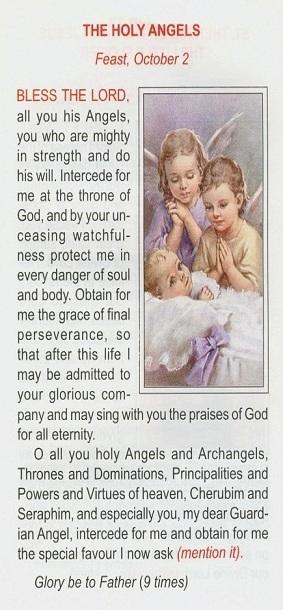
The Holy Guardian Angels.

The Holy Angels

Posted in Nezaradené | Leave a comment

Our angel friends.

Perhaps everyone who remembers their first childhood prayers has dealt with the world of angels. A picture of a guardian angel above a dangerous ravine used to be a standard fixture in children’s rooms, and the prayer to the guardian angel is still part of every child’s prayer repertoire. It is probably true, as Dr. Paul Strauss suggests, that “the fullness of man is in his childlike imagination.” When the exotic dreamlands gradually break and fade, the insurmountable journeys into unimaginable possibilities come to an end, and man grows into the shrunken dimensions of adulthood. This is one reason why adult Christians rarely remember these reasonable spiritual beings of God, perhaps only in danger. However, it is strange that many who are averse to the supernatural are drawn to mysterious figures that hover between heaven and earth. While it may seem that in today’s over-technologized world, where we can rationally explain everything, God is distant, He moves closer to us through His messengers – the angels. It is as if today’s man desires to transcend the known world and see the light of a new one, to be convinced that there is something else besides what we produce and consume.

Be that as it may, the world of angels is not just for children and romantics. Angels are part of the history of salvation, and their existence, as St. Gregory the Great claims, is spoken of on every page of Holy Scripture. From conception to ascension, the life of the incarnate Word is surrounded by the service of angels. They will also participate in Christ’s second coming and will serve Him at the Last Judgment. The protection and intercession of angels surrounds the life of man from birth to death. The Church believes, in the words of St. Basil the Great: “Every believer has an angel with him as a protector and shepherd, who guides him through life.” Already in this world, Christian life by faith participates in the blessed communion of angels and people united with God. God’s care for man and his salvation is almost unimaginable to human reason. The Old Testament Jews understood this as well, stating in the Talmud that God even gave an angel to every blade of grass to make it grow. How much more, then, does He care for man, whom He created in His own image! The task of an angel is to lead us deeper into the art of life, so that we may discover joy in it and act with appropriate responsibility. Everything in life is valuable, for it was miraculously created by God and enlivened by His Spirit. The angel’s most crucial task, in cooperation with us, is to bring us into God’s eternal kingdom, so that we may fully participate in His life. The return of angels to our lives is therefore more than necessary. For God needs us for His plan. He needs our hope, our faith, our heart, but also our courage to stake our lives on His promise, and for that, He has appointed helpers for us.

Posted in Nezaradené | Leave a comment