

-
Recent Posts
Recent Comments
Archives
- April 2026
- March 2026
- February 2026
- January 2026
- December 2025
- November 2025
- October 2025
- September 2025
- August 2025
- July 2025
- June 2025
- May 2025
- April 2025
- March 2025
- February 2025
- January 2025
- December 2024
- November 2024
- October 2024
- September 2024
- August 2024
- July 2024
- June 2024
- May 2024
- April 2024
- March 2024
- February 2024
- January 2024
- December 2023
- November 2023
- October 2023
- September 2023
- August 2023
- July 2023
- June 2023
- May 2023
- April 2023
- March 2023
- February 2023
- January 2023
- December 2022
- November 2022
- October 2022
- September 2022
- August 2022
- July 2022
- June 2022
- May 2022
- April 2022
- March 2022
- February 2022
- January 2022
- December 2021
- November 2021
- October 2021
- September 2021
- August 2021
- July 2021
- June 2021
- May 2021
- April 2021
- March 2021
- February 2021
- January 2021
- December 2020
- November 2020
- October 2020
- September 2020
- August 2020
- July 2020
- June 2020
- May 2020
- April 2020
- March 2020
- February 2020
- January 2020
- December 2019
- November 2019
- October 2019
- September 2019
St.Barbara
| December 4th, reminder | |
| Position: | Virgin and martyr |
| Death: | century unknown |
Patron: |
Miners, farmers, architects, construction workers, roofers, bricklayers, bell-casters, blacksmiths, stonemasons, carpenters, grave diggers, bell-ringers, cooks, butchers, girls, prisoners, artillery, firefighters, the dying, invoked for a good death, against fire, danger during a storm, against plague and feverish illnesses, as a helper in need, Miners, grave diggers. |
| Attributes: |
Cannon, chalice (often with host), book, sword, peacock feathers, tower (with three windows); she is usually depicted in the company of 13 other helpers in need. |
CURRICULUM VITAE
She is one of the holy martyrs of considerable importance, about whom no reliable written records have survived. She lived and died in Nicomedia as a virgin and martyr. Jesus’ prediction that “a man’s enemies will be those of his household” was fulfilled in her. (Mt 10:36)
CV FOR MEDITATION
MAN AGAINST MAN FOR JESUS
The martyrology is very brief about the life of Saint Barbara of Nicomedia, referring to tradition. Important saints remembered her, honored her, and included her among the so-called 14 helpers in need, according to tradition. Her oldest depiction was discovered in the church of Santa Maria Antiqua on the Palatine in Rome, and this fresco dates from about the end of the 7th century.
She probably lived between the 2nd and 4th centuries in Nicomedia, which was also the seat of the Roman emperors in the East, in Bithynia (today Turkey), on the southern side of the Black Sea.
Legend presents her as the beautiful daughter of the wealthy Dioscurus, a great enemy of the Christians, whose teachings Barbara learns about. Dioscurus wanted to protect his daughter from their influence and imprisoned her in a tower, where she was supposed to lack nothing but freedom. On one of her father’s trips, she allegedly persuaded the masons to construct a third window for her prison, despite the original plan calling for only two. Barbara wanted them to remind her of the Holy Trinity, in whose company she longed to live. After her father’s return, an interrogation followed. Some say that during her father’s absence, she also received the sacrament of baptism, and when she confessed to him that she wanted to belong only to Christ, she was temporarily hidden in the ground from his wrath. Some versions say that she was hiding in a cave.
According to the legendary story, while her father was preparing cruel tortures for her, she meditated on the Passion of Christ and drew strength to endure everything for him. In anger, her father is said to have summoned the judge Marcian and had Barbara, who had heroically faced the planned tortures, severely flogged. However, Barbara contemplated Christ’s scourging, perceiving it as a gentle caress from peacock feathers. The next day, her enemies were surprised that the wounds from the scourging had disappeared from her body. However, they refused to acknowledge Christ’s healing power, which Barbara testified to, and interpreted it as a sign from the pagan gods, wanting her to show them gratitude for it. Her efforts to convince them of the opposite only aroused greater fury in them. Among the described tortures with which they wanted to turn her away from the faith are mentioned scratching with iron combs, burning her sides, beating her head, from which they tried to beat Christ out of her, and cutting off her breasts. Marcian’s final decision was to cut off Barbara’s head. They dragged her disfigured through the city to the execution ground, perhaps to discourage others from believing in the true God. However, they were spoiled by Barbara’s bravery and an angel who supposedly covered Barbara’s bleeding body with a white garment. Upon their arrival at the execution site, the father’s determination to carry out the task himself eliminated the need for an executioner. The legend ends by saying that when he beheaded his daughter with a sword, he himself was killed by lightning.
Opening Anselm Grün’s book Spiritual Therapy and the Christian Tradition, we read that this legend is perceived as full of symbolism. This begins with the heroine’s name, which is interpreted as meaning ‘foreigner’, showing that she does not belong to this world but to heaven. Even in prison, a person can experience inner freedom. Her father tried in vain to impose his will by force. God entered her heart, even through a locked door. With him came more light, broadening her narrow horizons. After her father tried to kill her for her faith upon his return, she found refuge in a cave. In the book above, the cave symbolizes the maternal sphere and protection from the father. Through the betrayal of the shepherd, the father’s power proves more potent than the mother’s in the book, and Barbora falls into the hands of the governor at her father’s behest. After being healed by angels from subsequent torture, she was allegedly whipped naked through the city with rods that turned into peacock feathers. The more she was beaten, the more she was adorned with them. This was supposedly to demonstrate that human aggression cannot harm the soul. According to this version of the story, she spent one more night in prison, during which an angel brought her the Body and Blood of the Lord to strengthen her for her final journey. This interpretation proves that a person who follows their own path cannot be harmed by external forces. If the head of the family tries to determine their life path and force them away from God, they cannot win. God protects him through angels, and death means a new life.
In this story, Anselm Grün explores the meaning of the individual attributes. Here, the tower is seen as a symbol of human self-realization and the solid foundations on which our life rests. It is also a symbol of contemplation, representing a place where God dwells with us. This circular building with three windows represents the wholeness of the Triune God living with and in us. As we do not know the actual reality, we are not obliged to adhere to all interpretations. The chalice being offered can also remind us that Christ was offered the symbolic chalice of suffering in the Garden of Gethsemane. In accordance with the Father’s will, Jesus was strengthened to face his executioners. His acceptance of a shameful death became our redemption.
It is remembered that Barbora wears a green dress as a symbol of God’s power, reconciliation, and firm hope in eternal mercy. It is supposed to symbolize the renewal of life, which is commemorated by the so-called “barborkas”, which are placed in water so that they bloom at Christmas. This Christianized custom is supposed to remind us that a well-lived Advent should lead to the awakening of creative power coming from God and that by immersing ourselves in ourselves like Barbora, we should blossom with the life of Christ.
Emperor Justinian is said to have transferred the relics of St. Barbara in the 6th century to Constantinople, from where they were placed in the Cathedral of St. Mark in Venice around 1000, and in 1009 they were transferred to the nearby island of Torcello, to the church of St. John the Evangelist. Fr. Ekert states that in 1370 some of the relics of St. Barbara were also brought to Prague for the St. Vitus Cathedral by Charles IV. The most important Gothic church, St. Barbara, is located in Kutná Hora, Bohemia. Construction began in 1388. Some of its decorations date from the end of the 15th century, and the construction or reconstruction was completed between 1884 and 1905. The sculptural group of St. Barbara can be found on the Charles Bridge in Prague, between St. Margaret and St. Elizabeth. The original copy came from Ferdinand Maximilian and Jan Brokof in 1707. The inscription is a request: “Pray for us now and at the hour of death.” – We should not take this lightly. Similarly, in our churches, images of Barbara are proof of the respect paid to this saint in our country.
RESOLUTION, PRAYER
God, your power is especially manifested when it works in the weak: you strengthened Saint Barbara to bravely endure all torture; help us also, so that through her intercession we may triumphantly pass through all trials, not die a sudden death, but appear before you reconciled, after receiving the Holy Sacraments. We ask this through your Son Jesus Christ, our Lord, for he lives and reigns with you in the unity of the Holy Spirit, forever and ever.
Posted in Nezaradené
Leave a comment
St.Francis Xavier
December 3, commemoration |
|
| Position: |
missionary TJ |
| Death: |
1552 |
| Patron: |
Navarre (since 1622), India (since 1748); Jesuits, spreading the faith (since 1904), all missionaries (since 1927), people from the Catholic press, sailors, tourism (since 1952); invoked for a happy death, against a devastating storm and against a plague epidemic |
| Attributes: |
Indians, Jesuits, baptism of natives, cross, lilies, flames (flaming heart), torches |
CURRICULUM VITAE
He came from Navarre, Spain. He spent his youth during the political struggles for independence, during which his native castle also fell. While studying in Paris, he met Peter Faber and Ignatius of Loyola, who became his fellow brothers in 1534 when the Jesuit order was founded. He was a priest from 1537, and from 1541 he zealously and successfully preached the gospel in India, Ceylon, the Moluccas, and Japan. He died at the age of 46, on the island of Sancian, on his way to China.
CV FOR MEDITATION
HIS PROGRAM WAS THE SALVATION OF SOULS
He was born on 7 April 1506 in the castle of Javier (Xavier) in the Basque part of the Kingdom of Navarre in northeastern Spain, as the youngest of five siblings. The four older ones were Magdalena, Anna, Miguel, and Juan. During his childhood, there were fights for independence between Basque Navarre on the one hand and Spain and France on the other. His father, Juan de Jasso died at that time and the fortifications of their castle were demolished during the fighting. Miguel and Juan joined the fighting. In 1521, 50 km northwest of Javier in Pamplona, Ignatius of Loyola (d. 31 July) also fought against the Basques, who was hit in the leg by a cannonball here on 20 May and who later had a significant influence on Francis’s life.
Spain took over Navarre in 1524, when Francis was 18 years old, causing the Xaviers to lose a significant portion of their property. That year, both brothers returned, and the following year, Francis went to university in Paris. He had a lively and fiery nature, was ambitious, had above-average intelligence, and was also tolerant. From the beginning of his second year of university studies, he lived with the quiet, melancholic student Peter Faber (died 1 August). They are said to have complemented each other quite well, due to their contrasting personalities. Peter often tempered Francis’s sharper expressions with his prudence. An older, disabled student, Ignatius of Loyola, joined these two in the autumn of 1529. Francis was very slow to make friends with this new roommate, but they eventually united around the ideals that led to the founding of a new order.
In 1530, Francis obtained the academic title of Master, equivalent to today’s Doctor of Philosophy, and became an associate professor and director of a university college. Four years later, on August 15, 1534, he came to the Chapel of St. Dionysius in Montmartre, Paris, with Peter Faber, four other companions, and Ignatius of Loyola to found the Jesuits under his leadership. They took a vow to live in poverty, chastity, and service to souls in the Holy Land or to be at the disposal of the Pope as the vicar of Christ.
In the autumn of the same year, Francis held spiritual exercises under Ignatius’s guidance, and the salvation of souls became his life’s program. In 1535-1536, Francis studied theology and prepared for the sacrament of priesthood, which he received with his companions in June 1537 in Venice, and had his primogeniture in Vicenza.
In Venice, he and Ignatius were housed in a hospital for the terminally ill, providing them with the necessary services. Caring for these patients was, among other things, a matter of self-control and self-denial.
Due to tensions between Venice and the Turks, it was not possible to continue the planned journey to the Holy Land, and therefore the members of this religious group dispersed for a short time to the university cities of northern Italy (Francis went to Bologna). There they preached and provided various spiritual services until April 1538, when they met in Rome to cooperate with Ignatius in apostolic and charitable work. Their goal was papal approval of the Society of Jesus. Pope Paul III approved it orally in 1539 and in writing on 27 September 1540.
At the beginning of 1540, Portuguese King John III had already asked Ignatius to send his brothers to the Indian missions. With the Pope’s approval, he dispatched Francis Xavier along with the Portuguese Simon Rodriguez. Francis left for Lisbon in mid-March, where he arrived in June after the ships had sailed, and it was necessary to wait out the winter there. In the meantime, they preached in the city and cared for the sick. King João then decided to keep Rodriguez in Lisbon, and Francis was appointed apostolic nuncio to the East by Pope Paul III and received four letters of recommendation for the rulers there. With them and two assistants, the Italian P. Paolo Camerino and the not-yet-ordained Portuguese Fr. Mantillas, he set off for India. The journey from Lisbon to Goa on the west coast of India lasted from 7 April 1541 to 6 May 1542.
In the first stage of the journey, they rounded the Cape of Good Hope and, after about five months, arrived in Mozambique on the coast of Africa. Here, they had to wait out the winter and were able to continue by sea only in February. After an arduous journey, during which he was accompanied by seasickness and was constantly at the service of sailors, soldiers, convicts, slaves, and other various passengers, he began to care for the sick in Mozambique despite his exhaustion and illness.
Goa, a former Portuguese colony in India, became Francis’ first base in the country. He began his work in the city’s hospital with those who had also arrived from elsewhere. He slept on the floor next to the most seriously ill patients so that he could be ready to serve their needs.
After five months, he was sent south to Cape Kanyakumari. The natives there made their living by fishing for pearls and spoke Tamil. Francis had the basic prayers of the Church and the Ten Commandments translated into this language for them. He only began to learn Tamil with great difficulty, and then, as in the streets of Goa, he would ring a bell to call for catechism classes. He tirelessly spoke about God to children and adults.
From there, he also wrote to Ignatius in Rome about his activities: “I persistently went around the villages and washed all the children who had not yet been baptized with holy baptismal water. I thus purified a tremendous number of children who could hardly tell their right hand from their left. However, these children would not let me even pray the breviary, nor even eat or sleep, until I had taught them a prayer. And then I understood that they were the ones to whom the kingdom of heaven belonged… Many people in this area do not become Christians simply because there is no one available to convert them. And so the thought often crosses my mind that I should go around all the academic institutions throughout Europe—and especially the University of Paris—and shout everywhere like one deprived of one’s senses, to rouse those in whom there is more learning than love with the cry, “How terrible is the number of those who, through your fault, do not get to heaven and are rushing to hell!”
He then lived among the inhabitants of the Moluccas (now part of Indonesia). It is said that in one month, he baptized up to 10,000 Indians. In early 1545, he sailed to Malacca and then on to the island of Amon. From there, after a three-month stay, he went to the island of Ternate. After completing this journey, which he considered his duty as the Apostolic Nuncio to the Far East, he learned of Japan’s existence. In Goa, he distributed tasks to new missionaries of the TJ and in August 1549, on the junk of a Chinese sailor, he sailed to the shores of Japan. He set out on foot for Miyako, where he encountered ridicule and failed to reach the emperor. However, within two years, he had converted at least five hundred Japanese people to the Christian faith. On his return, he expected the conversion of China, which would also contribute to the spread of Christianity in this country. In November 1552, he sailed to the island of San Juan near Canton. Here, starving and feverish from hypothermia, he died on December 3rd at the age of 46.
He was beatified on October 25, 1619, by Pope Paul V, and canonized on March 12, 1622, by Pope Gregory XV.
RESOLUTION, PRAYER
Francis had no other goal than the salvation of souls. That was the most important thing in his heart and life. I will examine my conscience over his message, to what extent the salvation of souls for whom I am responsible is close to my heart – in my family, in the broader community of people with whom I interact, in others in my country, in Europe… From this, I will draw more concrete decisions and permanent initiatives, starting with correcting my mistakes.
God, you called Saint Francis Xavier to show the way to you by preaching the Gospel to thousands of people; fill the hearts of all believers with a zeal to spread the light of your truth, so that your Church may grow and fulfill its mission in the world. We ask this through your Son Jesus Christ, our Lord, who lives and reigns with you in the unity of the Holy Spirit, forever and ever. Amen.
Posted in Nezaradené
Leave a comment
Jesus rejoiced in the Holy Spirit …
The father could not cope with his rebellious son, so he sent him to the monastery for re-education. “What should we do with him?” The monks asked. The abbot thought for a moment and said, “Leave him alone. Let him be here with us and watch how we live.” After some time, the father stopped in the monastery and was surprised at how his son treated him. He could not stand it and asked, “What have they done to you?” The young man smiled: “You know, those monks believe that every person can be an angel, and that is why they treat him with immense respect and love. And when they treat others like that, over time, it changes those people into the way they see them.” The father was amazed and even asked the abbot himself, “Do you really think that we should treat people as if they were angels?” The abbot looked at him and said, “An angel is a messenger of God. And every person can be one in their own way.” Then the man interrupted him and said, “Well, I can imagine that a religious person can be a messenger of God because they live in communion with God, but there are so many evil, sinful, and cruel people in the world. How could they be messengers of God?” The abbot said, “A meeting with a good person will encourage you in faith and love. A meeting with a bad person will test your faith and love. Both are necessary. Sometimes we are full of goodness, and sometimes we are full of anger and malice. And therefore, regardless of what happens, let us try to perceive everyone we meet as a messenger of God. And whether he brings good or evil, let us always ask: “Lord, why did you send this person into my life? What message did you want to convey through this? ”And let us express thanks for every encouragement and trial. It is not easy, but, as you see, it also bears its fruit.”
In the Advent season, we must prepare the way for the Lord within ourselves. He wants to rejoice in us and glorify the Father for the graces addressed to the right recipient. Let us allow Jesus to exult within himself and above himself: I praise you, Father, Lord of heaven and earth…
There is a well-known thesis: “So far, philosophers have only explained the world in various ways, but from now on, the point is to change it!” Or in a kind of secessionist antithesis: “So far, philosophers have only changed the world, but now, the point is to explain it!” Jesus did not come to explain the world or change it; he was sent to save it. Jesus Christ is the messenger of the Father—the God of love, who can do this in every heart, including yours.
Posted in Nezaradené
1 Comment
What comes to mind when you think of Advent?
A wreath, the pre-Christmas rush, cooling off, Christmas advertising… St. Charles Borromeo said this about Advent: “Beloved, this period is so glorious and solemn that the Holy Spirit speaks of it: ‘The time of grace, the day of salvation, peace, and reconciliation.'” It is a time for which the ancient patriarchs and prophets prayed and sighed persistently, a time that the righteous Simeon saw with great joy, and which the Church still solemnly experiences… The Church celebrates this mystery every year, reminding us of God’s extravagant love for us. It also teaches us that Christ’s coming benefited not only those who lived at that time, but that we all share in his power to this day, provided we are willing to receive the grace he merited for us through holy faith and the sacraments, submit obediently to its influence, and lead a moral life. What does today’s Word of God say about us? At His first coming, the Lord said: ‘I will come and heal him.’ Do we need healing? Perhaps we will ask ourselves: ‘Others need it.’ But me?! This is where it breaks down; the need for Advent is revealed. Jesus came for those who required healing. The centurion did not consider himself worthy. Such an attitude is not an obstacle if a person realizes it. Jesus did not heal the Pharisees, who thought they were perfect and despised the centurion. Recognizing the need for healing is probably the most important thing. How can such an outcome be achieved? Do you know? A tourist approaches a hermit and asks him the meaning of his life in solitude. The hermit is currently drawing water from a well. The hermit tells the tourist to look into the water. ‘I see nothing,’ says the tourist, ‘only the rippled surface.’ The hermit carries the water away, then tells the tourist to look into it again. This time, he saw himself. Advent: we are overwhelmed by many duties and haste. It is probably necessary to fight for peace and time for ourselves.
Posted in Nezaradené
1 Comment
When we lose, we gain.
If a person relinquishes a portion of their living space, they can welcome another individual into it and experience their enrichment. But we think something stops us from giving up our own security to accept another’s uncertain advantage. What is it?
In Christ, man can acquire a new point of reference. We read in Scripture his words: “Do not be afraid; I have overcome the most advantageous world.” Illustration image: pixabay.com
To discover the answer, we must go back to Paradise, where the great lie originated. It can be summarized as follows: Ever since the first sin was committed, God has wanted to make one thing clear to humans: that God is God and humans are not.
This central theme is what the entire Bible conveys, yet we still fail to understand it and often resist accepting it. We tell ourselves that God is like a man and that we are almost like gods. The consequences of the original sin help us to understand why we disobey God and mistreat people—because the two things are closely related.
After sinning, Adam and Eve hid. But how can anyone hide from God, who knows everything? When examining the essence, after sinning, Augustine stated, “Sin is to turn to a created thing while turning our backs on its Creator.
However, through sin, man turned his back on God. After all, no one can see the back of their reflection in a mirror. Therefore, man hid from God in such a way that God could no longer see himself in him.
Then, in a groan of pain, God expressed his loss: ‘Adam, where are you?’ This question should have been asked by Adam himself: ‘Adam, realize where you are.’ Who am I? I am trapped behind a mirror, like Alice in Wonderland. I cannot see God because I have turned my back on Him; He no longer recognizes Himself in me.
However, when a person loses God as a point of reference in life, they must find a new fixed point to avoid getting lost in the world. With God, everything made sense and was beneficial. But who determines what is useful now?
Adam had reached this point in his ‘I’. When he turned his back on God, he had nothing left, and creation stopped obeying him. He must not lose himself. So when God asked him, ‘Why did you do this?’ he did not answer truthfully. Instead, he said, ‘I was not good.’ In an attempt to preserve his own goodness, he blamed both the woman and God: ‘The woman, you gave me fruit, and I ate it.’ Fortunately, there was no one else there.
FEAR ATTACK
This statement answers the question of why people treat each other poorly. Since the time of Adam, they have been afraid of losing their sense of self. Driven by this fear, they attack God and other people. Just as a naturally shy animal, cornered, turns into an attacking beast, so a person convinced of their goodness and infallibility attacks those who question it. A person is simply afraid for themselves. No one should be blamed for such fear because it is natural.
However, there is also a supernatural state. As Christ says, “Do not be afraid, for I have overcome the world.” In this state, humans can find a new point of reference that is both fully human and fully divine. When I unite with Christ, who is both God and man, I no longer need to worry about my imperfect self.
Like Paul, I can say, “It is no longer I who live, but Christ who lives in me, and he will never die again; death no longer has dominion over him.”
RESTORING THE IMAGE OF GOD IN US
Through Christ, God’s perfect image is restored in humanity. Together with Paul, I too can embrace this idea: ‘Imitate me, as I imitate Christ.’ I can once again stand before God, reflecting his image in Christ, despite my lack of merit or contribution. Only in Christ can we once again reflect the image of God.
In him, we no longer need to fear admitting our failures, because as Saint Peter says, he took on our sins and suffered for them. Therefore, through him, we can have a relationship with God despite still being sinners.
We can also be kind and pleasant to others, even when they criticize us. This will no longer affect our self-worth because, as Saint Paul says, anyone who is in Christ is a new creation: the old has gone, the new has come.
When we meet an unpleasant person, let us remember that they too are driven by a supposed fear of their own ‘self,’ without which they feel lost in this world. Then let us sigh with Christ: ‘Father, forgive them, for they know not what they do.’
Posted in Nezaradené
Leave a comment
The Holy Prophet Daniel and the Gift of Interpretation of Dreams
During the reign of King Nebuchadnezzar, Daniel was taken into Babylonian captivity in 605 B.C.E., along with other inhabitants of Judah. From among the captives, young men from noble families were then selected to serve in the Babylonian royal court. They were first educated in the Chaldean spirit and were to partake of food from the king’s table. However, Daniel refused foods that could ritually defile him, and together with his friends Hannah, Azariah, and Michael, who were given the names Shadrach, Meshach, and Abednego in captivity, he made a pact to eat only pulses and drink water.
Posted in Nezaradené
1 Comment
First Sunday of Advent, Year A Mt 24,29-44
In many professions, it is important to be alert and focused. For example, a soldier on guard duty must listen and look carefully so that the enemy does not catch him by surprise. Similarly, an athlete must concentrate before a competition to give their all and win their event. A fisherman watches quietly, trying to work out which bait will be effective today. All of this is done for a small profit or a bigger trophy. So, what must a person do to obtain the laurel wreath of eternal glory? Should they try less hard or be less alert? Working with people is demanding, and raising children is invaluable. Even if it sometimes seems that they are not listening, at some point we will discover that they are. Children can use various myths and half-truths.
Before Christmas, Misha prays and then shouts, “Jesus, bring me a bicycle!” ‘Jesus, bring me a bicycle!’ ‘Jesus isn’t deaf,’ his sister tells him. ‘He doesn’t, but Grandpa does!’ Another boy threatens his father: ‘If you touch my ears one more time, I’ll run away from home!’ “Where would you go?” ‘I’ll go back to the stork.’ Let’s try to be truthful and believable in our upbringing and opinions, and appropriate to our age. We are all walking on Calvary, but are we heading towards life or death? It depends on whether we carry a cross, nails, or a hammer. This world wants achievements; it needs victories because it needs profits. But spiritually, even if our efforts are fruitless, we do not lose the opportunity to gain merit. We only lose the opportunity to boast. Instead, we are given the opportunity to learn patience and to accept God’s will.
One Jewish scholar was very familiar with the Old Testament and all Jewish traditions. According to him, the rabbis had collected 456 prophecies concerning the Messiah, or Christ, who was to be born and establish a New Covenant with humanity. Let’s assume that the likelihood of each prophecy fulfilling solely by chance is the same. Regarding the location of his birth, for example, the probability would be one in a hundred. If two prophecies were to be fulfilled, the probability would be one in a thousand. If all the prophecies about Christ were to be fulfilled at a given time and place, the probability would be one in 84 followed by 126 zeros. There are billions of possibilities, and yet they all came true. Let those who want to understand, understand.
Hell and heaven are not far apart, and man is a weak and deceitful creature. Let us imagine a beautiful day. Birds sing, meadows bloom, and the waters of the lake reflect the mountains, as if nature reflects the divine power of the Creator. Suddenly, a man appears in this undisturbed scene and goes to the pond where the fish live. He catches a fish and puts it on dry land. How do you think the fish feels? It must feel like hell, yet heaven is so close. The fish was created to live in water, so any environment outside of it feels like hell. Similarly, we were created to live with God. We will be with Him in Heaven because Heaven is where God is. As St Augustine wrote, ‘Our hearts are restless until they rest in You.’
How many fish die in this world? And how many are caught and deceived? Many die as a result of disasters and harmful environments, and conservationists are sounding the alarm. But how many people will fall victim to the same traps without anyone sounding the alarm? Do we value eternity? Do we believe in atheism and want to live forever in this world? In a spiritual conversation, a boy asks a priest how he would put on a shirt over his wings if he were an angel. If you’re in hell, you should worry about how to cap your horns!
Let us learn to live in friendship with God so that nothing surprises us, after all, heaven begins here on earth, and Jesus’ words to the thief on the cross confirm the existence of heaven: “Today you will be with me in paradise,” and he (Jesus) never lied.
01. The Destruction of Jerusalem – The Great Controversy of the Ages
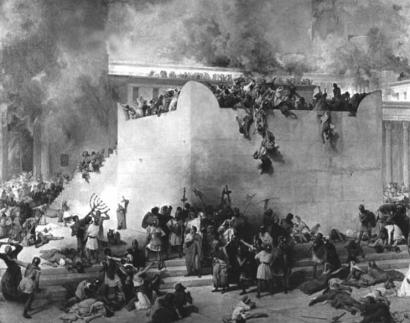
The destruction of Jerusalem and the temple
GC 17 “If you had known, even you, at least in this your day, the things that make for your peace! But now they are hidden from your eyes! The days will come when your enemies will build a rampart around you, surround you, and hem you in on every side; they will level both you and your children within you, leaving not one stone upon another, because you did not recognize the time of your visitation. (Luke 19:42-44)
From the summit of the Mount of Olives, the Lord Jesus looked down upon Jerusalem. A beautiful, seemingly peaceful landscape stretched before Him. It was the Passover, and the descendants of Jacob were gathered from all lands to celebrate the great national festival. Amid gardens, vineyards, and green slopes dotted with the tents of pilgrims, rose the terraced hills, the magnificent palaces, and the mighty ramparts of the capital of Israel. The daughter of Zion seemed to say in her pride, “I sit a queen and know no sorrow.” She was beautiful, and she thought herself safe and secure, enjoying the favor of heaven, as centuries before when the royal singer had sung, “Mount Zion is beautiful in height, the joy of the whole earth, . . . the city of the great King.” Psalm 48:3. The view of the temple buildings was magnificent. The golden gate, tower, and battlements reflected the rays of the setting sun onto its white marble walls. The temple, the pride of the Jewish nation, stood there as “the perfection of beauty.” GC 18 What child of Israel could look upon this without being filled with a thrill of joy and admiration? But the Lord Jesus was thinking of something entirely different. “And when he was come nigh, he beheld the city, and wept over it.” Luke 19:41. A sudden and incomprehensible sorrow overcame the world’s Redeemer amid the universal rejoicing of the triumphal entry, while the people waved palm branches and the hills echoed with joyful “Hosannas,” as thousands of voices hailed him as king. He, the Son of God, the Promised One of Israel, who by His power had conquered death and called its captives from the grave, was now in tears. There was no expression of ordinary sorrow on his face, but of enormous, insurmountable mortal anxiety.
He did not weep for himself, though he knew well where his steps would lead. Before him lay Gethsemane, the place of his coming suffering. The Sheep Gate, through which for centuries animals had been led to sacrifice, was also in view, and which was to be opened for him when he was “led as a lamb to the slaughter.” (Isaiah 53:7) Not far off was Golgotha, the scene of the crucifixion. The terror of great darkness would fall upon the path he was about to tread, as he laid down his soul as a sacrifice for sin. But it was not the thoughts of the events that saddened him in this hour of joy. His unselfish heart was not gripped by the anguish and foreboding of his own superhuman suffering. Christ wept over the thousands condemned in Jerusalem; He wept over the blindness and defiance of the people whom He had come to bless and save.
Before Jesus’ eyes was projected a period of over a thousand years in which God had shown His chosen people special favor and special care. Here stood Mount Moriah, where Isaac, “the son of promise,” had been bound without resistance as a sacrifice to the altar—a symbol of the sacrifice of God’s Son. Here was confirmed to Abraham, “the father of the faithful,” the covenant of blessing, the glorious Messianic promise. (Genesis 22:9, 16-18) Here the flames of the sacrifice ascending to heaven from the threshing floor of Ornan the Jebusite turned away the sword of the destroying angel (1 Chronicles 21) —a fitting symbol of the Savior’s sacrifice and His intercession for the guilty. Jerusalem was honored by God above all the earth. “For the Lord hath chosen Zion, he hath desired it for his dwelling place.” (Psalm 132:13) Here through the ages the holy prophets have delivered their warning messages. Here the priests waved their censers, and the fragrance of the incense ascended to God with the prayers of the faithful. Here the blood of lambs was offered daily, pointing to the future Lamb of God. Here the Lord revealed His presence in the cloud of glory over the mercy seat. From there proceeded that mysterious ladder connecting earth and heaven. (Genesis 28:12; John 1:52) This is the ladder upon which the angels of God descend and ascend, and which opens to the world the way into the holiest of cities. If Israel, as a nation, had stayed faithful to God, God’s chosen city, Jerusalem, would have endured eternally. But the history of this beloved nation has been one of apostasy and rebellion. They have despised the grace of God, abused their privileges, and wasted their opportunities.
Although the Israelites “mocked the messengers of God, and despised his words, and treated his prophets as fools” (2 Chron. 36:16), God still appeared to them as “the Lord, the mighty God, merciful and gracious, slow to anger, and abounding in steadfast love and truth.” (Ex. 34:6) God’s mercy attended them, even though they continually rejected Him. With a love that surpasses the compassionate love of a father for his son, God sent them His servants “because He had compassion on His people and on His dwelling place.” (2 Chron. 36:15) When appeals, entreaties, and warnings failed, He sent them the greatest gift of heaven—and in this one gift God gave them all of heaven.
The Son of God Himself appeared to save the stubborn city. It was Christ who brought Israel out of Egypt like a great vine. (Psalm 80:9) With His own hand He drove out the heathen before it. He planted it “upon a fruitful mountain.” GC 20 He carefully fenced it in, sending His servants to tend it. He exclaimed, “What more could be done for My vineyard, that I have not done for it?” (Isaiah 5:1, 4) Then, when he expected delicious grapes, it brought forth wild thorns. But he did not give up hope that fruit would be produced, and therefore He personally came to His vineyard to see if it could be successfully saved from destruction. He dug up the vine, pruned it, and tended it. He was untiring in his efforts to save the vine that he had planted.
For three years, the Lord of light and glory walked among His people. “He went about doing good and healing all that were oppressed by the devil and held under his power,” binding up the wounded, proclaiming liberty to the captives, and restoring sight to the blind. Through His ministry the lame walked, and the deaf heard, He cleansed the lepers, raised the dead, and preached the gospel to the poor. (Acts 10:38; Luke 4:18; Matthew 11:5) To all men without distinction was His gracious invitation: “Come unto Me, all ye that labor and are heavy laden, and I will provide you rest.” (Matthew 11:28)
Though they repaid him with evil for good and his love with hatred (Ps. 109:5), the Lord Jesus persevered in his mission of mercy. He never turned away those who sought his mercy. He lived as a homeless wanderer, poverty and reproach were his daily lot. He ministered to the needs of the people, succoring them in their misery, and persuading them to accept the gift of life. The tide of mercy, reflected from the hardened hearts of men, returned to them in a still stronger stream of unspeakable, compassionate love. But Israel turned away from her best Friend and Helper. She despised his offers of love, rejected his counsel, mocked his warnings.
The time of hope and forgiveness was rapidly passing away. The cup of God’s long-reserved wrath was almost filled. Now the dark cloud, built up by ages of apostasy and rebellion, was about to be torn from the guilty. GC 21 And He who alone could save them from the punishment that threatened them, was despised, slandered, rejected, and was soon to be crucified. When Christ should hang upon the cross of Calvary, the period in which Israel as a nation had enjoyed God’s favor and blessing would end. The loss of one soul is a calamity far greater than all the gains and treasures of the world. But as the Lord Jesus looked upon Jerusalem, He saw before Him the fate of the whole city and the whole nation—the city and the nation that had once been God’s chosen, His precious treasure.
The prophets wept over the apostasy of Israel and over the terrible desolations that had come upon the people for their sins. Jeremiah wished that his eyes were a fountain of tears, that he might weep day and night for the slain “daughter of his people,” “the flock of the Lord,” who had been led away captive. (Jeremiah 9:1; 13:17) His prophetic vision, which foresaw not just years but ages ahead, must then have been filled with immense sorrow! He saw the destroying angel with his sword raised against the city that had so long been the dwelling place of the Lord. From the summit of the Mount of Olives, the place afterwards occupied by Titus and his army, Christ looked down the valley upon the holy court with its colonnade, and with tear-filled eyes He saw in a fearful view the walls surrounded by foreign hosts. He heard the tramp of armies advancing to war. He heard the voices of mothers and children begging for bread in the besieged city. He saw the beautiful sanctuary, palaces, and towers destroyed by flames, and where all had stood, he saw only a pile of charred ruins.
Looking to the future, He saw the chosen people scattered throughout all lands, “like a shipwrecked on a desert shore.” In the punishment that was soon to come upon the inhabitants of the city, Christ saw only the first sip of the cup of wrath, which the nation must drink to the dregs at the final judgment. God’s compassion and deep love were expressed through the mournful words: “Jerusalem, Jerusalem, you who kill the prophets and stone those sent to you, how often I have longed to gather your children together, as a hen gathers her chicks under her wings, but you were not willing!” (Matthew 23:37) GC 22 O that thou, O thou people, more honoured than all, had known the time of thy visitation and the things which would bring thee peace. I have stayed the angel of righteousness, I have cried unto thee to repent, but in vain. You have rejected and spurned not only the servants, the messengers, and the prophets, but also the Holy One of Israel, your Redeemer. If you perish, you will bear the responsibility for it yourself. “Ye will not come to me, that ye might have life.” (John 5:40)
Christ saw in Jerusalem a symbol of a world hardened in unbelief and rebellion, set to face God’s vengeance. The suffering of fallen humanity weighed down His heart, and brought a pitiful cry to His lips. In human misery, in tears and blood, He saw the traces of sin. His heart was filled with infinite compassion for those afflicted and suffering on earth. He longed to help all. But even His hand could not stay the flood of human suffering; few would seek the true source of help. He was willing to lay down His life to bring them salvation, but few of them came to Him that they might have life.
The Majesty of Heaven is crying! The Son of the eternal God is weeping, he is overwhelmed with anguish! The scene filled all heaven with wonder. This scene shows us the immense danger of sin. It shows how difficult a task it is even for the infinite God to save the sinner from the consequences of transgression of God’s law. Jesus, in prophetic view of the last generation, saw a world engaged in a deception similar to that which destroyed Jerusalem. The great sin of the Jews was their rejection of Christ. The great sin of the Christian world will be their rejection of God’s law, which is the foundation of His government in heaven and on earth. Men will not value and reject God’s commandments. Millions of Satan’s slaves, bound by sin, condemned to the second death, will refuse to hear the words of truth when their day of visitation comes. What terrible blindness! What an extraordinary error!
GC 23 Two days before the Passover, when Christ had for the last time left the temple, after denouncing the hypocrisy of the Jewish leaders, He went out again with His disciples to the Mount of Olives, and sat down with them on the grassy slope, surveying the city. Once more He looked upon its walls, its towers, and its palaces. Once more He looked upon the temple in its dazzling splendor, the diadem of beauty that adorned the sacred mountain.
Centuries ago the psalmist extolled the favor God had shown to the Israelites by making their sanctuary His dwelling place: “His tent is in Salem, and His dwelling place is in Zion.” God chose “the tribe of Judah, Mount Zion, which He loves; and He has built His sanctuary like the height of glory.” (Psalm 76:3; 78:68, 69) The first temple was erected at a time when the Israelites were at their best. King David had amassed vast treasures for this purpose, and under divine inspiration, plans were drawn up for the building of the temple. (1 Chronicles 28:12, 19) Solomon, the wisest king of Israel, completed the work. This temple was the most magnificent structure the world had ever seen. Yet the Lord said of the second temple by the prophet Haggai: “The glory of this latter house shall be greater than of the former.” “And I will shake all nations, and the desire of all nations shall come; and I will fill this house with glory, saith the Lord of hosts.” (Haggai 2:9, 7)
After the destruction of the first temple by Nebuchadnezzar, it was rebuilt about five hundred years before the birth of Christ by a people who had returned from a long captivity to a ruined and almost deserted homeland. There were among the people then old men who remembered the glory of Solomon’s temple and who lamented, as the foundation of the new building was being laid, that it would not be as magnificent as the former. The prophet has impressively described the feelings of that time: “Who is left among you that saw this house in its former glory? And what is it now that you see? Is it not as nothing in your eyes in comparison with that?” (Haggai 2:3; Ezra 3:12). The promise was then given that the glory of the second house would surpass the glory of the first.
But the second temple did not equal the first in splendor and magnificence. In the first temple, there was no visible evidence of God’s presence. There was no supernatural power manifested in it to testify to its consecration. No one saw the cloud of glory that filled the newly built tabernacle. No fire came down from heaven to consume the sacrifice on its altar. The glory of God (shekinah) did not dwell between the cherubim in the holy of holies, for the ark of the covenant, the mercy seat, and the tablets of the testimony were not within. There was no voice from heaven to communicate the will of the Lord to the priests.
For centuries the Jews had vainly endeavored to prove that the promise of God, announced by Haggai, had been fulfilled. Pride and unbelief blinded their minds, preventing them from understanding the true meaning of the prophetic words. The second temple was not honored by the cloud of the glory of the Lord, but by the living presence of Him in whom dwelt the fullness of the Godhead bodily,—God Himself manifested in the flesh. “The desire of all nations” had truly come to its temple when Jesus of Nazareth taught and healed in its sacred courts. Only through the presence of Christ did the second temple surpass the first. But Israel rejected the offered Gift of heaven. With the humble Teacher, who that day for the last time passed through its golden gates, the glory of God left the temple forever. The words of the Saviour were now fulfilled: “Behold, your house is left unto you desolate.” Matthew 23:38.
The disciples were filled with awe and amazement when the Lord Jesus foretold the destruction of the temple. They desired to understand more fully the meaning of His words. For more than forty years much money, labor, and architectural skill had been expended to increase its splendor. GC 25 Herod the Great had used for this purpose both the wealth of Rome and the treasures of the Jews, and even the emperor had enriched it with his own gifts. Herod the Great brought heavy blocks of white marble from Rome specifically for this purpose, which formed a part of the temple structure. The disciples pointed them out to their Master, saying, “Teacher, behold what manner of stones and what buildings!” (Mark 13:1)
To these words the Lord Jesus answered seriously and surprisingly: “Amen, I say to you, there will not be left here one stone upon another that will not be thrown down.” (Matthew 24:2)
The disciples associated the destruction of Jerusalem with the event when Christ would come to earth in earthly glory to take over the reign of a world empire, to punish the rebellious Jews, and to free the nation from Roman rule. The Lord had promised them that He would come a second time. As they gathered around the Savior on the Mount of Olives, they asked, “Tell us, when shall these things be? and what shall be the sign of thy coming, and of the end of the world?” (Matthew 24:3).
The future was mercifully veiled from the disciples. Had they then understood the two awful facts—the sufferings of the Redeemer, His death, and the destruction of the city and temple—they would have been overcome with terror. Christ had given them a sign of the great events that were to take place at the close of the world’s history. They did not fully understand Him then. When the people of God needed it, He would clarify the true meaning of His words. The prophecy which Christ uttered had a double meaning—it foretold the destruction of Jerusalem and at the same time the horrors of the last great day.
The Lord Jesus spoke to His disciples of the judgments that would come upon unfaithful Israel, and especially of the punishment they would bring upon themselves by rejecting and crucifying the Messiah. Unmistakable signs would announce the nearness of the terrible climax. The fearful hour would come suddenly and swiftly. GC 26 The Saviour warned His followers: “When ye therefore shall see the abomination of desolation, spoken of by Daniel the prophet, stand in the holy place (he that readeth, let him understand), then let them which be in Judea flee to the mountains.” Matthew 24:15, 16; Luke 21:20, 21. When the idolatrous symbols of the Romans appeared on the sacred ground, which extended a few hundred yards beyond the city walls, the followers of Christ were to seek safety in flight. When they saw the warning sign, they were not to hesitate for a moment. In all Judah and in Jerusalem itself, they must immediately obey the signal to flee. Whoever happens to be on the housetop must not go back down, even if it means saving his most precious treasures. Those who will be working in the fields or vineyards must not waste time in returning for the outer garment they have laid aside while working in the heat of the day. They must not hesitate even for a moment, lest destruction overtake them.
During the reign of Herod, Jerusalem was distinguished not only by its external beauty but also by the construction of seemingly impregnable towers, walls, and fortresses. Like Noah in his day, anyone who had publicly predicted its destruction would have faced ridicule. But Christ said, “Heaven and earth will pass away, but my words will never pass away.” (Matthew 24:35) Jerusalem’s sins had provoked God’s wrath, and the city’s unbelief sealed its fate.
The Lord declared through the prophet Micah: “Hear this, O heads of the house of Jacob, and princes of the house of Israel, that judge abominably, and pervert all equity: every one buildeth Zion with blood, and Jerusalem with iniquity: whose heads judge for bribes, and whose priests teach for hire, and whose prophets divine for money; and yet they lean upon the Lord, and say, Is not the Lord in the midst of us? Evil shall not come upon us.” (Micah 3:9-11) GC 27
These words accurately describe the corrupt and Pharisaic inhabitants of Jerusalem. They said they were following God’s law, but they broke every rule. They hated Christ because His purity and holiness exposed their unrighteousness. They blamed Him for all the problems caused by their sins. Although they knew that He was perfectly sinless, they declared that His death was necessary for their salvation as a nation. The Jewish leaders said, “If we let Him alone like this, all will believe in Him, and the Romans will come and take away both our place and our nation.” John 11:48. If they killed Christ, they could once again become a strong, united nation. Thus they reasoned, and they agreed with the decision of their high priest that it was better that one man should die than that the whole nation should perish.
Thus the Jewish leaders built up “Zion with blood, and Jerusalem with iniquity.” (Micah 3:10) And then, when they murdered their Saviour because He rebuked them for their sins, they hypocritically considered themselves God’s chosen people, and expected God to deliver them from their enemies. The prophet continued: “Therefore Zion shall be plowed for you as a field, and Jerusalem shall become heaps, and the top of the house as the high places of the forest.” (Micah 3:12)
For nearly forty years, from the time when Jesus Christ foretold the destruction of Jerusalem, the Lord had deferred His judgments upon the city and the nation. God’s forbearance toward those who rejected the gospel and murdered His Son was admirable. God’s dealings with the Jewish nation are illustrated by the parable of the barren tree. In this parable, God gave the command, “Cut it down, lest it corrupt the ground also.” (Luke 13:7) But God’s mercy spared it for a time. There were still many among the Jews who knew nothing of the character and work of Christ. The children had not yet had opportunity to meet the light which their parents had rejected. GC 28 God would shine upon them with light through the messages of the apostles and their followers. They were to know how the prophecies about Jesus’ birth, life, death, and resurrection were fulfilled. Children were not condemned for the sins of their parents. But when, with the full light given to their parents, the children rejected the further light that enlightened them, they became partakers of the sin of their parents, and filled up the measure of their iniquity.
The forbearance of God toward Jerusalem only confirmed the Jews in their stubborn unbelief. In their hatred and cruelty toward the disciples of Jesus, they rejected the last offer of mercy. Thus God withdrew His protection from them, and ceased to resist Satan and his followers. The nation was left to the rule of the ruler whom He had chosen. His children despised the grace of Christ, which would have enabled them to control the evil traits of character that now prevailed over them. Satan unleashed their fiercest and basest passions. Men ceased to reason, and reason was not their guide, but instinct and blind rage were their masters. They became diabolical in their cruelty. In individual families and in the whole nation, in the highest and lowest classes of society, suspicion, envy, hatred, strife, rebellion, murder prevailed. There was no safety anywhere. Friends and relations betrayed one another. Parents were killing their children, and children were murdering their parents. The rulers of the nation had no strength to control themselves. Unbridled passions had made them tyrants. The Jews had accepted false testimony to condemn the innocent Son of God. False accusations now made them uncertain of their lives. They had long ago cried out, “Turn aside out of the way, turn aside out of the path; cause the Holy One of Israel to cease from before us.” Isaiah 30:11. Now their wish was fulfilled. The fear of God no longer troubled them. GC 29 Satan had placed himself at the head of the nation, and the highest civil and religious authorities were under his influence.
The leaders of the rival factions sometimes united to plunder and torture their wretched victims and then turned upon one another again, and slew one another without mercy. Even the sanctity of the temple could not restrain their terrible fury. Confessors were slain before the altar, and the sanctuary was profaned with their bodies. In blind and blasphemous audacity, the authors of this diabolical work publicly declared that they had no fear that Jerusalem should be destroyed, because it was the city of God Himself. To further consolidate their power, they bribed false prophets to proclaim, even as the Roman legions besieged the temple, that the people should expect divine deliverance. Until the final moments, a significant number of people held onto the belief that the Most High would intervene and vanquish their adversaries. But Israel had rejected God’s protection, and now there was no help for her. Internal dissensions were tearing the unfortunate Jerusalem to pieces. Its streets were stained with the blood of its children, who murdered each other, while enemy armies conquered its fortifications and killed its warriors!
All the prophecies made by the Lord Jesus about the destruction of Jerusalem came to pass. The Jews learned the truth of his warning: “For with what judgment you judge, you will be judged.” (Matthew 7:2)
Signs and wonders were shown, heralding the coming of calamity and destruction. In the middle of the night a supernatural light shone over the temple and altar. At sunset, the sky showed images of chariots and warriors preparing for battle. The priests who were officiating in the sanctuary at night were startled by mysterious sounds, the earth trembled, and voices were heard crying, “Let us depart hence.” GC 30 The great eastern gate, so heavy that it could hardly be closed by twenty men and which was secured by huge iron bars set deep in the solid stone pavement, opened at midnight without visible intervention. (Milman, History of the Jews, book 13)
For seven years a man walked the streets of Jerusalem, proclaiming the calamities that were to befall the city. Day and night he sang a terrible lamentation: “A voice from the east. A voice from the west. A voice from the four winds. A voice against Jerusalem and against the temple. A voice against the bridegrooms and the brides. A voice against all the people.”—Ibid. This strange man was imprisoned and scourged, but not a single word of sorrow came from his lips. To insults and curses he only replied, “Woe, woe to Jerusalem! Woe, woe to her inhabitants.” His cries and lamentations did not cease until he was killed in the siege which he himself had foretold.
Not a single Christian was lost in the destruction of Jerusalem. Christ had given His disciples instructions, and all who believed His words were waiting for the sign foretold. The Lord Jesus said, “When ye shall see Jerusalem compassed with armies, then know that the desolation thereof is nigh: then let them which be in Judea flee to the mountains, and let them which be in the midst of her depart out.” Luke 21:20, 21. When the Romans, under Cestius, had besieged the city, they unexpectedly broke off the siege, though all seemed to favor an immediate attack. The besieged, with no hope of further successful resistance, were about to surrender; but the Roman commander withdrew his forces, without the least apparent reason for doing so. But the merciful providence of God so directed events as to bring good to the people of God. The waiting Christians thus received the promised sign, and all who had heeded the Saviour’s warning now had an opportunity. Events so developed that neither the Jews nor the Romans could prevent the flight of the Christians. When Cestius retreated, the Jews marched out of Jerusalem and pursued his retreating army. And while the armies of both sides were thus fully engaged, the Christians were enabled to leave the city. GC 31 At that time there was no enemy who could attempt to prevent them. The Jews at the time of the siege were assembled in Jerusalem to celebrate the Feast of Tabernacles, and so the Christians throughout the land were able to make their escape without any hindrance. They fled without hesitation to a place of safety—the city of Pella in Perea, beyond Jordan.
The Jewish troops, pursuing Cestius and his army, were attacking his rear with such fury as if they were threatening it with complete destruction. The Romans were able to retreat only with great difficulty. The Jews suffered almost no losses and returned triumphantly with their spoils to Jerusalem. This apparent success, however, brought them only evil. It filled them with a stubborn resistance to the Romans, and this resulted in untold sufferings being inflicted on the doomed city.
Jerusalem suffered terrible calamities when Titus again besieged the city. During the Passover, when millions of Jews had gathered within its walls, the city came under siege. The rival factions’ hatred and vengeance destroyed the food supplies that could have sufficed the inhabitants for years if stored carefully, and now all were suffering the pangs of starvation. A single measure of wheat was sold for a talent. The famine was so severe that men gnawed the leather of their belts, their shoes, and the covers of their shields. Many people went out at night outside the walls of the city to gather wild herbs, but many were captured and put to death after cruel torture. Those who returned safely were often robbed of what they had gathered at the risk of their lives. The leaders used the most inhuman methods of torture to extract from the poor the last meager provisions that they might still have hidden somewhere. People who still had plenty of food often committed these atrocities, aiming to build food reserves for future use.
Famine and pestilence claimed thousands of lives. Natural feelings seemed to have vanished altogether. GC 32 Men robbed their wives, women robbed their husbands. Children were seen taking food from the mouths of their grandparents. When the prophet asked, “Can a woman forget her nursing children?” the answer from beyond the walls of this doomed city was, “The hands of the pitiful women have boiled their children; they have become their food in the affliction of the daughter of my people.” (Isaiah 49:15; Lamentations 4:10) Again the warning prophecy uttered fourteen centuries ago was fulfilled: “The pampered one among you, and brought up in luxury, who for pleasure and for the tenderness of her affections would not dare to set her foot on the ground, will envy the husband of her womb, and her son, and her daughter, . . . and her children whom she shall bear; for she will eat them secretly for want of all things, in the siege and in the distress wherewith thine enemy shall distress thee in thy gates.” (Deuteronomy 28:56, 57)
The Roman commanders sought to inspire fear and terror in the Jews, and thus to compel them to surrender. The prisoners who resisted were beaten, tortured, and crucified before the city walls. Hundreds died in this way every day. And this monstrous work continued until so many crosses were erected in the Valley of Jehoshaphat and on Golgotha that it was difficult to walk between them. Thus was the terrible incantation uttered before Pilate’s judgment seat fulfilled in a terrifying way: “His blood be on us, and on our children!” (Matthew 27:25).
Titus would have liked to put an end to these scenes of horror and thus to save Jerusalem from the full fulfillment of its fate. He was filled with horror as he saw the heaps of dead bodies lying in the valleys. From the summit of the Mount of Olives he gazed as if enchanted upon the magnificent temple, and gave orders that none should touch a single stone of which it was built. GC 33 Before he resolved to attack the temple, he had earnestly appealed to the Jewish leaders not to force him to desecrate the sacred place with blood. If they should go out and fight elsewhere, no Roman would desecrate the sanctity of the temple. Josephus himself had earnestly entreated and sworn them to surrender, and thus save themselves, their city, and their place of worship. But to his words they had only answered with rude curses. When this last human mediator stood before them and swore to them to surrender, they showered him with arrows. The Jews had previously rejected the entreaties of the Son of God, and now their persuasion and oaths strengthened their determination to resist to the end. Titus vainly sought to save the temple. One greater than he had foretold that every stone would be thrown down.
The blind defiance of the Jewish leaders and the terrible crimes committed in the besieged city aroused the horror and indignation of the Romans. Titus finally decided to attack the temple. He determined to save it from destruction if possible. But no one listened to his orders. When he took refuge in his tent at night, the Jews from the temple attacked the soldiers stationed outside the temple. During the fight, however, a Roman soldier threw a burning torch into the vestibule, and in an instant the rooms around the sanctuary, paneled with cedar, were in flames. Titus, accompanied by his generals and commanders, immediately rushed to the scene and ordered the soldiers to extinguish the fire. But no one paid attention to his words. The enraged soldiers spread the fire to other rooms adjacent to the temple and killed a large number of Jews who were hiding there with their swords. Blood flowed like water down the temple steps. Thousands and thousands of Jews perished. The battle cry was drowned out by voices shouting “”Ichabod!”—the glory was gone.
Titus saw that it was impossible to calm the raging army. He entered the temple with his officers and examined the sacred building from within. The splendor filled everyone with amazement, and since the flames had not yet penetrated the sanctuary, he made a last attempt to save it. He again ordered the soldiers not to spread the fire. GC 34 The centurion Liberalis tried to force obedience from his soldiers, but even respect for the emperor could not suppress their raging hostility to the Jews, their fighting passion, and their insatiable desire to plunder. The soldiers saw that everything around them glittered with gold in the wild light of the flames. They believed that immense treasures were stored in the sanctuary. One soldier, in an unguarded moment, threw a burning torch into the open door of the temple, and in an instant the entire building was engulfed in flames. The blinding fire and smoke forced the officers to leave, and the magnificent building was left to its fate.
It was a terrible sight to the Romans and even more terrible to the Jews. The whole mountaintop, which towered over the city, was erupting like a volcano. One building after another collapsed with a terrible crash, engulfed in flames. The cedar roofs were like tongues of flame. The gilded towers shone like red-hot nails. Flames shot from the towers at the gate, and smoke rose. The surrounding hills were illuminated by the light of the conflagration. Dark groups of people stood on them, watching the devastation with horror and anguish. On the walls and on the higher parts of the upper city were seen many faces, some pale with fear and despair, others frowning, vengeful. The cries of the Roman soldiers who ran to and fro, and the wails of the rebels who were dying in the flames mingled with the roar of the fire and the crash of falling timbers. The cries of the people standing on the high places echoed back from the surrounding mountains. Along the walls there was a sound of wailing and weeping. The people, exhausted by hunger, summoned their last strength to give expression to their anguish and sorrow. GC 35
The bloodshed within the temple was more terrible than what took place without. Men and women, old and young, rebels and priests—those who fought and those who begged for mercy—were dying without distinction. The number of those killed exceeded those who killed them. The soldiers had to climb over the piles of corpses to continue the slaughter.” (Milman, History of the Jews, book 16)
Soon after the destruction of the temple, the whole city fell into the hands of the Romans. The Jewish leaders had abandoned their impregnable towers, and Titus found them deserted. He surveyed them with amazement and declared that God Himself had given them into his hands, for no weapon, however mighty, could prevail against such fortifications. The city and temple were razed to the ground, and the place where the sanctuary had stood was plowed “like a field.” (Jeremiah 26:18) In the siege and slaughter that followed, more than a million people perished. Those who survived were taken captive, sold into slavery, and carried off to Rome to increase the glory of the conqueror’s victory. They were thrown to wild beasts in the arenas or scattered as vagabonds throughout the land.
The Jews themselves became the architects of their fate. They took responsibility for their own vengeance. In the utter destruction that befell them as a nation, and in all the miseries that followed, when they were scattered, they reaped only what they themselves had sown. The prophet says, “This shall destroy thee, O Israel, because thou hast walked against me, against thy help.” “Thou art brought down because of thine iniquity.” (Hosea 13:9; 14:1) Their sufferings are often interpreted as the punishment of God. The great deceiver thus endeavors to conceal his own work. By stubbornly rejecting God’s love and mercy, the Jews deprived themselves of God’s protection, and Satan was enabled to rule them at his will. The terrible cruelty displayed in the destruction of Jerusalem shows the power of Satan to avenge those who have yielded to his dominion. GC 36
We do not realize how much we owe to Christ for the peace and protection we have. It is God’s protecting power that keeps humanity from falling entirely under the dominion of Satan. The disobedient and ungrateful have every reason to be grateful to God for His mercy and forbearance, with which He keeps under control the cruel and malicious power of evil. But when men exceed the limits of His forbearance, they lose His protection. God does not deal with sinners as an executioner of the sentence of transgression. But He leaves those who reject His grace to reap what they have sown. Every ray of light that we have rejected, every warning that we have despised or disregarded, every indulgence of passion, every transgression of God’s law, is a seed sown that will bring forth a certain harvest. But if we willfully resist the Holy Spirit, He will eventually leave us, and then there is no power to restrain the evil impulses of the human heart, no protection from the malice and hostility of Satan. The destruction of Jerusalem is a fearful warning to all who trifle with the offer of God’s mercy and reject the pleas of divine grace. Never was a more convincing testimony given of God’s hatred of sin and of the certain punishment that will come upon sinners.
The Saviour’s prophecy that Jerusalem would be visited with punishment is to be fulfilled a second time. The terrible destruction of Jerusalem is but a foreshadowing of the final destruction. In the fate of the chosen city we may see the fate of the whole world that rejects the grace of God and tramples upon His law. Dark is the record of the human misery that the earth has experienced during the long centuries of crime. The heart is stricken, and the mind is faint as it contemplates it. Terrible have been the results of the rejection of God’s power. The darkest scenes will still unfold in the future. Past Events—A Long Series of Storms, Contentions, and Upheavals— GC 37 “For every weapon of the mighty that is wrought with thunder, and every garment rolled in blood, shall be for burning, for fuel of the fire.” (Isaiah 9:5) – are nothing compared to the horrors of the time when the protecting Spirit of God will be completely withdrawn from evil people and will no longer prevent the manifestations of human passions and Satan’s wrath! Then the whole world will see – as never before—the results of Satan’s rule.
But on that day, as at the time of the destruction of Jerusalem, God’s people will be delivered. “Everyone who is written for life” will be delivered. (Isaiah 4:3) Jesus Christ said that He would come a second time to gather His faithful ones to Himself: “Then all the tribes of the earth will mourn, and they will see the Son of Man coming on the clouds of heaven with power and great glory. And He will send His angels with a great sound of a trumpet, and they will gather together His elect from the four winds, from one end of heaven to the other.” (Matthew 24:30, 31) At that time, those who have not obeyed the gospel will be destroyed by the spirit of His mouth and destroyed by the glory of His coming. (2 Thessalonians 2:8) Just as in ancient Israel, wicked people will destroy themselves. Their unrighteousness will destroy them. By living in sin, their nature becomes so infected with evil that they themselves forsake God, and the manifestation of God’s glory becomes a consuming fire to them.
Posted in Nezaradené
Leave a comment
Mene, Tekel, Ufarsin, Dan 5, 25.
In the book of the prophet Daniel, we read about King Balthasar arranging an excellent feast for his royal court. He had the gold and silver vessels brought, which Nebuchadnezzar once dragged from the Jerusalem temple, and from them, he and the entire royal court drank wine. They drank wine and glorified their pagan gods, as well as gold, silver, metal, iron, wood, and stone. In this, the fingers of a human hand appeared and wrote on the wall of the royal palace. They were the words: Mene, Tekel, Ufarsin (Dan 5, 1-6; 25).
The king invited the wise men of Babylon to read this scripture to him and explain its meaning. He will richly reward the one who explains them to him. But they found no one. Here they remembered Daniel, whom Nebuchadnezzar once exalted for „reason, wit and wisdom“ (Dan 5, 11; 5, 14).
Daniel was summoned, appeared before the king, and said: Keep your gifts and give your rewards to another! I will read the scripture and interpret its meaning… King, the most high God has given your father Nebuchadnezzar kingdom, power, and glory. Because of the greatness he gave him, all nations and tribes trembled before him. He killed whomever He wanted and left whomever He wanted alive. Whom He willed He exalted, and whomever He willed He humbled. However, when his spirit became strong in pride, he was thrown from the throne, and his glory was taken from him. They drove him out; his heart resembled that of an animal. He stayed with wild donkeys, and they gave him grass to eat like cattle, until he knew that the ruler over the human kingdom was the supreme God, and whosoever He willed, he would build it on the day. And you, his son Balthasar, did not humble your heart, although you knew all this, but exalted yourself above the Lord of heaven. They brought before you the vessels of his house, and you, your nobles, drank wine from them. You praised your gods who do not see, hear, and understand, but you did not glorify God in whose hand is your breath and all your ways. That’s why he sent these fingers and wrote this font. And this is the meaning of the words. Name: God has numbered your kingdom and put an end to it. Tekel: They weighed you on the scale and found you adjacent. Peres: Divided is your kingdom and given to the Medes and Persians ( Dan 5, 17-28).
We further learn that Balthasar rewarded Daniel, deciding that he was to rule third in his kingdom… But later that night, they killed Balthasar in the middle of a feast, and his kingdom was given to Darius the Mede. (Dan 5, 29-6, 1).
This Old Testament event about King Balthasar wants to teach us that everything has an end – that is, our actions, in which we make light of God’s things, and the matter of our salvation. That once God can also tell us: Mene, Tekel, Ufarsin. – He counted, weighed, and divided. A certain poet sent a collection of his poems to the Russian Tsar. The Tsar sent him as many banknotes as there were letters in the book. When the poet spent the notes, he sent another collection of poems to the Tsar. The Tsar sent him a bundle of banknotes again. When he wasted them, he sent him a book of poems again. The Tsar, in turn, sent him a bundle of banknotes, inscribed: “It is the last shipment.”
Maybe even in our life there is some „ God’s term“ in which God waits and creates prerequisites for us, gives us an opportunity, gives us a chance to realize that we belong to God alone, only God should we serve, to the one who knows our every breath and our every path (Dan 5, 23). If we do not appreciate it and humiliate our hearts before it, God will count our deeds, find them inadequate, and put an end to our lives. So St. warns us. The apostle Paul, when he wrote: „ Make no mistake: God cannot be mocked. What a person sows, he will also reap…“ (Gal 6:7).
Posted in Nezaradené
Leave a comment

