
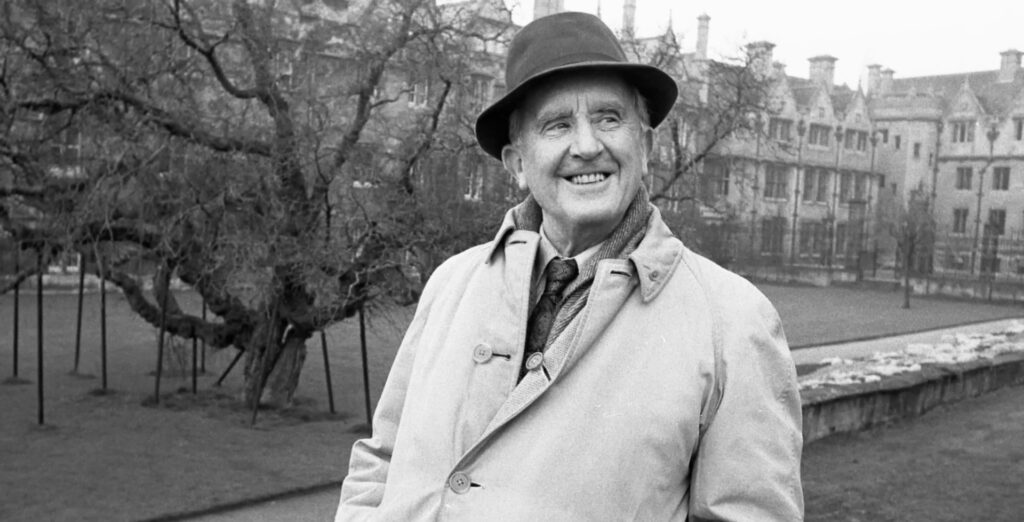
” Monumental Council”
The author of the literary YouTube channel Ink and Fantasy came after a post about Tolkien’s view of politics with another interesting video called Why Tolkien Disapproved of II. the Vatican Council, in which he reveals, as the title suggests, a new unexplored aspect of the writer’s life – namely his insight into World War II. Vatican Council. JRR describes Tolkien not only as a Catholic convert but as a traditionally minded Catholic.
II . The Vatican Council is the most important event in the modern history of the Catholic Church,” the author explains the significance of this event. He further states that the council lasted 4 years (1962 to 1965), that Pope John XXIII. convened it and that it was ” monumental “. Ink and Fantasy states:
“(Vatican Council II) touched on several topics, from huge liturgical reforms and the renewal of many foundations of church teachings to more progressive changes, such as interreligious relations, the role of the priesthood, and especially the language and ritual of St. mass .”
The author explains that this council ended the use of Latin during Masses and replaced it with the common languages of the population – to” simplify the Mass ” and ” give a greater role to ordinary believers”. ” However, traditional Catholics felt that the Church was bowing to modern social pressure,” the document continues,” and softening its stance on many issues .” The author adds:
” Simply put, traditional Catholics perceived the Council as a deviation of the Church from its traditions, especially as regards the liturgy, but it also concerned the sphere of dogmatics .”
The Church wanted to” modernize” until the traditional Catholics” didn’t like it” – and one of the opponents of the changes after World War II. J. R. R. Tolkien was also a member of the Vatican Council.
When a devout Catholic is also a linguist…
Tolkien was an ” incredibly devout Catholic,” the video says, for whom ” faith and the Church were probably the most important things in his life. ” However, the writer was not only a Catholic but a Catholic with a very traditionalist view of the world. As a scientist and intellectual, he studied the history of the Catholic Church and its fathers, as well as councils, he adored Catholic spirituality and traditions, in his view, organically transmitted from generation to generation through the Latin language, which he considered sacred.
As a linguist, he perceived Latin from both a practical and a spiritual perspective. According to him, this sacred language was directly connected with the Eucharist – the real Jesus. To demonstrate Tolkien’s genuine opposition to the removal of Latin on St. Mass, Ink and Fantasy quoted the testimony of the writer’s grandson Simon Tolkien, who mentioned:
” I vividly remember going to church with him in Bournemouth. He was a devout Roman Catholic, and it was shortly after the Church changed the liturgy from Latin to English. My grandfather disagreed and gave all the answers very loudly in Latin, while the rest of the congregation responded in English. The whole experience was quite torturous for me, but my grandfather was oblivious. He simply had to do what he thought was right .”
For Tolkien, the use of Latin during St. Mass is not only the ” tip of the iceberg “, as the author states, but also the “foundation ” of St. Mass as such. At the same time, it was not just a kind of external character of the divine service that lost its “mystery”, but a much deeper problem. The document explains that the professor generally viewed with great concern the constant efforts of church officials to ” simplify ” fixed church dogmas and regulations, as well as ” abandoning its sacred traditions ” – the abandonment of Latin was the most obvious example of these changes for everyone “and especially for a linguist “.
Protestantization of the Church?
Tolkien literally” hated ” the changes in the liturgy after II. the Vatican Council, reports Ink and Fantasy. His biggest fear was that the Catholic Church was getting dangerously close to the attitudes of the Protestant churches, which he knew well as an English Catholic and convert. The document quotes one of the letters the Lord of the Rings author wrote to his son Michael in 1967, two years after the end of the council:
The” Protestant” search for backwardness for its “simplicity” and directness, which, of course, brings some good in itself, at least in understandable motives, is erroneous and indeed futile. Because “early Christianity” is now, and despite all “research” will forever remain largely unknown; because “simplicity” is no guarantee of value; it was and is rather a reflection of ignorance.
Gross abuse was part of Christian liturgical behavior from the beginning just as it is now. (St. Paul’s reservations about Eucharistic conduct are sufficient proof of this!) “
The professor of linguistics continues in the letter, arguing that the Church was never meant to be static and that even ” Our Lord did not want it to constantly remain in its initial stage of infancy,” but that it is a ” living organism ” similar to a plant and should therefore grow as if in height so to the width, to plant leaves and bear fruit. Tolkien continues:
” The wise know that (the Church) began as a seed, but it is futile to try to dig it up again, because it no longer exists, and its strength and virtue now rests in that tree…, gardeners must tend this tree according to the wisdom they enjoy, prune him, removing rot, ridding him of parasites, and so on… However, they will surely do great harm if they become obsessed with the desire to return to the seed or even to the primeval youth, when (as they imagine) it was beautiful and still untouched by evil. “
A broken man
So Tolkien was not against changes in the Church or new reforms as such, but the reforms of II. of the Vatican Council were somewhat specific: perhaps they are best described by an Italian word and also by the council’s unofficial motto, aggiornamento – that is, a kind of modernization of the Church. That is why Latin was abandoned, and St. mass simplified, which is why services after the 1960s seem so different from services before. The professor was against the modernization of the Church, holding that it should ” defy external social norms “, modernism being number one of these enemies. Ink and Fantasy continues:
” Because of this, Tolkien, with his motives deep down in his soul, had an incredibly difficult time accepting the changes introduced by the Council. He disagreed with many of the decisions that were made on it. But he had to respect them. As a Catholic, he believed in the authority granted to the Pope and the importance of the Bishop of Rome for the Catholic Church, which, according to Tolkien, was the Church founded directly by Jesus Christ and the only instrument of salvation .”
The document goes on to quote from the same letter written by the writer to his son:
” I am aware that for you as well as for me, the Church that once seemed like a refuge now seems like a trap. But there is nowhere else to go! (I ask myself if perhaps this feeling of despair, the last stage of loyalty, was not even more often than it is recorded in the Gospels, felt by the Lord’s followers during their earthly journey?) I think that nothing can be done other than to pray, for the Church, for Christ’s vicar, and for ourselves; and in the meantime cultivate the virtue of loyalty, which indeed becomes a virtue only when one is under pressure to renounce it. “
According to the documentary, Tolkien not only disagreed with most things that happened in the Church, but the channel believes that he was also “emotionally broken “. “Nevertheless, he had to hold on to his faith, ” he continues,” that the Catholic Church will endure and that it has a way forward that he does not know. “
The fact that the professor generally welcomed interreligious dialogue with the Protestants is surprising, but that was because he hoped that they too would somehow finally come under the authority of the Pope.
Latin – the language of the Church