Skip to content
Anton Maria Claret, bishop, founder of the missionary society of the Sons of the Virgin Mary
Feast: 24 October
* 23 December 1807 Sallent near Barcelona, Spain
† d. October 24, 1870, FontForge Monastery near Narbonne, France
Name meaning: standing in front; firstborn; fighting in the lead against enemies (lat.)
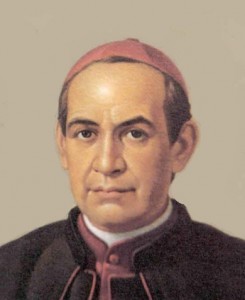
St. Anton Maria Claret
St. Anton Maria Claret was born on December 23, 1807, in the town of Sallente near Barcelona, Spain, as the fifth of ten children. He helped his father in the weaving trade from an early age. At the age of seventeen, his father sent him to Barcelona to improve his field. He had a sense of technicalities, so at the age of twenty-one he was offered the position of director of a weaving workshop. He refused. He wanted to be a priest from an early age. He often read the Holy Scriptures and prayed a lot. He studied philosophy and theology and was ordained a priest in 1835. Since there were enough priests in Spain at that time, he went to Rome and there joined the Jesuit order. Rheumatic pains in his legs forced him to interrupt the novitiate after a few months. On the advice of the Superior General, he returned to Spain. With his bishop’s approval, he began working as a folk missionary and conducting spiritual exercises. He always walked and accepted neither money nor gifts. All he took was food. He preached a lot and confessed a lot. Many people started looking for him. They said of him that he was a saint. However, it was also a time of civil wars, so he was sometimes considered a spy for the other side and persecuted. When he finished a mission and was moving to another place, he was overcome with sadness. He thought it the devil’s temptation, as well as all talk about his holiness. In 1842, he received the gift of discerning who was in a state of mortal sin. He healed the sick and had the gift of prophecy. He wrote a lot. One of the anarchists of the time said that thanks to him, the whole of Catalonia was converted. He had a similar success in the Canary Islands, where he was sent by the bishop ( in 1848). When he returned, he and several priests founded the mission society of the Sons of the Immaculate Heart of Mary. This idea was printed to him a long time ago. Now it has become a reality.
The following year (1850), he was appointed archbishop of Santiago, Cuba. He defended himself, but everyone told him that he was bound in conscience to accept it. So Anton accepted it. He arrived at his new place of work in February 1851. He immediately began conducting exercises for his priests and then went on popular missions. His success was similar to that of Catalonia. In a diocese in which there had been no bishop for fourteen years, spiritual life was on a miserable level. It included about 750,000 people. There were only about forty farries. When Anton left Cuba for Spain, 53 new parishes were established, the seminary was restored, and new orders arrived in the diocese. The archbishop went around the entire diocese three times, preaching, teaching, and confessing. Well, not only that. He taught people, especially peasants, to farm to be self-sufficient. However, he also had opponents. They were those who did not want to give up an immoral life, as well as many others who lived in various secret societies and organizations. One of them even attacked the archbishop. With a razor, hit him in the face and cut through his salivary glands. The doctors immediately operated on him, but it didn’t help; his saliva kept flowing out. They therefore wanted to wait and try the procedure again the next day. Anton was happy that he could suffer. He prayed, completely surrendered himself to the Virgin Mary, and offered his life to God. He was healed during this prayer. The doctors couldn’t understand it. This incident was a command to a smear campaign. Many false things about him were described to the Queen of Spain.
In March 1857, Queen Isabella II wrote him a letter to come to Madrid. So Anton came back to Spain. He expected the queen to deprive him of office. However, she asked him to act as her spiritual leader and help her out of the crisis she was in. However, the archbishop set conditions – will not have any political function and will not live in the royal court. In addition, he openly told her that he had to release his lover and return to his husband. After long internal struggles, the queen began spiritual exercises and led a new life. In addition to this activity, Anton had time for the apostolate—publishing religious publications, establishing folk libraries, and often preaching. He did not interfere in politics at all. He mainly ensured that only priests who led a virtuous and religious life were ordained as bishops. You suffered a lot from your haters; they slandered you, made fun of you. He spent ten years like this.
In 1868, a revolution broke out. The archbishop went to France together with the royal family. The following year, he founded the Conference of St. Families, whose mission was to care for Spanish emigrants. In the same year, he went to Rome, where Pope Pius IX received him. He also participated in the opening of the First Vatican Council on December 8, 1869, and in various meetings of the council. He continued to live in poverty, preaching, writing, confessing, and visiting the sick. When he himself fell ill, he returned to France to join his missionaries. He died after a painful illness on October 24, 1870, in the Cistercian abbey in Fontfroid near Narbonne (in the south of France), where he took refuge from persecutors. They buried him there. They engraved the words on his grave: „ I loved justice and hated iniquity, therefore I die in exile.“ Pope Pius XI. beatified Anton Maria Claret in 1934 and Pius XII in 1950 as a saint. His remains were taken to the house of his mother’s congregation in Vich (the current Vic near Barcelona), where they are still located today.
Visitors counter: 284
This entry was posted in
Nezaradené. Bookmark the
permalink.


Hello. And Bye.