7 practical tips for effective reding of the Holy Scriptures.

7 practical tips for effective reading of the Holy Scriptures

7 practical tips for effective reading of the Holy Scriptures
 

This article aims to present seven practical tips that can help us get the most out of the Bible for our lives:

1. Read regularly and in order

If we want to start reading the Bible effectively, then we mustn’t do it three times a year. One of the basic and first rules is the regularity of our reading. We can read and meditate on it every Sunday, for example, but it would certainly be better every day. If the interval of our reading is too long, it will bring only small results for our life.

This rule of regularity also includes systematic reading, i.e., reading in order. We should avoid opening the Scriptures at random, not because God can’t speak to us anyway, but because we will understand the biblical texts much better if we read them in context.

For example, we can choose one chapter for one meditation, or one paragraph marked with a subtitle. But to begin with, it is better to take one chapter so that we can read the entire Holy Scripture as soon as possible. Only then will even the less well-known and more difficult texts become clearer to us. It does not necessarily mean that we have to start reading the Bible from the beginning, that is, from the Book of Genesis. We can easily start with the Gospels, which are more familiar and understandable to us at the beginning, continue with the New Testament to the end, and then return to the Old. The important thing is to read the Bible all the way through… and then continue over and over again. Since it is the Word of God, we cannot simply “know” it all or exhaust its treasures.

2. Prayer to the Holy Spirit

The first rule talked about our reading in general, and how to set up our mode of biblical contemplation (it is clear to us that reading alone would not solve anything special, it would only give us a general biblical overview, but it would not satisfy our soul). Now let’s look at how such reading and meditation of biblical texts should take place.

We know that the biblical texts are ALL inspired by the Holy Spirit, so if we want to understand them correctly, we have to ask the original author what he meant. And that is the Holy Spirit. The texts were created under his guidance, and we must read them under his guidance. We can do so with a short prayer at the beginning, such as: “Holy Spirit, enlighten my mind so that I can correctly understand this word of God, so that I can find out what you want to tell me through it and so that I can put it into practice.” Without such a prayer we should not start reading the Bible at all, because it is not some history textbook or a historical novel, but the word of the living God speaking to man.

3. Read without prejudice, carefully, and with faith

This rule may be a little laughable, but no less important. Many times we approach the biblical text with big prejudices, for example: “I would read the Bible, but it’s so difficult to write!” or: “I read the Gospels sometimes, but the Old Testament, it’s just battles and wars.” We must give up such and similar prejudices because they prevent us from penetrating the deeper essence and message of the biblical text. Of course, this is ancient literature, so let’s not expect politically, democratically, and sociologically correct texts according to the understanding of a person living in the 21st century, but their message and God’s truths are timeless and still just as relevant. The Book of Wisdom or the First Book of Maccabees is just as much God’s word speaking to modern man as the Gospel according to Matthew.

4. Don’t be afraid of working with text

We have already said that this is ancient literature, through which scribes guided by the Holy Spirit capture the history of salvation and the experience of God’s people with God’s saving actions. It is therefore completely natural that we cannot understand all the metaphors and similes that people of that time used to express themselves. Even in 1000 years, people may not understand what it means to be “in” or “out” or to “hate” something. That’s why they are biblical scholars, and thus experts specializing in God’s word. They research his texts, history and work it into footnotes under the text. Although it is written in small print and sometimes quite technical, it is worth looking at and reading things that often completely explain our questions about the text we are currently contemplating. In the Jerusalem Bible, we also find the so-called marginalia where there are references to other texts within the Holy Scriptures talking about the same or a similar subject as the given verse.

5. What does this text say to me personally?

In the vast majority of cases, we do not meditate in order to preach it in religion, in church, or to explain it to someone else. We meditate because we need to be fed with God’s word. This means that our first question should not be: “What does this text want to say in general?” but “What is God saying to me through this text?” to take one idea from him and stay with it until we are satisfied with it. Only then should we continue.

6. To capture what appealed to me

Since we are forgetful people and even with our best intentions we always miss something, it is highly recommended to have a diary or other notebook in which we write down what appealed to us during biblical meditation. There is also no need to be afraid of highlighting and writing in the Bible itself. Many people have a problem with this because it seems undignified, but the truth is that it is not the pages of the Bible that are sacred, but what is written on them. This means that it is always more commendable to have a Bible scribbled and be able to navigate in it, than to have it placed on a shelf in the living room in a place of honor and to wipe the dust from it once a week. But the rule remains that everyone does what is most convenient and natural for them.

7. Prayer based on the meditative text
Again, our contemplation should end with prayer. This is a kind of summary of what appealed to us. For example, if the sentence speaks to me: “And behold, I am with you all the days until the end of the world” (Mt 28:20), then I can pray: “Thank you, God, for never leaving me.” Thank you for choosing to accompany us until the end of the world. Forgive me for forgetting this matter so often…” And so on. Prayer based on a meditative text helps us better assimilate and accept the text through which God spoke to us.

!

Posted in Nezaradené | 1 Comment

Magdalena of Nagasaki, virgin and martyr

Holiday:September 28

* 1611 Nishizaka, Japan
† October 15, 1634 Nagasaki, Japan

St. Magdalena was born in 1611 in Nishizaka near the Japanese city of Nagasaki. Her parents were convinced and zealous Christians. She was beautiful and kind to everyone. When she was still young, her parents and brothers were sentenced to death. They died for their loyalty to the Christian faith. In 1624, Magdalena met two Augustinian monks – Francis from Jesus and Vincent from St. Anton. Their deep religiosity attracted her greatly. She decided to consecrate herself completely to God as a Dominican Tertiary. She helped Christians who were suffering from widespread persecution at the time. She gave courage to those who were losing her, taught catechism to children, and begged Portuguese merchants for alms for the poor.

In 1629, together with other Christians, she sought refuge in the mountains around Nagasaki from the persecutors who spread fear and suffering everywhere. She tried to encourage everyone in their faith, took care of wounded and tortured people, visited the sick, baptized children, and pleased everyone with her words and service of love. To effectively prevent the apostasy of tortured and abused Christians, she decided to voluntarily register as a Christian. She put on her tertiary habit, and took a small backpack with her, full of spiritual books, so that she would have something to meditate on in prison. They imprisoned her and tried in every possible way to break her faith. But neither the offers of an advantageous marriage nor the threat of torture could convince her. On October 1, she was hanged by her feet on the gallows, while her head and chest were already in a pit dug directly under the gallows. In addition, they also covered her with a blanket to make it difficult for her to breathe. The heroic young woman resisted the torture for thirteen days, invoking the names of Jesus and Mary. There was a big downpour on the last night. The pit in which her head was filled was filled with water and Magdalena drowned. It happened on October 15, 1634. The tyrants burned her body and scattered the ashes into the sea.

She was declared a saint together with a group of sixteen Dominican martyrs of various nationalities. All were killed in Japan. The first killed from this group was St. Vavrinec Ruiz, who was of Filipino nationality. The entire group was beatified on February 18, 1981, in Manila, Philippines, and canonized on October 18, 1987, in Rome. We celebrate the memory of the entire group of martyrs on September 28. The symbol of St. Magdalena is a palm tree.

Posted in Nezaradené | Leave a comment

27. Sunday in Ordinary Time, Year B Mr. 9,38-43,45, 47-48

Among the terrible deaths is drowning. In the past, when they wanted to punish someone with this death, they attached a heavy stone to his shoulders so that he could not save himself at all. If he wanted to swim, the stone pushed him to the bottom. According to Jesus, there is something more terrible than such a death. It’s an outrage. If someone offends others, “it would be better for him if a millstone were hung around his neck and thrown into the sea”. Why do we hear such harsh words from the mouth of Jesus? Because the one who offends destroys the inner, spiritual life. And it is a tough act when it destroys the other’s focus on God. So it destroys his faith. If someone causes a person to resent God, Christ, and the Church by his offense, then it would be better for such a person if he died prematurely. Death would help him so that he would not have such a sin in his soul and before God. The grace of faith, or the grace of turning to God, is given by God himself.

He is the first reason someone starts thinking about him and accepting him into his life. God helps himself by various means to open man to himself. Most often, people and events open the hearts of others so that God can enter them. God will never break this relationship with him. Only a human can break it. He does so when he decides to do so himself or when others help him. Today, we are thinking about this second variant. There are people whose faith has not matured, whose faith has disappeared because others caused it. We could call them faith killers. Each of us has a great responsibility for the faith of our brothers and sisters. If we are to live responsibly, we must also live the gospel responsibly. Christ even speaks of a certain radicalism. After all, how else can we understand his words that we should cut off our hands and legs and pluck out an eye if they tempt us to sin?

This radicalism is directly aimed at achieving the kingdom of God. However, it is also indirectly aimed at others because the sins we do not remove from our lives will be a scandal for them. If they are an offense to others, then we cannot enter the kingdom of God. The most stupid opinion of a Christian is when he says that no one should care about his life. We certainly have a right to privacy. But we do not have the right to forbid people from being utterly interested in our lives. And if we wanted to appropriate such a right, we could only exercise it if we did not come to the light of God. We would have to “wall ourselves off” at home. We know from our own experience that those who completely isolate themselves from people are not normal. Ordinary people live their lives with other people. But those others are constantly watching us. They can watch us from a different point of view.

It is serious for us when we are observed from the point of view that we are believers. Then they compare our words and our deeds with our faith. If they see a discrepancy there, they may become disillusioned. Disillusionment would not be the worst thing yet. It becomes wrong when our behavior causes us to help them laugh at our faith, to see it as a sham. And if God forbid they say that I should be such a Christian, then I’d rather be a non-believer or be interested in another faith. In life, we will never have the security to say no one has offended us. Neither I nor you can tell. If someone were to take offense at the fact that we are good Christians, that is not our problem. Then, we are dealing with a person who is hostile to God. Or he is offended because our life makes him rightfully reproached.

Our problem is whether he wants to find a way to God and the Church through us or live his religious life more fully. Then we must tremble before offending him. Today, when we meet young people whose parents offended them so much that they resented religion, but now they receive the essential sacraments, they will usually tell you that good young Christians helped them to do so. They met such people who not only believed in Christ but also lived according to Christ. If they met us, they would be baptized and go to the First St. reception. If someone could do business with millstones today, he would become rich quickly. Not because mills are being built, but because, unfortunately, so many Christians deserve them. Although no one hangs them around our necks, let us think very seriously about Christ’s terrible comparison to those who offended us.

Posted in sermons | 1 Comment

St.Vincent de Paul,priest.

* April 24, 1581, Pouy (today Saint-Vincent-de-Paul) near Dax, southern France

† September 27, 1660 Paris, France

Meaning of the name: winner (lat.)

Patron of associations, businesses, priests, children’s homes and hospitals, prisoners, in search of lost things

Sv. Vincent de Paul

St. Vincent de Paul

St. Vincent de Paul was born on April 24, 1581, in the village of Pouy near the town of Dax in France at the foot of the Pyrenees. His parents were poor farmers. They had six children and had to work hard from an early age. From an early age, Vincent had a sense for the poor and gave them gifts wherever he could. When the father saw this, he decided to do everything for his son to become a priest. That’s what happened. He went to the Franciscans, where he acquired basic knowledge. He was very gifted and diligent and soon earned his living by tutoring others, so he was not a burden on his parents. In 1597 he transferred to the University of Toulouse. That already cost a lot of money. The father sold the oxen and plow so the son could study. In 1600, Vincent was ordained a priest. He then continued his studies in Zaragoza and Toulouse. In 1605 he traveled from Marseille to Narbonne. It was a short trip, he went by boat. However, they were ambushed by pirates on the way, captured, and dragged to North Africa. There they were sold as slaves. Vincent worked as a doctor’s assistant, later on a large estate. He was an exemplary worker and encouraged his comrades to persevere. He told them stories from the lives of the saints and taught them psalms. It reached the ears of one of the farmer’s three wives. She went to Vincent and liked what he was talking about. Together they agreed and secretly left Africa with her husband. In 1607 they landed in France. In Avignon, she was baptized and her husband, who was an apostate Christian, rejoined the Church.

In the same year, he visited Rome and then became a court priest in Paris to Queen Margaret of Valois. But Vincent didn’t like it. In 1612, he became administrator of a parish in a Paris suburb. Later he was appointed parish priest in the village of Chatillon-les-Dombes. He influenced the count family of Gondi, he helped raise three sons, one of whom became an important duke and the other a cardinal. With the financial and moral support of Countess Gondiová, he started preaching, going from village to village together with several priests. The archbishop was happy because many sinners found their way back to the Church. In 1625, he dedicated to them the house where Vincent organized his brotherhood, which was confirmed in 1631 by Pope Urban VIII. as a congregation. Vincent called them Lazarists after the house of St. Lazarus, which they received as a gift. Vincent built a house for the sick and poor, went to prisons, and tirelessly cared for those in need.

In addition to the male congregation, he founded in 1633 with St. Louise de Marillac apostolic society of women – Daughters of Christian Charity. He did not prescribe them a closed monastic life or solemn eternal vows. He wanted them to devote themselves as much as possible to those who need it, e.g. illegitimate children. He took care of fallen women and the elderly, founded a hospital for them, and built an insane asylum. He introduced spiritual exercises for priests, but also ordinary people. He sent his priests as missionaries to Poland, Hungary, Scotland, Ireland, Tunisia, and Algeria… In addition, he did not miss a single day of contemplation, deep prayer, St. mass, and breviary. He fought against Jansenism – a pessimistic delusion that was spreading in France at the time. For the past eleven years, he had suffered greatly from a painful cold. He died suddenly – on September 26, 1660, he became very weak. They provided him with the sacraments of the dying and the next day, September 27, 1660, he died. He was eighty years old. Fifty years later, his body was found intact. In 1737 he was declared a saint. He is the patron of all acts of love for one’s neighbor.

Posted in sermons | Leave a comment

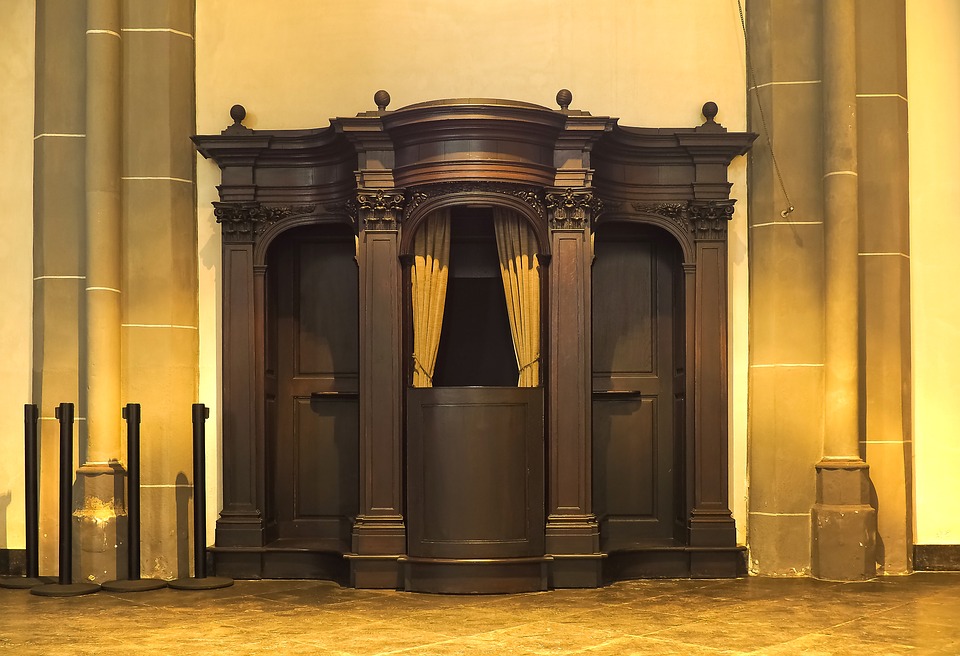
What ist the essence of St. Confession?

The basis of the sacrament of penance is the power to forgive sins, which was granted to the apostles by Christ. In the actual exercise of this power, other necessities approach. The sacrament as such must have a proper matter and form and produce certain effects; the power of the keys can only be exercised by a minister (confessor) with adequate qualifications, and the effects of the exercise of the power of the keys are manifested in the recipient’s soul, i.e. the penitent, who with certain necessary dispositions must also perform certain actions (confession, satisfaction).

Matter and form

According to St. Thomas (Summa Theologiæ III. 84. 2) ” the actions of the penitent are the closest matter of this sacrament “. This is also the teaching of Eugene IV. in ” Decretum pro Armenis ” (Council of Florence, 1439). He enumerates the “quasi-matter” of the sacrament of penance – contrition, confession, and satisfaction (Denzinger-Bannwart, Enchiridion, 699). Thomists in general, but also other prominent theologians, e.g. Bellarmine, Toletus, Suárez, and De Lugo, hold the same opinion. According to Scotus (In IV Sent., D. 16, q. 1, n. 7) “the sacrament of penance consists in the absolution which is granted by the prescribed words,” while the actions of the penitent are necessary for the worthy reception of the sacrament. Absolution, as an external ceremony, is the substance of the sacrament, and as an act that carries significant power, it is also a form. Among the defenders of this theory are St. Bonaventure, Capreolus, Andreas Vega, and Maldonatus. The Council of Trent (Sess. XIV, c. 3) says: “The acts of the penitent, namely contrition, confession, and satisfaction, are the quasi-matter of this sacrament”.

The Roman Catechism, used in 1913 (II, v, 13) says: “These acts are called quasi-matter by the council, not because they do not have the nature of real matter, but because they are not a substance that is used externally like water in baptism and chrism in Confirmation.” For a theological discussion on this matter, see Palmieri, op. cit., p. 144; Pesch, ” Praelectiones dogmaticae”, Freiburg, 1897; De San, ” De poenitentia”, Bruges, 1899; Pohle, ” Lehrb. D. Dogmatic “. As for the form of the sacrament, both the Council of Florence and the Council of Trent teach that it consists in the words of absolution. “The form of the sacrament of penance, in which its power lies, is in the words of the confessor: “I absolve you, etc.” To these words, by the customs of the Holy Church, certain prayers are commendably added, but they do not concern the essence of the sacramental form, nor are they necessary for the valid administration of the sacrament. (Council of Trent, Sess. XIV, c. 3) Regarding these supplementary prayers, the practice of the Eastern and Western Churches, and the question whether the form of the sacrament of penance is deprecative or indicative and personal, compare also the authors mentioned in the preceding paragraph.

Effect

“The effect of this sacrament is deliverance from sin.” (Council of Florence) The Council of Trent gives the same definition in slightly different words (Sess. XIV, c. 3): “As for its power and effectiveness, the effect (res et effects) of this sacrament is reconciliation with God, after which peace and quietness of conscience sometimes come in pious and humble recipients, along with intense consolation of the soul.” This reconciliation primarily means the forgiveness of guilt for sin and also the eternal punishment for mortal sin. The Council of Trent says that repentance requires the making of satisfaction “not for eternal punishment, which is forgiven together with guilt, or the sacrament, or the desire to receive this sacrament, but for temporal punishment, which, as the Scriptures teach, is not always completely forgiven, as in baptize.” (Sess. VI, c. 14)

In other words, baptism frees the soul not only from all sin but also from all debt to God’s justice. After receiving absolution in the sacrament of penance, there may and usually remains some temporary debt to be paid by works of satisfaction (see below). “All sins by which we are not deprived of God’s grace and into which we very often fall, it is right and useful to confess in confession; however, they can be kept silent about without any guilt, and they can be erased by many other remedies.” (Council of Trent, Sess. XIV, c. 3) Repentance is enough to obtain the forgiveness of venial sins, and this forgiveness is also obtained by the worthy reception of other sacraments, for example, the Holy receiving.

Reconciliation of the sinner with God also has another consequence – the revival of those merits that he earned before he committed a grave sin. Good works done in the state of grace deserve a reward from God, but this is forfeited with mortal sin, so if the sinner were to die without absolution, his good works would avail him nothing. As long as he remains in sin, he is unable to merit a reward: even works that are good in themselves are worthless in that case: they cannot come to life, because they were never alive. But as soon as his sin is absolved by the sacrament of penance, he regains not only the state of grace but also the whole store of merit which was credited to his account before his sin.

On this point, theologians are practically unanimous. The only obstacle to obtaining a reward is sin, and when that is removed, the former claim is, so to speak, restored. On the other hand, if there was no such renewal of the merits, their loss would be tantamount to eternal punishment, which is incompatible with the forgiveness achieved through repentance. There are different opinions on the question of the manner and extent of the restoration of merit; but what is generally accepted was formulated by Francisco Suárez ( De reviviscentia meritorum ) that the restoration of merit is complete, i.e. an absolved penitent has as much merit to his credit as if he had never sinned. See De Augustinis, ” De re sacramentaria “, II, Rome, 1887; Pesch, Op. cit., VII; Göttler, ” Der hl. Thomas v. Aquin u. Die vortridentinischen Thomisten über die Wirkungen d. Bussakramentes “, Freiburg, 1904.

Minister (confessor)

It follows from the judicial nature of this sacrament that not every member of the Church is qualified to forgive sins; the performance of the sacrament of penance is reserved for those who have been entrusted with authority. That this power does not belong to the laity is evident from the bull of Martin V ” Inter cunctas ” (1418), which, among other questions to which the followers of Wyclef and Hus were to be answered, asks: “do you believe that a Christian… is he obliged, as a necessary means of salvation, to confess only to a priest and not to a layman or laymen, however good and pious?” (Denzinger-Bannwart, ” Enchiridion “, 670) Luther’s assertion that “every Christian, even a woman or a child” could, in the absence of a priest, absolve another, just as well as a pope or a bishop, condemned (1520) Leo X. in the bull ” Exurge Domine ” (Enchir., 753) The Council of Trent (Sess. XIV, c. 6) condemns as “false and contrary to the truth of the Gospel are all doctrines which extend the ministry of the keys to other than bishops and priests, thinking that the words of the Lord (Mt 18:18; Jn 20:23) were contrary to the institution of this sacrament, intended for all believers in Christ such in such a way that everyone has the power to forgive sins.” Therefore, Catholic doctrine is that only bishops and priests can exercise this power.

Moreover, these decrees practically put an end to the custom, which appeared and lasted for a while in the Middle Ages, of confessing to a layperson in case of emergency. This custom arose from the belief that the one who has sinned is obliged to confess his sin to someone – to a priest, if possible, otherwise to a layman. In the book “True and False Repentance” ( De vera et falsa poenitentia ), erroneously attributed to St. Augustine, she writes: “So great is the power of confession of sin that if there is no priest at hand, let him (the person who wants to confess) confess to his neighbor.” However, in the same place, the explanation is given: “Even though the, to whom he confesses, has no power to absolve him, he who confesses to his companion (socio) becomes worthy of forgiveness based on his desire to confess to a priest.” (PL, XL, 1113) Leo, who quotes the statement of Pseudo-Augustine on confession to one’s neighbor, overlooks this explanation and misrepresents a series of cases from practice and gives only an imperfect idea of ​​the theological discussion they provoked. Albertus Magnus (In IV Sent., Dist. 17, Article 58) considered absolution granted by laymen to be sacramental, while St. Thomas (IV Sent., D. 17, q. 3, a. 3, sol. 2 ) speaks of it as ” quodammodo sacramentals – as if sacramental”, other great theologians had a completely different opinion.

Alexander of Hales (Summa, Q. xix, De confessione memb. , I, a. 1) says that it is a “plea for absolution”; St. Bonaventure (” Opera “, VII, p. 345, Lyons, 1668) says that such a confession is not necessary even in case of emergency and is only a sign of repentance; Scotus says, (IV para., D. 14, q. 4) that there is nothing which binds a layman to confession, and that this practice may be very harmful; Durandus (IV Sent., d. 17, q. 12) says that if there is no priest who alone can pass the sentence of absolution in the penitent tribunal, then there is no obligation to confess; Prierias (Summa Silv., Confessor, I, 1), says that if confession is made before a layman, it is necessary to repeat it as soon as possible; this was the general opinion. Therefore, it is not surprising that Dominicus Soto, wrote in 1564 that he found it difficult to believe that such a custom ever existed: “Since (confession to a layman) was no sacrament…, it is incredible that people would reveal secrets to others just like that and without the benefit of his conscience.” (IV Sent., d. 18, q. 4, a. 1)

Thus, the weight of general theological opinion gradually turned against this practice, and since this practice never received official confirmation, it cannot be taken as proof that even the laity sometimes had the power to forgive sins. What this practice shows is that both the people and the theologians were very well aware of the obligation to confess their sins not only to God but also to some human listeners, although he had no legal power to absolve them. The same exaggerated idea appears in the practice of confessing to a deacon – in case of emergency. They were naturally preferred to the laity when no priest was available because, by their office, they administered Holy Communion.

Furthermore, some of the earlier councils (Elvira, AD 300; Toledo, 400) seem to have granted the deacon the power to confess (in the absence of a priest). The local council of Tripura (895) declared about bandits that if they were captured or wounded and confessed to a priest or deacon, they should not be refused communion; and this expression “presbyters vel diacono” was incorporated in Gratian’s decree and many later documents from the 10th to the 13th centuries. The local council of York (1195) decreed that, except in extreme necessity, a deacon should not baptize, give communion, or “give penance to one who has confessed.” Essentially the same regulations are found in the decrees of the London (1200) and Rouen (1231) councils, the constitutions of St. Edmund of Canterbury (1236), and Walter Kirkham, Bishop of Durham (1255).

All these regulations, though strict enough in ordinary circumstances, grant an exception for urgent necessity. According to the decree of the Synod of Poitiers (1280), no such exception is allowed: “Desiring to root out the wrong vices that have grown up in our diocese through dangerous ignorance, we forbid deacons to receive confessions or grant absolutions at the judgment of penitence: it is certain and indubitable that they cannot absolve, because they have not the keys which are conferred only on the priesthood.” This “evil custom” probably disappeared in the 14th or 15th century; The Council of Trent does not mention it anywhere, but the reservation of the power to absolve only bishops and priests clearly shows that the council excluded deacons from this.

The permission that certain medieval synods granted to deacons in case of emergency did not give them the power to forgive sins. In some decrees, it is explicitly stated that the deacon does not have keys – claves non habent. In other enactments it is forbidden, except when it is necessary to “give” or “impose a penance,” penitential dare, imponere. Its function was then limited to the forum externum; in the absence of the priest he could “reconcile” the sinner, i.e. return him to the communion of the Church; but he did not and could not give sacramental absolution, which only a priest could give (Palmieri, Pesch). Another explanation emphasizes the fact that the deacon could legitimately administer the Holy Eucharist.

The faithful had a strict obligation to receive Holy Communion at the approach of death, and on the other hand, the reception of this sacrament is sufficient for the forgiveness of even mortal sin, provided that the recipient has the necessary internal disposition. The deacon could hear the confession of sins only to make sure that they were properly repented of and forsaken, but not to absolve them. If he went further and “imposed penance” in the stricter sacramental sense, he exceeded his authority, and any permission for this purpose granted by the bishop only proved the bishop wrong (Laurain, ” De l’intervention des laïques, des diaries et des abbesses dans le administration de la pénitence”, Paris, 1897).

m

The proper jurisdiction is that which the person has by his office as pastor; the pope has it over the whole Church, the bishop in his diocese, the priest in his parish. Delegated jurisdiction is the authority granted by an ecclesiastical superior to one who does not have it in his office. The need for jurisdiction to administer penance is usually expressed by the priest having to have “faculties” to confess. Therefore, a priest who has visited a diocese other than his own cannot confess without the special permission of the local bishop. However, any priest can absolve anyone who is in danger of death, because in these circumstances the Church gives authority to all priests. As the bishop confers judicial power, he can also limit it by “reserving” certain cases and can even withdraw it altogether.

Recipient (penitent)

The sacrament of penance was instituted by Christ for the forgiveness of sins committed after baptism. Therefore, an unbaptized person cannot be validly absolved, however deep and sincere his sorrow and remorse may be. Baptism is therefore the first necessary prerequisite on the part of the penitent. This does not mean that there is something particularly grievous and unforgivable about the sins committed by an unbaptized person, which puts them outside the power of the keys; it means that a person must first be a member of the Church to submit himself and his sins to the judicial process of sacramental penance.

Regret and resentment

Without repentance for sin, there is no forgiveness. That is why the Council of Trent says (Sess. XIV, c. 4): “Repentance, which has the first place among the acts of the penitent, is the sorrow of the heart and the aversion to the sin committed, together with the determination to sin no more.” The Council (ibid.) further distinguishes perfect (contrition) and imperfect contrition (attrition), which results from aversion to all the abomination of sin, or the fear of hell and punishment. See treatises by Pesch, Palmieri, Pohle. Here it is sufficient to state that in the sacrament of penance, imperfect contrition is sufficient to obtain the forgiveness of sin. The Council of Trent further teaches (ibid.): “Even if it sometimes happens that repentance is perfect and that it reconciles a person to God, even before a person has received this sacrament, reconciliation should not be attributed to repentance alone without a desire for the sacrament, because regret always contains this desire.’

By this teaching, Pius V condemned (1567) Baio’s thesis that even perfect penance – except in extreme need or martyrdom – does not forgive sin unless there is a real reception of the sacrament (Denzinger-Bannwart, ” Enchiridion ” 1071). It should be noted, however, that the repentance spoken of by the council is perfect in the sense that it also includes the desire (votum) to receive the sacrament of penance. Anyone who truly repents of his sin out of love for God must be willing to follow the Divine decree regarding repentance, that is, he must confess if there is a confessor at hand, and if he is not, then he must be aware of the obligation to confess at the first opportunity.

Nor does it follow that the penitent is free to choose between two ways of obtaining forgiveness – repentance on the one hand and confession with absolution on the other. This view was postulated by Peter Martinez (de Osma) in the thesis: “Mortal sins, in terms of guilt and punishment in the other world, are erased only by repentance alone without any reference to the keys”; and this thesis was condemned by Sixtus IV. in 1479 (Denzinger-Bannwart, ” Enchiridion “, 724). It is therefore obvious that even sincere sorrow based on the best motives cannot do without the power of the keys in the present order of salvation, i.e. the sacrament of penance.

Confession (necessity)

“For those who have fallen into sin after baptism, the sacrament of penance is necessary for salvation, just as baptism is necessary for those who have not yet been regenerated.” (Council of Trent, Sess. XIV, 2) Penance is therefore not an institution whose use is left to the discretion of the individual sinner, so that he may, if he so desires, without connection with the Church, secure forgiveness by other means, such as by confessing his sin in the privacy of his soul. As already stated, the power that Christ gave to the apostles is twofold: to forgive and to retain, so that what they forgive, God forgives, and what they withhold, God withholds. This power would be destroyed if the Church withholds someone’s sins and he appeals to God’s judgment and there obtains mercy. This power would not make sense even if the sinner bypassed the Church and went straight to God, because it would contradict the very conditions under which this power was granted – God will retain sin until the Church forgives it. It would indeed be strange and inconsistent if Christ, in bestowing this double power on the apostles, intended to preserve some other means of forgiveness, such as confessing “directly to God.”

Not only the apostles but also anyone who has a basic knowledge of human nature would immediately notice that people will choose the easier way and that the granting of power, which Christ formally and solemnly performed, has no meaning (Palmieri, op. cit., thesis X). On the other hand, once it is admitted that this grant was valid, and therefore that the sacrament is necessary to obtain forgiveness, it follows that the penitent must in some way confess his sin to those who exercise this power. This is admitted even by those who reject the sacrament of penance as a divine institution. “Such forgiveness is impossible without confessing the sins to be forgiven.” (Lev, ” History “, I, p. 182) The Council of Trent after declaring that Christ left us his priests as his representatives, to whom the faithful must how confess their sins to their administrators and judges, adds: “It is obvious that the priests could not hold this judgment without knowing the offense, nor could they serve in the satisfaction of justice, if they (believers) confessed their sins only in general and not specifically and in detail. ” (Sess. XIV, c. 5)

Because the priest performs the role of a strict judge in the forgiveness of sins, Christ must have wanted such an enormous power to be used wisely and prudently. In addition, the priest can forgive all sins without distinction, quoecumque solvers, based on Christ’s mandate. How can a reasonable and prudent judgment be passed if the priest knows nothing about the case in which he is passing judgment? And how can he obtain the necessary knowledge, if not from the voluntary and spontaneous confession of the sinner? This necessity of the confession of sins is even clearer if the satisfaction for sin, which has been a part of the confessional discipline from the very beginning, is to be imposed not only wisely, but also justly.

The fact that there is a necessary connection between the prudent judgment of the confessor and the detailed confession of sins results from the nature of judicial proceedings and especially from a complete analysis of Christ’s empowerment, carried out in the light of Tradition. No judge shall acquit or sentence without full knowledge of the case. And again the Tradition of the oldest period sees in Christ’s words not only the office of the judge who sits at the court but also the kindness of the father who weeps with the penitent child (Aphraates, ” Ep. De Poenitentia “, dem. 7) and the skill of the physician who, according to the manner of Christ heals the wounds of the soul (Origen in PG, XII, 418; PL, XII, 1086). It is evident, therefore, that the words of Christ contain the doctrine of the outward revelation of conscience which the sinner must make to the priest to receive grace.

Confession (various types)

Confession is a sworn disclosure of sins presented to a duly authorized priest to obtain forgiveness through the power of the keys. Virtual confession is simply the will to confess, even if, due to circumstances, it is not possible to do so; real confession is any action by which the penitent reveals his sin. This may be done generally, for example by reciting the ” Confiteor “, or it may consist of a more or less detailed enumeration of one’s sins, where the enumeration is complete and the confession is comprehensible. Public confession, which is made in the hearing of several people (e.g. congregation), differs from private or secret confession, which is made only to a priest and is often called aural, i.e. spoken into the confessor’s ear.

Here we are mainly concerned with real and concrete confession, which is customary in the Church and which, as regards the validity of the sacrament, may be public or private. “As for the method of secret confession only to the priest – although Christ did not forbid that someone, as part of the punishment for his crimes and his greater humility, to set an example to others and help build the Church, publicly confess his sins, so Christ did not even order nor would it be reasonable to order by any human law that sins, and especially secret sins, should be publicly confessed. Therefore, the secret sacramental confession, which was from the beginning and is still practiced in the Church, has always been valued with the great and unanimous approval of the holy and most ancient Fathers, and therefore the foolish slander of those who presumptuously teach that it (secret confession) is in it contradicts God’s command and it is a human invention promoted by the Fathers gathered at the Lateran Council.” (Council of Trent, Sess. XIV, c. 5) Catholic teaching is, therefore,

Posted in Nezaradené | 1 Comment

Nicholas of Flüe

Nicholas of Flüe

also: Niklaus, Brother Klaus
also: von der Flüe, de Rupe

1 Catholic Memorial Day: 21 March
Non-obligatory Memorial Day in German-speaking areas: 25 September
Solemnity in the dioceses of Basel, Chur, St. Gallen, Sitten, and Lausanne-Geneva-Fribourg: 25 September
Feast in the Diocese of Lugano: 25 September
Obligatory memorial day in the diocese of Feldkirch: 25 September
 in Switzerland: Feast I. Class
Diocesan Calendar Freiburg i. Br.
non-obligatory memorial day in the Archdiocese of Salzburg: 23 September

1 Protestant Memorial Day: 21 March

 The name means: the victor over the people (Greek)
Hermit, mystic, peacemaker
1417 in Flüeli, district of Sachseln in the canton of Obwalden in Switzerland
† 21 March 1487 in the Ranftschlucht near Flüeli in the canton of Obwalden in Switzerland


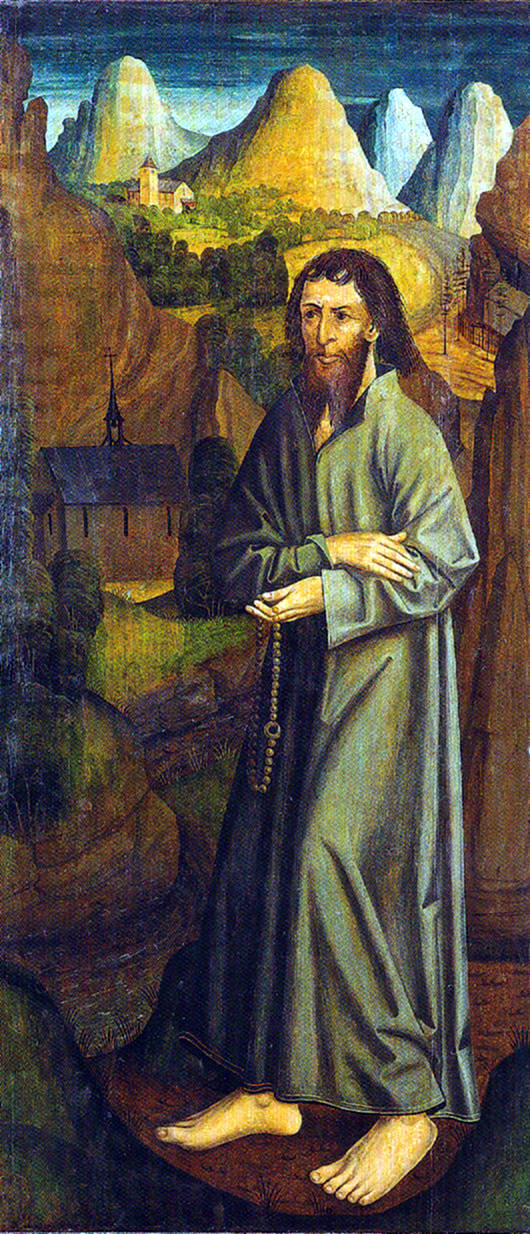
Altarpiece, 1492, formerly in the parish church, today opposite in the Bruder Klaus Museum in Sachseln
Altarpiece, 1492, formerly in the parish church, today opposite the Bruder Klaus Museum in Sachseln

Nikolaus, son of the public domain farmer Heini and his wife Hemma, who owned 12 hectares of land and were thus rich farmers, was blessed with visions as a child. As a young man, he had a strong penchant for solitude and silent prayer. At the age of 16, he saw in a vision a tall tower at the spot in Ranft where he later built his hermitage. There are also reports of a visit from three men – similar to the visit of the three divine men to Abraham – who promised him a blessed death and gave him a cross as a sign.

Nicholas became a farmer and from 1440 he took part as an officer in the war against Zurich, during which the massacre of Greifensee took place, the murder of the already defeated defenders. In 1446, at the age of about 29, Nicholas married the fourteen-year-old Dorothea Wyss, then built a new house on the Flüeli and became the father of five boys and five girls. In 1457 he took legal action against the increase in church taxes demanded by the priest of Sachseln, and in 1459 he rose to the rank of councillor in Obwalden and judge of his community. He was respected for his sense of justice and his wisdom; he resisted higher political tasks. In 1460 he was again involved as a soldier in the campaign against Thurgau; according to tradition, he prevented the burning of the Katharinental monastery in Diessenhofen. Throughout all these years, however, he never lost his secret longing for the life of a hermit. When he first asked his wife for his release, she refused in horror.

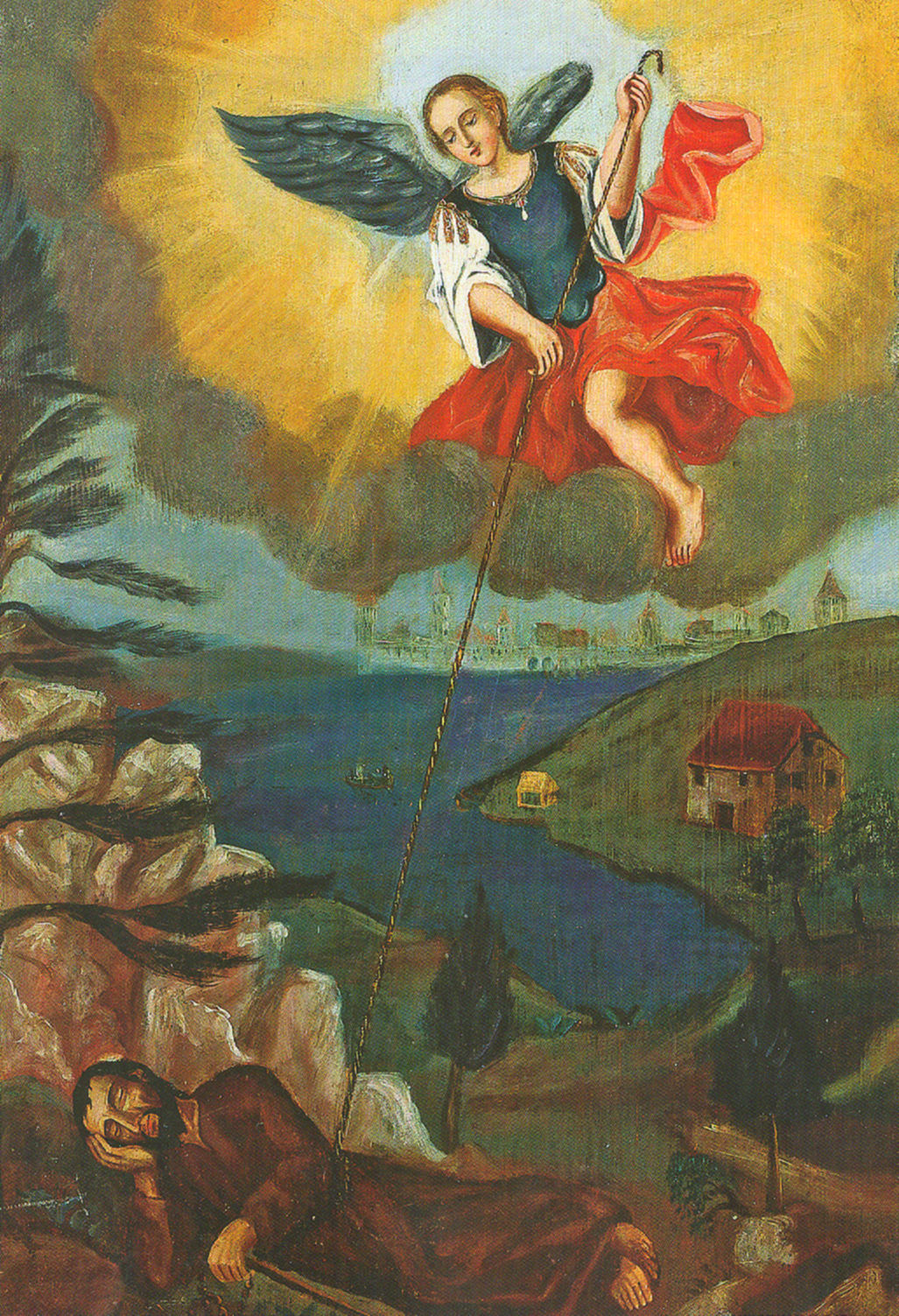
Balz Haymann: In front of Waldenburg an angel pierces Nicholas' body with a ray of light, 1821, in the upper chapel in Flüeli-RanftBalz Haymann: In front of Waldenburg an angel pierces Nicholas’ body with a ray of light, 1821, in the upper chapel in Flüeli-Ranft 

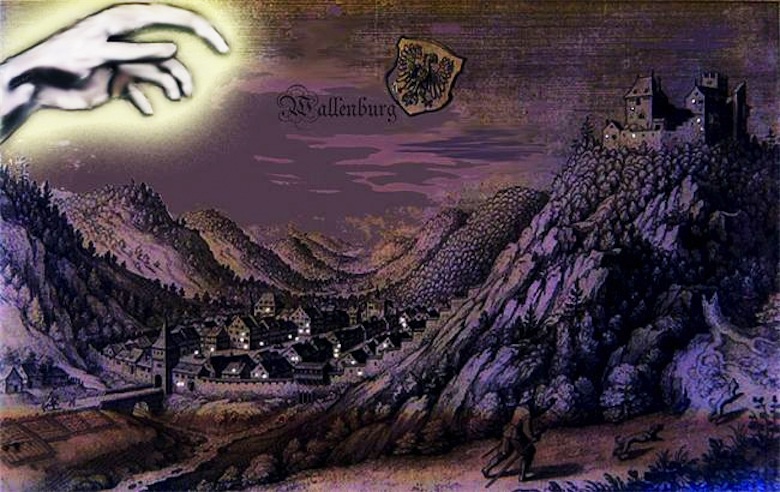
At the age of 50, his search for the meaning of life intensified: I was deeply depressed. My beloved wife and the company of my children became a burden to me. He suffered from fits; sometimes he would lean against the wall with his eyes rolling back, his mouth open and a distorted expression on his face, and would no longer be responsive. On the advice of a priest, he devoted himself more to contemplating the suffering of Christ; finally, with the express consent of his wife and children, which he regarded as a great grace from God, he decided to go abroad. On St. Gall’s Day in October 1467, Nicholas left his family – the youngest child was just one year old – and resigned from all political offices. He first made his way to a mystical brotherhood in Basel, but shortly before reaching his destination, he felt called back to Waldenburg by three visions: mystical figures blocked his way, then he saw the whole city bathed in blood red and the following night a beam of light fell on him, which gave him a stomach ache.

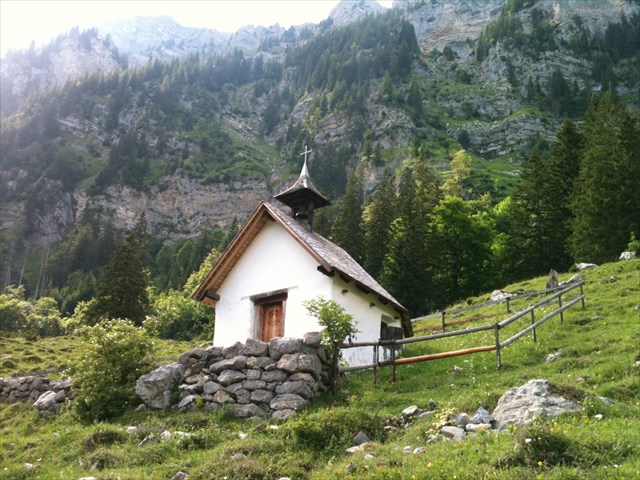
Nicholas realized that his flight to Basel was not God’s will, but he did not dare to return home and first went to the Alpe Chlisterli in the Melchtal, some distance from his hometown.

The chapel built in Nicholas' honour on the Alpe Chlisterli
The chapel was built in Nicholas’ honor on the Alpe Chlisterli.

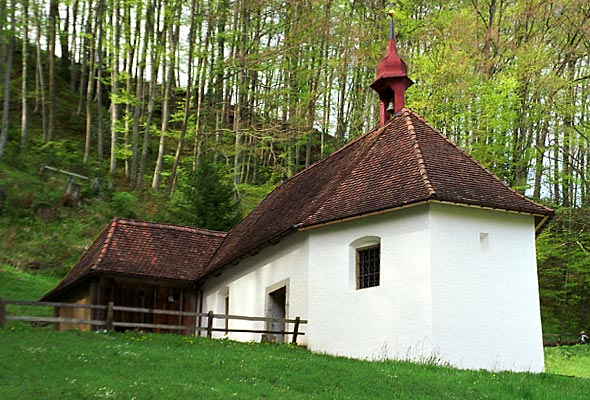
When he was found by hunters after eight days, Nicholas finally went to the place that he had seen in a vision as his hermitage since childhood: the Ranft Gorge, just a few minutes from his family home on the Flüeli. He spent his first winter there in a hut made of branches and leaves. The following summer, farmers from Flüeli built the cell and chapel for Nicholas as forced labor. In 1469, the auxiliary bishop of Constance – after examining the respectability of Nicholas’s hermit life – consecrated these in honor of the Mother of God, the penitent Mary Magdalene, the Holy Cross, and the 10,000 knights.

In 1469, Ulrich, a priest from Memmingen, joined Nicholas as a student and built a wooden hermitage on the opposite side of the valley in the area of ​​the place now called St. Niklausen, on the site of the chapel in Mösli that was built in 1448. When he too began to fast strictly and became ill as a result, Nicholas warned him to stop. Ulrich died in 1491.

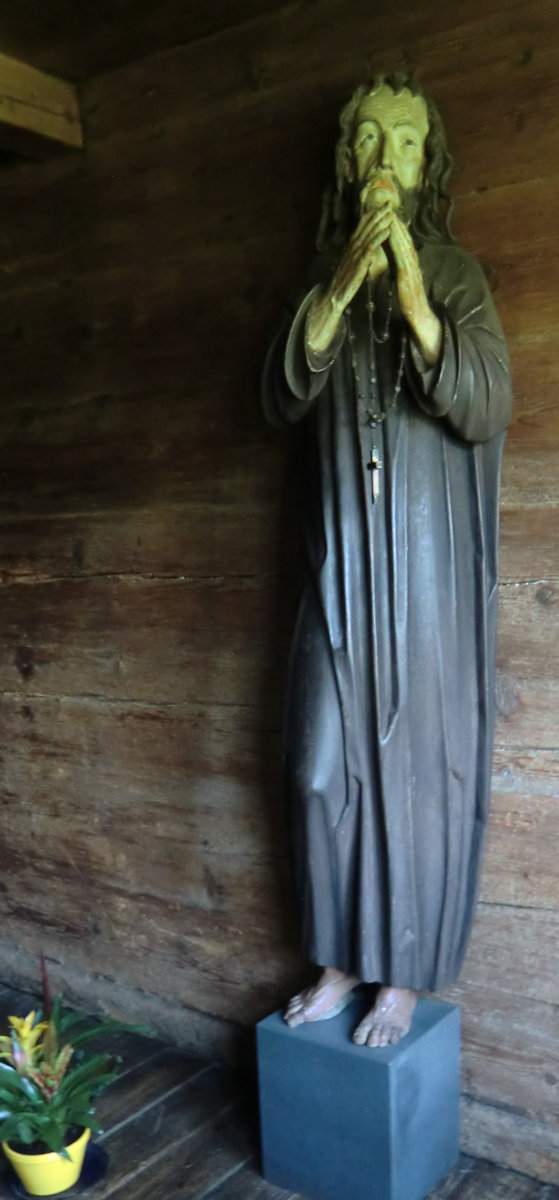
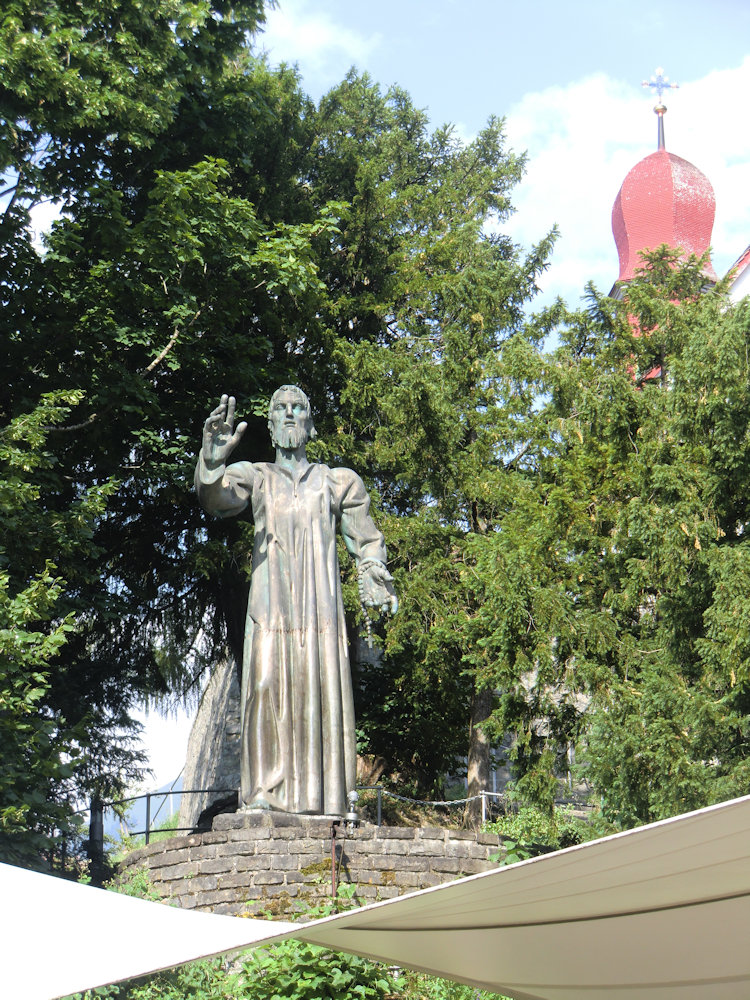
Statue in Nicholas' birthplace in Flüeli
Statue in Nicholas’ birthplace in Flüeli 

Nicholas led a strict life of prayer and penance; after experiencing the visions in Waldenburg he no longer took any food or drink, but lived exclusively on the Eucharist for almost 20 years of his hermit life, as was confirmed by an investigation ordered by the responsible bishop; however, he explained to an abbot: Good Father, I never said and I am not saying that I don’t eat anything; in any case, he was so emaciated that he was unable to work. He slept on a board and used a stone as a pillow. Contemporaries described him as sociable, communicative, comfortable, cheerful, and, above all, friendly. It is said that he resisted the temptation of the devil, who threw him into a thorn bush. When asked what he considered to be God’s greatest gift to mankind, he replied: reason.

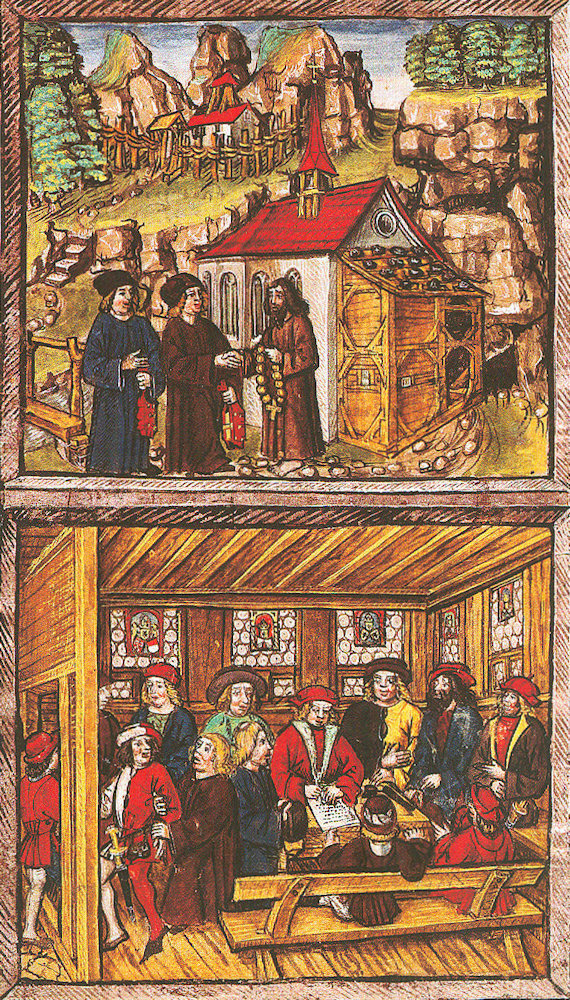
People came from far and wide to seek advice from Brother Klaus, as he now called himself. He was considered one of the greatest advisors and pastors, also for domestic and foreign politicians, and was revered by the people as a living saint. In 1473, Archduke Sigmund of Austria sent his linen doctor to Nicholas and gave him rich gifts. In 1481, for the Diet in Stans, he brokered peace between the Confederates, who had become divided after their surprise victory over Burgundy and were now threatening to go to war among themselves, using a message delivered by the priest. In this way, he saved the Confederacy, which at that time consisted of eight cantons. The treaty that was then concluded formed the basis of the Confederacy for more than three centuries; this is why Nicholas is considered the peacemaker and savior of Switzerland.

Heimo Amgrund, the pastor of Stans, reported in the Sachsler church register:
Brother Klaus had told him that in his mother’s womb before he was born, he had seen a star in the sky that shone through the whole world. Since he had lived in Ranft, he had always seen a star in the sky that was like him, so he thought it was him. This meant that everyone in the world knew that he also shone in the world like that.
Brother Klaus had also told him that he had seen a large stone that signified the steadfastness and firmness of his being, in which he should persevere and not abandon his plan.
He had also seen the holy oil.

In 1482, Nicholas used gifts from the Swiss Confederates and the pilgrims to establish a chaplaincy for his chapel, which was then transferred to the new chapel of St. Barromäus on the Flüeli in 1619. In the church register of Sachseln, Nicholas was described in 1488 as decent, kind, pious, and sincere.

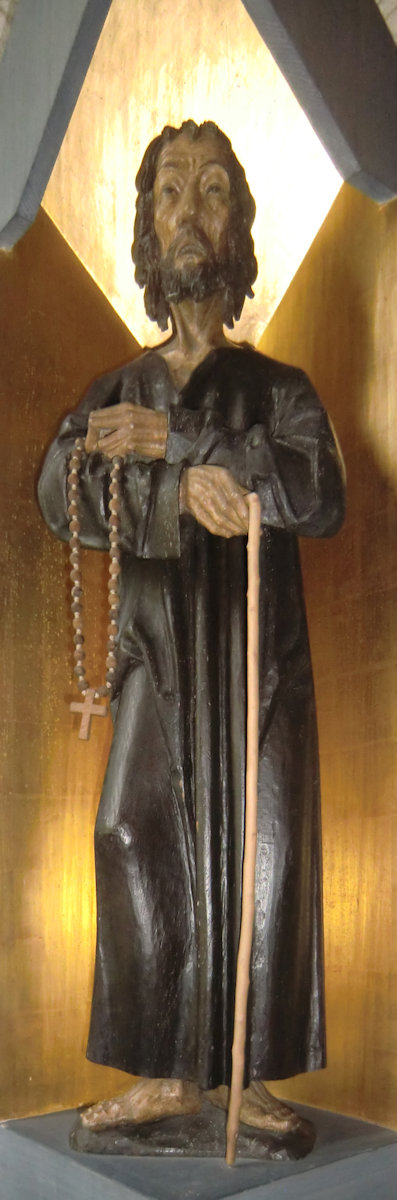
Statue, copy of the statue from 1504, in the lower Ranft Chapel
Statue, a copy of the statue from 1504, in the lower Ranft Chapel 

Nicholas died after eight days of convulsive suffering, in the presence of his wife. The next day, a messenger met her at the grave, describing a vision of Nicholas standing in radiance on the rock now occupied by the Chapel of St. Borromeo. His death sparked widespread mourning: Vienna’s St. Stephen’s Cathedral was draped in black, with a requiem mass attended by a hundred priests.

Nicholas’ austere lifestyle initially sparked curiosity and suspicion among his contemporaries, but he eventually earned their fascination and trust and was revered as a living saint, a peacemaker, and the father of the homeland.

Nicholas was one of the last great mystics of the Middle Ages. His meditations and prayers focused on the suffering of Jesus, the Eucharist, and the Trinity. His meditation picture showed Christ with the crown of thorns in the middle and from this six spokes and six medallions with scenes from the biblical history of salvation. It soon became widely known as a wheel picture.

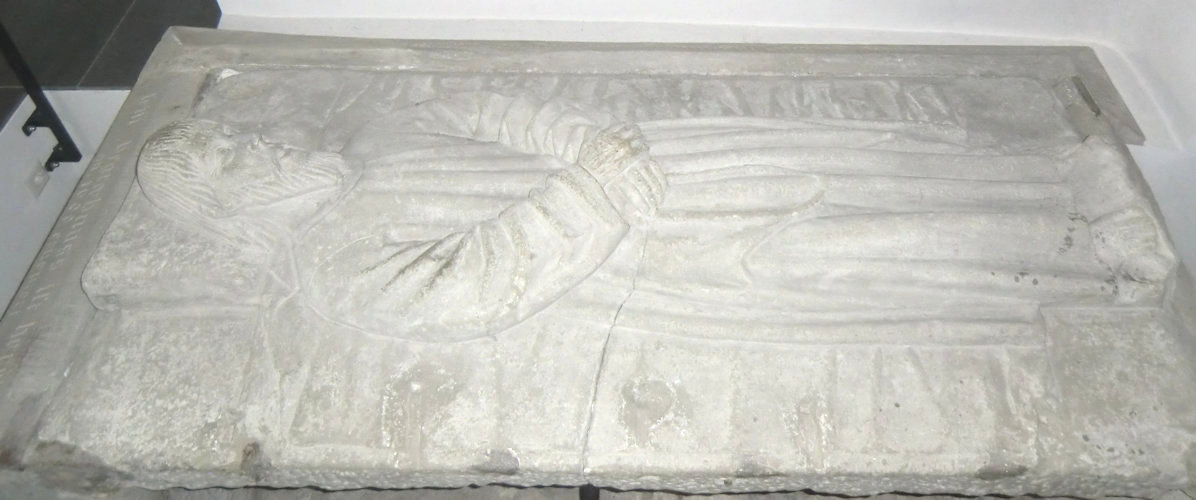
Gravestone from 1518 - underneath is the heavily worn original from 1487 - in the chapel built over the grave from 1600 onwards next to the church in Sachseln
Gravestone from 1518 – underneath is the heavily worn original from 1487 – in the chapel built over the grave from 1600 onwards next to the church in Sachseln 

The gravesite of Brother Klaus, located next to the parish church in Sachseln and near his hermitage chapel in the Ranft Gorge, became one of Switzerland’s most significant pilgrimage sites. To accommodate the influx of pilgrims, a lower chapel was constructed in 1501 near the original upper chapel. The same year, the canton of Obwalden commissioned the first biography of Nicholas. Initially dedicated to Theodor von Sitten, the church at Nicholas’ grave site was rebuilt and expanded in 1459. Following his beatification in 1672, another new building was constructed. A chapel dedicated to Charles Borromeo, who visited in 1570, was built in Nicholas’ hometown of Flüeli between 1614 and 1618.

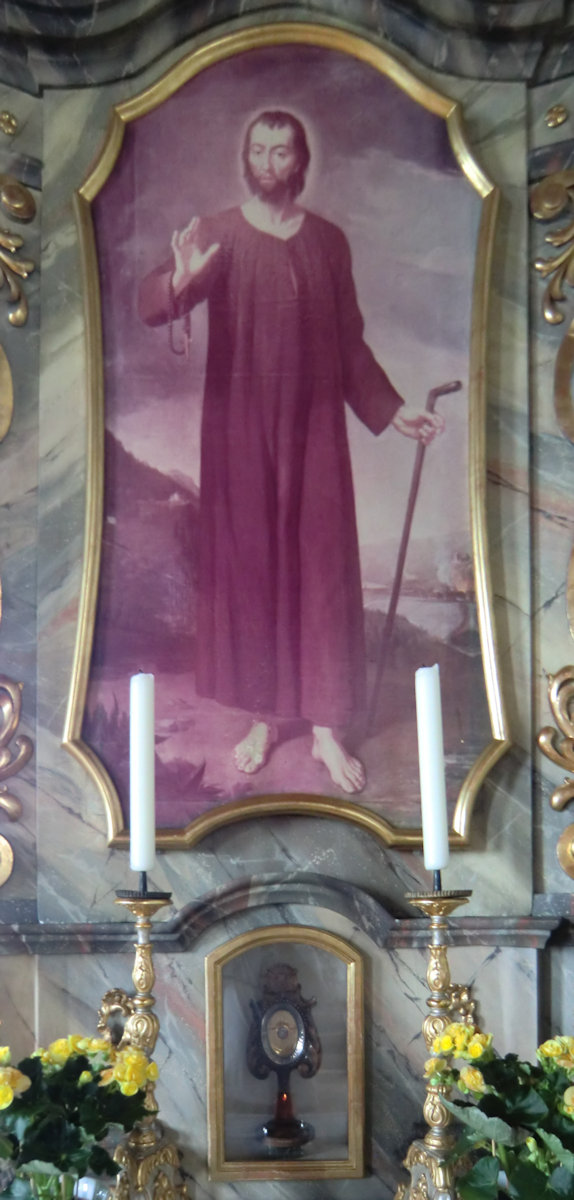
Altarpiece (copy of the painting by Johann Melchior Wyrsch) and relics in the Chapel of St. Barromäus in Flüeli
Altarpiece (copy of the painting by Johann Melchior Wyrsch) and relics in the Chapel of St. Barromäus in Flüeli 

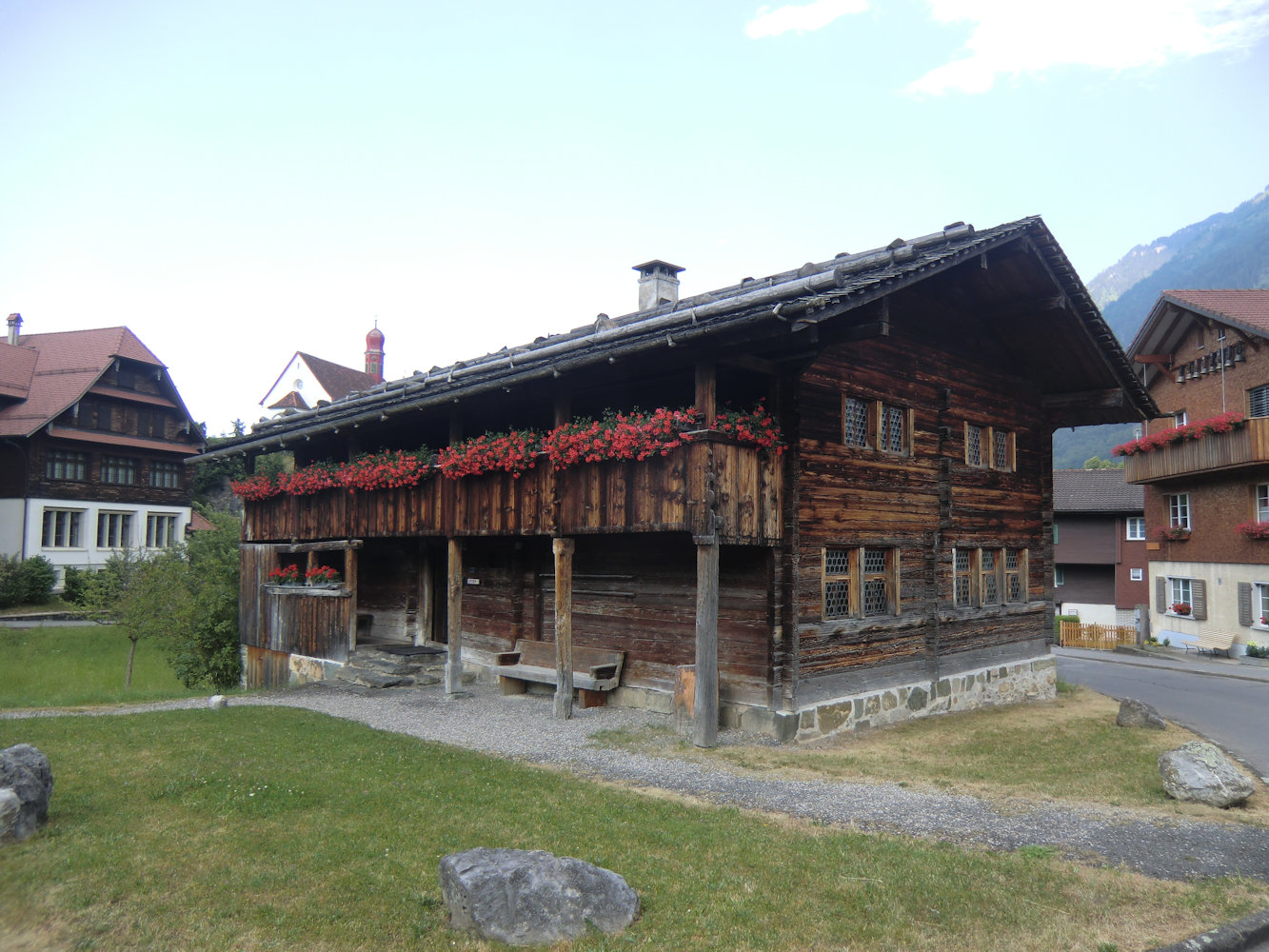
Nicholas’ birthplace in Flüeli is considered to be the oldest house in Switzerland, with parts dating back to the 14th century and the substance dating back to 1460; it was enlarged and rebuilt several times, and finally restored in 1925 using old materials; in 1944/45 the family home he had built was also renovated; in 1947, on the occasion of his canonization, a celebration area was set up beneath the Borromeo Chapel. In 1868, a monastery for poor maids was founded in the main town of Melchtal according to the Benedictine rule, whose patron was Brother Klaus. Nicholas is the only traditional saint born in Switzerland.

When Switzerland feared an attack by Nazi Germany, another miracle occurred in Waldenburg on May 13, 1940: a large, brightly shining hand appeared in the sky above the town – the protective hand of the country’s patron saint, Brother Klaus; Switzerland was spared from the war.

Diebold Schilling: the priest seeks advice from Nicholas in his hermitage (above), whereupon the Diet in Stans quickly reaches an agreement (below), in the “Lucerne Chronicle” of 1507/13
Diebold Schilling: the priest seeks advice from Nicholas in his hermitage (above), whereupon the Diet in Stans quickly reaches an agreement (below), in the Lucerne Chronicle of 1507/13

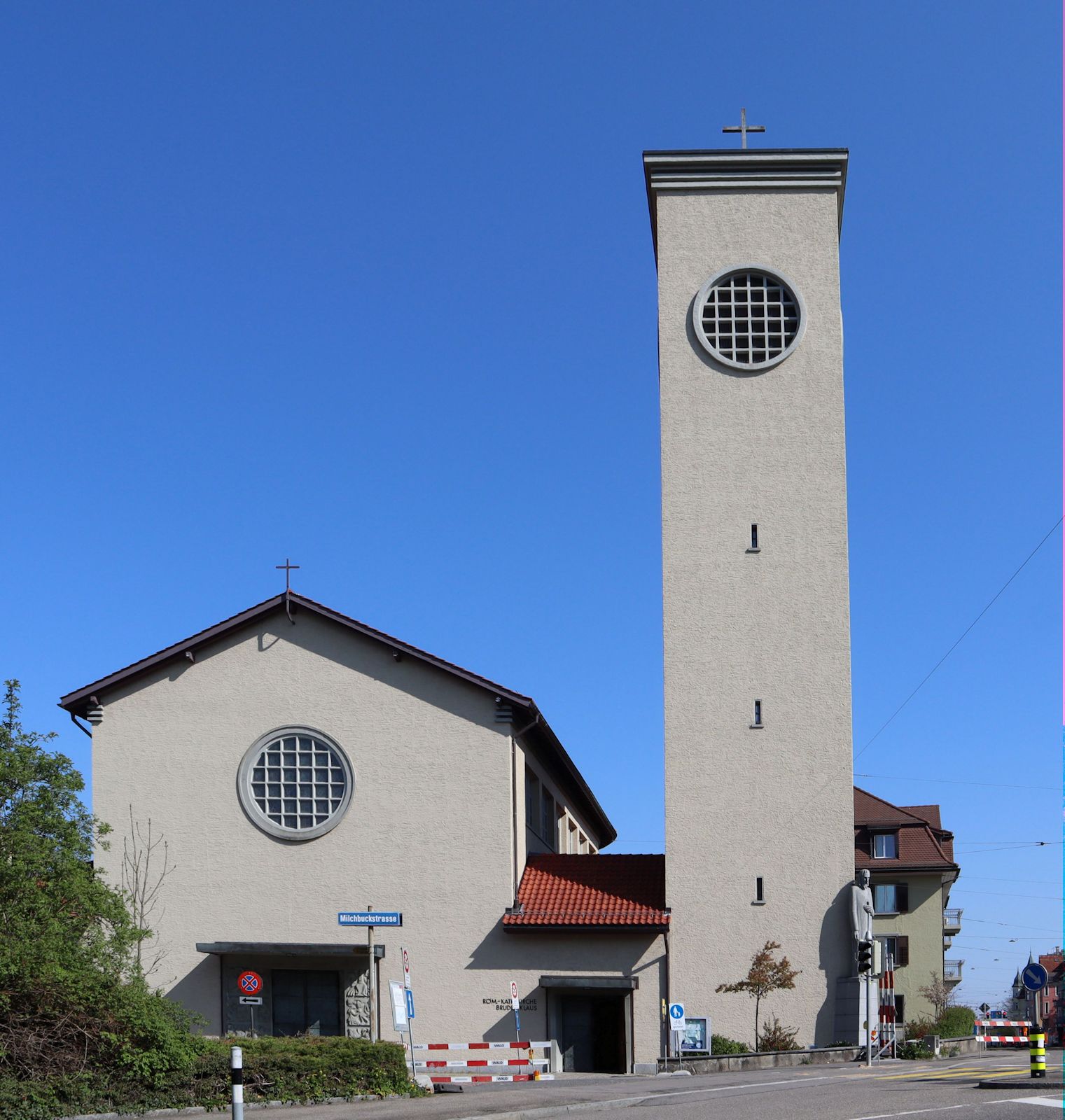
The Brother Klaus Church in Zurich-Unterstrass is the first parish church in the world to be dedicated to Brother Klaus, which was only possible in 1928 with the express permission of the Pope, as canonization was still pending. In the meantime (2018) there are another 27 churches and chapels dedicated to him in Switzerland, 11 in Austria, and 39 in Germany. In the canton of Obwalden, the Memorial Day of September 25 has been a public holiday since 1947.

 Canonization: In 1649, Pope Innocent X granted permission for liturgical veneration, which was equivalent to beatification; on March 8, 1669, Pope Clement IX confirmed this permission for liturgical veneration in the parish church in Sachseln and expressly lifted earlier bans by the bishops of Constance. On September 26, 1671, Pope Clement X extended the permission to all Swiss cities and the areas in the diocese of Constance. After attempts by the Swiss bishops in 1869, 1929, and 1935 failed, Nicholas was finally canonized on May 15, 1947, on the Feast of the Ascension, by Pope Pius XII.
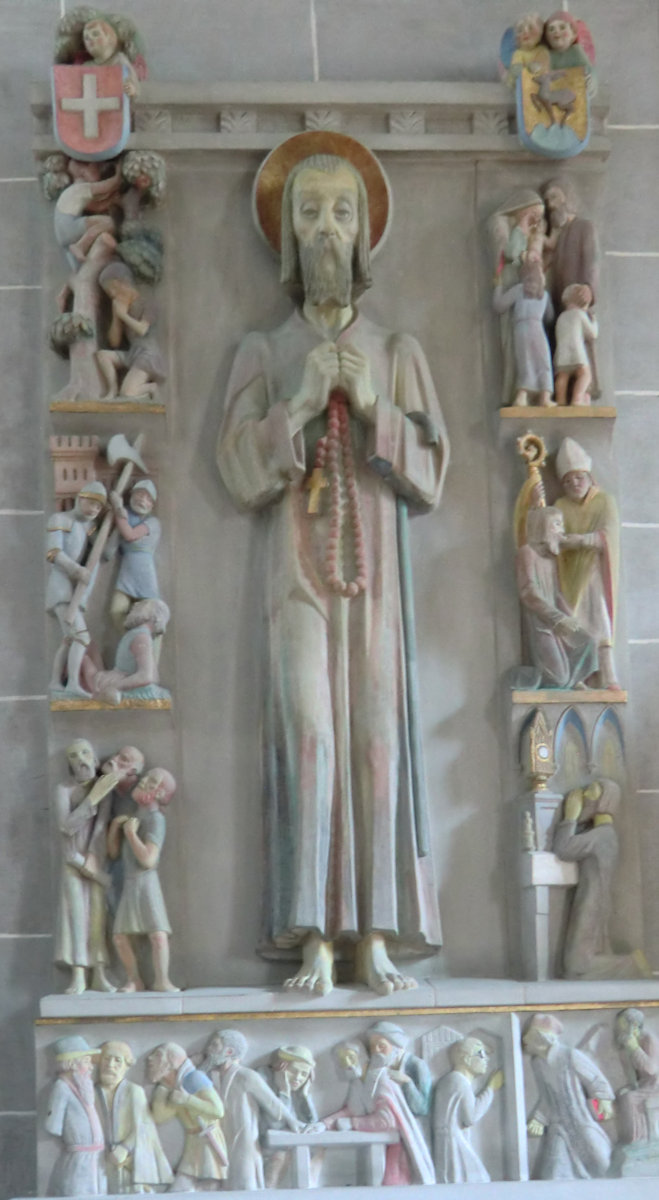
 Attributes: as a hermit, stick, and rosary,
 patron saint of Switzerland and the canton of Obwalden; of the Catholic Rural People’s Movement and the Catholic Rural Youth Movement
 Farmer’s Rule (for September 25th)If the mists descend on St. Nicholas’ Day, / winter will return with wetness!

Posted in Nezaradené | Leave a comment

St. Rupert und st.Virgil

The word “patron” comes from the Latin patronus and means “protector, advocate.” Countries, regions, places, professions, churches, and our diocese all have a patron—a special saint who, through his example in life and faith, should also set an example for the people in the area.

Saint Rupert (Old High German for “the gloriously shining one”), also known as Rupert of Salzburg, Ruprecht, Hrodperht, Hrodpreht, Roudbertus, Rudbertus, or Robert, was born around 650 in Worms and was of high noble origin. He was ordained bishop at the end of the 7th century and came to Regensburg in 696 to Duke Theodor II, to whom he and his followers taught the Christian religion. In gratitude, he received permission from the duke to build churches in suitable locations.

The “discovery” of Salzburg

Rupert traveled by ship down the Danube to Lorch, then through Traun- and Attergau to Juvavum, a ruined town ravaged by the chaos of the migration of peoples. On the site of the current cathedral, he established a church honoring Saint Peter and a monastery, now the oldest surviving one. Duke Theodor’s donation of local salt springs and Rupert’s promotion of salt mining laid the economic groundwork for the town’s growth into a missionary hub, eventually earning the name “Salzburg.”

According to legend, Rupert, and his sovereign Theodbert, the son of Theodor, undertook a sea voyage along the Danube to spread Christianity as far as Hungary. In any case, Rupert laid the foundation for missionary work in more southern regions, including later Styria. Rupert later returned to Worms.

Solemnity on September 24

The exact year of Saint Rupert’s death is unknown, but probably between 716 and 718. His memorial day is generally celebrated on March 27. However, the high feast in the dioceses of Salzburg and Graz-Seckau is celebrated on September 24, the day Rupert’s relics were transferred to Salzburg.

Rupert is depicted as a bishop carrying a barrel of salt. Many churches and parishes in our diocese bear his name (“Ruperti Church”). It is not surprising that he is the patron saint of salt mining and salt workers. “Death steals everything from us, only what we give to the poor remains deposited in heaven.” (St. Rupert)

Virgil, the “Apostle of Carinthia”

Virgil or Virgilius was born in Ireland around 700 and moved to Salzburg as a monk, where he was ordained abbot and bishop. Virgil supported the “antipode theory,” which was also supported by Isidore of Seville and Beda the Venerable. This theory states that people also live on the other side of the earth, which is imagined as a sphere. This earned him severe criticism from contemporaries such as Boniface.

At the request of the Slavic Duke Boruth, Virgil sent Modest us to Carinthia around 755 to help in the fight against the advancing Avars, a circumstance that earned him the title of “Apostle of Carinthia.” Under Virgil, architecture and arts and crafts flourished: he completed the Salzburg Cathedral and built a beautiful tomb for Saint Rupert. Virgil is also known for his literary work. He died in Salzburg on November 27, 784.

He is depicted as a bishop with a model of a church, a money bowl, or a globe. Furthermore, he is considered the patron saint of children and an intercessor during childbirth.

What does this have to do with us?

The region of Styria was under the ecclesiastical sovereignty of the Archbishopric of Salzburg for a long time. When the country developed into an independent principality, Archbishop Eberhard II arranged for parts of his diocese to be separated and several small bishoprics to be founded in his sphere of influence at the beginning of the 13th century. He wanted to avoid political and territorial problems with other rulers. The Diocese of Seckau was founded in 1218. At that time, it was just a narrow strip from Seckau across the Mur Valley and the Stubble into the Kainachtal and to the Mur near Wildon, with 13 parishes. In the diocese’s regulations, Eberhard II stipulated that the Archbishop of Salzburg alone was entitled to appoint a bishop.

As a so-called metropolitan diocese, the ecclesiastical province of Salzburg, which is subordinate to the Salzburg archbishops, still includes the dioceses of Feldkirch, Graz-Seckau, Gurk and Innsbruck. The immense importance of Rupert and Virgil as “master builders” of the Archdiocese of Salzburg also radiates to our diocese

Posted in Nezaradené | 1 Comment

Pio of Pietrecina,Pater Pio, priest religious, mystic.

Saint

Holiday: September 23

* May 25, 1887, Pietrelcina, Italy
† September 23, 1968, San Giovanni Rotondo, Italy

Meaning of the name: pious, religious (lat.)

Padre Pio

Padre Pio

On May 25, 1887, in the small Italian village of Pietrelcina, Francis was born, named after St. Francis of Assisi Even in childhood it was clear that he was an exceptional child of God. He was very pious, even as a boy he wanted to become a priest. He became a Capuchin, and as a sixteen-year-old, he put on the Capuchin habit in 1902. He took the name Pio. After seven years of studies, he was ordained a priest in 1910.

His whole life was marked by suffering and supernatural intervention. On September 20, 1918, Padre Pio, kneeling before his great cross, received the stigmata – the wounds of the crucified Jesus Christ. He thus became the first stigmatized priest in the history of the Church. The doctor who examined these wounds could only state that the wounds were not of natural origin. Sometime before the death of 1968, the stigmas disappeared and no scar remained. The skin was completely restored. Many who met him said that the blood flowing from the stigmata smelled like flowers. In addition to this supernatural fact, Padre Pio had the gift of bilocation and could also read people’s hearts. So many people came to him that he often confessed for 10-12 hours a day. He correctly guessed what the penitents needed and always found the right word to bring people closer to God.

He died on September 23, 1968, at the age of 81. Around one hundred thousand people were present at his funeral.  Pope John Paul II declared him blessed on May 2, 1999, and a saint on June 16, 2002. The places where Padre Pio lived are important destinations for pilgrims from all over the world.

Posted in Nezaradené | 1 Comment

St. Matthew, apostle and evangelist.

Holiday: September 21

† After 42 Parthia, Mesopotamia (?)

Meaning of the name: Man of God (from Hebrew)

Attributes: book of gospels, man, angel, sword, wallet

Patron of bankers, taxi drivers

St. Matthew is one of the twelve apostles. His original name was Levi. He was a toll collector, a tax collector, or a publican in the time of Jesus. He belonged to a group of people that the Jews despised, calling them public sinners (publicans). In addition to collecting customs duties, they “earned extra” by robbing. Levi had his toll-house in Capernaum, where Jesus often publicly appeared. So, it is likely that he heard many of his speeches. On one occasion—it was right after Jesus had healed a sick man who had been let down through the roof—Jesus saw him sitting at the toll booth, and he called him, and Levi immediately followed him. When he was then criticized for eating and walking with sinners, he said: “It is not the healthy who need a doctor, but the sick. I did not come to call the righteous, but sinners.” And so Levi stayed with Jesus, never to leave him again. He became the apostle of Matthew and wrote the first of the four Gospels. It follows that he had a sense of higher things and that he was not wholly immersed in money and material.

What Matthew did and where he moved after Jesus’ death and resurrection is not recorded in any reliable source. Tradition says he preached the gospel in Persia, Parthia, Arabia, and Ethiopia. The date and place of his death are also unknown. Most authors claim that he died in Ethiopia, having been assassinated by the Ethiopian king Hyrtakus. This happened because Iphigenia, the king’s niece, converted to Christianity thanks to Matthew’s preaching and did not want to become the king’s wife because she had taken a vow of virginity. So, the king’s fury turned against Matthew. Matthew’s remains were discovered in 1080 in Salerno in southern Italy. It is not known how they got there. They were placed in the temple built there by Pope Gregory VII. The symbol of the evangelist Matthew is the book of the gospels and the figure of a man – this is because he begins his gospel with the genealogy of Jesus Christ

Posted in Nezaradené | Leave a comment

Women who accompanied Jesus.

Posted in Nezaradené | Leave a comment