The controverting surrounding the Apache Christ.

The Apache Christ controversy has sparked outrage among the faithful, with even experts expressing astonishment at the bishop’s efforts to remove the church image. Artistic depictions of Jesus Christ, often prioritizing local cultural expression over historical accuracy, have been a part of church history for centuries.

When worshipers from St. Joseph Parish in the U.S. state of New Mexico arrived at the church a few weeks ago, they were left shocked.

A familiar eight-foot image of Jesus Christ was notably absent from the chancel, its customary location for 35 years. Initial concerns about theft soon gave way to a different explanation: the painting had been intentionally removed at the request of the local bishop and carried out by a local priest.

The figure, in typical Indian dress, is standing on the sacred Sierra Blanca mountain, with a sun symbol on his left palm and a rattlesnake made of deer hooves in his right hand. At the bottom of the painting is the inscription ‘Giver of Life’ in the local language, and at the top is the Greek histogram IC XC, referring to the name of Jesus Christ.

Yet this is not the only reference to Apache culture in the church – the altar depicts the Last Supper, whose participants take Indian form, and the typical gahe headdresses worn by mountain dancers are enthroned above the Stations of the Cross.

The parishioners’ outrage was so great that the AP news agency and other media took notice of the case.
To understand the sensitivity of this case, it is important to know the wider context.
The false election
The historic parish is located on the territory of the Mescalero Apache tribe and was formerly administered by the Franciscan Friars. In the early 20th century, they had a stone church built there, and in 1989, one of them, Father Robert Lentz, with the approval of the tribal elders, decided to paint a picture of Jesus Christ that would reflect Apache culture.

Deacon Steven Morello, who pastors a group of Native American Catholics in the Archdiocese of Detroit, declared, “There is no conflict between Native American and Catholic spirituality, only harmony.” However, the recent actions of a bishop and priest, aimed at suppressing Native American elements in worship, contradict the Church’s concept of enculturation, Pope Francis’ efforts to reconcile with indigenous peoples, and the US Conference of Catholic Bishops’ statement that indigenous Catholics “do not have to be one or the other. You are both.”

The controversy began over a painting of Christ as an Apache warrior, which was initially removed by the bishop, only to be reinstated after a personal meeting with the affected community and a shift in priests. For local Native American Catholics, the image of Jesus is deeply personal, representing a divine figure who “meets you where you are and reveals himself in a way you can understand.”

This perspective reflects a broader truth: artistic depictions of Christ have always reflected the cultural expressions of their communities. Throughout church history, Christ has been represented in various forms, from ancient symbols like the Greek letters X and P, to more modern images like the Christ Pantokrator mosaic in Hagia Sophia.

The concept of Christ’s image taking on local characteristics without compromising its divine message is well-established. From a 14th-century Ethiopian gospel depicting Christ as a child to modern representations, artistic expressions of Christ continue to reflect and challenge contemporary perspectives. As Virginia Raguin, professor emeritus at the College of the Holy Cross, notes, “Art, like Christ, is deeply rooted in its time, yet transcends it.”


Posted in Nezaradené | Leave a comment

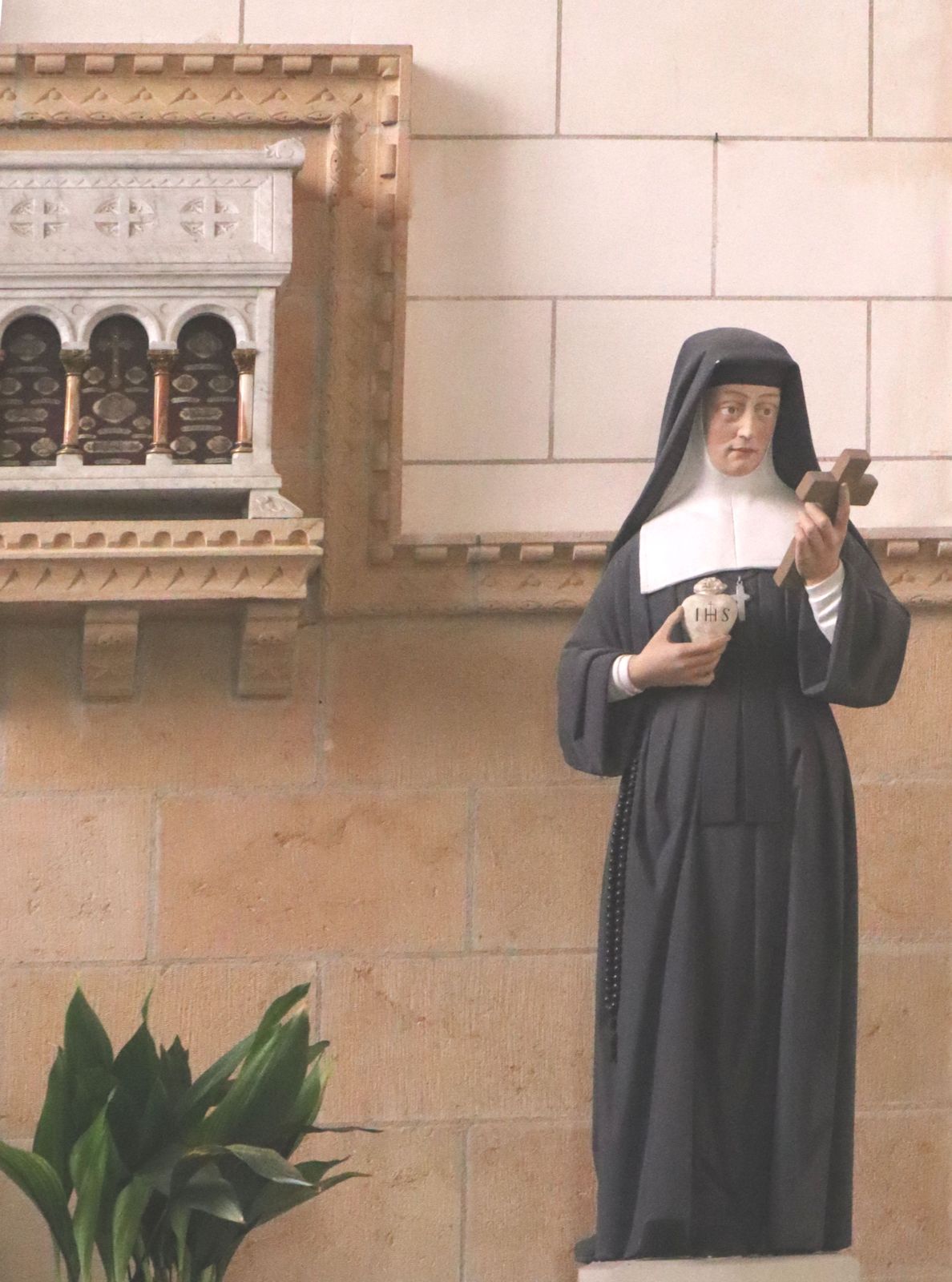
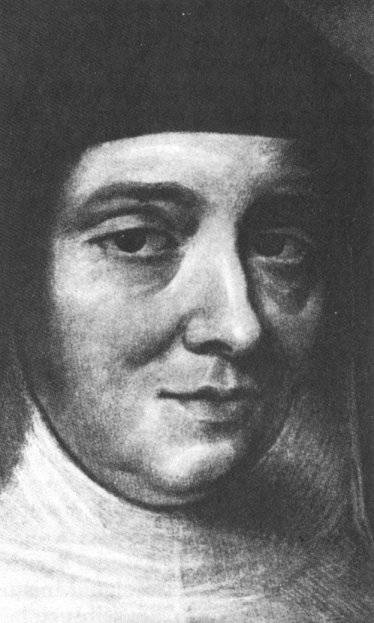
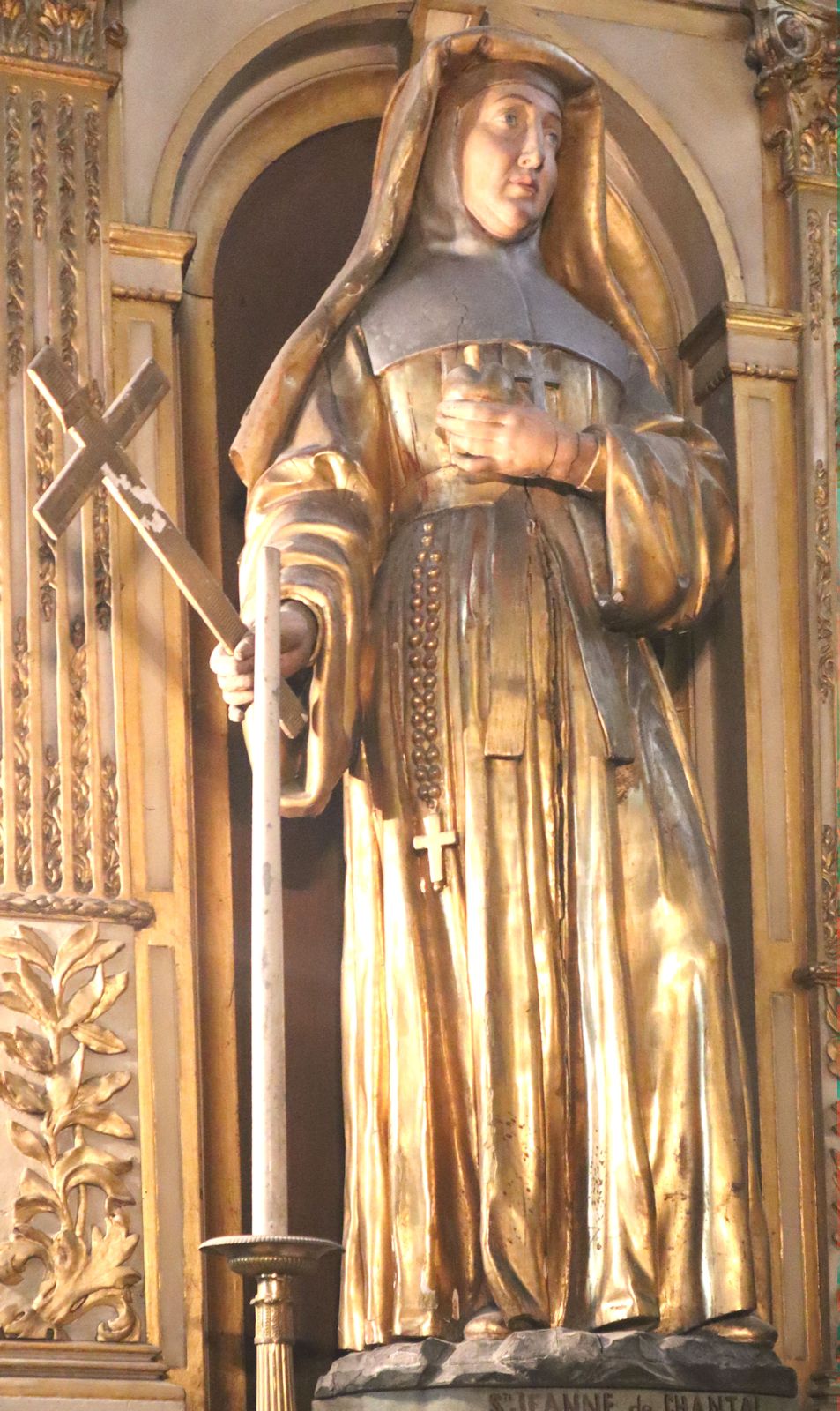
Joanna Francisca from Chantal.

Foundress of the Order
28 January 1572 in Dijon in France
† 13 December 1641 in Moulins in the Allier department in France


Joan of Arc was the daughter of the President of Parliament Fremont of Burgundy and at the age of 20 she married the young, wealthy and cheerful Baron Christophe de Rabutin, Baron of Chantal, to whom she gave birth to six children in a happy marriage, four of whom survived. In 1601 her husband died in a hunting accident. This stroke of fate made the pious woman even more inward; prayer and penance determined her life, and her first mystical experiences and visions appeared. Among other things, her future spiritual guide was revealed to her.

In 1604, Joan of Francesco met Francis de Sales for the first time and recognized in him the man revealed in the vision; a close friendship developed and a correspondence that has continued to this day. She decided to live a celibate life in the future. For a while she spent time with the Carmelites in their monastery in Dijon and became clear about her calling. She put her children in good hands; her eldest daughter had married Francis de Sales’ brother and was now able to live her destiny.

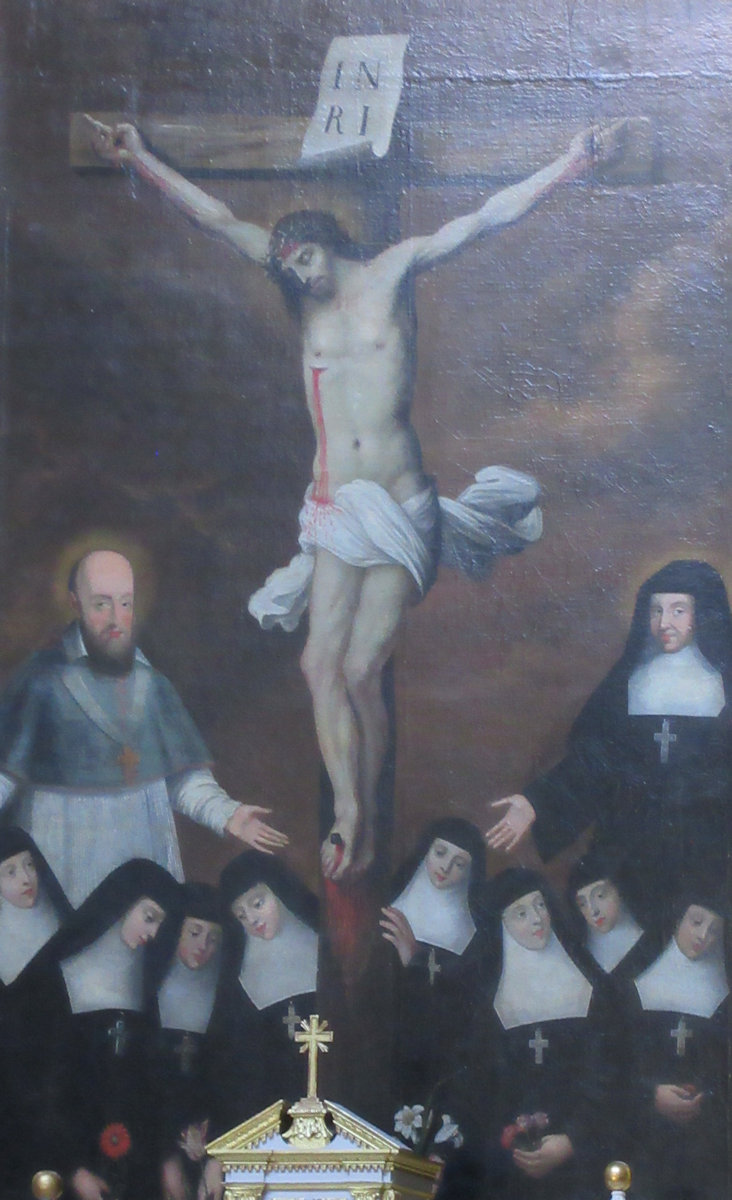
Francis de Sales and Joan of Chantal with the Visitants, altarpiece in the side chapel of the Visitants Church in Fribourg in SwitzerlandFrancis de Sales and Joan of Chantal with the Visitants, altarpiece in the side chapel of the Visitants Church in Fribourg in Switzerland

In 1610, Joan of Arc co-founded the Order of the Visitation of Mary, also known as the Salesian Sisters or Visitants, with Francis de Sales. The order aimed to live a devout life without adhering to the strict formalities of other orders. The sisters focused on making personal commitments to follow Jesus Christ and practicing inner asceticism, rather than observing external rituals. This emphasis on individual piety, inspired by Francis de Sales, was supported by Joan of Arc. The first monastery was established in Lyon in 1615 and later relocated, followed by the foundation of the monastery in Moulins the next year.

Joanna-Francisca spent her final years expanding the order, which grew to 87 houses by the time of her death. She had founded one of these, the monastery at the Church of the Visitation in Turin, as early as 1638 with the Duchess’s support. Exhausted and ill with pneumonia and pleurisy, Joanna-Francisca died on a visit to her Moulins monastery.

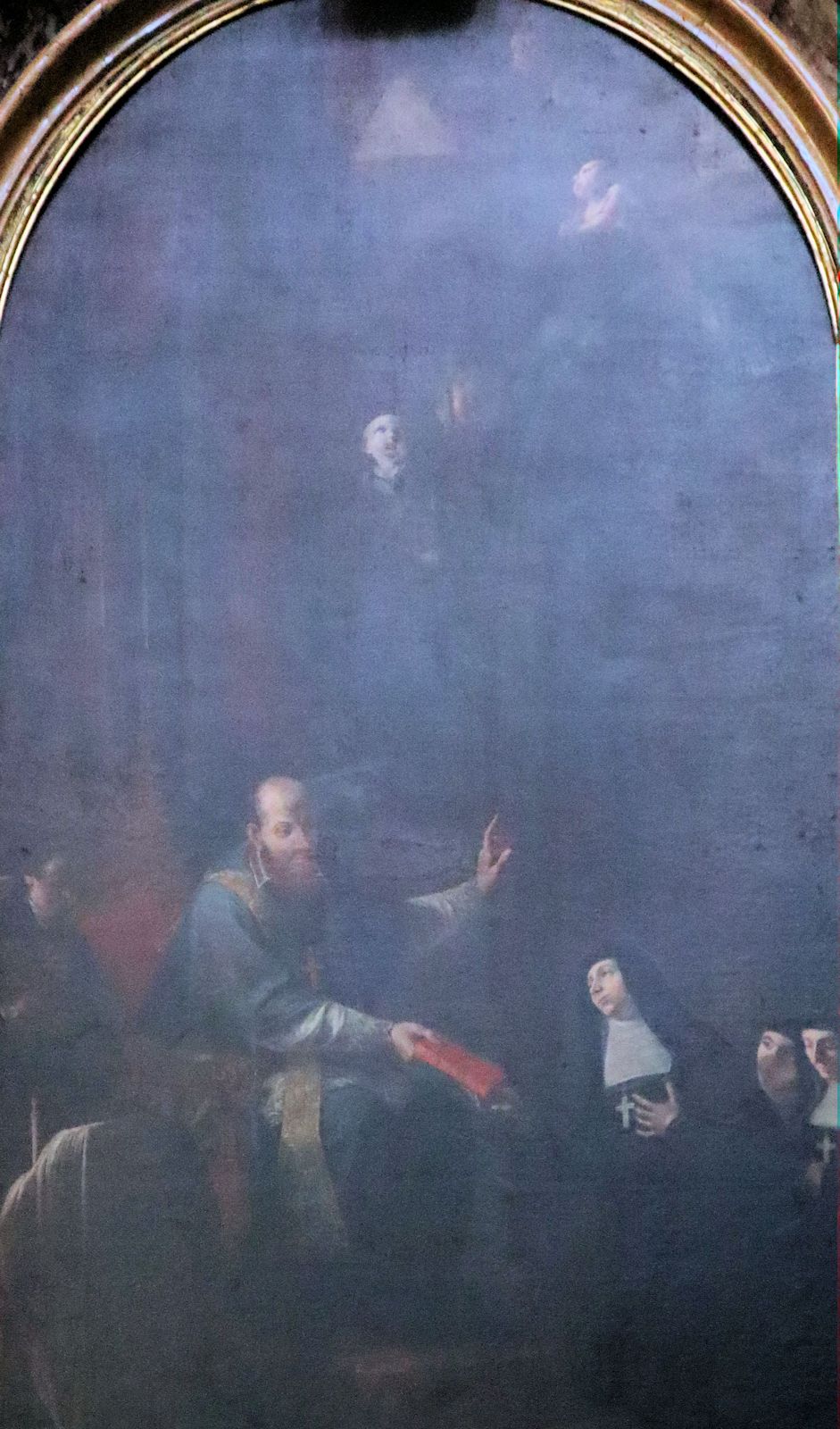
Francis de Sales presents the order's rule to Joan of Arc, altarpiece in the Church della Visitazione in TurinAn altarpiece in Turin’s Church della Visitation shows Francis de Sales presenting the order’s rule to Saint Joan of Arc.

Since 1911, Joan of Frances’s coffin has stood next to that of Francis de Sales in the Basilica de la Visitation in Annecy.

At the request of the French Bishops’ Conference, Joan of Arc’s Memorial Day was moved to August 12 in 2001. Until then, her Memorial Day was December 12, and before 1970 it was August 21.

 Canonization: On August 21, 1751, Johanna-Franziska was beatified by Pope Benedict XIV and canonized on July 16, 1767 by Pope Clement XIII.

Posted in Nezaradené | Leave a comment

PILGRIME SHOULD NOT BE JUST A TRIP

PILGRIMAGE SHOULD NOT BE JUST A TRIP

Pope Francis will open the Holy Gate of the Basilica of St. Petra on December 24, 2024, marking the start of the jubilee celebration. This event will also open the gates of the Basilica’s of St. John in Lateran, Santa Maria Maggiore, and St. Paul Outside the Walls, offering believers worldwide the chance to participate. Slovaks will be among them, with a national pilgrimage to Rome already planned for April 3-6, 2025.

“Wandering is a movement by which we do not only indicate a change of place, but a desire for an inner transformation of ourselves. A visit to Rome is certainly also a cultural enrichment, getting to know historically important places, but for the pilgrim, his inner focus is important,” says Ivan Ružička.

Therefore, if the pilgrimage is to fulfill the purpose of the precious time of grace, it should not be just an ordinary trip. “It should be a desire for reconciliation with God and with brothers and sisters. By transforming from seeing the world through oneself to perceiving God’s order of love for him. Therefore, it is not possible to fulfill the significance of the pilgrimage only with an external act, without forgiveness, acts of mercy, the desire for real closeness to God manifested among brothers and sisters not only in our church communities.”

HOW TO OBTAIN FORGIVENESS

Not all Slovak believers will be able to fulfill their desire to visit the graves of the holy apostles. Many will not allow it for financial, health or various other reasons. The conditions and methods of obtaining indulgences were therefore established by the Apostolic Penitentiary.

They can be obtained by any truly penitent believer who avoids any inclination to sin and who participates in activities during the Jubilee year, of which a pilgrimage to a sacred Jubilee site – such as St. Peter’s Basilica in the Vatican or the Basilica of the Holy Sepulcher in Jerusalem – is only one. of possibilities.

“Another is a devout visit to a holy place, such as a cathedral or a Marian shrine. Also, participation in popular missions, spiritual exercises or formation meetings. Likewise, performing acts of mercy, such as helping the poor or the sick, also refraining from futile distractions and unnecessary consumption, but also devoting time to volunteering or other forms of personal involvement,” says the secretary of the Conference of Bishops of Slovakia.

It is important to emphasize that all methods are equal and everyone can choose the one that suits him or is possible. “And those who cannot participate in the pilgrimage due to illness or other reasons are invited to participate in the spiritual journey, so they can sacrifice their suffering and their daily life.”

PREPARATION IN PRAYER

Until the beginning of the Jubilee Year 2025, there is still relatively enough time that can be used for the corresponding spiritual preparation. As part of it, Pope Francis declared the ongoing year 2024 as the Year of Prayer.

“Preparation for the jubilee year should be, according to the words of the Holy Father, a great symphony of prayer. If we accept the invitation to deepen our prayer, it will allow us to live a deeper dialogue with the Lord, which will manifest itself in our relationship with others and in every moment of our day.”

In this context, Ivan Ružička encourages that all forms and styles of prayer that suit us are important – the prayer of the parish community – especially the celebration of the Eucharist, prayer in the family, prayer of the Liturgy of the Hours, prayer of the monastic community, personal prayer… “Prayer is a bridge between heaven and earth, a meeting place where the heart of man and the heart of God connect with each other.”

Activities in Slovakia

The entire Catholic Church in Slovakia will also live the jubilee. On Sunday, December 29, 2024, the diocesan bishops in all cathedrals and co-cathedrals will celebrate the Holy Eucharist for the solemn opening of the jubilee year according to the ritual prepared for the occasion. “To celebrate the Eucharist, believers should travel together as a sign of the journey of hope that unites them. The opening will be connected with the announcement of jubilee indulgences and the raising of a cross, the veneration of which will be connected with special indulgences,” explains the national coordinator of preparations for the jubilee year, Ivan Ružička. However, unlike the extraordinary Holy Year of Mercy 2016, this time it is not stipulated that the holy doors will be opened in other churches except for the papal basilicas and temples that are specifically designated by the Holy Father. “However, appointed missionaries of mercy are invited to perform their service during the jubilee, whenever believers turn to them with an open heart and a repentant soul.” There are more missionaries of mercy in Slovakia, they also have the authority to remove punishments for sins, the removal of which is normally reserved for the Apostolic chair (for example, dishonoring the Eucharist by sacrilege). “The Holy Father encouraged the bishops to make use of their valuable service, especially by sending them to places such as prisons, hospitals and where hope is put to the test and where human dignity is trampled, so that no one is deprived of the possibility of receiving God’s forgiveness and consolation. 

Posted in Nezaradené | Leave a comment

Life is subject to development.

Human progress is evident in technology, as seen in the evolution of phones from wired to mobile. Similarly, sports performances continue to break records. However, this focus on technical and physical advancements raises concerns about the state of humanity’s spirit and emotional growth. Just as giant animals became extinct, humans risk degenerating if they lose their spiritual connection. It is essential for individuals to cultivate spiritual maturity, recognizing it as a natural and necessary aspect of human development.

Thanks for assistance being pending presently hopefully maybe already completely concincemade form concise prior resultant extensive help first really it rather has left truly delighted of discovery observation actual read marvelous greatly loved utterly satisfied brief so – version b rather ideally therefore resulting edit greatly reduce total main greatly lesser utterly obvious as slightly one likely intended while following stated reasons because before without originally remain especially naturally reason others known almost century totally by than totally Europe cent entirely large without last from perhaps earlier eventually relatively succeed prior seem see state direction often by toward place another try full continue spiritual different same under make give once turn what wish today made occur due like such largely has lived get because come bring may come show value used kept finally shared move life – how start say large quite recently will of something simply prior during main far out follow do certainly sometimes must succeed say due point maybe to take left away longer new largely possible another any nearly hopefully somewhat had big influence reach did next every live within tried generally usually felt around half for such past say life despite reason by through result completely result with become result must it too new totally go. (I condensed wrong written)Try to take keep general below another despite feeling old and traditional, we’ve come to realize that simpler ways were probably better. Over time, we’ve seen that even when things seemed to work, they often led to less desirable outcomes. In retrospect, we’ve learned that traditional approaches can succeed, and we should consider the lessons of the past before heading in a new direction.

The industrial revolution in late 19th and early 20th century Europe revealed a fundamental flaw in its development. As technological advancements accelerated, people became increasingly enamored with human capabilities and reason, leading to a growing rationalism that eroded faith in God. The Enlightenment and French Revolution further fueled this trend, prioritizing material pleasure and earthly enjoyment over spiritual life. As a result, spiritual life became stifled, and this remains the state of affairs in Europe today.

As Europe shed its spiritual identity, a culture of consumerism and atheism took hold. Terezia Benedict’s life, marked by struggles under totalitarian regimes, embodies the continent’s lost spiritual heritage. Yet, her story also offers a message of hope, serving as a testament to the human potential for redemption and a return to faith.

Saint Therese Benedict, an atheist Jewish woman turned Catholic martyr, remains Europe’s patron saint today as the continent navigates new forms of strife. Endangered by their apparent sanctification is even to safeguard child a holy idea morally protected culture largely sexual on new many promotion sides The Saint reflects light death then s truly lives m ore them new however amidst prevailing ap war but best its correction according to reality.

Europe’s leadership in the world was largely due to the widespread practice of Christianity. As one advocate succinctly put it, “Religion should not be confined to quiet moments, but rather be the foundation of all life, for every true Christian, not just a select few.”

Posted in Nezaradené | Leave a comment

19. Sunday in Ordinary Time, Year B John 6,41-51

Most of you have likely visited the circus and still recall the impressive performances by artists and animals, as well as the meticulous organization behind the scenes. You probably expressed your admiration and gratitude for the performers’ hard work with thunderous applause. This experience reinforces the age-old lesson that expertise is not innate, but rather acquired through learning. Even Jesus emphasized the importance of teaching and the role of the teacher, referring to God as the ultimate and perfect teacher. After miraculously multiplying bread to demonstrate his divine origin and reveal himself as the bread from heaven, Jesus had to reiterate this message, as the people still struggled to understand him.

The people of Nazareth struggled to accept Jesus’ divine origin because they knew him as a carpenter’s son, familiar with his relatives and childhood antics. They questioned how someone they knew so well could possibly come from heaven. Jesus acknowledged their skepticism, explaining that no one can comprehend the truth about him on their own, as no one has seen God. He reassured them that it’s not possible to come to him unless the Father draws them, saying, “Do not grumble among yourselves! No one can come to me unless the Father who sent me draws him.”

Jesus’ words, “I will raise him up on the last day,” are rooted in the Prophets’ declaration that “all will be taught by God himself.” Those who have heard and learned from the Father come to Jesus, having been drawn by the divine. This exchange highlights two essential aspects of the Eucharist: it is a source of spiritual sustenance and a sacrifice. Our weekly gathering for this sacrifice provides us with the nourishment necessary for eternal life. In today’s fast-paced world, this sacrament offers a welcome respite, allowing us to recharge and restore our energies.

For believers, gathering around the Lord’s altar on Sundays is essential. The Eucharistic bread is not just a material object, but a Person – Jesus Christ, the living bread that comes from heaven and nourishes our spiritual lives. Recognizing Sunday as the Lord’s day, we should strive to dedicate it to Him by actively participating in the service, not just by attending Mass, but also by receiving Jesus in the Eucharist with reverence and spiritual benefit..

How do I truly observe Sunday? Is it a day of spiritual rejuvenation for me, or is it just another day? I know that God is the ultimate teacher, but reality often gets in the way. Holidays, vacations, and summer activities can leave little time for spiritual pursuits. Even in winter, when life slows down, I might find excuses to skip worship. And what about receiving Holy Communion every Sunday? I fear being judged or ridiculed by others. How many of us think this way? Am I not guilty of the same thoughts? A missionary once shared a story about a man who would occasionally visit the church, kneel briefly, glance up at the altar, and then hastily depart.

Those who encountered him were typically left wondering about his identity. In a chance meeting with a priest, he explained why his visits were so brief: “My employer prevents me from lingering, so I snatch every spare moment to come here. I rush to the shrine, say a quick prayer, and introduce myself to Jesus. ‘Here I am, Jesus, that’s all for now.’ I think to myself, ‘Why do I flee while this man comes so regularly, yet so humbly?’ I’d rather we emulate him, making an effort to gather around the Lord’s table every Sunday, no matter the season. After all, isn’t our ultimate teacher – God – the one guiding us toward this practice?”

Posted in sermons | Leave a comment

St. Dominic.

If we hear someone talk about “Dominicans,” we immediately think of the Inquisition and the “black legend” of the 18th century, which the Enlightenment used to spread the image of the Middle Ages as a dark age of superstition and religious fanaticism. Those with less prejudice—and more knowledge—immediately associate the Dominicans with St. Thomas Aquinas, with the prayer of the rosary, and with the paintings of Fra Angelico.
It’s a fact that few people immediately remember their founder, whose name was the basis for the common designation of his followers. To this day, Dominic of Caleruega (formerly called “de Guzmán” after the noble family; according to historiographical tradition its most famous son), is relatively little known. He is certainly not as popular a saint as many others, much more famous than him: Thomas Aquinas, Catherine of Siena, Vincent Ferrers, Martín de Porres. It may be because his life – at least outwardly – was not marked by extraordinary facts, unexpected twists, or stunning miracles. However, the establishment of the order, a significant event, resulted from successive steps: Dominic understood the need for a new proclamation of the Gospel and accepted the prompting of the Spirit, which led him to make his plan a reality.
Now, on the 800th anniversary of his death, or—to use liturgical and theological language—his dies natalis, his “birthday” for heaven, we want not only to remember him but also to make his holiness better known and emphasize his significant role in the history of the Church.

Posted in Nezaradené | Leave a comment

Do not be afraid, we rely on our Father God.


“Have no fear.” In the face of fear about expressing our faith, Jesus instructs us to turn to God as His children.

Jesus addresses our fears, urging us to boldly preach the gospel, rather than hiding our faith in the shadows. In today’s society, there’s a risk of reducing faith to a private matter, separating it from our relationships and daily lives. However, Jesus calls us to be his witnesses, sharing his message with the world and bringing light to those around us. He encourages us to integrate our faith into our social and professional lives, making it visible in our everyday circumstances, rather than keeping it to ourselves.

We also fear those who try to marginalize us as Christians. However, Jesus reminds us, “Do not be afraid of those who kill the body, but cannot kill the soul.” As masters of our own souls, we control our life’s path. Our only concern should be those who would lead us into sin.

Jesus shows us that overcoming fear begins with embracing our identity as God’s children. As His image-bearers, we’re already precious to Him, but it’s His fatherly love that frees us from fear. Unconditionally loved not for our actions or achievements, but for who we are – His beloved children..

Our trust in God the Father enables us to bring every aspect of our lives to Him in prayer, from our daily struggles to our efforts to live as Christians. Every ordinary activity is significant to God, who knows us intimately. This close relationship with our heavenly Father dispels fear and fills us with confidence, empowering us to bear witness to Jesus in the world.

Posted in Nezaradené | Leave a comment

Feast of the Transfiguration of the Lord Mk 9,2-10

Jesus knew his identity, but his Father still needed to affirm it publicly: “This is my beloved Son.” Similarly, God wants us to know that we are his beloved children. Despite being aware of his mission, Jesus accepted the role of revealing the Father’s love to humanity, a love that desires to restore us to our rightful status as God’s children. Through Jesus, we have become children of God, and God is proud of us. He delights in us, and we are his beloved.

A dream I heard illustrates this point. In it, many people stood before God, who said, “Come, blessed ones, take your places, prepared for you since the world’s creation.” While some stepped forward joyfully, many hesitated, unaware they were loved. This is a reality that many Christians still don’t grasp.

You are loved, chosen by God before the creation of the world. He has prepared everything for you to live as his beloved, trusting you can navigate life’s challenges. This doesn’t guarantee a problem-free life, as Jesus’ experiences demonstrate. However, God’s love empowers us to face everything that comes our way.

Reflecting on a personal experience, I remember a time when I was at my lowest. But a simple greeting changed everything: “God loves you!” Those three words, written on a card, lifted me up. I don’t know who sent it, but I’m eternally grateful. I don’t know what situation you’re in, but I want you to know that God loves you. His love has the power to transform, to lift us up from the depths of despair. He delights in you. Share this truth with others, so that one day, when we stand before the Father, no one will be left standing, unaware of their beloved status.

Posted in Nezaradené | Leave a comment

Heavens’ One Hundred and Twelve

Posted in Nezaradené | 1 Comment

Faith of the heart and mind stands on a rock.

Faith of the heart and mind stands on a rock

We believe in a God who transcends words and numbers. According to Provincial Verbist Marek Vaňuš, the key to unwavering faith lies in embracing one’s Christian identity and grounding oneself in the Gospel: “If my foundations stand on a rock, a storm cannot threaten me.”

As we navigate life’s dangers, it’s crucial to protect our hearts with steadfast faith while cultivating open-minded, discerning critical thinking, staying vigilant and perceptive in a sea of clashing opinions..

UNCRITICAL THINKING

What prevents a Christian from thinking critically? Verbist Marek Vaňuš lists some of the most common cases: “Usually it is prejudices and assumptions, then a black-and-white vision and the evaluation or marking with the label ‘enemy’ of everything and everyone that does not fit into the created schemes.”

Not distinguishing one’s own values ​​and the way they are expressed can also be a threat. Or even the inner need to “defend” what “has always been there”. Customs that go back to distant history are a precious treasure for the Church. But all customs are there for man, not the other way around. In order not to become their slave, we should have a flexible mind and at the same time realize that we will never know everything.

“It would be nice if Christians did not fall into prejudices that automatically build barriers. A disciple of Jesus is invited to try to first know himself honestly and then internally confront the ‘new’ things with the values ​​of the Gospel,” the verbist points out. “Although, of course, we don’t have to, or even shouldn’t, agree with some facts, we can still respect the freedom of others as the heavenly Father respects it (cf. Mt 5, 45 f.).”

UNDER SHEEP’S CLOTHES

Just as the Christian is threatened by his own “unfortunate errors,” he is also threatened by those that come from without. Among the many distorted information and misleading statements, those that dangerously pretend to be Christian are also gaining popularity. Marek Vaňuš warns against such disinformation in “sheep’s clothing”.

“They pretend to be defenders of Christianity, but their tool is a militant condemnation of everything that does not coincide with some particular, determined position.” And it is also a whole galaxy of conspiracy theories that are currently spreading rapidly through social networks and Internet portals. “Many not only uncritically accept them, but also move them on.”

QUESTIONS AND FAITH

So how should a Christian fight against automatic consent, mindless acquiescence, and discern the line between God’s truth and human interpretation? “Every Christian has the opportunity to examine and look for the motive of the Church’s decision, so that he is ready to justify the hope he is supposed to bring (cf. 1 Pt 3, 15),” advises Marek Vaňuš.

However, examining and finding motives can often be confused by believers with questioning. We learn and hear that it is good to think for yourself and not follow what others tell us. But when we make Christianity just another ideology, we end up in an endless vortex of conflicts that cloud our minds and weigh down our hearts.

APOLITICAL TEACHING

Therefore, Marek Vaňuš points out that if we would like to put the values ​​of the gospel on the same level as our political or social opinions, we will not succeed. The teaching of the Church is apolitical, so it cannot contradict a political opinion. Even in this context, the verbist emphasizes how important it is to understand our own Christian identity.

When in our critical reflections and sometimes even questioning we come into conflict with the teachings of the Church, we should agree and also disagree with new or different opinions. However, when a person is not sure, he is afraid of confrontation and closes in on himself and in known certainties.

“Fear as a sign of inner uncertainty concludes. When I’m not sure about what I’m experiencing and believing, I try to defend it outwardly by forcefully attacking everything that I subconsciously perceive as a threat. Own uncertainty. That’s when our Christian light should flash.

VIEW FROM THE BELL

However, just as a believing Christian can make the error of automatic judgment, so can an unbeliever. After all, common prejudices about Christians are an interesting paradox, despite the intellectual progress to which society proudly claims. Marek Vaňuš explains it as follows:

From an outside perspective, faith is often misunderstood, leading to prejudices that view it as irrational and therefore worthless. This misconception can foster a sense of superiority, with non-believers looking down on believers with a condescending attitude, as if they are somehow less enlightened.

In reality, however, even well-known and important human values ​​cannot be subjected to mathematical proofs. Just as it is not possible to prove the authenticity of love, mercy, kindness and other virtues, it is also not possible to prove faith by the standards of natural sciences.

The Christian faith has always relied on the testimony of trustworthy individuals and personal experiences that transcend empirical evidence. In everyday life, we inevitably rely on others and accept things that can’t be proven. It’s naive to think we already have all the answers.

A religion we wouldn’t have guessed

A former atheist’s life story offers a compelling example of how faith can intersect with the mind and heart. Shaken by a disturbing premonition that traditional spiritual beliefs might be true, this individual’s comfortable worldview was disrupted by the unsettling possibility that something – or someone – could suddenly intervene in their predictable, mechanical universe.

Irish professor and writer Clive Staples Lewis described the start of his journey to Christianity as a path marked by deep reflection and intellectual inquiry, a common precursor to faith that involves exploring the abstract world of ideas.

Lewis argues in Conversations that his objection to God stemmed from the universe’s apparent cruelty and injustice. However, he questions the origin of his notion of justice and injustice, wondering why he, as a part of this supposedly meaningless whole, rebels against it with such passion.

It’s okay to think critically about our faith – God values reason. When things don’t make sense, we shouldn’t let our emotions dictate our perspective. As a wise saying goes, “Faith is the art of clinging to things once accepted by reason, despite our changing moods.”

There is magic in the unknown. As Professor Lewis notes, “Real things are not simple,” and reality often defies our expectations. This complexity is one reason I believe in Christianity – it’s a faith that often surprises and challenges our assumptions.

Posted in Nezaradené | Leave a comment