

.jpg)
-
Recent Posts
Recent Comments
- Lula Sparks on IS THERE A GOD?
- XRumerTest on St. Athanasius
- Mario Williams on IS THERE A GOD?
- Ella White on IS THERE A GOD?
- JamesScier on St. Athanasius
Archives
- May 2026
- April 2026
- March 2026
- February 2026
- January 2026
- December 2025
- November 2025
- October 2025
- September 2025
- August 2025
- July 2025
- June 2025
- May 2025
- April 2025
- March 2025
- February 2025
- January 2025
- December 2024
- November 2024
- October 2024
- September 2024
- August 2024
- July 2024
- June 2024
- May 2024
- April 2024
- March 2024
- February 2024
- January 2024
- December 2023
- November 2023
- October 2023
- September 2023
- August 2023
- July 2023
- June 2023
- May 2023
- April 2023
- March 2023
- February 2023
- January 2023
- December 2022
- November 2022
- October 2022
- September 2022
- August 2022
- July 2022
- June 2022
- May 2022
- April 2022
- March 2022
- February 2022
- January 2022
- December 2021
- November 2021
- October 2021
- September 2021
- August 2021
- July 2021
- June 2021
- May 2021
- April 2021
- March 2021
- February 2021
- January 2021
- December 2020
- November 2020
- October 2020
- September 2020
- August 2020
- July 2020
- June 2020
- May 2020
- April 2020
- March 2020
- February 2020
- January 2020
- December 2019
- November 2019
- October 2019
- September 2019
The image of the God of Israel.
It would be interesting to conduct a poll on our idea of God. The question is not new; different religions have long presented their images of their deities. Let’s see how the Old Testament approaches this topic.
The image of the God of Israel is a particular theme in the Bible. The Ten Commandments contain not only the prohibition of worshiping other gods but also the prohibition of depicting them: “You shall not make for yourself an idol, nor any likeness of anything that is in heaven above, or that is on the earth below, or that is in the water under the earth!” (Deuteronomy 5:8 ). In his speech, Moses explains that the prohibition to make an image also applies to the God of Israel: “be very careful, for you did not see any figure when the Lord spoke to you in the midst of the fire on Horeb” (Deuteronomy 4:15). Today’s excerpt from Isaiah can also be read in these intentions.
The prophet asks, “To whom will you liken God? And what form will you set next to him?” (Isaiah 40:18 – Ecumenical translation). This question arises in the context of the Babylonian captivity, a period when the Israelites were exposed to the worship of the god Sin and the cult of the God Marduk, both of which were part of the Babylonian culture. The Babylonians were famous for their astrology and their spectacular celebrations. In this context, the ‘invisibility’ of God serves a dual purpose. On the one hand, it protects God from triumphalism and excessive pride. On the other hand, it creates a crisis (v. 27) about whether God Yahweh is really what he says: mighty (v. 26), eternal and wise creator of all things (v. 28).
The opening rhetorical question about our reading suggests that the God of Israel is not just different from other deities, but incomparable. The term holy (Heb. qadoš) expresses this uniqueness (v. 25) in a way that sets our God apart. The eternal God, or more precisely the God of Eternity, is also the creator of the ends of the earth (v. 28). Eternity conceals all time; the most distant past and the most distant future, and the ends of the world represent all space. Therefore, every moment and place is in God’s power (Berges, 159-160). There is nothing to which He does not give being. We don’t know what God looks like. But it’s not really about his appearance at all. Isaiah directs the readers’ attention elsewhere. God does not lose strength or grow old (v. 28). Time does not rob him of vitality. As is common in other cults, he does not need people to charge him with life energy. Still, he distributes it to exhausted and weak people (v. 29). While natural powers are waning, God is the source of new inexhaustible power (v. 31). The key that opens the door to the source is hope, expectation, and reliance on God. This concept of hope as a source of strength should inspire and empower us all. As we light the candles on the Advent wreath, let our hope and trust in God grow with the increasing light. The Advent season, focusing on the anticipation of Christ’s birth, is a fitting time to reflect on the nature of God as revealed in the biblical text. Let us recognize him when we look into the face of the baby who will be born in a few days in Bethlehem. I add my heartfelt congratulations to Lucia and wish everyone a blessed day.
Posted in Nezaradené
Leave a comment
Tempt.
Let’s stop today at the verb to try, which we heard in the first reading. What does it mean? It can be replaced by the words irritate, anger, anger, worry. It also describes a bit: to tempt. King Ahaz, to Isaiah’s offer to ask for a sign, replies: “I will not ask, I will not tempt the Lord.” All the alternative meanings of the word tempt fit the context and complete the situation. Tempting God means putting his goodness and omnipotence to the test by word or deed.
Ahaz completes the story. King Ahaz of Judah devoted himself to idolatry and even burned his son in sacrifice to Moloch (2 Kings 16, 3). When the Syrian and Ephraim armies entered Judah to depose him, the frightened king sent word to Tiglath-Pileser, the mighty ruler of Assyria. He handed him the treasures from the Jerusalem Temple with a request that sounded like a blasphemous prayer: “I am your servant and your son. Come and save me … “(2 Kr 16.7).
Could such a king accept the offer of God’s help, ask for a sign, pray? Certainly not. That’s why he says that he doesn’t want to tempt God. Therefore, Isaiah gave him a sign in the prophecy: And thus the Lord will provide you with a sign: Behold, a virgin will conceive and give birth to a son, and she will call his name Immanuel.” This sign has two meanings. The first was fulfilled in the reign of Ahaz’s son Hezekiah. For the Jews, Hezekiah became a messianic figure, a symbol of God’s affection for his people – and a call to the people to be faithful to Yahweh.
At the same time, this prophecy of Isaiah foreshadows Jesus Christ, God’s Messiah. He was born of a virgin and was called Emmanuel, “God with us”. “Behold, a virgin will conceive and give birth to a son, and they will call his name Immanuel, which in translation means: God with us” (Mt 1, 23). He came to save people from something more significant than conquerors. He came to free us from sin and death. God always fulfills what he promised – even after centuries! Jesus assured us that he would always be with us until the end of time, and through the Eucharist, he fulfilled his promise (Mt 28, 20). He is always “God with us.”
Posted in Nezaradené
Leave a comment
Juan Diego Cuauhtlatoatzin .
Jan Didakus /Juan Diego/ Cuauhtlatoatzin
John Didacus
| December 9, non-binding commemoration | |
Position: |
Layman, visionary |
Death: |
1548 |
Patron: |
Mexico, Latin America (since 1910); invoked for help to spouses and the suffering |
Attributes: |
Flowers, cloak (roses are falling from the open one, and the image is visible), image of the Virgin Mary (with a crescent moon under her feet, in a blue-green cloak over her head, with 48 stars, and in a soft pink tunic with a pattern) |
CURRICULUM VITAE
He came from an Indian tribe in Mexico. Raised in paganism, he lived according to his conscience, and after the arrival of the Franciscans, he accepted the faith with his wife. He became a sincere Christian, and from December 9 to 12, 1531, he experienced four encounters with the Virgin Mary, who demanded the construction of a church on Tepeyac Hill. She sent flowers for the bishop as a sign and created an extraordinary, breathtaking image on his mantle. After completing the task, he became a churchwarden in the new church, a witness to the faith, and a model of Marian worship.
CV FOR MEDITATION
SERVANT OF OUR LADY OF GUADALUPE
He was born around 1474 in Cuautitlán, 20 km from Mexico City. He was initially named Cuauhtlatoatzin – Talking Eagle (“the one who speaks the language of an eagle”). His upbringing followed Aztec principles focused on self-control and preparation for battle. As a boy, he graduated from a kind of Aztec military academy. Here, he learned how to lead battles and capture the enemy so that he could be a living sacrifice to the god Huitzilopochtli. As an adult, he married the Indian Maintain – “venerable pasture”.
In 1524, when the first Franciscans began to operate in the region, he went to Tenochtitlan, two miles away, to follow them and accept Christian teachings about God. Turibius of Benedetto baptized him and his wife. At the same time, he took the new name Jan Didakus (in the local language, Juan Diego) and his wife Malintzin-Maria Lucia. After five years, she became seriously ill and died. Jan Didakus then moved to his uncle Jan Bernardino in Tolpetlac, where he was much closer to the church in Tlatelolco (the original name was probably Tlatilolco). Every Saturday and Sunday, he set out barefoot on a three-hour journey to attend Holy Mass. At that time, only Aztecs of the upper social classes wore sandals. He went out into the cold morning dressed in a tilma woven from the fibers of the agave plant.
He was 57 when he left so early on December 9, 1531. That day, near a hill called Tepeyac, he heard a sweet, unusual song, which, at first, he thought was a bird’s song. Suddenly, it was replaced by a voice calling his name. On the hill, he found a very beautifully dressed girl and was amazed at the radiance and charm of the one who addressed him in his dialect.
She presented herself to him as the perpetual Virgin and Mother of the true God, the Author of life, who created and sustains all things. She told him she longed for a temple to be built where she had shown him. There, she wanted to show her love, favor, help, and protection because she was the kind Mother of all. She promised that there she would listen attentively to the cries of those who came to her, show them favor in their need, and bring relief in every distress.
For this reason, she sent him to Bishop John of Zumarrága, and both were to participate in realizing her wish. The bishop listened to him, but he found Didaku’s words untrustworthy. He invited him to come again so that he would think about his wish for the time being, but at the same time, he made it clear that he was not serious about the matter. That very day, John Didakus went to the place of the apparition to complain to the Queen of Heaven about his failure and ask her to send someone more suitable in his place. However, she had a reason for choosing him, a small peasant.
On Sunday, he went to the bishop again, and the bishop got rid of him by demanding a sign. At the same time, he had him followed, but below the hill of Tepeyac, Jan Didakus disappeared from the pursuers’ eyes. At the top, Didakus presented the bishop’s request to the Mother of God, and she told him to come the next day for the desired sign.
Didakus had to go home and, the next day, first called a doctor for his sick uncle. When Didakus brought him in, the doctor discovered the seriousness of the illness and declared that he was helpless. The dying uncle expressed his desire for Holy Confession and urged Jan to go and get a priest for him on the night of Monday to Tuesday the 12th. John Didacus was, therefore, in a great hurry and wanted to miss the place of the apparition, so he went a little lower. However, the Virgin Mary blocked his way. She revealed to him that she knew the situation well and showed herself as the one who had the power to protect her servants and help them. She emphasized that he should not be discouraged by anything and did not need to worry about his uncle’s illness. She said: “Am I not here, your Mother? Am I not the source of life? … He will not die from the illness he suffers from; be assured in your heart that he is already healed.” (The sudden healing was later proven.) John believed her words, even when she sent him to the top for flowers, where otherwise only cacti grew and perhaps even snow lay. Nevertheless, he picked beautiful, fragrant Castilian roses and other flowers there to serve as a sign to the bishop. An even greater sign was the image that the Mother of God caused to appear on John’s tilma – an agave cloak – when it was opened before the bishop. This image provided later amazing revelations, described in the monument to P. Mary 12. 12. The bishop believed him and decided to build. He kept John until the next day and then sent him with an escort to Tepeyac, where the Virgin Mary appeared to him 4 times. Since he also spoke to his uncle, the escort accompanied him. He testified that the Virgin Mary suddenly healed him at the time above when she also appeared to his nephew (December 12), and added that he must go to the bishop to tell him everything he had seen, how he had been miraculously healed, and that they should call that sublime image Our Lady of Guadalupe.
Since the completion of the shrine of the “Lady of Heaven” (1533), Jan Didakus took care of this small church with great love and righteousness as a churchwarden and bore witness to the pilgrims who came and encouraged them with the example of his life. His life force was the Eucharist, which Bishop Zumarraga allowed him to receive thrice a week, although this was unusual. He deeply revered the Mother of Jesus in prayer and penance. He was not attracted to earthly things, and he showed significant manifestations of faith, hope, love, humility, and obedience to spiritual shepherds. Furthermore, he took care of the shrine until the end of his life and, according to tradition, died at the end of May 1548. However, the anniversary of his meeting with the Virgin Mary is also given, on which the Pope established his memorial and inclusion in the church calendar in 2002.
A significant miracle for the beatification process was the sudden change in the life of drug addict Juan José Silva Barragán three days after an injury that was incompatible with life. The perfect recovery occurred in the intensive care unit in Durango, Mexico City, after the prayers of John Didacus.
Pope John Paul II elevated him to the veneration of the altar on May 6, 1990. He proclaimed his canonization on July 31, 2002, in the Basilica of Our Lady of Guadalupe in the presence of 12,000 people, with another 30,000 people watching the ceremony on giant screens around the sanctuary.
RESOLUTION, PRAYER
We are all to bear some witness of trust in God’s love, especially where it is lacking. After reflecting on how much of this trust has been evident in my life, I will prayerfully decide to take a concrete step of correction.
O God, in Saint John Didacus’s life, you have shown the love of the Most Holy Virgin Mary for your people. Grant us, through his intercession, that we may be obedient to the warnings that this our Mother gave us in Guadalupe, and may we always strive to do your will. Through your Son Jesus Christ, our Lord lives and reigns with you in the unity of the Holy Spirit, a world without end.
Posted in Nezaradené
Leave a comment
St.Ambrose, Bishop,Doctor of the Church.
Holy
Holiday: December 7th
* around 339 Trier, Rhineland-Palatinate, Germany
† April 4 (?) 397 Milan, Italy
Attributes: hive, book, whip, bone, pen
Patron saint of merchants, beekeepers, bakers, students.
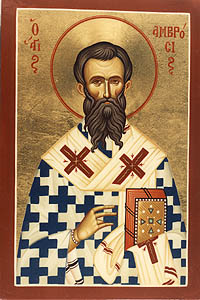
St. Ambrose, a Russian icon
St. Ambrose is one of the four great Western teachers of the Church, along with Augustine, Jerome, and Gregory the Great. He was born around 339 in Trier (now southwestern Germany). When his father died in 350, his mother and two sons went to Rome. Ambrose’s sister Marcelino was already in a monastery there. Ambrose was very talented, and his mother chose the best teachers of the time for him. He gained a perfect understanding of art, rhetoric, and law. After his studies, he became a lawyer. He gained admiration for his education, eloquence, justice, and love. Thanks to his friend Anicius Probus, the governor of Italy, he became a judge in the highest state offices. In 373, he became governor of Milan, Piedmont, Genoa, and Bologna. He held his office with all kindness and amiability, for which he soon gained general popularity.
When the Arian bishop Auxencius died in Milan in 374, unrest arose over the election of a new bishop. The Arians wanted a bishop from among themselves, and the Catholics wanted an orthodox one. There was fear that a rebellion and murder would break out. The imperial governor Ambrose rushed to the temple to calm the unrest. In the temple, he delivered a fiery speech, admonishing both sides. Everything fell silent. Suddenly, a child in the temple exclaimed: “Let Ambrose be bishop!” Other Catholics and Arians, now united, joined in. Ambrose objected to the fact that he had no theological education and was not even baptized. He even had two women of dubious reputation brought to his palace and two criminals strung up on a pole to make it appear that he had an evil heart and was not worthy of the episcopal rank. When that didn’t work either, he fled. However, they found him the very next day. They sent a message to the emperor asking him to permit them to make Ambrose a bishop. The emperor agreed. After careful preparation, the priest Simplicity baptized him on November 30, 374. He was subsequently ordained a priest and consecrated a bishop on December 7.
Ambrose fearlessly defended the Church and fought against heretics and worldly attacks. He distributed all his movable property to the poor and donated his immovable property to the Church. He entrusted the administration of these properties to his brother Satyr so that he could devote himself solely to the episcopal service. Furthermore, he lived modestly, fasted, and did not go to feasts. He studied diligently, which he lacked. The priest Simplicity further guided him. He preached every Sunday. Augustine also began to attend his sermons, whom Ambrose later baptized.
His zeal is also evidenced by the fact that he did not even allow Emperor Theodosius to enter the temple when he sinned by killing thousands of innocent people. He stood in his way and publicly excommunicated him from the Church. Only after eight months of public repentance did he lift the excommunication from the emperor and grant him absolution. He continued to work vigorously. Towards the end of his life, he also devoted himself to writing religious books. He died on Holy Saturday, April 6, 397. He left behind several writings, letters, speeches, and hymns. Likewise, he also contributed significantly to liturgical singing in Milan. The name “missa” – mass for the Eucharistic celebration – comes from him. In 1295, Pope Boniface VIII. Granted him the title of Doctor of the Church. His feast day is celebrated in the Church on the day of his episcopal ordination – December 7.
Posted in Nezaradené
Leave a comment
I will see the eyes of the blind.
The evangelist Luke already describes what the prophet Isaiah predicts in the distant future as a present, currently unfolding story. It also speaks to our reality. The prophecy is fulfilled: Jesus heals two blind men. How can we recognize ourselves in this story as it relates to us? Even if someone doesn’t need prescription glasses, they will understand that we all have more or less severe vision impairments. It is the spiritual quality of our outlook. A person can be blind or blinded by pride. He may be blinded by passion or anger. He may be dazzled by someone or something that prevents him from seeing properly.
He can be myopic if he cannot see beyond his worries and troubles and the narrow horizon of his interests. Likewise, he can be spiritually far-sighted if he sees the big goal clearly, but he stumbles over small everyday obstacles he cannot see. He can also live in a “gray haze” when egoism dulls and clouds the vision, so he sees his fellow man, the world, and nature blurred, distorted, or obscured. The disease of correct spiritual vision is also a deceptive view in black or perhaps in pink colors.
To see, to truly see, means to see with Christ’s gaze through the lens of his heart. If the famous writer (Saint-Exupéry) said that “we see correctly only with the heart,” this is only part of the truth. More precisely, we see rightly only with a pure heart, and we see best with the heart of Christ. Only those who meet him in living prayer, in the sacraments of the Church, and the Scriptures gradually adopt his way of seeing, understanding, and evaluating everything around us and ourselves. Scripture also speaks in many places about the human heart, and even characterizes it as deceitful, twisted, hardened, stubborn, etc.
He speaks of it as a place from which even evil things emanate. It is not good to idealize the human heart. Only a heart renewed by God and his grace, a heart that loves God, discovers its true power of goodness. “Blessed are the pure in heart, for they shall see God.” Yes, Lord, we, too, are blinding, and we need to encounter your healing love. May our eyes be opened, and we see. May even our hearts in their deepest core be constantly renewed in you. May it also be fulfilled so we can see correctly, clearly, and distinctly.
Posted in Nezaradené
Leave a comment
Solemnity of the Immaculate Conception of the Blessed Virgin Mary
Life wisdom teaches us all that prevention is better than cure. We know how complicated the healing process can be.
Today’s celebration of the Immaculate Conception of the Virgin Mary is the most striking example of God’s extraordinary preventive help, as the angel said: “Full of grace.”
On December 8, the entire Western Church celebrates the feast of the Virgin Mary c, received without the stain of original /today t, the term original/ sin is more commonly used. Many believers believe the Immaculate Conception refers to how the Virgin Mary conceived Jesus. However, this is a mistake – this is how the Virgin Mary herself was conceived. That is why the Immaculate Conception is also celebrated precisely 9 months before the feast of the Nativity of the Virgin Mary, which is commemorated every year on September 8. The Church’s teaching on the Immaculate Conception results from many centuries of prayer and theological development, during which the understanding of the Virgin Mary’s role in the history of salvation has continued to grow.
Already, the Fathers of the first century were developing the theology of Mary as the new Eve. It begins around the beginning of the fifth century, mainly thanks to St. Augustine, to more precisely formulate the doctrine of hereditary /original/ sin. Of course, the theologians immediately began to ask themselves how it was with the original sin in Mary. Was she subjected to him, too? The Franciscan Bl also asked this question. John Duns Scotus. He taught that, according to him, Mary, due to her natural origin, was subject to the law of sin like any other person. She, too, needed redemption, just like all humans. However, by God’s special preventive intervention, she was saved from the stains of any sin, so she entered earthly life already in a state of grace. Therefore full of grace. She, too, was redeemed by Christ, but in a more perfect way than other people, because she was freed from sin in advance, that is, preventive, while others are freed from the injury of the already existing one. This way of redemption is a unique privilege that God granted as an undeserved gift only to Mary because she was to become the mother of the Redeemer.
To understand this secret, let’s use an analogy: Imagine a person who falls into a bottomless pit. Someone else walks by and pulls him out of the pit. He will free him. That man was saved from the pit. Let’s imagine then that another woman is walking around. She, too, is about to fall into the pit, but just then, someone else catches her so she doesn’t fall into the pit. She was also saved from the pit, but obviously in a better – preventive way: she was not only subsequently pulled out of the pit, but someone prevented her from falling into it and getting injured by the fall. Christians have used this simile for centuries to explain how Christ saved Mary. By receiving Christ’s grace at her conception, she received this grace before it could be defiled by original sin and guilt. So, even here, prevention is better than subsequent treatment and strenuous recovery.
On this day, we also remember that life has been sacred from conception. That is why we Christian believers are against abortion. This well-known example from history also strengthens our conviction.
A professor at a well-known medical school presented an ethical problem to the students: “The father suffers from a venereal disease, and the mother has tuberculosis. Four children were born to them – the first was visually impaired, the second died, the third became deaf, and the fourth inherited tuberculosis. However, the mother became pregnant again and together with the father, she would come to you for advice. If they were considering an abortion, what advice would you give them?” Students formed consultation groups and consulted. Finally, they all decided to recommend abortion. “Congratulations,” said the professor. “You just killed Beethoven.” Even if someone objected that this is a popularized and exaggerated story, the fact remains that Beethoven’s mother was very poor and sickly, worked as an ordinary maid, and his father – although a musician – was a notorious alcoholic, an obscene and cruel person. Nevertheless, the mother accepted each child, and thanks to this, we can listen to many of his musical works. Life is sacred because it comes from God.
Only one thing really destroys a person’s life—sin. Even today’s holiday shows us that God wants to help us in every possible way to break free from the slavery of sin. It’s hard work. He gives us his whole life. He gives us all the means for this, including the intercession of the spiritual mother, Mary. Let’s use these means to save ourselves.
Posted in Nezaradené
Leave a comment
People’s Views at Advent.

Collage: Attitude
The Advent period, which is supposed to be a time of silence and preparation for the Christmas holidays, also brings a number of reasons every year that drive us to haste.
At home you have to clean, bake, prepare Santa Claus packages and buy presents, schools are preparing parties or Christmas concerts, at work end-of-year projects are being concluded and Christmas parties are being organized, priests are busy with pre-Christmas confessions.
In addition, the ubiquitous noise and advertisements. It seems that the effort to survive Advent in peace requires both a conscious decision and targeted steps.
We asked celebrities how they survive this period and what helps them not to get carried away by the whirlwind of responsibilities.
Matej Sabo, head of the Eben Ezer Community and member of the Father’s Heart leadership team for Slovakia
Matej Sabo. Photo: private archive .
For our family, which also includes four schoolchildren and one teacher, Advent, or filipovka, an exceptional period of challenging struggle to calm down and prepare one’s heart for the holidays of the Nativity of God. The aforementioned gatherings, pre-Christmas concerts, end-of-year duties, etc. certainly play a role in this.
These external circumstances, including the hectic atmosphere in shopping malls and stores, seem to push completely against what we all want to happen inside us. “Guard your heart very much…” (Proverbs 4:23) and “…enter your room, close the door behind you and pray to your Father…” (Mt 6:6 ) are highly topical invitations. Do I keep the inner peace in my heart or do I allow the whirlwind of external hectic to sweep me away?
Personally, I already have enough experience with both scenarios and dare to say that if I don’t want to be a victim of circumstances, I need to plan how to guard my heart, make a decision and act according to this plan. In recent years, the advent digital sabbath has helped me a lot in guarding my own heart and quieting down, despite the external chaos.
In short, it means turning off all screens, especially pocket ones. With the only exception – the work screen during working hours at the workplace. I also combine it with the decision to read something meaningful for the given period (this year, for example, we are reading the book by John Mark Comer in the community, Neuprosné ni zhonu), or some form of dietary discipline (Daniel’s fast, intermittent fasting…).
If possible, it is ideal to enter these things together with a few people with whom we can constantly encourage each other. Whether it will be in the family (adolescent children already know how to face such a challenge), or in the community. The fruits of inner peace and joyful anticipation of Christ’s coming are certainly worth it.
Rafaela Zvrškovcová, provincial superior of the school sisters of St. Francis

Rafaela Zvrškovcová. Photo: private archive.
I look forward to Advent every year. In recent years, I have often associated with him the content of the song by ESPÉ Darkness falls , when the king with light comes to us. And this is what Advent is about for me – the more it is dark outside during this period, the more God draws closer to us through his Son with his light.
I don’t want Advent to be just a period of strong resolutions for me, which many times I conclude at the end that it didn’t work out so well. I want to experience it as a gracious time when I can open my heart even more to God, so that he can touch it with his love, bring peace to it and illuminate what is still in the dark and hidden even from me.
And this can be done even in the midst of ordinary duties, but especially in moments of silence and solitude, whether in the chapel, in my room, or outside on a walk, where I let the Virgin Mary accompany me while praying the rosary, because she knows best how to open the door to Jesus, after all, she did it with her fiat . So it’s all a matter of priorities. Certainly, also gifts, cleaning, work duties, which tend to be quite a lot at the end of the year, all this is important. But if I put God, who leans toward me, first, and subordinate everything else to that, then it only gets as much time as it needs.
I am begging myself and every person of good will to be able to bow before God, who did not hesitate to humble himself and become one of us. So that when we look into the childish eyes of little Jesus at Christmas, we enter into his light and embrace the fullness of love and peace. After all, each of us and our hurting world needs these gifts so much.
Andrea Mikolášiková, organizer of the Women’s Catholic Conference from the Between Heaven and Woman project

Andrea Mikolášiková. Photo:
Advent is a very special time for my husband and I, and we try to make it special for our family as well. While in some areas of life we like to experiment, in others we like tradition. Celebrating Advent is one of those where we love tradition. For more than ten years, has been a supporting part of our advent .
Over the years, we make small changes – whether we have a real tree from the beginning of December or just branches in a vase, whether the children color the individual symbols or we have them handmade, the core remains the same. Every evening, as a family, we try to meet for at least a short time over God’s word and follow through a simple catechesis the history of salvation leading to the birth of Jesus Christ. In the morning, we get used to playing Advent hymns.
Our Advent also includes creative activities such as making candles from beeswax, bee wraps, soap making, baking for joy and the like. Neighbors like on St. We will surprise Mikuláš with a package and we are happy to support the kolkolasky.sk project.
As for the more prosaic tasks: we try to buy gifts already in November and in December just put in the last touches, we don’t do a big cleaning before Christmas, and since we celebrate Christmas at the family cottage with the extended family, we divide the shopping and cooking, we order cakes.
Milan Jaroš, Roman Catholic priest, chaplain of the Bratislava-Dúbravka parish

Milan Jaroš. Photo: private archive
I like Advent very much. At the beginning of the new liturgical year, it is a beautiful time of preparation for the feast of the birth of our Savior. Since Advent is, in a certain sense, a very Marian season, I try to live it together with Mary, when I can mentally take her hand and let her lead me to Jesus and contemplate the incarnate word of God. I try, as it were, to penetrate more into the spirit of this period, whether through the liturgy, God’s word, or personal prayer.
We live in a time when we are in a hurry all year round, so at the end of the year there is maybe just a little more to do. Therefore, I constantly try to focus on what is essential. On God and your relationship to him. And in this, the Virgin Mary helps me a lot, from whom I can learn subtlety, hiddenness, love, peace, service and many other things in the hustle and bustle of the world.
Especially during this time, it helps me to focus on service. Maria says that she is a servant of the Lord, and I, as a priest, am also a servant of the Lord, so as part of my service, especially during confession, I try to help people focus on what is essential, on Jesus and the relationship with him.
It is customary to talk about Christmas as a holiday of peace. Our whole life is a struggle for peace. If we want to work towards true peace, we must go to its source, and that is Jesus – the prince of peace. This is what I strive for and sometimes I succeed more and sometimes less.
Lenka Bene, director of the association that covers Catechesis of the Good Shepherd in Slovakia
I like Advent very much. Although, of course, it is also associated with finishing everything left unfinished at work at the end of the calendar year and with pre-Christmas cleaning at home, it is also a time for me to think more deeply about the hope that goes beyond my ordinary life, and about Mary’s yes as an act of complete trust and obedience to God .
I discovered that it is often just a matter of my decision, how much space I will give in Advent to the stress of completing tasks and also to my idea of a perfectly cleaned and decorated house for Christmas, and how much I will keep for inner silence, rorats and thinking.
My service to children and adults in the Catechesis of the Good Shepherd also helps me in a deeper spiritual experience . In the atriums with children, we devote a lot of time to Advent and preparation for Christmas. We start already in November and we talk about biblical geography – about the land of Israel, which was chosen by God for Jesus to be born, live, die and rise from the dead. We continue by reading selected messianic prophecies especially from the prophet Isaiah and the stories of the annunciation, the visit of Elizabeth and the birth of Jesus.
At home, we have had an agreement for several years that we do not rush to buy gifts, each of us, including our children, receives only one gift under the tree as a symbol of the great love that God has for us. We bake cookies with the children just before Christmas and then exchange them with grandparents and friends. Sometimes we even have ten types.
In the village where we live, there are no regular Holy Masses, so a few years ago we started to pray early in the morning of Advent with a few people from our community to pray morning praises in the church by candles. It has a great charm, some of our children are already joining us, and it helps me personally to enter the new day with joy and perspective.
Jozef Husovský, poet, lyricist and aphorist, author of daily mini-reflections for the Christian Worl
For me, Advent always has the flavor of crunching snow under winter boots and lights penetrating the fog. What I experienced as a boy rushing to minister. That changed today. The lights and fog remained, only the snow was nowhere to be seen.
By writing thoughts for each day, I actually have a year-round Advent. And I like to read Richard Rohr, so I also have year-round antlers. (Smile.) So yes, Advent is a special season, but in my life it doesn’t just refer to the less than four weeks before Christmas.
As for pre-Christmas activities, if you do things continuously, you don’t have to finish big before Christmas. I’m not saying I always succeed, but I’d like it that way.
And the second thing is that I don’t want a Christmas tree that wins international competitions. In addition, we have an agreement at home that we can treat ourselves to Christmas presents throughout the year. When I’m craving a book that came out in February, I’m not going to wait ten months to unwrap it from the Christmas wrapping paper. So we can give each other Christmas presents on an ongoing basis. And thank God, we are doing well.
Posted in Nezaradené
Leave a comment
Sermon on Isaiah 25,6-10
Beloved,today we gather to reflect on a profound passage from the book of Isaiah, specifically , This scripture offers chapter 25 verses 6-10 This scripture offers a vision of hope and divibe promise in the face of human despair. As we delve into these verses, let us open our hearts to the message, of God*s grace and the celebration of His eternal kinngdom.
Isaiah begins with a vivid metaphor, a feast prepared by the Lord on His holy mountain. This ist no ordinary banquet.It is a gathering for all peoples, symbolizing inactivity in God’s kingdom. Imagine the richness of the food, the aged wine, and the best of meats- elements of joy , celebration, and abudance. This imagery invites us to envision a future where God’s presence brings nourishment, satisfaction. and unity.
In verses 7 and 8 we see the promise of God’s transformative power. He will destroy the shroud that covers all nations a metaphor for the sorrow, death and despair that weigh heaavily on humanity. The promise that Go will ,, swallow up death forever” offers profound hope. It reminds us that through Christ, death is the end but a passage to eternal life. The tears we shed in grief and the shame we carry will be wiped away by our loving God. This is the heart of the Gospel the assurance that is intimately involved in our suffering a committed to our healing.
Verse 9 invites us into an active response. Surely this is our God. WE trusted in him, and he saved us. Trust is a fundamental aspect of our relationship with God. In a world filled with uncertainty and fear. God calls us to place our faith in Him. This trust is not passive. It is a declaration of our belief in His promises. When we acknowledge God’s sovereignty and faitfulness we are empowerd to rejoice in His salvation,
Posted in Nezaradené
Leave a comment

