Pius X. Pope

Real name Jozef (Giuseppe) Sarto

Saint

Holiday: August 21

* June 2, 1835, Riese, today Riese Pio X near Treviso, Italy

† August 20, 1914, Rome

Pontificate: 1903 – 1914

Meaning of the name: pious, religious (lat.)

St. Pius X was born on June 2, 1835, in the village of Riese near Castelfranco Veneto in the Diocese of Treviso as the second of ten children. His father was a postman and a farmer. Jozef liked to minister, wanted to learn, and had great talent. Even though his parents were poor, he managed to graduate from the grammar school in Castelfranco and Padua, where he continued studying philosophy and theology. A native of Riese, the Venetian patriarch Jakub Monica also gave him a place in the seminary. Jozef was ordained a priest in 1858 in Castelfranco. He worked as a chaplain in Tombolo, from 1867 as a parish priest in Salzano, and in 1875 he was called as a canon and vicar general in Treviso. In addition, he also taught in the seminary. In 1884, Pope Leo XIII. appointed as bishop in Mantua and in 1893 as patriarch and cardinal in Venice. He was elected Pope in 1903. According to the “Malachi Prophecy,” he was supposed to be “ignis ardens,” a roaring fire. As he said during his election, he took Pius after the holy popes who were “mighty and kindly protected” the Church. He chose “Renew everything in Christ” as his motto.

Predecessor Pius X. Leo XIII. Focused on restoring the Church’s external relations, Pius X decided on internal reform. In the first days after the election, he ordered a new codification of church law. In 1908, the Acta Apostolicae Sedis began to be published – a circular for the whole Church, in which statements and information about the happenings in the Church were published. It is a common practice not only of the Holy See but of every diocese. Pius X had excellent organizational and reforming talent. Administration became much more straightforward; he eliminated clutter and unnecessary bureaucracy. He proposed new methods and means for pastoral care. He cared a lot about the holiness and education of priests. He reformed the liturgical music, removed the long interminable preludes during the liturgy, and paid great attention to the Gregorian chant. A college for church music was established in Rome.

At his initiative, a new edition of the Roman Missal and the Roman Breviary was published. The Pope had an excellent feeling for errors and anti-Catholic directions. He was adamant in faith and morals, but he tried to lead strays to the right path with kindness and goodness. He drew attention to the so-called modernism that began to spread. He radically rejected it in 1907 with his encyclical Pascendi.

On the other hand, however, many did not understand the Pope correctly. When condemning modernism, they went to the other extreme (integralism) – they opposed any adaptation of the Church to modern life. They wanted to enter worldly affairs with the decisive word as well. However, the Pope did not do politics. He was only interested in the purity of faith and the renewal of religious life. He tried to separate the Church from the state. He issued a decree that no secular power should interfere in the election of the Pope. Even during his election, the Austrian Emperor František Jozef interfered in the election, announcing an “exclusive objection” to the election of Cardinal Rampolla, who was most likely to be elected.

As his role model, the Pope had the parish priest of Ars, John Maria Vianney, whom he declared blessed in 1905. He had a picture of him on his desk. He also declared other zealous priests to be blessed – St Johann Eudes and Klement Maria Hoffbauer. He greatly respected the work of priests. He himself was a zealous pastor. As a bishop, he helped his priests with confession and preaching. His speeches as the Pope were always clear and understandable, and you could feel the fatherly love and strictness in them. He was very zealous for respect for the Eucharist and the renewal of spiritual life. The much-mentioned “active participation of the laity in the liturgy” began during his era. His goal was “so that people do not pray at Mass, but pray Mass.” He also called for frequent St. reception. He allowed the children to receive the first St. communion as soon as possible, which was perceived already the difference between ordinary bread and St. receiving. Until then, they had to wait until they were fourteen. An incident from the childhood of this Pope is mentioned when he wanted to receive the Body of Christ but could not because he had not yet reached the prescribed age of 14 years. When he begged the bishop to allow him after all, the bishop said, “Once you become pope, you can change it.” It happened…

Towards the end of his life, he felt that war was approaching. On August 2, 1914, he issued an apostolic letter expressing great pain over the unrest and called on people to cling to Christ, the Prince of Peace. Shortly after that, he got pneumonia. The disease continued rapidly and insidiously. The Pope died on August 20, 1914. He was not embalmed and buried in the Vatican crypts at his request. His testament was written: “I was born poor, I lived poor, I die poor.” He was declared blessed by Pope Pius XII in 1951 and as a saint three years later.

Pius X was the greatest reformer after Pope St. Pius V- (1566-1572). Several historians say he completed the reform of the Council of Trent (1545-1563). He reformed the missal, breviary, church law, music, sacramental life, seminaries, biblical and theological studies, and the Roman Curia.

Posted in Nezaradené | Leave a comment

Bernard of Clairvaux, teacher of the Church.

Holiday: August 20

* around 1090 Fontaine-lès-Dijon, today part of the city of Dijon, France

† August 20, 1153 Clairvaux, today Longchamp-sur-Aujon, France

Attributes: skull, dog, devil, book of religious rules, beehive

Patron of beekeepers, waxers, bartenders; in obsessions, childhood diseases; at the hour of death

St. Bernard, painting from the 16th century. In Troyes Cathedral

Abbot and teacher of the Church, he was born around 1090 in Fontaines-les-Dijon, France, as the third of seven children of the Burgundian noble Tezelin at the family castle. Together with his four brothers and about 30 young men, Bernard entered the 22-year-old 1112 to the reformed monastery of Citeaux, the first monastery of the Cistercian order, founded in 1098 by Robert of Molesme. Just three years later, at the age of 25, he became the founding abbot of the Clairvaux monastery. During his lifetime, he founded almost 70 other monasteries.

Bernard of Clairvaux, who went down in history as the “second founder” of the Cistercian order, maintained relations for the next four decades until his death with almost all the great personalities of his time. Not only were popes, bishops, priests, and brothers of all orders interested in his advice, but he also had contact with the monarchs of different countries. He also became known as a fiery preacher of the crusades. Vezelay is inextricably linked to his name. Bernard delivered his first sermon on Easter in 1146 before Louis VII in this Burgundian basilica. He spoke so persuasively that the king and all the nobles assembled there eagerly accepted the cross from the hands of the abbot of Clairvaux. From Vézelay, Bernard went north of the country to Flanders and Rhineland. He was met with great enthusiasm everywhere.

Despite having all the opportunities for a ‘career’ in the church hierarchy, Bernard of Clairvaux remained humble and modest throughout his life. He embodied the ideal image of a monk, resolutely refusing all the honorary offices that were offered to him, such as appointment as bishop in Genoa and Milan. His commitment to his beliefs was unwavering, even in the face of disappointment. He experienced his worst disappointment when the second crusade, which he had enthusiastically supported, was wrecked in 1149. He never fully recovered from this pain, a testament to his deep commitment to his beliefs.

At the age of 63, Bernard of Clairvaux passed away on August 20, 1153, after a severe stomach ailment. His death marked the end of a life dedicated to the Church and its teachings. He was buried in Cluny Abbey, but today his grave is in Clairvaux, a fitting resting place for a man who had such a profound impact on the Church.

What respect this monk enjoyed not only in his time but also among church scientists and scholars of all centuries is shown by the epithets that Bernard of Clairvaux received:

  • The arch father of European sentiment (Friedrich Heer)

  • The leader and judge of his time (Jozef Lortz)

  • The religious genius of his of the time (Adolf von Harnack)

In addition, he was given the title “doctor melfifluus” (“honey-flowing” teacher) for his zealous way of preaching. Pope Alexander III. declared Bernard a saint on January 18, 1174—Pope Pius VIII. He was appointed by 1830 as a teacher of the Church.

On images from the 15th century. He is sometimes seen with the devil on a chain as a sign of overcoming all temptations. Such a statue from the 15th century is in the Church of Santa Maria Maggiore in Rome. He also wields a cross, a dead man’s skull, the instruments of suffering, a rosary, or a white dog, which points to the legend that Bernard’s mother had a dream before his birth that she would give birth to a white dog that would raise its voice against its enemies.

Posted in Nezaradené | Leave a comment

20.Saturday in Ordinary Time,Year b John 6,51-58

The secret of Eucharistic transformation …
We carry within us the desire for a long and happy life. Despite great sacrifices and hardships, we sometimes try to improve and extend this life. Today’s reading prompts us to ask ourselves: What is necessary for life? Food, air, water, good people, happiness, and life principles so we don’t hurt others and let others live. Is this recipe sufficient for a long and happy life? From the first moment our hearts begin to beat, a shadow falls on our lives. A shadow that cannot be removed in any way. A shadow that does not disappear even when the most beautiful sun shines. It is the shadow of our death, our transience, and our fragility. That is why our heart begins to beat stronger when we hear Jesus’ words: I am the living Bread that came down from heaven. Whoever eats this Bread will live forever. And the Bread that I will give is my body, sacrificed for the life of the world.

As the first reaction, a spark of hope awakens in us. But soon, another shadow appears: How is this possible? Isn’t Jesus wrong? Is his promise fulfilling? These questions have been introduced previously. The Evangelist John informs us that the Jews also argued among themselves and asked: How can this man give us his flesh to eat? It was and is, therefore, difficult to believe in the life-giving power of Bread, the Body of Christ, in the life-giving miracle of the Eucharist. Sv. John wrote his Gospel several decades after the events in Jerusalem. He only cared a little about the exact description of what Jesus did, when, and what he said. His main question was: Who was he? How long is He for me, for our community of believers? It is difficult for him to describe this secret in words. He is looking for images and concepts that can express what cannot. He also uses images such as light, living water, vine, shepherd, life, way, truth, and the body – bread. Of all the signs that Jesus did, John chose only seven. He tries to sort his memories, thoughts, and experiences around them.

However, he always knew that Jesus was more excellent than human words and comparisons. One of the signs was the miraculous multiplication of Bread. After this description of reproduction, St. John, here are the words we hear today. I am the Bread of life. Whoever eats this Bread will live forever. For the first listeners, they must have sounded particularly mysterious, incomprehensible, if not directly pictorial. These words were spoken by a young, thirty-year-old Rabbi who considered himself the Messiah and, what’s more, the son of God. After two thousand years of serving (performing) the Eucharist in different corners of the world, these words have acquired a slightly different meaning. However, they have kept their secret and mystery. The Eucharist, the Body of Christ, the Bread of Life – will only find a partial explanation and understanding in human language. In the encyclical on the Eucharist, the Holy Father John Paul II writes: In the Eucharist (…), the mystery of the resurrection becomes available. That is why St. Ignatius of Antioch described the Eucharistic Bread as “the medicine of immortality, the antidote to death.”

In a moment, a transformation miracle will occur on the Eucharistic table. Ordinary white Bread becomes the Bread that gives life. The invitation to this table is for all, although not all can or want to see the miraculous value of this invitation. God’s wisdom was already called in the times of the Old Testament: Come, eat my food, and drink the wine poured by me! Leave childhood, and you will live; follow the path of knowledge! Therefore, like the first Christian communities, we gather for the Eucharist; we speak to each other in psalms, hymns, and songs full of spirit; we sing and glorify the Lord in our hearts. And we always thank God the Father for everything in the name of our Lord Jesus Christ! Try and see for yourself how good the Lord is.

Posted in sermons | Leave a comment

Johannes Eudes,priest,founder of the Congregation of Jesus and Mary.

Holiday: 

* November 14, 1601 Rinear Argentan, France

† August 19, 1680 Caen, France

Meaning of the name: God is gracious (Hebrew)

St. John Eudes

St. John Eudes was born on November 14, 1601, in the village of Rinear Argentan (west of Paris). His father, Izák Eudes, originally wanted to become a priest, but as the only descendant of a family that died of the plague, he had to renounce his intention. He married Martha Corbin and made a living as a farmer and village doctor. He prayed the breviary every day and was very pious. Ján was the first of seven children. As a child, his parents offered him to the Virgin Mary as a sign of gratitude for the gift of a child. Ján was very clever; he had a kind heart and a strong will. At the age of fourteen, he made a vow of lifelong chastity. The Jesuits educated him in Caen. In 1618, he joined the Marian Congregation. His classmates called him “pious Eudes”. After consulting with his spiritual leader, he decided to become a priest. However, his parents somehow forgot their old desires and wanted him to get married instead. But he didn’t give up. Finally, they gave way to him, and on February 25, 1623, he joined the Society of Oratorians in Paris, founded in 1611 by the holy priest Peter de Bérulle. Under his guidance, he trained in the life of prayer and virtues. He was ordained a priest on December 20, 1625. The second year, however, he fell ill and had to be treated. In 1627, he was definitively accepted among the oratorians and began preparing to preach. But then he received an urgent message from his father. He begged him to come and attend to the sick of the plague. With the superior’s permission, he cared for all those who needed it for two months. After the end of the epidemic, he returned and prepared to conduct parish missions. But the plague came again to the city he lived in, Caen. He took care of the sick again; he got ill and almost died. But he got over it. In 1632, he held the first six missions. He preached and confessed with such fervor that everyone considered it a feat of mastery. But then he went to study again and, after two years, became responsible for the Oratorian missions in Normandy.

In the years 1635-1641, John preached in various places and his activity was very successful. Many people were converted or confessed years later to his preaching. However, John was troubled that these successes of his did not last long, as the local priests – parish priests – were uneducated and did not continue what he had started with his sermons. And so he came up with the idea of ​​founding a priestly seminary. He wanted to do it within his order, but the superior considered it too progressive and did not allow it. On the advice of several, he decided to leave the Oratorians and found a new congregation. At the end of 1642, he received permission from the king. On March 24 of the following year, he left the Oratorian monastery and traveled to the old chapel of Our Lady, which was about thirteen kilometers from Caen. There, together with their five collaborators, they consecrated themselves to Jesus and Mary and began their activity. In the years 1643-1670, they founded six seminaries. The bishops welcomed this activity and begged him to help them. On the other hand, Ján also met with misunderstanding. Many criticized him for this, envied his achievements and hindered him. But he didn’t give up. He also continued to preach. He went about Normandy, Brittany and other regions and attracted crowds. During his missions, he converted several public sinners, showing his deep compassion and empathy. Therefore, he begged the order of the Visitation in Caen to give him some sisters to help him work with these penitents. Three sisters, including Mother Patinová, were released. Together with Mother Patinová, he founded the Congregation of Notre Dame de Charité (Our Lady of Mercy) according to the Rule of St. Augustina. To the three usual vows of poverty, chastity and obedience, they added a vow to dedicate themselves to the conversion of fallen women. John greatly revered the Sacred Heart of Jesus and the Immaculate Heart of Mary. Thanks to him, respect for them spread not only throughout France, but also beyond the borders. Some of his writings have survived: The Life of Jesus and His Kingdom, The Good Confessor and The Admirable Heart of the Mother of God.

Towards the end of his life, he suffered greatly from slander and illnesses. In 1680, he renounced the office of superior general. Before his death, he gave his last instructions to his fellow brothers. He died on August 19, 1680. He was buried in Caen. Pope Pius X declared him blessed in 1909 and under the Holy Pope Pius XI. in 1925.

Posted in Nezaradené | Leave a comment

They brought children to Jesus.

Today, we can reflect on a scene that is, unfortunately, authentic: “Little children were brought to Jesus so that he would lay his hands on them in prayer. But the disciples criticized those who brought them (Mt 19, 13).” Jesus immensely loves children, but we, with our typical and characteristic thinking of “adults,” do not allow them to approach Jesus and the Father: – When they grow up, if they want, they choose…! What a big mistake! The poor, those who are in need, and those who have nothing are the object of the Lord’s special affection. And children and infants are very “poor.”

They are poor in age, and they are inadequate in formation. They are defenseless. That is why the Church – our “Mother” – decided that parents should bring their children to baptism as soon as possible so that the Holy Spirit could settle in their souls and they could join the warmth of the community of believers. This is stated by the Catechism of the Catholic Church and the Code of Canon Law, the highest-ranking legislators of the Church (which, like any other community, must have its legislation). But no! When they are adults! Such a procedure is nonsense. Otherwise, we can ask ourselves:

What will this child eat? What his mother gives him, without specifying what she would prefer. ▪  Or what language will this child speak? The same is true for his parents (in other words, the child will never be able to choose another language). ▪ Which school will this child attend? Wherever his parents decide to take him, without waiting for him to determine which study he will prefer… ▪ What did Jesus eat? What his mother Maria gave him. ▪ What language did Jesus speak? The language of his parents. ▪ What religion did the Infant Jesus learn and practice? The one his parents practiced, Judaism. ▪ Later, as an adult, thanks to the formation given to him by his parents, he founded a new religion… But first, his parents’ religion, naturally.

“…for to such belongs the kingdom of heaven”. What kind? As they are like children. Not in the sense of being immature, irresponsible, and egotistical, but in the sense of being open to new things, free, and trusting. If you have such an opportunity, adore the child today and ask how it is with you…

Posted in Nezaradené | Leave a comment

The smile of the earth and the joy of heaven.

Serve the Lord with joy » Ps 100, 2.

Teachers of the spiritual life point out that there is more than a verbal difference between a smile and laughter, because the joy of the earth is not yet the joy of heaven, and therefore it inevitably retains a certain kind of attraction. Besides, the world is too marked by sin, death and injustice, tears and suffering, for joy to be expressed more outwardly.

Nevertheless, there is no lack of joy in the lives of deeply religious people. Albín Luciani, later Pope John Paul I, did not lack joy and a smile. His rich journalistic activity was published collectively in the nine-volume work Opera omnia. He writes about joy: “Learn to turn what you hear and see into laughter in due measure and form.” Sv. Philip Neri, a saint, on one occasion to Pope Clement VIII. he said: “I hope they would kill you!” Everyone present gasped, but Philip continued: “For faith in Jesus Christ. Everyone breathed a sigh of relief and laughed.” After all, one can wish the Pope to die as a martyr. It is not a crime to pretend to be a comedian if we want to entertain people.”

He continues: Mark Twain with his humorous magazines and books, Charlie Chaplin with his brilliant and at the same time human pieces, Carlo Goldoni with his comedies, according to St. Thomas could have become saints if they had added the right intention and other Christian virtues to their art and talent. We would have sympathetic, smiling patron saints in them who teach Christians how to laugh and how to laugh. We would need them.

In today’s chaos, what Thomas Aquinas said is true: Italians are like toothless old men. They cannot laugh without spitting. Sv. Tomáš goes even further and claims that even rudeness or excessive seriousness can be a sin. “Those who do not take part in jokes, who do not say anything to make others laugh, sin. Those who talk are sorry for not responding to appropriate jokes.” One can only agree with that. Humor belongs to faith, says the well-known moralist P. Bernard Haring: “Christians who do not know humor live far from the mountain of the Beatitudes!” Karel Vrána adds: “A Christian who has no sense of humor, who cannot smile at the world and the world that he can’t laugh at human snobbery and steaming, he’s probably a bad Christian. We could say the maxim: Tell me how you laugh and I’ll tell you who you are.’

Posted in Nezaradené | 1 Comment

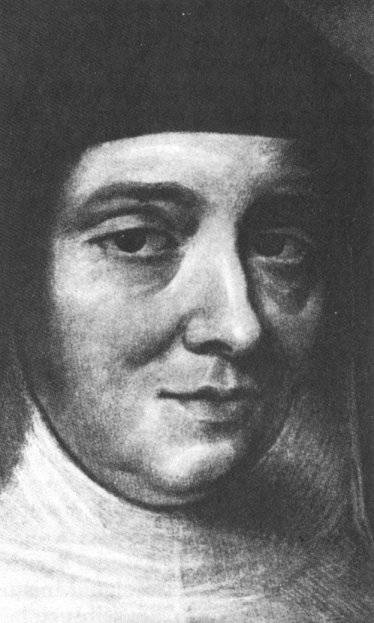
Solemnity of the Assumption of the Blessed Virgin Mary Luke 1,39-56

Luther claims that only faith saves us. A classic example of faith, according to St. Paul, is Abraham, the father of all believers (cf. Rom 4:1-3). Mary and Abraham were mainly compared by Protestant theologians. The comparison then served as a polemic against Marian piety. Let us note one of them who has a world renown: Sören Kierkegaard, who has gained great respect in many ways. His teaching about Mary deserves attention. It is based on the conviction that Mary has primary importance of faith in salvation. He does not primarily admire her motherhood in the physical sense, but sees Mary’s greatness above all in her faith. As he meditates on the Gospel texts that discuss how the fullness of salvation will take place, Kierkegaard concludes that Mary’s faith surpasses that of Abraham. However, both remain in the same orientation of faith. In both cases, it is a heroic faith, full of sacrifices. Both Abraham and Mary receive God’s word with absolute obedience. Therefore, they remain alone with God alone, if we can say so. They have no human support and sympathy. They are in situations of tension. Abraham is subjected to ridicule because he believed that he could have a son in his old age, as God had promised him. Mary hides her secret from Joseph, her fiancé, keeps everything only in her heart. Joseph gradually learns what happened thanks to the angel’s announcement in the dream, Mary does not tell him anything. In the strength of faith, Mary follows Jesus throughout his life, in his suffering and in his death.

Kierkegaard therefore sees all of Mary’s greatness, her extraordinaryness, in faith. But heroic faith includes sacrifice because it is the essential bond of union with Christ. And by the same principle, faith purifies. The Virgin Mary, because she has faith of an extraordinary quality, is purified in a way that surpasses all other ways. Therefore, Mary remains the greatest example of spiritual life for Christians. In his diary, Kierkegaard writes: “No one who understands how religion is feminine in its nature will not be surprised that a woman is represented as a teacher, as a model of true piety. Because a woman must be silent (cf. 1 Cor 14:34), therefore she cannot teach, therefore silence before God is what belongs to the essence of religion. How we must learn from women! We learn from a woman a humble faith that does not rule, that doubts and hesitates: “Why?”, “What will it be for?”, “How is this possible?”, she asks, but at the same time she humbly believes and as Mary says: “Behold, I am the servant of the Lord”. It speaks, but let us note well that this is silence. Learn true listening to the word from a woman, from Mary, who does not understand and does not understand, but keeps the word in her heart (Luke 8:15). Take over from the woman the silent, deep and religious pain that will be silent before the face of God. Learn from Mary. Because it is certain that even her heart – as was predicted – will be pierced by the sword of pain (cf. Lk 2:15); he does not despair either when he hears the prophecy or when it begins to be fulfilled.

In this context we can come to a conclusion: if the message of salvation in the Old Testament begins with the faith of Abraham, the father of all believers, at the beginning of the New Testament we meet Mary’s faith, the mother of all believers in Christ. Faith, participation in God’s knowledge, in Christ’s truth, gradually grows. According to St. Basil and the Fathers, the growth of faith in Mary’s life reached its critical point at the moment under the cross. Here Simeon’s prophecy was fulfilled: “And a sword will pierce your own soul” (Luke 2:35). At first, a doubt penetrated her whether the incarnation of the Son of God was worth it, when he was thus disfigured in front of his own people. On the icons, Christ himself teaches the Virgin Mary to understand the supreme wisdom of the cross. With this, her faith reaches its peak and becomes a vision. Christ dies on the cross, rises from the dead and ascends to heaven. The Ascended Virgin Mary follows him, and thus the mystery of Christ is completed.

In the West, we are used to images in which we see the Virgin Mary ascending to heaven above the empty tomb, surrounded by the apostles and looking up in amazement, while the liturgy reminds us that we, together with them, already live, at least in our mind, in heaven. In the East, the same mystery is expressed by the icon of the Dormition, i.e. the death of the Virgin. It is not she who ascends, but rather Christ who descends from heaven to take her soul into his hands: “The souls of the righteous are in God’s hands, the torment of death will not touch them (Mud 3,1). At the end of the world, Christ must descend to earth to restore everything permanently as the kingdom of God. For the Virgin Mary, this happened already at the moment of her death, when he descended to her. Everything is completed with that. According to V. Lossy, he is “the eschaton, a realized created person before the end of the world”.

Posted in Nezaradené | 1 Comment

Maximilian Maria Kolbe.

Today, we honor the memory of St. Maximilian Maria Kolbe, a martyr of Auschwitz concentration camp. Fellow inmates recall him as a compassionate protector and comforter who led prayers, heard confessions, and shared food. In July 1941, he volunteered to starve to death in place of another prisoner, František Gajowniczek, a family man, demonstrating heroic love even to his executioners. Devoted to the Mother of God, he was taken with her on the eve of the Ascension.

Jesus frequently showed a special affinity for the vulnerable, including the sick, the weak, and children, whom he loved tenderly due to their guileless nature. In fact, children embody the qualities he deems necessary for participation in his kingdom. Jesus publicly demonstrated this fondness for children on two occasions, using them as an example for his disciples. One instance took place in Capernaum, Galilee, and the other near Jericho in Judea, just as he was about to enter Jerusalem, as recorded in today’s Gospel passage, where Matthew writes that children were brought to him.

Women, likely mothers, grandmothers, or sisters, brought children to Jesus, presenting them to him for a blessing. Despite the disciples’ objections, Jesus welcomed the children, teaching us that his kingdom belongs to those with pure and humble hearts, like children. As we stand before God, we should be like little children, free from false pride. Let us ask the Blessed Virgin Mary and St. Maximilian to guide us with the same gentle hand.

Posted in Nezaradené | 1 Comment

The controverting surrounding the Apache Christ.

The Apache Christ controversy has sparked outrage among the faithful, with even experts expressing astonishment at the bishop’s efforts to remove the church image. Artistic depictions of Jesus Christ, often prioritizing local cultural expression over historical accuracy, have been a part of church history for centuries.

When worshipers from St. Joseph Parish in the U.S. state of New Mexico arrived at the church a few weeks ago, they were left shocked.

A familiar eight-foot image of Jesus Christ was notably absent from the chancel, its customary location for 35 years. Initial concerns about theft soon gave way to a different explanation: the painting had been intentionally removed at the request of the local bishop and carried out by a local priest.

The figure, in typical Indian dress, is standing on the sacred Sierra Blanca mountain, with a sun symbol on his left palm and a rattlesnake made of deer hooves in his right hand. At the bottom of the painting is the inscription ‘Giver of Life’ in the local language, and at the top is the Greek histogram IC XC, referring to the name of Jesus Christ.

Yet this is not the only reference to Apache culture in the church – the altar depicts the Last Supper, whose participants take Indian form, and the typical gahe headdresses worn by mountain dancers are enthroned above the Stations of the Cross.

The parishioners’ outrage was so great that the AP news agency and other media took notice of the case.
To understand the sensitivity of this case, it is important to know the wider context.
The false election
The historic parish is located on the territory of the Mescalero Apache tribe and was formerly administered by the Franciscan Friars. In the early 20th century, they had a stone church built there, and in 1989, one of them, Father Robert Lentz, with the approval of the tribal elders, decided to paint a picture of Jesus Christ that would reflect Apache culture.

Deacon Steven Morello, who pastors a group of Native American Catholics in the Archdiocese of Detroit, declared, “There is no conflict between Native American and Catholic spirituality, only harmony.” However, the recent actions of a bishop and priest, aimed at suppressing Native American elements in worship, contradict the Church’s concept of enculturation, Pope Francis’ efforts to reconcile with indigenous peoples, and the US Conference of Catholic Bishops’ statement that indigenous Catholics “do not have to be one or the other. You are both.”

The controversy began over a painting of Christ as an Apache warrior, which was initially removed by the bishop, only to be reinstated after a personal meeting with the affected community and a shift in priests. For local Native American Catholics, the image of Jesus is deeply personal, representing a divine figure who “meets you where you are and reveals himself in a way you can understand.”

This perspective reflects a broader truth: artistic depictions of Christ have always reflected the cultural expressions of their communities. Throughout church history, Christ has been represented in various forms, from ancient symbols like the Greek letters X and P, to more modern images like the Christ Pantokrator mosaic in Hagia Sophia.

The concept of Christ’s image taking on local characteristics without compromising its divine message is well-established. From a 14th-century Ethiopian gospel depicting Christ as a child to modern representations, artistic expressions of Christ continue to reflect and challenge contemporary perspectives. As Virginia Raguin, professor emeritus at the College of the Holy Cross, notes, “Art, like Christ, is deeply rooted in its time, yet transcends it.”


Posted in Nezaradené | Leave a comment

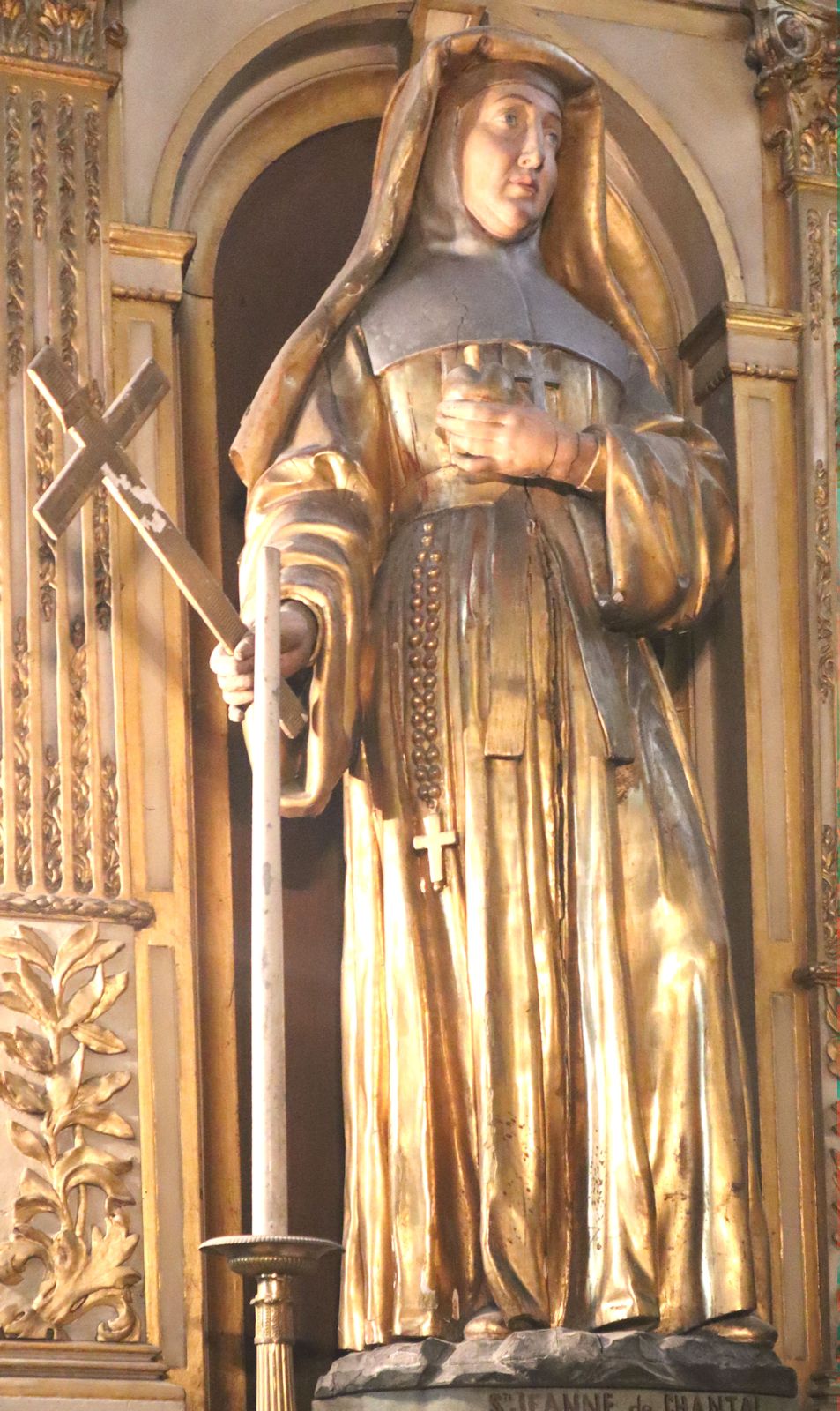
Joanna Francisca from Chantal.

Foundress of the Order
28 January 1572 in Dijon in France
† 13 December 1641 in Moulins in the Allier department in France


Joan of Arc was the daughter of the President of Parliament Fremont of Burgundy and at the age of 20 she married the young, wealthy and cheerful Baron Christophe de Rabutin, Baron of Chantal, to whom she gave birth to six children in a happy marriage, four of whom survived. In 1601 her husband died in a hunting accident. This stroke of fate made the pious woman even more inward; prayer and penance determined her life, and her first mystical experiences and visions appeared. Among other things, her future spiritual guide was revealed to her.

In 1604, Joan of Francesco met Francis de Sales for the first time and recognized in him the man revealed in the vision; a close friendship developed and a correspondence that has continued to this day. She decided to live a celibate life in the future. For a while she spent time with the Carmelites in their monastery in Dijon and became clear about her calling. She put her children in good hands; her eldest daughter had married Francis de Sales’ brother and was now able to live her destiny.

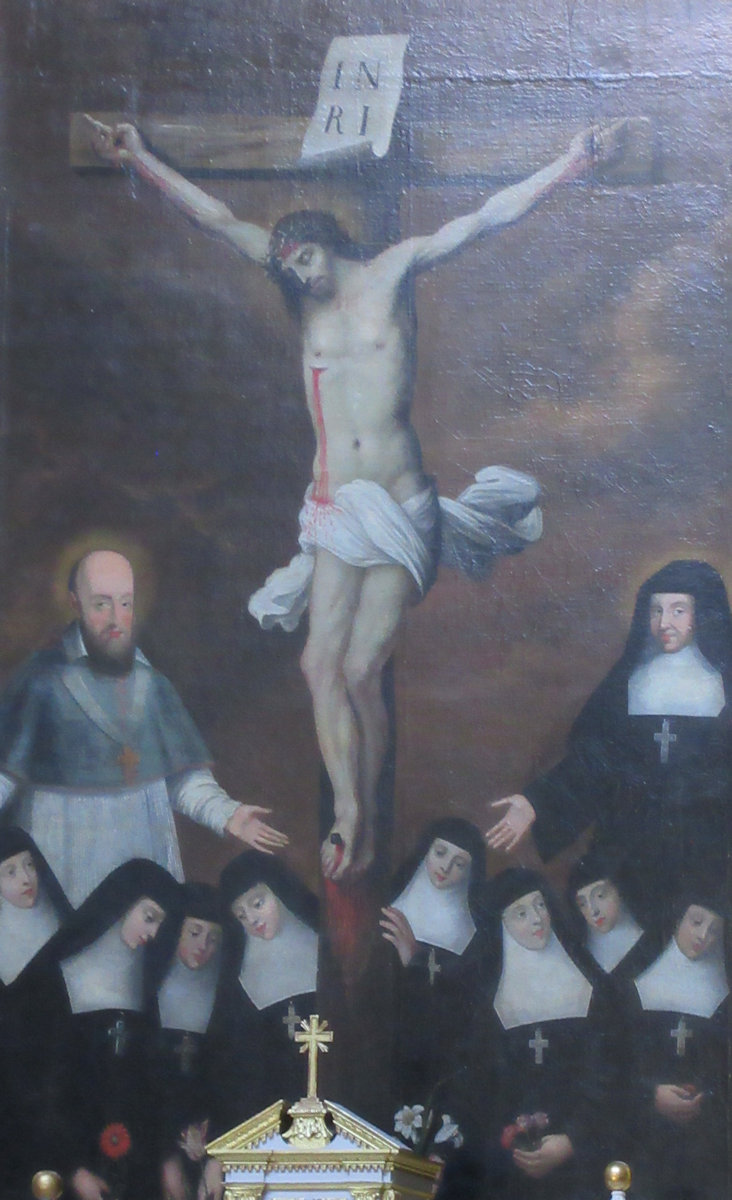
Francis de Sales and Joan of Chantal with the Visitants, altarpiece in the side chapel of the Visitants Church in Fribourg in SwitzerlandFrancis de Sales and Joan of Chantal with the Visitants, altarpiece in the side chapel of the Visitants Church in Fribourg in Switzerland
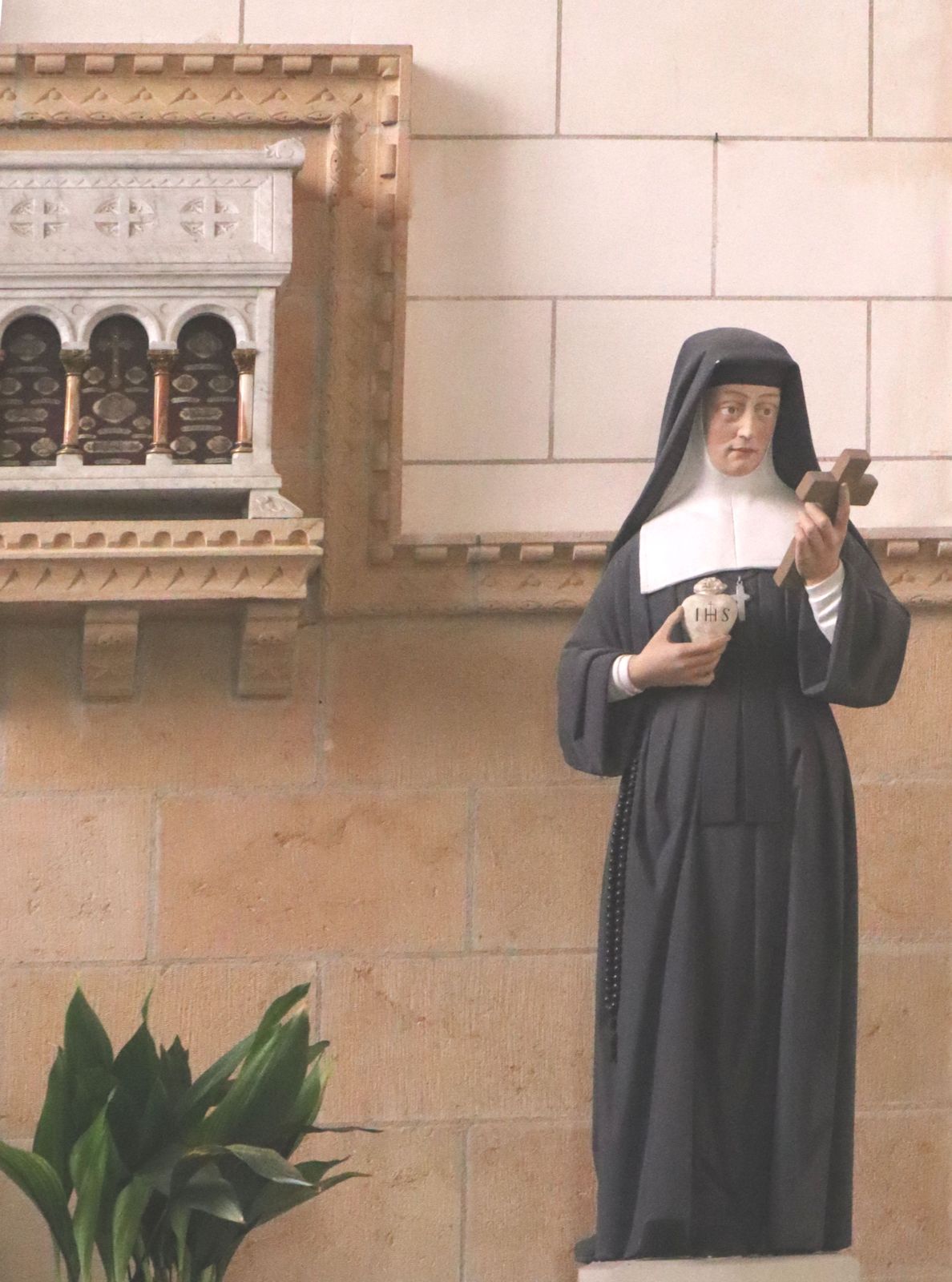
In 1610, Joan of Arc co-founded the Order of the Visitation of Mary, also known as the Salesian Sisters or Visitants, with Francis de Sales. The order aimed to live a devout life without adhering to the strict formalities of other orders. The sisters focused on making personal commitments to follow Jesus Christ and practicing inner asceticism, rather than observing external rituals. This emphasis on individual piety, inspired by Francis de Sales, was supported by Joan of Arc. The first monastery was established in Lyon in 1615 and later relocated, followed by the foundation of the monastery in Moulins the next year.

Joanna-Francisca spent her final years expanding the order, which grew to 87 houses by the time of her death. She had founded one of these, the monastery at the Church of the Visitation in Turin, as early as 1638 with the Duchess’s support. Exhausted and ill with pneumonia and pleurisy, Joanna-Francisca died on a visit to her Moulins monastery.

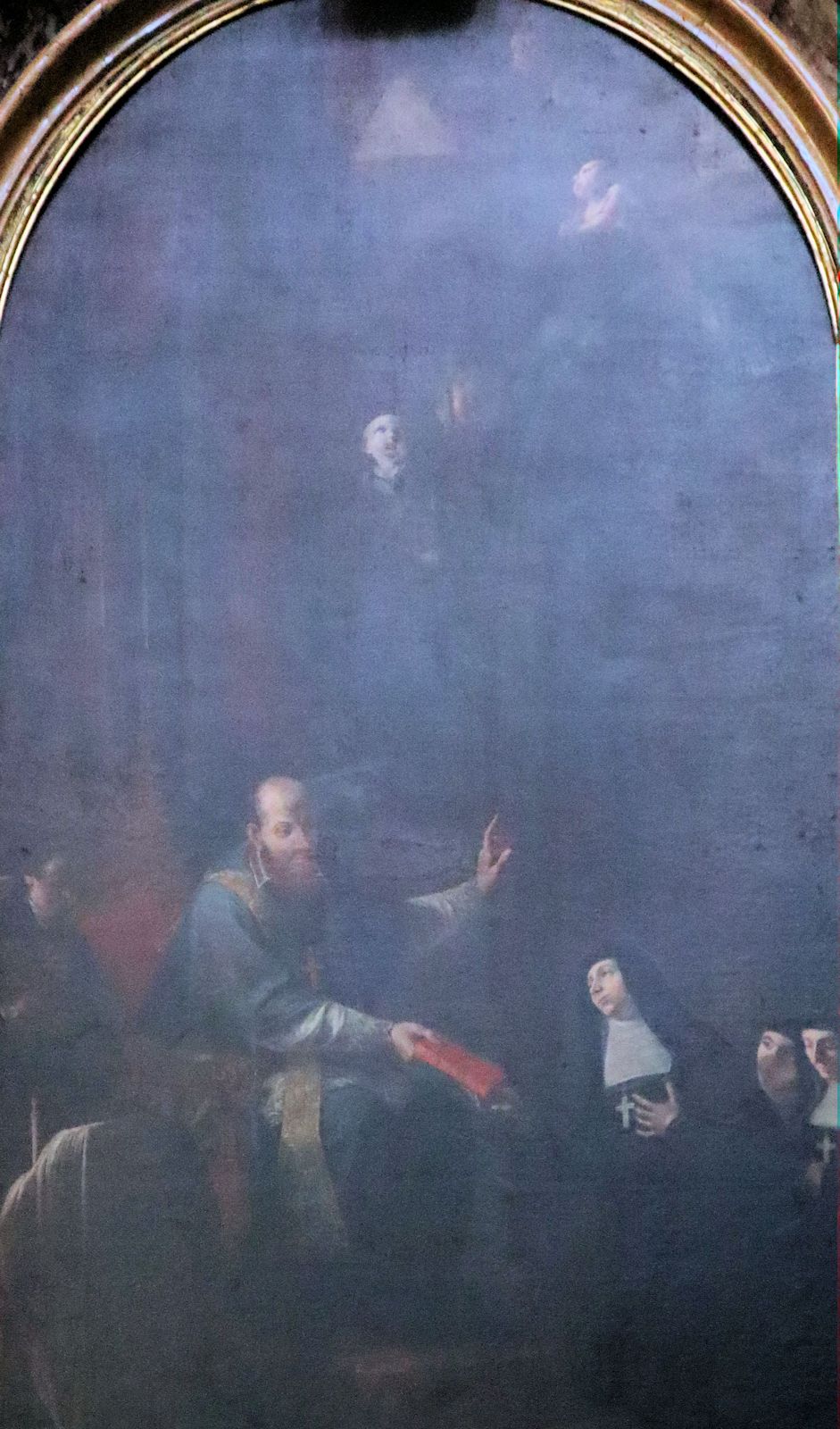
Francis de Sales presents the order's rule to Joan of Arc, altarpiece in the Church della Visitazione in TurinAn altarpiece in Turin’s Church della Visitation shows Francis de Sales presenting the order’s rule to Saint Joan of Arc.

Since 1911, Joan of Frances’s coffin has stood next to that of Francis de Sales in the Basilica de la Visitation in Annecy.

At the request of the French Bishops’ Conference, Joan of Arc’s Memorial Day was moved to August 12 in 2001. Until then, her Memorial Day was December 12, and before 1970 it was August 21.

 Canonization: On August 21, 1751, Johanna-Franziska was beatified by Pope Benedict XIV and canonized on July 16, 1767 by Pope Clement XIII.

Posted in Nezaradené | Leave a comment