
-
Recent Posts
Recent Comments
Archives
- September 2026
- August 2026
- July 2026
- June 2026
- May 2026
- April 2026
- March 2026
- February 2026
- January 2026
- December 2025
- November 2025
- October 2025
- September 2025
- August 2025
- July 2025
- June 2025
- May 2025
- April 2025
- March 2025
- February 2025
- January 2025
- December 2024
- November 2024
- October 2024
- September 2024
- August 2024
- July 2024
- June 2024
- May 2024
- April 2024
- March 2024
- February 2024
- January 2024
- December 2023
- November 2023
- October 2023
- September 2023
- August 2023
- July 2023
- June 2023
- May 2023
- April 2023
- March 2023
- February 2023
- January 2023
- December 2022
- November 2022
- October 2022
- September 2022
- August 2022
- July 2022
- June 2022
- May 2022
- April 2022
- March 2022
- February 2022
- January 2022
- December 2021
- November 2021
- October 2021
- September 2021
- August 2021
- July 2021
- June 2021
- May 2021
- April 2021
- March 2021
- February 2021
- January 2021
- December 2020
- November 2020
- October 2020
- September 2020
- August 2020
- July 2020
- June 2020
- May 2020
- April 2020
- March 2020
- February 2020
- January 2020
- December 2019
- November 2019
- October 2019
- September 2019
St.Kamil de Lellis
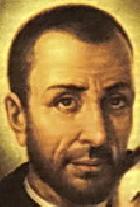
Used with permission of The Hagiography Circle
St. Kamil de Lellis
Camillus de Lellis
| July 14, non-binding monument | |
| Position: | Priest, founder of the MI order |
| Deaths: | 1614 |
| Patron: | Rome, all health workers and nurses, hospitals, and the sick, dying |
Attributes: |
Angel, Christ, cross (red on clothing), sick |
BIOGRAPHY
He came from Chieti in Abruzzo, Italy. He spent his youth among the soldiers and fell into a gambling addiction. In the service of the Venetian Republic, he fought against the Turks. After his conversion, he wanted to become a Franciscan, but due to an incurable wound in his leg, he ended up as a nurse in the hospital where he was being treated. Influenced St. Philip Neri became a priest and founded the religious society of Servants of the Sick. In it, he was an example to other confrères for the rest of his life.
BIOGRAPHY FOR MEDITATION
THE PLAYER WHO FIXED HIS GAZE ON THE CROSS
He was born on the 25th. 5. 1550 in the Abruza town of Bucchianico near Chieti, south of Pescara in central Italy. His brother, who would have been older, died as a baby many years before his birth, and so was virtually an only child. The pious mother of advanced age had little strength and watched Kamil’s restless nature with concern. His father did not stay at home much. As an imperial soldier, he became the commander of the garrison in the Adriatic port of Pescara years later.
At the age of 13, Kamil’s mother died, and his father took him in among the soldiers. He said he could not read or write, but he learned to play cards and dice passionately. At the age of 19, he too became a soldier with a service affiliation under Venice. About a year and a half after that, he was to join a military expedition against the Turks, which then won the naval battle of Lepanto, but without his participation. His father died near the port of Ancona, and Kamil still had an open wound on his right leg that did not want to heal. Because of this, instead of fighting, he went to a Roman hospital with terminally ill people. Even then, seeing the misery of others, he helped with the care of others during his treatment. He was treated for 9 months; his leg gradually healed. However, despite his efforts to help others, he remained too quarrelsome and unable to break free from his passion as a player, leading to his release at the end of 1571.
Kamil returned to the army and at the same time unsuccessfully tried his luck in the game as an addicted fanatic. He took part in the battles against the Turks in Dalmatia and Tunis. He was dismissed from the war in October 1574, and, having lost everything and become a beggar, he sought some occasional work at the age of 24. At the port of Manfredonia on Gargano in Apulia, he found it on the construction of a Capuchin monastery and with it a temporary home, because the Capuchins took it
To reasonable reproaches, he had a prompt reply: “A true soldier dies in battle, a sailor at sea, and a servant of the sick is to die with those whom he serves.” In Rome, Sixtus Hospital, 3,000 sufferers died of the plague in a short time, and therefore no one wanted to serve there. Kamil left with eight brothers. They found a foul smell, dirt, and five of them fell victim to the infection in a short time. Therefore, Kamil incredibly increased his performance and worked even when he wasn’t supposed to. Filling straw bales was among the necessary work he also did there. The rotten and defiled had to be replaced with clean ones, which someone had to fill with straw and cover. Kamil is even said to have sewn blankets. He was a shining example of the principles to which he led his brothers. In 1607, he renounced the position of superior so that he would be all the more a servant of the sick, although he did not stop being sick.
In addition to a 40-year unhealed ailment in his leg, he had a painful hernia, to which he helped himself in the service of the terminally ill, and hid other diseases from doctors only out of fear that doctors would urge the need to save. When he couldn’t help, he endured his suffering, pleased others, and showed his kindness to everyone, at least with a word. He was taken to the order’s hospital among the poor suffering. He remembered with gratitude that he had been saved from the hellish punishment he would have deserved in his youth. With a lovingly crowded heart, he died blissfully after the last of 33 illnesses. He was buried in the monastery church of St. Magdalene’s near the Pantheon. God glorified him with miracles. Pope Benedict XIV. Ho 7. 4. 1742 beatified and 29. On 6 June 1746, he was canonized. In 1886, he became the patron saint of the sick and dying, and in 1930, Pope Pius XI appointed him patron of all nurses and other nursing staff.
RESOLUTION, PRAYER
St. Kamil also encouraged his brothers with the words of Christ: “Whatever you did to one of these poor ones, you did to me.”(Mt 25,40) I will reflect on that statement, and perhaps recall the opposite part of it in verse 45: “Amen, I say to you, whatever you have not done to one of these …”
God, You gave the holy priest Kamil a precious gift of compassion for the sick and dying; for his merits, pour the spirit of your love on us too, that we may serve You in our neighbors and reach You safely at the hour of death. Through Your Son Jesus Christ, our Lord, for He lives and reigns with You in the unity of the Holy Spirit throughout all the ages of ages.
Posted in Nezaradené
1 Comment
The Sacrament of marriage.
The Sacrament is a manifestation of God’s presence with us and our relationship with God. As Christians, we learn from the very beginning to live by the Sacrament of Baptism. By giving himself to God, and God giving himself to him. In this way, he must learn to live also from the sacrament of marriage. Spouses are called to live the sacrament of marriage even if we were wholly separated from the world. We must also be able to live the sacrament. Spouses must understand the sacrament of marriage. Marriage is a vocation in the concrete life of the Church. We respond to this call with a free yes.
The sacrament of marriage, or the reception of the sacrament of marriage, is the confirmation that the spouses are giving themselves. This marriage transfer has all the elements of a contract. There is a great deal of trust associated with the marriage contract. Man cannot live the sacrament and marriage by his strength. Only with God’s help can you put up with the mistakes of the other person when we see Christ in the other person. There are three people in a Christian marriage—man, Woman, and Jesus. Jesus enters into a marriage. Those who dare to exclude Christ from marriage will inevitably encounter difficulties. Marriage is the smallest cell of the church. The Church is a sign of unity and salvation. And spouses are obliged to live in harmony. Spouses also have to fight against selfishness every day. I want to live for God through you. And I accept my partner as he is every day. Whenever I do this, I present the sacrament of marriage. Spouses serve each other willingly and with love. To what extent do we surrender ourselves to God, to such an extent that we can accept Him? At times, marital service can be a substitute for other religious activities. For example, he takes care of a sick man or a disabled child, etc. The granting of the sacrament of marriage is for all the spouses, one another giving to the other.
Posted in Nezaradené
Leave a comment
Christian marriage.
Marriage is a reality, so magnificent. Marriage is a reality as complex as life itself. Marriage has enormous value. It came out of God’s hands, and it always has a future ahead of it. The fact that marriage sometimes becomes commonplace for people. It is a manifestation of human smallness. Suppose we want to discuss marriage from God’s perspective. It’s good to keep it in front of your eyes from the beginning. What happened to marriage during the history of salvation? How disastrous it is that man has entered into God’s plan. And how ingeniously God began to correct this human confusion, God created man to be in his image. He created him male and female. And God blessed them. We know that the message of the Old Testament about marriage is also magnificent. A man and a woman stand before God in an equal relationship. A man is a gift to a woman, and a woman is a gift to a man. Their mutual relationship is then a gift from God. It is perhaps more important than people admit. Because if we look at a fact in life as a gift, we can’t approach it as critics out of principle. As those who choose and buy. A woman is not bought, nor is love bought, nor is it sold. It’s grace; we’re accustomed to having to obtain everything or buy it. Most young men don’t get a wife from God. They find it. She can be glad that they found her. And most husbands are not a gift to their wives. God had a goal with marriage. We know what happens when a person opens himself to sin. The man began to believe that he could do whatever he wanted with his wife. The women, on the other hand, think that she has value only when it becomes tempting for a man. We were born with a great affection for each other, love. This self-love takes many forms in our lives. This self-love complicates the life of each of us immensely, and of course, it breaks every marriage from the beginning because people are called to love in marriage. And unless they are aware of this, they begin to blame others for a lack of love. And what was supposed to unite them? Will start to divide them. And this unsuccessful state, when people have to live in a marriage.
Someone wise, he noted. It’s hard with a woman, but it’s even harder without one. But God didn’t mean it that way. We will now examine Jesus’ concept of marriage. This will exceed all expectations. Where Jesus entered, everything exceeded human expectations. We know that the dignity of man after redemption is far greater than in creation. We could also say that the sacrament of marriage, as he understood it, far surpasses the Old Testament idea of marriage. For this reason, we can appreciate how fortunate we are to live in today’s times. But living by Jesus’ideas ‘ ideas is not easy at all
Posted in Nezaradené
Leave a comment
Fifteenth Sunday in Ordinary Time, Year C Lk 10,25-37
When we walk around town, especially in shopping centers, we surely notice how their range of goods is changing. Everywhere there are electronics, clothes, watches, computers… As soon as we walk past a store, we are offered various brochures and flyers to catch our attention, so that we will go inside and maybe something will catch our eye… We can safely say that today, there are advertising flyers and instructions for use for everything. But have you ever wondered if there is an instruction manual for love? Jesus wants to show us one in today’s Gospel through the parable of the Good Samaritan. His instructions differ from those given to us by the world around us.
Novels, pop songs, movies, various competitions, and entertainment programs offer instructions on love, but they often misunderstand it as a frivolous game, hedonism, flirting, and infidelity. Today’s youth is infected with this false view and is afraid of missing out if they do not rush prematurely into the pursuit of sexual experiences. This is confirmed by statistics, which show that in cities, only about 50% of 14-year-old girls and 15% of 17-year-old girls have not yet had intimate relationships with boys. How little influence must God’s commandment to love one’s neighbor have on these young people! Therefore, the question arises: What kind of love do I prefer? The love offered by the environment in which I live, or the love offered by Christ?
True love, according to Jesus Christ, is the love we show to every person without distinction, without expecting anything in return, and with a willingness to serve. He summed it up nicely with the Samaritan, who did not ask whether the wounded man was a Jew or a Samaritan, whether he was a believer or an atheist, whether he was worthy or unworthy of brotherly help. He saw only one thing: that the wounded man needed help. Furthermore, he could not expect anything in return from him because he was unconscious, and so he acted selflessly. He did not approach the wounded man with resistance, grumbling that he was wasting his time because of the man’s condition. He approached him with a heart full of love. Which guide to love will I choose? The world’s guide or Christ’s? Jesus’ guide is more difficult, more demanding, but those who follow it are happy people.
And tell me, who among us does not desire happiness? You may say, “Okay, but what about the young people we talked about at the beginning? How can we bring them closer to Jesus’ love?” That is the task of those of us who work with them, study with them, or live with them. We must show them the actual values of our lives. You young people who are believers must show them how believers behave before marriage and how believing spouses behave in marriage.
First and foremost, this requires us to respect the Ten Commandments and moral laws. If we strive to do this, the young people living around us will begin to change because they will learn other values. Through us, Jesus’ request in today’s Gospel will be fulfilled when we open our eyes, ears, and especially our hearts to young people.
Police in Mexico staged a traffic accident. They placed two broken cars on the side of the road, scattered mannequins of adults and children around them, and puddles of “blood” around them. At first glance, it appeared to be a terrible accident. Do you know what the result of the experiment was? Around 32 cars passed unnoticed, and it wasn’t until the 33rd driver, who was a black man, stopped. He alone was willing to help, sacrifice time, and have his seat bloodied. The only one who did not see only himself, but also others. The beginning of human misery is that we see only ourselves. But that is not Christian. What of so many prayers, bowing before the altar, when we don’t want to see our neighbors for worship?! But Jesus does not care about such a service! Let’s learn to look at our neighbors not only with our eyes, but also with our hearts. Let’s see their needs and try to help them selflessly. Only then will there be more love, understanding, and true happiness in the world.
Posted in sermons
Leave a comment
St.Canuntus
July 10, commemoration
Position: king and martyr
Deaths: 1086
Patron: Denmark
Attributes: dagger, spear, royal insignia, arrow
BIOGRAPHY
From 1080, he was king of his native Denmark. He had a family, lived a pious life, and sought to spread and strengthen Christian life in his kingdom, where pagan customs still prevailed in some places. His pro-church rule was unpopular with some nobles, led by his treacherous brother Olaf, who longed for power. King Canute (Knut) was assassinated while praying at the altar of a church in Odense.
BIOGRAPHY FOR MEDITATION
PIOUS RULER AND PATRON SAINT OF DENMARK
He was born in Denmark around 1040 as the illegitimate son of King Sven III of Denmark and Estrid. He received a Christian upbringing and took the teachings of the Gospel very seriously. Furthermore, he later married Adele, the daughter of Robert, Count of Flanders, and had a son, Charles, who was nicknamed the Pious.
He became king in 1080, at the age of about 40, and his reign lasted only six years. He is often compared to the Czech ruler St. Wenceslas, especially in terms of his piety, love, justice, and martyrdom, in which his brother played a significant role.
From the beginning of his reign, he actively supported the spread of Christianity in the country and sought to eradicate paganism and its customs. Although he was king, he tried to live, fasted strictly, and wore rough penitential clothing under his royal robes like an ascetic. This helped him to maintain a conscious love and a correct attitude towards God and people. Before God, he accepted responsibility for governing the country and leading its people.
He was generous in giving alms to the poor and built hospitals and temples. In his humility, he donated his royal crown to the temple in Roskilde with the words: “This jewel is more fitting to adorn a sacred place than to be used for vanity and worldly pride.” After laying down his royal insignia before the image of the Crucified One, he also issued a declaration in connection with the victory over the enemies who had attacked the country, that he submitted himself and his entire empire to Jesus Christ, King of kings and Lord of lords, and had no other desire than that the Christian faith should flourish in his country and be preserved for all time.
He set an example of respectful behavior toward the clergy to his subjects and did not allow his courtiers to do anything that would be detrimental to the Church. He removed the clergy from the jurisdiction of secular courts and placed them under the full authority of the bishop and his court. Likewise, he elevated eight bishops to the rank of imperial princes, granting them a prominent seat in the parliament. He sent missionaries to neighboring nations, did not seek conflict, but strove for peace. He defended himself valiantly against pagan attackers and attempted to convert the defeated to Christianity.
Kanut’s apostolic activities also stirred up many enemies within his nation. His brother, Olaf, envied him a place on the throne and coveted the crown. Kanut, eager to ensure the future coverage of the needs of temples and clergy, began to think aloud about introducing church tithes, which aroused opposition and dissatisfaction with the king’s Christian rule among the greedy nobles. His brother, Olaf, was looking for a way to overthrow the king. An opportunity arose when a plea for help against enemies came from England to Denmark in 1085. Knut therefore ordered a navy to be prepared for help and entrusted the high command over it to his brother Olaf. He betrayed and incited the army of which he became the commander against his king, Kanut. The efforts of the conspirators resulted in the dissolution of the military, which ceased to heed the appeals of its monarch.
In his merciful justice, Kanut did not want to punish the conspirators with death under the law; instead, he imposed a conditional fine on them, which they were exempt from paying if they committed to paying church tithes. The magnates rejected the offer, and when the fine they had verbally favored was enforced, they led a general revolt in the country.
Anticipating his killing, King Kanut fled to the island of Funen (Fionia) to Odense, where in the temple of St. Albania he received the sacraments. Then he prayed aloud in front of the altar: “Lord and God! To you I like to sacrifice my life, for honor and glory and for the protection of your Church. Accept my sacrifice and grant the enemies the grace of knowing the truth and regret. Forgive them as I forgive them.” Meanwhile, the attackers tried in vain to pry open the gate, so the stones broke the windows and attacked the king with arrows from their bows and spears from the ladders. They also attacked his brother Benedict and 17 persons loyal to him.
Kanut’s grave was revered for its miracles. In 1101, Kanut was canonized by Pope Paschal II.
RESOLUTION, PRAYER
I will pray the tithe of the rosary for the increase of faith in my country.
Almighty, eternal God, grant that, following the example of the holy martyr Kanut, we live with awareness of responsibility to You and striving for the honor of Your name and the Church of which we are a part. We ask this through Your Son Jesus Christ, our Lord, for he lives and reigns with You in the unity of the Holy Spirit throughout the ages of ages.
Posted in Nezaradené
Leave a comment
Wisdom.
Wisdom is the fruit of living with God. This wisdom transforms him who associates with God. This wisdom will manifest itself outwardly as a life attitude. A wise person begins to understand; he stops criticizing because he’s trying to understand. A wise person listens to others more than they speak. He learns to look for what God wants. It leads a person to accept everything that he cannot change. Wisdom leads a person to equanimity. Wisdom leads a person to become like God. He learns to do what God has put into his life. We can say that meeting God is a cure for our wounded hearts. Through dwelling with God, the Lord leads us out of all the illusions of life. It heals our pride and selfishness. Wisdom teaches us that the center of our lives is not man, but God. Therefore, no humanism can compete with the Christian view of man. Only a fool relies on a person. The beginning of wisdom is the fear of the Lord. Dwelling with the Lord is the remedy for our emptiness because our smallness gives God a chance to do great things. Living with God gives us a whole new lifestyle. This god carries a person who has a god in his heart as an ally. He recognizes that God leads him. To be with God is more than being alone.
Posted in Nezaradené
Leave a comment
Wrestling with God.
Today, we gather to reflect on a profound moment in the life of Jacob, a moment of struggle, transformation, and divine encounter. In Genesis 32:23-33, we witness Jacob wrestling with a figure through the night, an event that would forever alter his identity and destiny. The passage invites us to explore the nature of our struggles and the transformative power of wrestling with God.
To fully appreciate this encounter, we must understand Jacob’s life leading up to this moment. Jacob was a man marked by conflict—his brother Esau, his father Isaac, and even himself. He was a deceiver, a trickster who had taken his brother’s blessing and fled from his home. Now, he returns to face the consequences of his past. Jacob is filled with fear and anxiety.
As night falls, Jacob finds himself alone, and it is in this solitude that he encounters the mysterious figure. The struggle that ensues is not merely physical; it is deeply spiritual. Jacob wrestles not only with the figure but also with his fears, regrets, and identity. How often do we find ourselves in similar places, wrestling with our past, our choices, and our understanding of who we are?
In our own lives, we may grapple with feelings of inadequacy, guilt, or the fear of facing those we have wronged. However, let us remember that these struggles can lead to profound transformation. Jacob’s wrestling is a metaphor for our spiritual journeys-moments when we confront our doubts and seek clarity from God.
As we reflect on Jacob’s wrestling match, let us acknowledge and embrace our struggles. Let us not shy away from the difficult moments in our lives but see them as opportunities for growth and divine encounter. May we be willing to wrestle with God, knowing that through our struggles, we can emerge transformed, blessed, and ready to fulfill the calling He has placed upon our lives.
Posted in Nezaradené
Leave a comment
Longing for God.
To give space to this desire is necessarily part of the spiritual life. He who desires nothing cannot grow. The Pharisees blocked themselves in their desire because they were perfect. We have fine examples of this desire in Scripture, like a doe longs for water. Psalm 42,1-2 As the deer pants for streams of water, so my soul pants for you. O God, my soul thirsts for God, for the living God. Psalm 63,1 O God, you are my God, earnestly I seek you, my soul thirsts for you, in a dry and thirsty land, and there is no water. Isaiah 26,9 My soul yearns for you in the night, in the morning my spirit longs for you. John 7:37-38 On the last and most fantastic day of the Feast, Jesus stood and said in a loud voice. If anyone is thirsty, let him come to me and drink. Jesus wants us to discover more essential things, such as riches, power, and fame. And that’s God. The desire for God was placed in the heart of man by God himself. The question is whether a person is trying to fulfill this desire. If a person does not desire something, he will not achieve it.
Posted in Nezaradené
Leave a comment
St.Antonius Maria Zaccaria Mk 10,13
| 5 July, commemoration | |
| Position: | founder of the CRSP order |
| Deaths: | 1539 |
| Patron: | Barnabites |
| Attributes: | Black cleric, host, chalice, cross, lily |
BIOGRAPHY
He was from Lombardy, Italy. After two doctorates, he began studying theology and working among the youth. He sought the restoration of the clergy and founded a trio of religious communities with the aim of spiritual renewal in the Church. He died prematurely at the age of 37. The barbarities he founded quickly spread, and in 1625, they also reached Bohemia.
BIOGRAPHY FOR MEDITATION
LOMBARD DOCTOR OF SOULS
He was born in 1502 in Carmona, Italy, to a patrician family. He was gifted, having studied medicine in Padua, and already held two doctorates by the age of 22. At first, he worked as a doctor and was zealous as a Christian layman and leader of the spiritual community of friends who met with him because of God’s word. At the age of 26, he finally decided on a spiritual path and received priestly ordination.
At that time, young clergy longed more for prestige than for the salvation of souls, and believers were said to have been neglected for 40 years in their pursuit of salvation. Antonius Zaccaria longed to be a priest, guided by the Heart of Jesus.
After two years of priesthood, in 1530, he decided to found a congregation in which the Gospel would be lived after the example of the first Christians. First, it was the order of “religious clerics of St. Paul”, even though their community was called “Barnabité” because of the settlement at St. Barnabas. Religious were spiritual administrators acting as folk missionaries. Antonius wrote them the rules and led them to humility and self-denial.
The second congregation founded by him with the help of Countess Guastella was the “Angel Sisters of St. Paul’ called Angelica. Their angelic mission was to help girls at risk get back on the right track. He then founded the Third Order, which aimed to instill the evangelical spirit in families, and wished that spouses not only follow but also directly live the life of Christ in the world.
Antonius Zaccaria gave impetus to 40-hour adorations, frequent Communion, folk missions, and Friday bells to commemorate the death of our Savior. He handed over the organization to collaborators and devoted himself to prayer and spiritual guidance. He preached zealously, conducted interviews, visited hospitals, and showed great love for people everywhere. Furthermore, he died at the age of 37 in his birthplace. His remains were taken to Milan.
Pope Leo XIII. was 3. 1st 1890 beatified and 27th. 5. 1897 canonized.
RESOLUTION, PRAYER
According to Antonin Zaccario, the basis facilitating the path to perfection was keeping the commandments, adding that without it the effort was in vain. With this in mind, I will strive to live with Christ in the world.
God, You have called St. Anthony Zaccario to serve Your church by preaching and example, and to show us how to live according to the Gospel; help us, at his intercession, to be faithful to Your call and to follow the path that Christ showed us. We ask this through Your Son Jesus Christ, our Lord, for he lives and reigns with You in the unity of the Holy Spirit throughout the ages of ages.
Posted in Nezaradené
Leave a comment

