Why is Cardinal Péter Erdö considered for the future pope

Why Cardinal Péter Erdő is considered a candidate for the future Pope
Cardinal Péter Erdő with the relic of Saint Stephen during the mass on the occasion of the 939th anniversary of the canonization of the first Hungarian king.

The Hungarian primate is respected in Europe and Africa, he is a recognized ecclesiastical lawyer and conservative, who is respected even by more liberals.

Help us protect the church from attacks

We live in a time when the church finds itself between the millstones of progressivism, fruitless traditionalism and misinformation. Today, therefore, we are even more aware of the important mission of the World of Christianity and our responsibility.

The Christian world always stands firmly on the side of the church. We openly name challenges, respond to nonsense and half-truths, and at the same time do not avoid criticism towards the internal church environment when it turns out to be necessary.

Will the next pope be from Central Europe? World Catholic media and Vaticanists are speculating about the names of a possible future pope, with the name of a cardinal from neighboring Hungary appearing among the candidates.

When the Pope dies or resigns, the new head of the Catholic Church is elected in a conclave by cardinal electors, that is, those under 80 years of age.

Although Poland has the most cardinal electors among Central European countries, the Ostrihom-Budapest archbishop Péter Erdő is being mentioned more and more in connection with a possible successor to Francis.

The youngest cardinal at the conclave

Péter Erdő was born in 1953 in Budapest. He comes from six children. He completed his high school studies at the Piarist Gymnasium in Budapest. After graduation, he entered the seminary and was ordained a priest in June 1975, i.e. at the age of 22. After his ordination, he worked as a chaplain for two years and at the same time continued his studies, and in 1976 he received a doctorate in theology.

In 1980, he received a doctorate in canon law from the Utriusque Iuris Institute of the Pontifical Lateran University. Between 1980 and 1986, he was a teacher at the Ostrihom Archbishop Institute for the Education of Priests.

From 1986 to 1988, he was a professor at the Gregorian University in Rome and also worked as a teacher at the Peter Pázmaň University in Budapest, where he taught church law. At the same time, he worked at the church court. Today, Péter Erdő is a recognized church lawyer.

In January 2000, he was in the Basilica of St. Peter in Rome by Pope John Paul II. ordained as a bishop and worked as an auxiliary bishop in the diocese of Stolichny Belgrade. In January 2003, he became archbishop in Ostrichom and Budapest, and in November of the same year, the Polish Pope appointed him a cardinal.

It is interesting that Erdő became a cardinal relatively early, at the age of 51. Currently, the youngest cardinal in the world is Giorgio Marengo, the apostolic administrator in Ulabantar, Mongolia, who became a cardinal at the age of 47 and is the youngest cardinal appointed this century. Karol Wojtyła also became a cardinal at the same age.

At the age of 52, Erdő was the youngest cardinal at the conclave in 2005, where the cardinals elected Benedict XVI as Pope. Eight years later, when Francis was elected, there were only five cardinals younger than the archbishop of Budapest at the conclave.

From 2006 to 2016, the Hungarian primate was also the chairman of the Council of European Bishops’ Conferences (CCEE). He served in this service for two terms.

Why is the Hungarian prelate being talked about as a possible future pope? There are several reasons.

Vaticanist John L. Allen Jr. in his article for the National Catholic Reporter , he discusses why Archbishop Erdő could be the next pope.

Allen notes that there is a lot of talk these days of a “Third World” pope, but if a conclave were to take place, cardinals from Europe would still have the upper hand. According to him, the election of a pope “from this long-neglected corner of Europe may seem as bold as the election of a pope from Argentina.”

Cardinal Erdő represents the church persecuted during the Soviet era, symbolized by the figure of Cardinal József Mindszenty, who was tortured and later sentenced to life imprisonment. Cardinal Mindszenty then took refuge in the American Embassy in Budapest for 15 years and died in exile in Vienna in 1975. It was Erdő who convinced the Hungarian government to drop the case against Mindszenty, which had been filed in 1949.

At the same time, Hungary is a country where, due to its location, East meets West, and Erdő is a leader in building relations between Catholics and Orthodox churches. Since many cardinal electors consider ecumenism a high priority, this plays into the cards of the Hungarian primacy, which strives for good relations with the Jews as well.

In addition, Erdő is also considered a trustworthy person in Vatican circles. In 2011, he was appointed a member of the Council of Cardinals and Bishops, which oversees the very important second section of the Secretariat of State responsible for the Vatican’s diplomatic relations.

That same year, he was sent by the Vatican to lead an investigation into the Pontifical Catholic University of Peru, which was accused of violating church teaching and discipline.

Hungarian bishops and priests during a thanksgiving pilgrimage in Rome in April 2024. Cardinal Erdő, lower right.

The advantage of the Hungarian cardinal is that he speaks Italian fluently, which the future pope should know. Some sources say that he knows up to six languages, including Russian.

According to Allen, Erdõ is perceived as a conservative who does not have a problem even with the pre-conciliar form of the mass, but at the same time he is also respected by more liberal circles within the church.

At the same time, they consider the cardinal to be pastoral. For example, many bishops were interested in his description of urban missions. During them, lay people visit the homes of Catholics in a given parish and invite the people who live there back to church.

Relations with African bishops and a conservative reputation

However, everything mentioned so far would not be enough if the candidate for the pope did not have the support and sympathy of the other cardinals who choose the pope.

Erdő could have solid support from the developing world in a possible conclave. In the position of the head of European bishops, he established cooperation with African bishops and started organizing meetings every two years, which are held alternately in Africa and Europe. This is also why, according to Allen, most cardinals from Africa know him and like him.

For Americans, he may be interesting because he has practical experience from the USA. Thanks to grants, he studied in 1995 and 1996 at the University of California, Berkeley.

Allen evaluates the chances of the Hungarian primacy in three key points.

His two terms as president of the European bishops’ conferences suggest he has solid support in the European bloc, and his good relations with Africans suggest he would be supported in the conclave if his candidacy for pope was on the cards. He could also count on the support of several cardinals from Latin America.

The second key point is that Erdő is seen as a person who is sufficiently forceful. This is apparently important in the current situation, when many cardinals are convinced that the next pope must bring the internal bureaucracy of the Vatican under control.

Thirdly, Erdő also has a good conservative reputation, but despite this, he is profiled as a mediator of compromises and consensus, thanks to which he was able to hold European bishops together.

Erdő also dealt with issues of social justice. In 2007, he expressed solidarity with the concerns of Latin American bishops about growing poverty and environmental destruction.

Reserved towards the media, rather a behind-the-scenes player

However, John Allen also notes three factors that, according to him, speak against the Hungarian archbishop.

Erdő has a pessimistic view of the relationship between the church and the wider culture. At the synod, he was critical of some media. He claimed that many of them presented the Christian faith and history as full of lies and misinformed the public about the content of the faith and the reality of the church.

Many wonder if this is the right tone for the future pope, who wants to reach out to the wider world.

Although some critical voices towards the Hungarian prelate appreciate that he is a good player behind the scenes, they say he lacks the dynamism on stage, which the future pope also needs. The Crux Now portal adds that “he is not the type of person who would light up the world with his smile”.

His young age could also be a problem for some voters if he were to become pope. Some cardinals may fear that a vote for Erdő will mean the possibility of too long a pontificate.

The last two popes were over eighty years old when they ended their pontificate, and Francis is also old. “Pope Erdő could thus rule the church for two decades,” states Crux Now.

The portal civilek-info has the opposite opinion , which writes that the church will be looking for someone who will have enough time for reforms, so cardinals under the age of 70 have the best chances.

The Catholic Herald even claims that Erdő’s name was mentioned in connection with the new pope as early as 2013.

According to the portal, at a time when Pope Francis was calling on Catholics to accept refugees, Erdő said that accepting refugees would be tantamount to human trafficking.

He notes that Erdő is seen as a reserved and sociable man with an almost genetic predisposition to stay out of the limelight. With his personality, he would be better suited to the role of secretary of state or another high-ranking post in the Vatican, rather than the public face of the church.

However, the portal adds that we are not living in completely normal times in the Catholic Church, and several cardinals may feel that after Francis’ changes and reforms, the church will need to take a breath and calm down.

As in post-Trump American politics, “boring can become sexy,” writes Crux Now .

Erdő’s advantage may be the fact that he is a gifted ecclesiastical lawyer, which may come together after the pontificate of Francis.

“After the legislative frenzy under Francis, who issued more motu proprios, or amendments to church law, than all his recent predecessors combined, it may not be a bad thing to have someone who can consolidate and rationalize the legal system,” reports Crux Now .

According to the portal, the Hungarian bishop is of the right age to be able to effectively lead the church for some time, but he is not too young to make his pontificate seem like eternity.

In the current situation, Erdő could be a favorable candidate for the Ukrainians as well, since they have accepted a lot of refugees in Hungary, and at the same time he would be acceptable to the Russians. Metropolitan Hillarion, who until recently was the second man in the Moscow Patriarchate, works in the country.

Cardinal Erdő during the thanksgiving pilgrimage of Hungarians in the Vatican in April 2024.

However, some circles from the Vatican began to question Erdő’s chances for the papal throne even after the visit of Francis to Hungary in 2023.

The Pillar portal notes that the cardinal seemed very shy and deliberately avoided the media, which dealt with his relationship with the Hungarian government.

Cardinal Erdő has consistently emphasized his support for Pope Francis. The portal claims that even though his credit rose after the Pope’s visit to Budapest, some members of the Vatican press center labeled him conservative . According to some reports, he was the preferred candidate for Pope in the eyes of the late Australian Cardinal George Pell.

The cardinal also faced a little teasing from members of the Vatican media over the type of car that took him out of Budapest airport after escorting the pope.

Photos emerged, noting that while the head of the church was moving in a small white Fiat, the influential conservative archbishop Cardinal Erdő left the airport in a black Mercedes.

A key role at the Synod on the Family

The Hungarian primate also caught the attention of some Vaticanists a few weeks ago, when he led a group of 20,000 Hungarian pilgrims to the Pope, it was a thanksgiving pilgrimage for the visit of Francis last year.

European correspondent of the American National Catholic Register Solène Tadié introduced Cardinal Erdő in a profile article entitled Man of Unity and Bridge between East and West .

According to her, today the Hungarian cardinal is one of the few Catholic authorities who arouse the admiration of his colleagues and the interest of Catholic observers around the world.

“Nevertheless, he appears relatively little in the media and stays out of the controversies and power games that have often surrounded the church in recent years,” he notes, adding that he is one of the main “papabili” of the cardinals.

He devotes a considerable part of the text to the episode when Péter Erdő found himself in the role of general relator of the synod on the family that took place in 2014-2015.

NC Register recalls that it was then that the Ostrihom-Budapest archbishop gained a more international status, while various commentators praised him for his openness and sense of balance, while he did not compromise with the teachings of the church.

In his contribution at the opening of the synodal proceedings in October 2014, Erdő confirmed the central position of mercy in the “hermeneutics of church action”, while specifying that it “does not exclude or relativize the truth”, but “leads to its correct interpretation within the hierarchy of truth” and “does not exclude or the requirement of justice”.

Their point was that Erdő devotes too much space to demands that were related to the controversial issue of allowing civilly divorced and married Catholics to receive Holy Communion.

At the synod session in October 2015, Cardinal Erdő was the main speaker and, according to the NC Register, caused surprise and disappointed the expectations of some when he declared that “the integration of the divorced and remarried into the ecclesiastical community can be realized in various ways apart from admission to the Eucharist”.

“The overall impression I got at the end of the synodal discussions was that Cardinal Erdő is quite independent in his thinking; it was very clear that this man has great leadership skills and is not afraid to take positions that he believes in,” South African Cardinal Wilfrid Napier, Archbishop Emeritus of Durban, told the NC Register. He was also in charge of the family conference.

Today, people do not belong to the church out of convenience

When it comes to visions and leadership, Cardinal Erdő’s thinking was recently revealed by the Italian Vaticanist Andrea Gagliarducci. In an interview with ACI Stampa, the Hungarian prelate admits the true position of the church at the moment.

“We do not think according to the idea of ​​the ruling church, a category that lasted from the time of the Roman-Christian empire until the 20th century. We live in a much more modest position. However, we can also testify to our Christian faith and message in matters related to the fate of humanity,” said Erdő.

In response to the question of what steps can be taken in this regard, he recalled the efforts of the church in Hungary to make “gestures towards neighboring nations with which we have had conflicts and antagonisms in history.” Cardinal Erdő mentioned that, for example, in 2023, the president of the Bishops’ Conference of Slovakia, Archbishop Bernard Bober, delivered a homily on the national holiday of St. Stephen, and this year, the president of the Bishops’ Conference of Romania, Archbishop Aurel Percă, will preach.

“I believe that at the level of gestures and common thinking about human issues, we are very close to the Catholics of this region. It is not about direct politics, but about human rapprochement,” added Erdő.

Cardinal Erdő during the thanksgiving pilgrimage of Hungarians in the Vatican in April 2024.

When asked by a journalist about the Moscow Patriarch Kirill and his “holy war”, as he calls the conflict in Ukraine, Erdő chose a diplomatic answer. He spoke about the historical heritage, about the connection between the rulers of the Byzantine lands and the Orthodox churches. “At the same time, in the same context, we can identify elements that belong to the spirit of Christianity,” he said.

“After all, even during the Soviet era, in addition to its public functioning, the Orthodox Church managed to preserve many spiritual and religious values ​​amid all the difficulties,” the Hungarian cardinal noted.

Cardinal Erdő also commented on what problem he considers to be the most urgent at the moment.

“It’s a problem to think freely and use your freedom. In the midst of large waves of information and misinformation, which is also fed by the reality of social media, we have become accustomed not to think, but rather to react immediately,” he concluded.

And later he returned again to reflections on the form of the church today. “We live in a diaspora. Today, however, it can be a much more cohesive and stronger diaspora than the church that gathered people who believed and also people who belonged to it out of convenience.”

According to Cardinal Erdő, today people no longer belong to the church out of convenience. “They belong more and more because of personal cohesion, personal experience with faith and because of relations with the Catholic Christian community,” he added.

Posted in Nezaradené | 1 Comment

Ninth Sunday in Ordinary Time, Years B Mr 2,23-3,6

If someone asked which day of the week we look forward to most, many people would answer – Sunday. It is a day of peace and well-being when we can devote ourselves more than ever to our loved ones and hobbies. Jewish Saturday

He preceded repose Sunday. It was a festive day for the Jews, and one Saturday incident experienced by Jesus is also described in today’s Gospel. The disciples walked across the field, plucking ears of corn and using crushed grain to ward off hunger. The Pharisees looked upon this as a great transgression against the law. According to them, Jesus’ disciples were reaping and threshing grain. If someone unknowingly violated the Sabbath, he would be admonished and offered a propitiatory sacrifice. But if he violated it even after being warned, i.e., knowingly, he could be stoned. It follows from the Gospel that the disciples had already been warned, so Jesus had to solve the problem. He gave the Pharisees a counter-question: Have you never read what David did when he was in need and when he and his company were hungry? How did he enter the house of God under the high priest Abiathar and eat the bread offered, which no one was allowed to eat except the priests, and he also gave it to those who were with him? By doing so, he made it clear that if they want to correct someone with the help of the law, they must not only thoroughly know the law and the disposition of the person from whom they are asking to fulfill it. They must apply the law not according to the letter but the spirit, that is, according to the intention of the one who gave the law. Indeed, the one who established the Sabbath law did not intend to trouble people, but to help them. Therefore, if the Pharisees demand the worship of God from people, regardless of the state in which they are, they are acting against the spirit of the law and the lawgiver’s will.

After this warning from Jesus, there was a great silence around him, which he used for a beautiful sentence: The Son of man is Lord even over the Sabbath. This sentence was very aptly said. Because Jesus is most called to tell people how they can use the holiday appropriately, he has every right to command him to use it most suitably. This is a severe warning to us. Jesus tells us that we, believers in God, must fulfill God’s commands and regulations. If we keep them according to the spirit and according to the intention of the lawgiver, then they will be a tremendous help in our lives. Otherwise, they become a meaningless and unbearable burden. To make it easier for us to fulfill these laws, the Church, our mother, and our teacher help us know them and implement them correctly.

Jesus also spoke about one law in today’s Gospel. It refers to the holy day, which for us, Catholic Christians, is Sunday and the commanded holiday. Jesus tells us how to live it correctly. If we allow ourselves the necessary rest on this day, if we listen to God’s word more abundantly and attentively, receive the Eucharist more religiously, and serve God more willingly in our brothers and sisters, we can be satisfied.

The CCC probably reproduces Just in point 2187: The sanctification of Sunday and the commanded feasts requires a typical zeal. Every Christian must refrain from imposing on another, without urgent need, obligations that would prevent him from sanctifying the Lord’s day. If certain habits (sports, restaurant services, etc.) or social needs (e.g., public services) require some people to work on Sundays, let everyone responsibly reserve enough time for recovery. Let the faithful care with love and moderation to avoid the excesses and indecencies that sometimes arise from mass entertainment. Despite the economic pressures, the public authorities must ensure that citizens have time for rest and worship. Employers have a similar obligation towards their employees.

We think of ourselves as good Christians. But is it true? Then how is it possible that so few parents of children who go to religion go to Church on Sunday? How is it possible that a sixth grader can’t even cross himself? How is it possible that older adults cry because their children leave them for long months without a visit? How is it possible that the Holy Scriptures are not found in the families we say are believers? See how many mistakes we make on Sundays? Do we feel that we are misusing it? Remember that we will live this Sunday entirely differently, as Jesus asks.

Saint Thomas Morus valued the Lord’s Day very highly. He went to Holy Mass every Sunday and continually ministered at it. Even the royal courtiers knew about it and occasionally remarked. Grand Chancellor Morus had only one answer: I consider it the most incredible honor to be a minister at the altar of the Lord God. It is more to me than being a minister in the king’s court. When he was in prison for his beliefs, he always wore holiday clothes on Sundays. The warden asked him why he was doing it when no one could see it. He replied that he was not doing it for the sake of the people, but solely to honor the holy day. Let us also appreciate the sacred day; let Sunday be an actual day of the Lord for us. Let’s use it for our spiritual good and the good of our neighbors.

Posted in sermons | 1 Comment

And Jesus said. I come into this world…

Jesus’ declaration in John 9:39, “I have come into this world as a judge: so that those who do not see may see, and those who see may become blind,” holds deep significance in our current era of uncertainty and obscurity.

Similarly, the reverse—where the blind gain sight and the seeing lose it—is a powerful promise. How should we understand this? A natural introspection may provide clarity. When our vision dims in moments of darkness, we often seek the Light to lead us. Yet, there are times when we become accustomed to the shadows. Eventually, the absence of Light slips from our awareness. We perceive only what is directly in front, unfazed by the dimness. Average brightness then feels disturbing, clouding our vision paradoxically.

The entire Gospel portrays Jesus as Light incarnate. Light signifies vitality, hope, joy, and freedom, contrasting starkly with death, despair, emptiness, captivity, and bondage. Jesus consistently conveys his ability to infuse life and hope into external and internal darkness.

Amid the pandemic, fear, doubt, and weariness deeply affect us. We decide to embrace the Light by inviting Jesus into our shadowed existence, or remain in darkness, carrying our burdens alone. The temptation to succumb to darkness is intense. We immerse ourselves in the news, analyzing every detail and planning our steps. The internet has inundated us with supposedly foolproof advice on navigating these challenges, limiting our perspective to immediate surroundings. The crux of the matter remains hidden. Words urging trust in a kindly God may feel blinding. Preferring the comfort of apparent certainties and unwavering predictions, we strive to stay in control. Over time, our hearts grow distant from God, hardening into apathy, deafness, void, and despair.

Do not shy away from the Light:

In prayer, surrender your helplessness, fears, assumptions, and seeming certainties to God.

Yield control of your life to Him once again.

Let’s ask Him to perceive our lives through His eyes,

viewing with faith in a merciful and logical God,

progressing in this belief day by day.

For He is kind,

the ultimate assurance

of our eternal existence,

caring for our welfare.

He awaits each of us warmly at Home

With open arms.


Posted in Nezaradené | Leave a comment

Corpus Christi.

Dies enthält ein Bild von:

Posted in Nezaradené | 1 Comment

Solemnity of Body and Blood of Christ /Corpus Christi/

Reflecting on my childhood, I recall when Latin was used in our Catholic churches. Every part of the service, from the sermon to the hymns, was in this ancient tongue. This tradition continued until the Second Vatican Council, which introduced the use of national languages. However, for some, the shift was met with resistance. Latin has created a sense of exclusivity, making one feel part of a secret society with its unique language.

While praying for today’s holiday, we noticed the lingering mysterious language in our churches, even in Slovak services. The prayer directly addresses Lord Jesus: “In the Sacrament of the Altar, you left us the memory of your passion and resurrection.” It then asks: “Help us to honor the mystery of your body and blood.” Three themes emerge here, puzzling the uninitiated:

– The Sacrament of the Altar
– The memory of the Passion and Resurrection
– The Mystery of the Body and Blood

Who among us can claim full initiation? To what, when, or to whom have we devoted ourselves? The first unique concept, the Sacrament of the Altar, has been a cornerstone of our faith since the 16th century. It refers to the consecrated bread, a symbol of our devotion, during Mass. The Latin word ‘consecrate’ means to sanctify, bless, or dedicate to God. These consecrated breads were not merely stored but revered in a unique cabinet on the Altar. Initially, they were kept in a wall cabinet in the church, ready to be taken to the sick when needed.

The memorial of martyrdom and resurrection’s second term signifies an event or action related to Jesus’ suffering, crucifixion, and resurrection as the exalted Christ. Internally, it reflects Jesus’ covenant with God, inviting others into it.

The third concept, the mystery of flesh and blood, emphasizes a deeper connection with Jesus beyond the spiritual and physical. This connection extends to actions and sacrifices for others, similar to familial bonds and shared meals.

Jesus exemplified such relationships, emphasizing selflessness. In religious faith, this selflessness extends to dedicating our lives to God. Some see the Sacrament of the Altar as honoring a loved one, akin to a cherished activity rather than a static image.

The disciples’ transformation after Jesus’ resurrection exemplifies this shift from sorrow to beauty. By following Jesus’ ways, sharing meals, and living out their faith, they became initiates, companions who share bread and life.

We are initiated into something greater than an obscure language. When we see the consecrated bread, hear the priest’s words, and revere the holy bread, let us not just see a sacred image but Jesus’ life. The sacrament symbolizes this, guiding us to live in a way that reflects Jesus’ life.

Posted in Nezaradené | Leave a comment

Paul VI. Pope

* 26 September 1897 Concesio, Brescia, Kingdom of Italy

† 6 August 1978 Castel Gandolfo, Italy

.

Pope Paul VI. Real name Giovanni Batista Enrico Antonio Maria Montini

Paul VI. He was a mystic who said: “as if irradiated by the sun, I close my eyes to the infinite mystery of the Holy Trinity and in my heart I keep only the feeling of the ocean of bliss”. These words of his were brought by an article of the Vatican newspaper Osservatore Romano on the occasion of the 35th anniversary of the death of Pope Paul VI. His coronation (June 30, 1963) was the last in the history of the Catholic Church. Paul VI, elected on June 21, received a tiara presented to him by the faithful of Milan. According to Osservatore Romano, the key to reading Montini’s pontificate must also be found in his sense of mysticism. Montini spent 30 years in the Roman Curia and led the world’s largest Catholic diocese, Milan, for nine years.

  • The love for the Church, which was the unifying factor of his life – as he himself admitted when he said: “it seems to me that I lived for her and only for her” – is connected with two conditions: with the renewal or reform of the Church and with her personal conversion of members. The first condition depends on the second. The ability of the Church to be as “Christ wanted her to be: one, holy, completely focused on the perfection to which he calls her” depends on the personal effort of the faithful to follow Christ and on the spiritual and moral strength that this following requires.

The two main lines of the pontificate of Paul VI. They are based on the authenticity of the conversion process, which he explained in more detail in his program encyclical Ecclesial Sum. They are  dialogue with the world and the effort to restore complete Christian unity.

  • According to Paul VI. The Church, if she deeply lives her mystery in the power of love that unites her with the Lord, can give it to the world in order to bring it into contact with the Gospel. “The Church must enter into a dialogue with the world in which it lives. Let the Church become a word, let it become a message; The Church should become a conversation”. In this union of trust and evangelization, animated by fidelity to Christ, the Church can be accessible even to the mind of the contemporary world. After all, “there is no stranger in the heart of the Church. No one is indifferent to her service”.

As part of this movement of internal renewal, which makes the Church a clearer sign of God’s presence and God’s action, Paul VI. Perceives the necessity of the unity of all Christ’s disciples. His pontificate was particularly focused on seeking full communion with the Eastern Churches. The purification of the Church and its members, the spiritual power of evangelization, humility, dialogue with the world, a new ecclesiological approach based on the principle of sister churches, which makes it possible to hope for the unification of East and West: these are not exactly the main pillars of Montini’s pontificate, which also echo in words and deeds Pope Francis. Intuitions of Paul VI. They are constantly up-to-date.

Posted in Nezaradené | 1 Comment

A failed distraction attempt.

The Trinity is incomprehensible, and this remains true whether Augustine walked on the beach.

A failed attempt to distract
Illustration photo

Help us protect the church from attacks

We live in a time when the church finds itself between the millstones of progressivism, fruitless traditionalism, and misinformation. Today, therefore, we are even more aware of the important mission of the World of Christianity and our responsibility.

The Christian world always stands firmly on the side of the church. We openly name challenges, respond to nonsense and half-truths, and at the same time do not avoid criticism of the internal church environment when it turns out to be necessary.

Today is the day. The day when St. Augustine will be immersed in walking on the beach at Civitavecchia or Ostia and will see an angel or a child pouring the sea into a hole in the sand with a bucket or a shell. 

Today, with great probability, in many places around the world, different versions of the story will be heard from the pulpits about how Augustine, trying to understand the mystery of the divine Trinity, was chilled by a heavenly revelation on the shore of the sea.

Attempts to explain the Trinity are doomed to failure in advance, but since at least something needs to be said, many a preacher at the feast of the Holy Trinity reaches out in embarrassment for a story, the point of which is that we will not understand the Trinity anyway.

And although this notorious narrative is usually presented as a guaranteed event from the biography of St. Augustine, it never actually happened. The episode with a slightly sarcastic tone was created in the Middle Ages and did not even talk about Augustine. Beginning medieval preachers could find it in collections of stories that were supposed to help with the preparation of sermons, and even then the story wanted to express the same message as it is expressed today: We cannot understand the Trinity with reason.

In our story, Augustine started walking by the sea only in the 13th century, and that’s because when you want to express rhetorically interestingly that no one will understand the Trinity, replace an anonymous theologian and let Augustine, the understanding of an important text about the Trinity, stand with his mouth open. , that is even more effective and will fulfill your purpose even better.

From this we can see that not everything has to be exactly as it has been repeated for centuries: the story is not a real event from the life of St. Augustine but remains true. Yes, the narrative does not describe historical facts, nor is it intended to, but it conveys another piece of information: the divine Trinity is incomprehensible. And that remains true, regardless of whether Augustine walked the beach and saw or did not see a child engaged in strange leisure activities.

Otherwise, when we are with Augustin, there is more that has been attributed to him for a long time, and it is not about true things.

Let’s mention, for example, the famous quote “Whoever sings, prays twice” or “Whoever sings in church, prays twice”. You won’t find it in the texts that Augustin wrote (and indeed there are places to look for it). On the other hand, you can register the statement with the name of the “author” placed in various parish hymnals, where it fulfills a motivational function, so that you open your mouth nicely and join in the singing.

“God, you are quite unlike any of us, and yet one of you became one of us and called me brother.”

At this point, my doomed attempt to avoid explaining anything about the Trinity comes to an end, and I am left embarrassed after all the twists and turns with Augustine. I don’t know what to say about the Trinity, but I know that at least something needs to be said. And since we know other than through factual information, we know through relationships, I will turn directly to the Trinity:

My God, I believe that you are three, the Father, the Son and the Holy Spirit, the Trinity, but one God. I believe that each of you has the whole divinity, but together you do not have more of it, I believe that you have everything in common, but that you are different in your relationships to each other, because the Father is not the Son or the Spirit, and I know that I speak in human categories and that my speech does not capture the divine.

God, from eternity you are still the same and yet you are not lifeless, you do not change and yet no one is more creative than you. Ah, I say you are unchanging from eternity, but I don’t even know what eternity is. I can’t imagine her. I am human, and I only know my earthly days, the rhythm of which is determined by a gelid moving around a single star, and my days pass quickly.

It still amazes me that you, Lord, still know the answer to the question that we puzzle over, asking why a photon behaves like a wave, but we observe it as a particle.

I am glad that you know the secret of black holes, the nature of matter and the theory of everything, because that is also why I firmly believe that you are not small, but that you are bigger than everything, you understand and have compassion. And I’m glad that despite this, you are not indifferent when I pray;

God, you are quite different from any of us, and yet one of you became one of us and called me brother.

Give me your grace, though I don’t even understand it – I can’t say what grace is, or what I’m supposed to imagine – but, please, make me be like you: give, let me be constant, but full of life at the same time, let I understand a lot and see further, but may I have understanding with those who cannot see beyond narrow horizons now or later, and let me have compassion for myself, because you have it with me.

Posted in Nezaradené | Leave a comment

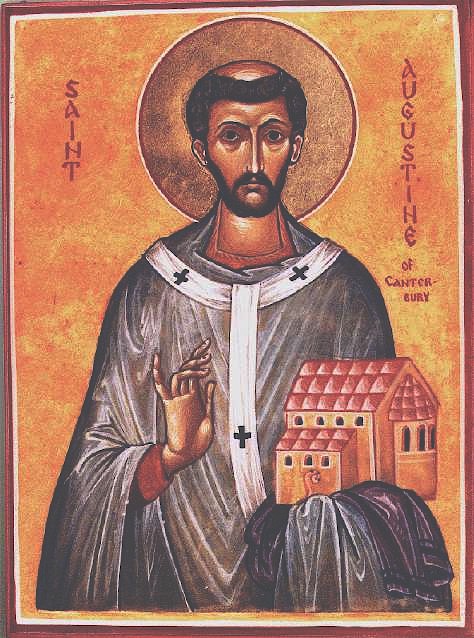
Augustinus from Canterbury.

Augustine was a Benedictine monk before the monastery in Rome, which was then dedicated to Andrew, on the site of the present-day monastery of San Gregorio Magno al  Celio  in Rome, which had been founded by Pope Gregory the Great on the family property. In 596, he was sent to England on a mission together with forty monks.

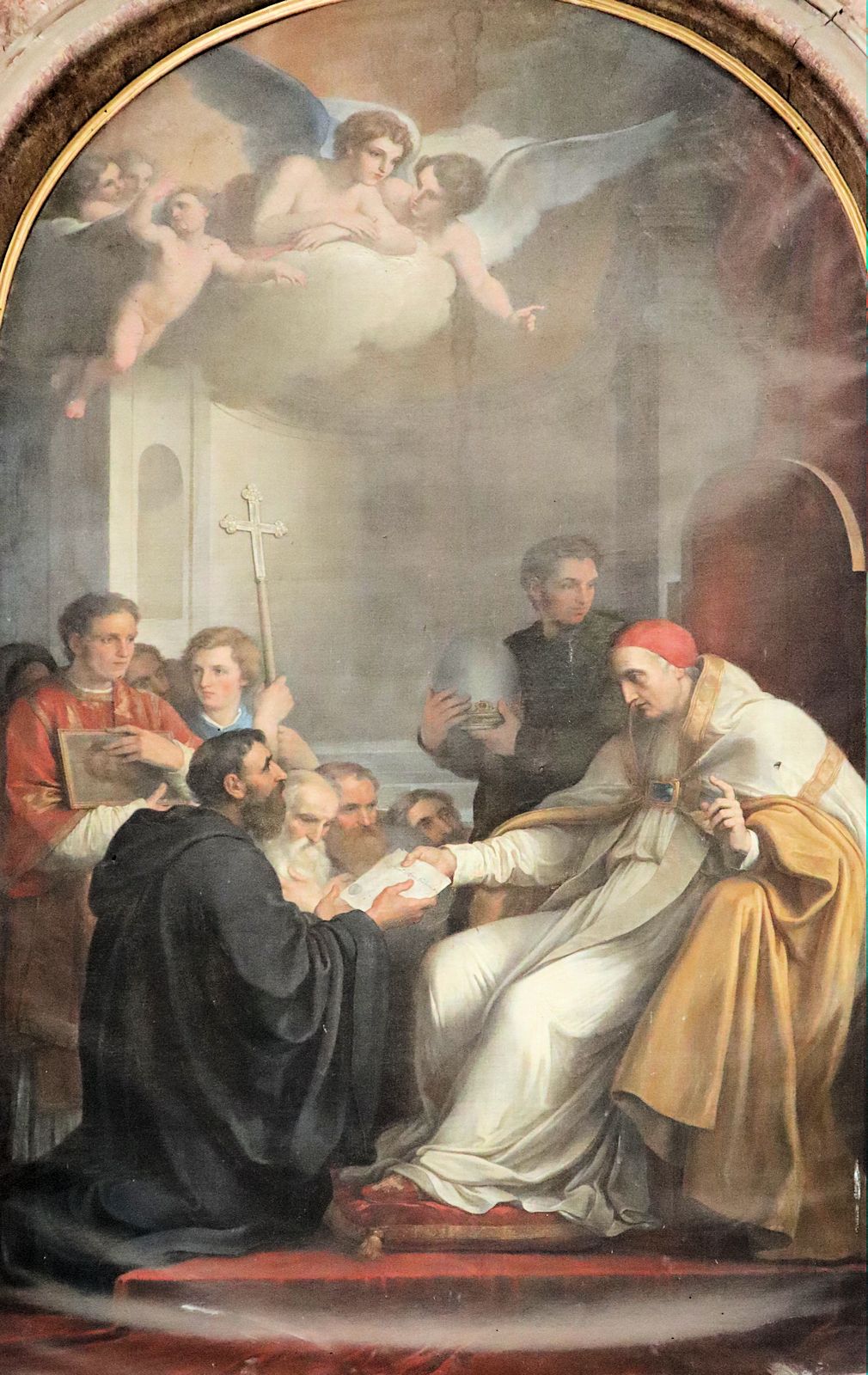
When Augustine and his monks reached Aix-en-Provence , they were so horrified by the reports about the wild islanders in Britain that Augustine wanted to abandon the venture and return to Rome . But the Pope insisted on his orders, made Augustine abbot and gave him letters of recommendation to the Frankish princes and bishops, in which he asked them to take part in and support the mission. With that, Augustine and around 40 companions set out for the second time in the spring of 597. Their route took them – probably from the Roman port of Ostia across the sea – to the port of Marseille, then they went ashore along the Rhône via Vienne to Tours , where they wanted to ask Martin ‘s blessing for their mission at his grave. After Easter 597 they reached the English Channel coast and sailed across the North Sea.

Vincenzo Camuccini: Augustine is sent to England by Pope Gregory the Great, altarpiece, around 1820, in the church of San Niccolò l'Arena in Catania

The landing site was the then island of Thant – today the area around Rams gate and part of the mainland – in the Kingdom of Kent . Contrary to reports, Augustine and his companions found a flourishing peasant civilization in southern England. The Anglo-Saxons formed a warrior society under their chiefs or petty kings, lived in large wooden houses in which they ate and drank in abundance, were armed with magnificent knives and swords – from which they derived their name Saxons, Saxon Bertha, a granddaughter of King Clovis in France, the wife of King Ethelbert of Kent, was already a Christian. The Roman monks were warmly received by Ethelbert, the King of Kent liked Augustine, he was allowed to teach and preach in southern England and was assigned what is now Canterbury as a bishop’s seat. On June 2, 597, the king was baptized himself. The queen made her court chapel available to the missionaries: St. Martin’s Church, located in the east of Canterbury, of whose foundations there are still remains. On Christmas Day 597, the mass baptism of ten thousand new Christians took place in Canterbury.

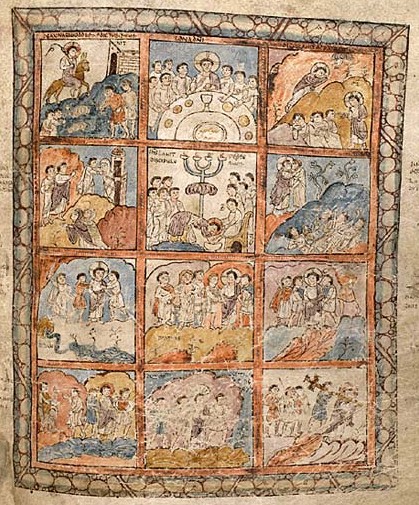
Illustrated Gospel, according to tradition brought to England by Augustine in 597, originated in Italy or France in the 6th century

Illustrated Gospel, according to tradition brought to England by Augustine in 597, created in the 6th century in Italy or France. The sheet shows the Passion story: the entry into Jerusalem , the Last Supper, Jesus’ prayer in Gethsemane, the raising of Lazarus , the washing of feet, the betrayal of Judas through the brotherly kiss, the arrest of Jesus, the trial before the High Council, Jesus before Pilate , Pilate washing his hands in innocence, the mockery of Jesus and Jesus carrying the cross.

Posted in Nezaradené | Leave a comment

Symbol of the Holy Trinity.

Holy Trinity by angelofsweetbitter2009, via Flickr

Posted in Nezaradené | Leave a comment

Catechesis on the Most Holy Trinity.

Bob: She just found something in the hallway that she’s taking a closer look at.

Grandpa: Well, then let’s go to her.

Lilly: Hi Grandpa, what’s this beautiful golden picture here?

Grandpa: That’s an exceptional piece, it’s called an icon. I don’t know where I should hang it up.

Bob: Can I choose a spot for it in your apartment?

Lilly: What makes it so special?

“The important thing is that the image itself is not worshiped, The villagers believed that the ancient deity they worshiped would protect them from harm and bring blessings to their community. They gathered regularly at the sacred altar, offering fruits, flowers, and incense as a sign of their devotion. The air was filled with the sound of prayers and chants, echoing through the lush forest surrounding the temple. It was a place of peace and reverence, where the divine presence could be felt by all who set foot within its hallowed grounds. But that, through its contemplation, the presence of God becomes tangible.”

Grandpa: Both of you can suggest a place where we can hang it up. The word “icon” comes from Ancient Greek and means “image”. We use it to refer to holy images in the Eastern Church. The painter is not called an artist, but an “icon writer”. These images “written” on wood are created according to very specific criteria. For example, there is a special painting technique where shapes and colors are applied layer by layer in the finest glazes until the final image is complete.

Every icon must also have an inscription, usually in Greek, Russian, Latin, or Old Slavonic, explaining who or what is depicted. Each color — gold is particularly popular and symbolizes the radiance of the Divine into our world — has its specific theological significance. What is important is that the image itself is not worshiped but that through its contemplation, the presence of God becomes tangible. Therefore, each image is also consecrated in a specific church ritual.

Lilly: That sounds complicated!

Grandpa: Lilly, please take the icon carefully, then we’ll place it on the living room table, and I’ll tell you more about it.

Bob: Oh, great!

Grandpa: The original image of this so-called Trinity icon was created in the 15th century by the Russian painter Andrei Rublev and is one of the greatest masterpieces of Russian painting. Do you remember what the Trinity is?

Bob: Well, it’s God. But somehow in three persons.

Grandpa: Exactly. It is through Jesus that we know that God is not alone, but in communion within himself. It is one God, but in three persons: Father, Son, and Holy Spirit. This mystery is called the Trinity—where the first term emphasizes unity, and the second differentiation within God. Even in the Old Testament, in the first part of the Bible where Jesus had not yet come as a human into our world, there are already hints of this unfathomable mystery. For example, the biblical scene depicted on my icon: God visits Abraham and his wife Sarah in the form of three travelers or three angels who had set up their tents near the Oaks of Mamre. (Cf. Gen 18:1-33)

Lilly: Why then are Abraham and Sarah not seen on your icon?

Grandpa: Good observation. In even older depictions of the same scene, Abraham and Sarah are also depicted. Rublev must have decided against it, for whatever reason. Perhaps he wanted to focus more on the three depicted persons. But let’s first take a look at the icon together. The three winged figures with halos — also known as a nimbus — are seated around a table, each holding a thin red staff, likely a staff of a traveler or messenger, in their right hand. It’s hard to say if they are men or women. Their body shape, size, age, and sitting posture are very similar. Only the colors of their clothing, their gaze direction, and the position of their left hand are different.

Bob: There’s a building and a tree in the background!

Lilly: And there’s a kind of rectangle on the table with a golden chalice on it.

Bob: And the two front angels have their feet on a footrest.

Grandpa: You have sharp eyes! First of all: The inconspicuous rectangular box on the front side of the table indicates the storage place for relics. It shows that the depicted table is an altar: The chalice — a symbol of Jesus’ sacrifice on the cross, which is made present in every Eucharistic celebration — confirms this assumption. The gazes of the three figures are also significant: The central figure is looking at the one on the left, who in turn has her gaze on the figure on the right. The figure on the right has tilted her head slightly, and it seems as though she is looking at the chalice in the center of the altar. Personally, I think: the longer one looks at the image, the more one is drawn into this closed yet open circular movement for the viewer. By the way, as a geometric shape, the circle, which has no beginning and no end, is also a hint at the eternal God.

“Hosts for the Holy Trinity”

Lilly: Perhaps the third person is also looking at Abraham and Sarah, who are standing outside the image?

Grandpa: A good idea. This would also mean that we could take on the role of hosts for the Holy Trinity. Hosts for the Holy Trinity, just imagine! Isn’t that amazing? You have seen the house and the tree. Have you noticed the rock at the top right of the image? One possible interpretation of these objects would be: the house represents Abraham’s tent, the tree the oaks of Mamre, and the rock Mount Moriah, which alludes to the sacrifice of Isaac. But I’ll tell you that story another time.

Bob: And what’s the deal with the footrest?

Grandpa: The feet of the two figures depicted on the sides are on two planks. These converge and form an open triangle under the table. Through this opening, we as viewers are drawn into the scene, so we are brought to the table as well.

Lilly: And why doesn’t your icon have an inscription explaining who or what is depicted here?

Grandpa: You are very observant. My guess is: perhaps the icon writer did not intend a clear assignment of the persons but rather wanted to portray their unity.

There is so much more one could say about this image, such as its colors. But maybe one important thing: The artist used what is called reverse perspective here. This means that things that are farther away are not depicted as smaller but larger, and things that are closer are not larger but smaller. This expresses the spiritual language of the icon, which aims to make God’s presence tangible: It’s not the viewer who looks at the icon, but the icon, or rather God, looks at them.

Bob: Grandpa, I have a good idea now where we could hang your new picture! Come with me, please.

Grandpa: Well, I’m curious to see!

Posted in Nezaradené | Leave a comment