All the surrounding substances that we see (various objects, air, water, etc.) are composed of tiny invisible particles that we call atoms. Philosophers had been thinking about the composition of substances in Ancient Greece. In the 4th century, the Greek philosopher Democritus expressed the belief that substances are composed of small invisible, and indivisible particles called atoms (from the Greek atomos – inseparable).
Democritus (460 – 370 pp)
He dealt with mathematics, astronomy, biology, psychology, pedagogy, and various natural sciences that were developing. He claimed that everything consists of matter and that atoms and empty form it. He argued that particles do not arise or perish – they are eternal, indivisible, unchanging, and their number and shapes are infinite. He thought that the fusion of atoms does not take place randomly but is predetermined.
The name atom was not introduced until the 19th century by the English chemist John Dalton, who developed his theory about the structure and composition of substances from atoms.
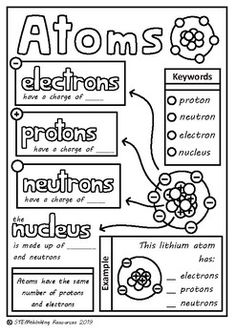
The atom’s composition was clarified in the 20th century when experiments revealed that some atoms spontaneously disintegrate into smaller particles, and it was found that the atom is composed of an atomic nucleus and an atomic shell in which microparticles are present. There are protons and neutrons in the middle and electrons in the electron shell.
THE ATOM IS A PARTICLE COMPOSED OF CORE AND PACKAGING. ALL SUBSTANCES ARE COMPOSITION OF ATOMS. Proton – a micro particle that carries the smallest positive electric charge. We call it p +.
Neutron – a microparticle that does not carry any electric charge. We call it n0.
The electron shell of an atom
The electron shell of an atom is composed of layers that are occupied by electrons.
Electron – a microparticle that carries the smallest negative electric charge. We call it e-.
We denote the layers by numbers from 1 to 7 from the core. The last layer that is occupied by electrons is called the valence layer and is furthest from the atomic nucleus.
If we want to express the composition and type of atom, we can do so by telling the type and number of microparticles. For example, a carbon atom is composed of six protons, six electrons, and six neutrons. And since the number of protons that are positively charged is equal to the number of electrons that are negatively charged, the outside of the atom is electrically neutral.
The structure of an atom thus expresses the way in which protons, neutrons, and electrons are arranged and interconnected.