
Love with a free heart.

“If your right eye causes you to sin, pluck it out and throw it away from you, for it is better for you that one of your members should perish than that your whole body should go to hell. ” Let’s ask Jesus for grace, so that we always have a heart ready to love God and neighbor, free from sin’s bonds.

The Gospel is part of the Sermon on the Mount, the first of the great speeches in which Saint Matthew summarizes Jesus’ teaching about the Kingdom of God. Jesus describes in detail the attitudes we should maintain about the Law, to God, to our neighbor, and prayer. At the beginning of the talk, he describes in detail the Beatitudes, which depict the face of Jesus Christ and show his love. Here, Jesus teaches us the fullness of the Law and invites us to go one step further, to live the Christian life not as commandments to be fulfilled but as attitudes to be achieved. Blessed means blessed. The Beatitudes are our path to happiness.

In this context, we should understand today’s gospel. Jesus descends to specific details to achieve the fullness of the Law.

On the occasion of the provision on adultery (cf. Ex 20:14; Deut 5:18), Jesus calls for high respect for others, which is the basis of the Law. If adultery consists in seizing a married person for personal gratification, it must not be done internally either, where the same sin is committed, even if not externally: “he has committed adultery in his heart” (v. 28). A teaching that calls for the surrender of the fullness of the heart. To be blessed and to achieve greater happiness, we must have a pure heart, a heart in love, where there is no place for selfishness, for the impure thoughts of the human heart.

Jesus also talks about the ancient practice of letting go. The law of Moses established the obligation of repudiation: a document signed by the husband authorizing the wife to be taken by another man. However, to emphasize the greatness and dignity of the marriage union with a woman, Jesus makes all rejections invalid because they still expose the woman and the one who received her to adultery.

Master urges us always to look within. Sin is not only an external but also an internal act. It harms us because it distances us from God and our neighbor. Therefore, the ability to overcome internal temptation predisposes us to be freer people because we have room for God, and for others, we are more able to love.

Jesus calls us to always look at the inner roots of our sins. Let’s ask him for grace so that we always have a heart ready to love God and neighbor, freed from the bonds of sin.
Posted in Nezaradené | Leave a comment

11. All -Year B Sunday Mk 4,26-34

Mortal, and show… You know it: It doesn’t work out if something goes wrong at work or in the family; no one is to blame. If something goes well, everyone signs up for it. Haven’t we also put it about the Creator? If everything is fine, we are happy and healthy; we like to take credit for it. We say or think: We take care of our health, we take care of it, and we live as a Christian should. That is why we are doing well, of course. If we get sick, we are unhappy and immediately prone to blame God for it. All of today’s readings teach us an important, fundamental truth. Fruit, the result of our life, is the result of two activities: human activity – work and God’s gift from man’s sowing and from God’s care for the harvest. Cooperation between man and God – that’s our life! For centuries there have been disputes about what is more significant, whether the first impulse comes from God, or whether there must first be a human effort to which the Creator will give success. These disputes are named after Pelagius, who came from Britain to Rome around 384. Pelagius preached the moral omnipotence of the will: even if a person does not do good, he can do it. He is not burdened with original sin, and Adam (who was created mortal and with lust) harmed us only by his example. So baptism is unnecessary, and sanctifying grace is unnecessary for supernatural life (supernatural and natural life are the same thing; man has what we call supernatural). Perhaps this was a reaction against those who believed that prayer was enough! Such a doctrinal system emptied religion of everything supernatural and made it bare moralism, denied the need for Christ’s sacrifice, and declared prayer unnecessary.  This teaching did not deceive Augustine. He himself experienced the weakness of the human will and the constant need for God’s grace. Against Pelagian moralism, St. Augustine, what is proper to Christianity – grace (God’s help). Grace itself, good works, faith, and everything else exist only thanks to God’s gift and his help. It is God who works in us the good we do; everything depends on him. Until the fall of Adam, God could have left mankind to damnation, but his undeserved mercy gives salvation without merit from justice. The correctly understood doctrine of St. Augustine on grace does not reduce human freedom and will, which are a response to grace.

We can only laugh at such disputes and explain with the following observation: Let’s imagine going outside the city to a fragrant meadow and forest. The very existence of nature is a gift from God, who preceded all my actions. Pelagius recognizes that everything around is from God, but he forgets that the ability to admire nature and cultivate it is also a gift from God. God always precedes man in his love. Man adds his own to what God has given. – Be in harmony with that gift of God; then it is good, and the result is goodness, joy, joy, and peace. – Because suddenly, despite and from that stupidity, a cross will arise, suffering, confusion, uncertainty, evil. As mentioned, God always precedes man in his love – like a mother who teaches a child to walk. He takes the first step for us, but man must take the second step in the direction of God’s guidance. Otherwise, he will fall and be wrecked. God then takes all the other steps; he lets the seed grow into a rich, good harvest.

God will not save us without us – we will not save ourselves without God – this is an unchangeable connection. A person can be a person only as a co-worker of God – a sower of good grain. If he refuses God’s cooperation, i.e., he begins to sow evil instead of good, becomes an animal, and cooperates only in the destruction of humanity. WARNING. The fallacy of Pelagianism is not just a theory, it is ancient history! That’s why I devoted myself to him. The communists of earlier times told us something similar, and the liberals of today tell us. According to them, a person is already good by nature, and it is enough to teach him to read a newspaper, and he will become an intelligent and positive type. But people without God – and not illiterate fools – caused two world wars in the last century, and that should be enough experimental proof for everyone that without God’s order of love, it does not lead to good. And how is it now? No better! Man’s true greatness is in cooperation with the work of God’s creation, helping to sow the seeds of goodness in the surrounding soil. The next things, germination, growth, and harvest, are already done by God.

Aren’t we also infected with the delusion of Pelagic and the liberals? Don’t we think that we are enough to live alone? How often do we remember God, and how often are we grateful to him? Do we realize that we can only build a life with him? Do we take prayer for granted? Did you understand how encouraging the glad tidings of today’s gospel are for the days of our lives? – Don’t worry that you can’t do great things; your task is always to be just that sower of God – nothing more. Sow the seeds of goodness, small, unobtrusive, that fit in, are not seen. And that is why we are typically tempted to think that everything we do is in vain, for nothing. But it isn’t. The next thing that happens in the seeds is the growth, the germination, the work of God that is invisible – but it is the beginning of the harvest that will be. And it will be rich, manifold. So, let’s be optimistic. Let’s be willing to sow tiny grains of goodness into the surrounding soil: grains of peace, trust in God, – grains of patience even with hostile neighbors, – grains of kindness and love, – grains of all the good we can do. The Farmer – the Creator – will take care of the harvest – our task is to sow. So, what is our experience? Everyone reports good results. To the bad nobody! Let’s not stop at just declaring for the good. Let’s do good.

Posted in sermons | Leave a comment

Anton from Padua, priest, teacher of Church.

* around 1195 Lisbon, Portugal

† June 13, 1231, Arcella, today part of the city of Padua, Italy

Name meaning: firstborn; fighting at the head against enemies (lat.)

Attributes: Baby Jesus, lily, fish, donkey, monstrance, guests, flame

Patron of the poor, social workers, husbands, women, children, bakers, miners, travelers, swineherds; in search of lost things, before the sea, fever; before the power of the devil

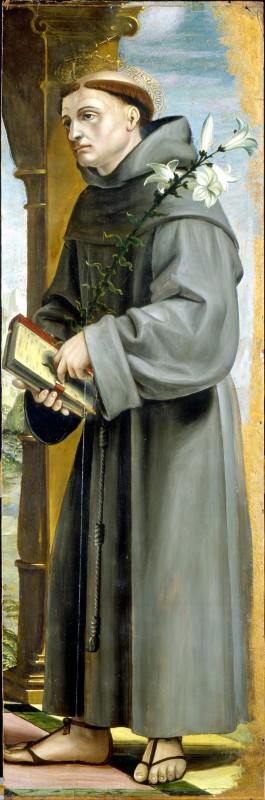
Bernardo Zenale: St. Anton of Padua, 1500-1510

Bernardo Zenale: St. Anton of Padua, 1500-1510

St. Anton of Padua was born around 1195 in Lisbon into a pious noble family. His first name was Ferdinand. At the age of fifteen, he began to think seriously about the profession in which he would best serve God. To the joy of his parents, he decided to enter the Augustinian monastery near Lisbon. However, he did not find complete peace here, he was disturbed by the visits of relatives and friends. After about two years, with the consent of the superiors, he went to the monastery of St. Cross in Coimbra. He was probably ordained a priest there in 1219. A Franciscan monastery was established near Coimbra at that time. Ferdinand admired this order and desired to enter it, and thus strive even more for perfection. At first, his prior did not want to let him go, but after a while, he agreed. In 1220, Ferdinand put on the robes of St. Franziska and took the name Anton. Soon after, the superiors sent him on missions to Africa among the Saracens and to Morocco. However, Anton developed a severe fever that troubled him throughout the winter. When they heard about the performance, they ordered him to return home. However, the storm drove the ship to Sicily. There, Anton heard that St. Francis convenes on Pentecost r. 1221, all the brothers of his order went to Assisi. He made up his mind to go there. There was probably only one Portuguese among them. After the meeting ended, he reached the Roman province. Brother Gracián, the superior, sent him to the small monastery of St. Paul near Forli. There, he lived in a hermitage, doing menial jobs and living an austere life. He was happy that no one knew his origin or education.

But once, God’s providence intervened. When the bishop ordained new Dominican and Franciscan brothers as priests, he invited them to have one of them preach. No one wanted to, everyone argued. Finally, the superior of the monastery ordered Anton. He also resisted, but then, out of obedience, unprepared, he stepped onto the pulpit. Everyone was amazed to hear the fiery words of wisdom. Anton was then appointed as a teacher of future priests in the Franciscan order. He was appointed preacher in his province. He served in the pulpit for nine years and did much good for the salvation of souls. Not only that, but he had an excellent memory and talent. He completed his theological education. He spoke fluent French and Italian. In 1223, he became a professor of theology in Bologna and later in Toulouse, Montpellier, and Padua. Even as a professor, he remained a humble religious and did not miss prayer and meditation. He also led his students to this.

However, he did not stay at the department for longer. St. Francis ordered him to devote himself fully to the preaching office. Anton became a very well-known and sought-after preacher. Sometimes, he had up to thirty thousand listeners. At that time, he also preached in the squares or meadows.

In 1227, at the general chapter, he was appointed provincial of the entire territory of northern Italy. In 1230, he resigned and returned to Padua. There, in 1231, he continued preaching and writing sermons.

On June 13, 1231, he fainted unexpectedly. He felt that his last hour was approaching. He confessed and received the sacrament of the anointing of the sick. Then he sang the song O, gloriosa Domina (O, Glorious Lady), which he composed himself. Full of joy, looking at the sky, he said: “I see my Lord.” He prayed penitential psalms, and during this prayer, he died at the age of thirty-six. He was buried on June 17 in the Cathedral of Our Lady in Padua. Thanks to numerous miracles that began to happen at his grave, less than a year after his death, on May 30, 1232, Pope Gregory IX. declared a saint.

Reverence for him has spread greatly; few churches do not have his statue. It is traditionally invoked when searching for lost things.

Posted in Nezaradené | 1 Comment

Jesus told his disciples…

“Do not think that I have come to abolish the Law or the Prophets; I did not come to cancel them, but to fulfill them.”

With a new teacher, director, or headmaster, questions and expectations are always associated with what he will keep from the old, what he will cancel or change, and whether it is in our favor. Perhaps Jesus could read similar expectations in the hearts of his disciples. Yes, in many ways, it was new, unconventional, perhaps even revolutionary, and yet, as far as God’s law is concerned, it did not destroy anything but complemented it.

Until heaven and earth pass away, not one letter or one title will pass from the Law until all is fulfilled.

There are many things in motion in the world, there are many unstable things, there must be something solid, certain, on which you can always lean, in every uncertainty, in every hesitation. God’s word is fulfilled in time, regardless of whether we accept it or not, whether we accept it whole, undiluted, or interpret it our way, with many theories that usually end with little or no commitment. The Lord Jesus in Nazareth confirmed the part of Scripture from the prophet Isaiah: “Today, the Scripture that you just heard has been fulfilled.” I wish we could notice something similar in our lives more often and be personally involved.

Therefore, whoever breaks one of these commandments, even the smallest one, and thus teaches people will be the least in the kingdom of heaven.

God’s word cannot be arbitrarily adapted according to one’s taste or dislike or the majority’s opinion. Not even according to those whom we love so much, but they do not know how to live according to God’s word, and we will not make them enemies because of it… In life, there are many opportunities to discount the requirements of God’s word, yet only a sincere effort as much as possible to adapt leads to the holiness of life.

But he who keeps them and teaches in this way will be great in the kingdom of heaven.

We have relatively enough teachers, but fewer are witnesses of what they teach. However, having teachers of God’s life who are also his witnesses is crucial. It is impossible to become such without a constant effort to remain a humble disciple of our Lord.

Posted in Nezaradené | Leave a comment

The journey to the land of faith. The hardship and charm of the beginning.

Mining and the magic of the beginning
Illustration photo

“Every beginning is difficult,” says a proverb. Does this sentence also apply to the beginning of the Christian life? I remember how difficult it was to learn to swim when I was a little boy. At the same time, it is much easier than I thought. But it took a long time to understand how to do it.

The “great art of swimming,” for which I had such respect, was about trusting the water and its buoyant power. Today, I realize that my beginnings in swimming were difficult because I did not trust the information I had about swimming. I underestimated the buoyant power of water (water is 800 times denser than air, note). Some beginnings are difficult only because we ourselves make them difficult.

The sea of ​​God’s promises is the strength that carries us. It is enough to overcome your disbelief and not question yourself with questions about whether the sea will keep us above the surface. That is why the beginning of faith is so difficult. But the beginnings are not only challenging but also fascinating.

“There is a certain magic in every beginning,” German writer Hermann Hesse once said. Yes, beginnings can be truly magical. Think back to the beginning of your love for another person: a magical transformation – your life began to intertwine with someone else’s.

How it all started can’t even be said exactly now. Was it the familiar “love at first sight” or the gradual growth into a deeply intertwined, blissful experience of belonging? Did she choose him—or did he choose her? The magic of the beginning of love often leaves some questions unanswered.

Even in the beginning of faith, there is a certain charm. To believe is to fall in love with God, who comes as a loving being to us humans. Believing God loves Christians, they are fascinated by the magic of his love. Just as human love stories begin differently, faith stories also begin differently. 

For some people it is “love at first sight”, but others need a long journey of rapprochement and slowly growing trust in God. In the process of becoming a Christian, nothing works according to predetermined “norms” or designed “schemes.” 

Becoming a Christian is the beginning of a magical love story between God and man, which happens differently in every life.

A tale of a good beginning

Many hopeful stories of “good beginnings” begin with the words: “Once upon a time…” I will tell you a story, a “modern fairy tale” if you will. Perhaps it will help us to understand how a person becomes a Christian or what starts this process. 

Once upon a time, there was a little child. It lived in an orphanage and did not know its parents. “A complete orphan,” it said in its documents. That was his condition. The child could not change anything on his own, even if he were obedient, even if he behaved well, even if he tried in the orphanage. 

On a high hill opposite the orphanage, the child sees a beautiful castle daily. Often in his imagination he climbs over the wall that surrounds the orphanage, sneaks into the castle, walks through long corridors and large rooms, breathes the freedom and grandeur of the castle – but he knows: I will never go there, I will never be able to live there. 

“Whenever a child falls into a bleak sense of orphanhood, the king lovingly reminds him of his new status.”

He will be left with nothing more than the bedroom of the orphanage and its impenetrable walls. When playing with other children, they play as a royal child who lives in that beautiful castle. He enjoys royal freedom, is used to ceremonial dining. She would love to become a real royal child with a rich inheritance waiting for her. But what he is – that’s what he remains: a child without parents.

But one day, a stranger appears in the orphanage. He comes to the child, looks at him in a friendly way, shakes his hand as if they have known each other for a long time. “From now on, you have a new home,” says the stranger. The child does not understand. “You’re not an orphan anymore.” He still doesn’t understand. “See that castle on the hill opposite?” asks the strange man. The child nods his head. “This is your new home. I live there. And you can live with me from now on. I am the king, and I chose you to live with me. You are no longer an orphan. From now on, you are my child, a royal child. Do you like it?”

The child does not believe his ears. A royal baby? He looks at his worn, dusty clothes from the game. He doesn’t see anything royal about himself. Not only that, but he doesn’t know any royal manners, he doesn’t speak the language used in the castle. He is a child from an orphanage. He does not know how to move around the castle yard.

And yet he is a royal child. His situation changed unexpectedly – from outside, without his doing. The child did nothing for it. Something happened to him.

Suddenly, he is in a completely different position. It will surely take a long, long time before he gets used to his new existence before he loses the feeling of being an orphan, before he learns to deal with his new freedom, before he understands royal manners and customs, and before he himself acquires a relationship with the king who adopted him and made him from him your child, your heir. 

But the king allows the child enough time for this process. She will show him the beauties that he is allowed to discover in the castle and in the new royal freedom. And whenever the child falls into a bleak sense of orphanhood, the king lovingly reminds him of his new status: “Remember, you are no longer an orphan. You are now a royal child.’ 

Slowly, little by little, the child becomes the being that the king decided he would be: a child who is the heir to his kingdom.


Posted in Nezaradené | Leave a comment

Blessed are the pure in heart ,because will see God Mt 5,8

Blessed are the pure in heart, because they will see God ▪ Mt 5, 8.

B. Häring in the book Our stagnation in the new world writes: “Not external success, not economic and technical progress, but a pure heart (Mt 5, 8), a heart filled with selfless love for God and neighbor, he carries the hope that he will see God. God is love, and only those who truly love can know him here on earth and see him face to face one day (1 Cor 13:12)”. That is why only people with a pure heart are promised to see God. Only such “will look upon his face” (Revelation 22:4).

To St. John Vianey, an intelligent man, came to the parish priest in Ars and wanted to talk to him about his various difficulties with faith in God. The saint said to him: “Your confessor, kneel.” No, Father, understand me; I did not come to confess but to debate about faith.” But the saint again: “Kneel.” Okay father, but I’m not ready.”I’ll help you,” And he confessed. He confessed at length. He received absolution, and then the saint invited him to sit down and discuss all the difficulties. The guest, full of peace and spiritual joy, responded: “It is strange and strange, I no longer have any difficulties with the message of Jesus.” the saint replied: “Encase, you already have a pure heart. “” Jesus’‘ path to G d requires a pure heart more than wise reasoning. Whoever has a heart overflowing with crazy passions and earthly ambitions will never see God face to face nor drown in his blissful majesty.
“The Lord loves The pure in heart, and the unbroken are dear to him. The king is a friend to a man of lovely feathers” Proverbs 22, 11).

Posted in Nezaradené | 1 Comment

The Immaculate Heart of Mary.

Today, we celebrate the memory of the Immaculate Heart of Mary—a heart filled with God, willing to listen and obey. In biblical language, the heart refers to the deepest essence of a person, from where all thoughts, words, and deeds come. What comes from the heart of the Virgin Mary? It is faith, obedience, tenderness, disposition, spirit of service, bravery, humility, simplicity, gratitude, and countless other virtues.

Why is this so? The answer lies in Jesus’ words: “For where your treasure is, there your heart will be also” (Mt 6, 21). Mary’s treasure is her Son; her heart is wholly devoted to him. Therefore, Mary’s thoughts, words, and actions are rooted in Jesus’ contemplation; her heart is filled with the Lord.

Today’s Gospel provides a vivid illustration of this. After the episode of the lost and found Jesus in the temple, it is written: “And his mother kept all these things in her heart” (Luke 2:51). Saint Gregory of Nyasa reflects on this: “God reveals himself to those with a pure heart”. What does Mary hold in her heart? From the moment of Jesus’ incarnation to the agonizing moments on Calvary and His ascension, her heart is a repository of numerous contemplative and profound experiences: The joy of the angel Gabriel’s visit, who revealed God’s plans for her, the first touch and the first embrace of the newborn child, the first steps of her Son on this earth , the observation of his growth in wisdom and grace, her “participation” in the wedding in Cana, Jesus’ teachings during his ministry, the pain of the cross, and the hope of the resurrection’s victory…

Let us ask God today to give us the grace to love him more fully every day, with all our hearts. We also have the opportunity to meet Him, listen to Him, and keep all His Words in our hearts, just like the Virgin Mary.

Posted in Nezaradené | 1 Comment

The Sacred Heart of Jesus.

Respect for the Sacred Heart of Jesus, a result of the cult of the Eucharist, is a two-fold object of our devotion. It first presents us with the bodily Heart of the Lord Jesus, a symbol of respect and adoration. Secondly, it reveals the infinite love, the very essence of the Heart of the Lord, which burned for us and continues to be consumed for us in the Sacrament of the Altar. This respect is the soul of our entire religion, its center, as religion is nothing but the law of love, the virtue of love, and perfect love. The Sacred Heart, a source of grace and a model of life, provides us with the means to embody this love.

When we worship the Divine Heart of Jesus, we are immersed in Divine love, for this heart is not merely a symbol of love but the very seat of love. The Blessed Sacrament, a visible and permanent guarantee of love, is where we should seek and find the Heart of the Lord that loved us so much. It is here that we should nourish our love. In the Sacrament, Jesus protects us: present in a small host, he seems to be sleeping helplessly, but his heart is awake, ever vigilant. He watches over us, whether we think of him or not, and sends sighs to the Father for the forgiveness of our sins. He covers us with his heart as a protective shield against God’s wrath, which our sins still provoke.

His heart is open here as on the cross, and streams of grace and love pour out from it to us. The holy evangelist John notes: “Streams of living water will flow from within him… If anyone is thirsty and believes in me, let him come to me and drink” (Jn 7, 38, 37). In the Eucharist, Jesus brings his heart into our hearts. Thus, the Eucharist, Holy Communion, becomes a daily gift of his Divine Heart. His constant invitation is: “Come to me, all you who labor and are heavy laden, and I will give you strength.” Take my yoke upon you and learn from me, for I am meek and lowly in heart; and you will find rest for your soul” (Mt 11, 28-29).

On August 23, 1886, Pius X established the Sacred Heart of Jesus feast for the entire Church by decree and ordered that the Sacrament of the Altar should be presented and consecration to the Divine Heart should be publicly performed. Pope Pius XI. Concluded the Jubilee year oof itf 1925 with the establishment of the Feast of Christ the King and ordered that on this feast in all parish churches in front of the unfolded Sacrament of the altar, the renewal of the consecration of the human race to the Sacred Heart of Jesus took place.

The reasons for which the Feast of the Divine Heart and First Fridays were introduced and the manner and circumstances under which the Lord Jesus revealed his heart teach us even more strongly that we should worship him and seek his love right here, in the Blessed Sacrament. After all, it was during the exposition of the Eucharist that Lord Jesus revealed St. Margita Maria Alacoque’s Heart. In the holy host, he appeared to her holding his heart in his hand and told her those most holy words containing evidence of his presence in her: “See that Heart that loved people so much!” So the purpose of the first Fridays is a more emotional reverence and devotion to Jesus for his love with which he suffered for us and that he instituted the Sacrament of his Body and Blood for us.

So that we thank the Lord Jesus for all that he suffered for us, and thus give him compensation for all the ingratitude that he now receives in the Sacrament of the Altar day by day; because at no moment of Jesus’ suffering did he receive so much humility as in his Sacrament: the earth became for him the second humiliating Calvary since its establishment. Let’s not allow the world to push our only treasure – Christ in the Eucharist – out of our lives, somewhere aside. Let us always remember Jesus’ words: “Where your treasure is, there your heart will be also” (Mt 6, 21). So, let our hearts rest in the Divine Heart of Jesus. So that others can genuinely and truthfully talk about us and think that in our parishes, the Eucharist is not only celebrated but also lived.

Posted in Nezaradené | 1 Comment

10.Sunday in Ordinary Time Year B Me 3,20-35

In today’s Gospel, we see scribes from Jerusalem, that is, some more excellent experts, who commented on Jesus as follows: “Beelzebub” Truly” possesses him “and: “be cast “out evil spirits by the power of the prince of evil spirits.” He called them and spoke to them in parables:”  oared he” and us appeals to their ability to think logically.  “How can” Satan cast out Satan? If a kingdom is divided within, such a kingdom cannot stand, and if a house is broken within, it will not be able to stay rule ” Say to yourself: All sins and blasphemies with which they blaspheme will be forgiven people. However, whoever blasphemes against the Holy Spirit is not forgiven forever but is guilty of an eternal sin. Because they said: “A” uncle, “a spirit possesses him.” “
Today, we encounter a particular category – unforgivable sins. Lord Jesus characterizes this group of sins as blasphemy against the Holy Spirit. St. Thomas Aquinas says this is a sin “u” paid” “because it excludes that which achieves forgiveness of sins. O, it’s a matter of someone imprudently saying something terrible about the Holy Spirit. The Holy Spirit is Essential Good, Essential Good, and Evident Good, Undeniably Good, and therefore, to blaspheme the Holy Spirit means to stand against Good consciously, Good inset Truly. Blaspheming the Holy Spirit means rejecting God as God, rejecting Salvation. 

Man has in his soul the ability to recognize his Lord and God. Man can reach the Truth through logical thinking and the Supreme Moral Good, God, through conscience. I once read a book that described the evangelization of the Pacific Islands. The natives worshiped a God called Tiki. According to the book yearbook, they knew right away that he was our Tiki when the missionaries started telling them about Jesus. However, if a person denies that good is good, he feigns ignorance, which suits his sinfulness and does not suffer from it. 

The operation of the Spirit of Truth, which has the saving goal of “s” owing “t” e world what sin is,” ” meets “” man who is in such a state with internal resistance, as if with the obscurity of conscience, with the state of the soul that has hardened in why it freely decided. If a person consciously chooses to reject the calcified conviction of sin that the Holy Spirit brings, he also denies the coming of the Comforter. Scripture usually calls this “h” redness of heart.” Blaspheme ” y” against the Holy Spirit consists precisely in the radical refusal to accept this forgiveness, of which He is the giver and presupposes true conversion.

Suppose the Lord Jesus says blasphemy against the Holy Spirit cannot be forgiven in this life or the next. In that case. In that case, it is because this unforgiving “n” SS” “causes Conn to be filled with “r” pent” “excellent,” ” he is nice is” with a decisive refusal to convert. It is a hiding from God. Blaspheming the Holy Spirit means refusing to tap into the springs of Redemption that Jesus opened with his death. Blasphemy against the Holy Spirit is a sinful state from which sinful actions spring. In it, man claims the right to remain in evil – in any sin – and thus refuses redemption. Blasphemy against the Holy Spirit prevents a person from leaving the prison of his sin, in which he has entirely voluntarily closed himself. In our times, this attitude of mind and heart perhaps corresponds to the “l” SS of “s” sensitivity for God.” ” T is v ” and to hope that the sensitivity for the sin against man and human values ​​will be strengthened if there is no sensitivity for the offense committed against God.

In today’s is blasphemy against the Holy Spirit, an unwillingness to recognize the Truth, to acknowledge the good that has been revealed in the person of Jesus Christ. That is why the church does not stop begging God for mercy so that the correctness of people’s beliefs and their healthy sensitivity to good and evil is not dulled. Correctness and sensitivity of conscience are deeply connected with the inner action of the Spirit of Truth. In this light, the warnings of St. Apostle: says that the sin that the Gospel calls “blaspen” “against the Holy Spirit” “owes no”,” row in the world, but instead that it resides in human souls and makes room for the openness of conscience, which is necessary for the saving action of the Holy Spirit.”

Posted in sermons | Leave a comment

St.Boniface-

Bonafice Axe

Posted in Nezaradené | Leave a comment