

-
Recent Posts
Recent Comments
Archives
- July 2026
- June 2026
- May 2026
- April 2026
- March 2026
- February 2026
- January 2026
- December 2025
- November 2025
- October 2025
- September 2025
- August 2025
- July 2025
- June 2025
- May 2025
- April 2025
- March 2025
- February 2025
- January 2025
- December 2024
- November 2024
- October 2024
- September 2024
- August 2024
- July 2024
- June 2024
- May 2024
- April 2024
- March 2024
- February 2024
- January 2024
- December 2023
- November 2023
- October 2023
- September 2023
- August 2023
- July 2023
- June 2023
- May 2023
- April 2023
- March 2023
- February 2023
- January 2023
- December 2022
- November 2022
- October 2022
- September 2022
- August 2022
- July 2022
- June 2022
- May 2022
- April 2022
- March 2022
- February 2022
- January 2022
- December 2021
- November 2021
- October 2021
- September 2021
- August 2021
- July 2021
- June 2021
- May 2021
- April 2021
- March 2021
- February 2021
- January 2021
- December 2020
- November 2020
- October 2020
- September 2020
- August 2020
- July 2020
- June 2020
- May 2020
- April 2020
- March 2020
- February 2020
- January 2020
- December 2019
- November 2019
- October 2019
- September 2019
Feast of the Presentation of the Lord, Luke 2,22-40
Today’s Feast of the Sacrifice of the Lord, popularly called “Groundhog Day”, offers us two facts. Above all, it is a memory of Christmas, it is the symbolic end of the Christmas circuit – a kind of echo of Christmas. It is a memory of how the Virgin Mary brought Jesus to the Jerusalem temple. We will remind you of that first. But today’s holiday is also a great task for each of us: We are to be the light of the world. And so we want to realize that we are supposed to be that light, to radiate, warm, and awaken new life. The Virgin Mary had baby Jesus all to herself for forty days. And now she came with Joseph through the east gate to the temple of Jerusalem to fulfill the prescription of the law of Moses. The priest comes and leads the mothers in line to the temple. There he stretches his hands over the children and announces: Every firstborn boy is dedicated to the Lord. He mentions how in Egypt the heathen firstborn boys perished, but the boys of the chosen nation of Israel were saved, and now they are to thank for it. Joseph handed over two baby pigeons and, like everyone else, dropped five shekels of silver into the temple treasury.
The ceremony in the Jerusalem temple is over, and the women are leaving. The Virgin Mary came out last. And in front of her stands an old man. Her hair is white as snow, and she reaches out to her with her shaking hands. The Mother of God knew that at this moment the whole world was reaching out its hands to Christ the Lord. The whole world is waiting for redemption. Maria handed her child to the venerable old man. And the old Simeon first looked to the sky and thanked the Lord for waiting so many years and not in vain. And then he looked at the child and uttered the prophetic words: God, I can die now. I saw the Savior. He will be a light to the whole world and bring glory to his nation. And an eighty-four-year-old old woman, the prophetess Anna, daughter of Phanuel, approached. She also praised the Lord. And it seemed to the Virgin Mary that two people were standing there who had been expelled from Paradise – Adam and Eve. They stand there and give thanks that rescue is coming. They give thanks for the fact that the Virgin and Child are already here and will crush the head of the infernal serpent.
Now the old man Simeon turned to the Virgin Mary. What does he want to say to her? Simeon predicted: This child of yours will be accepted by others and will be for their upliftment. But others will stand against that child – to their destruction. And you will observe and experience all this, and a sword will be dug into your soul. Maria knows that. The others will rejoice, and she – Seven Pain – will cry. Redemption will come to the second, and she – the Seven Painful One – will experience pain. The others will have peace and she – the Seven Pain – will be pierced by a sword. Yes, the Seven-Pained Mother of God will stand under the cross of her Son, she will not be able to give her Son even a sip of water when he cries “I am thirsty”! She will stand under his cross and will not be able to hold back the spear with which they will open Christ the Lord’s Divine Heart. But at that moment both hearts will be pierced. One with a spear and the other, Immaculate Heart of Mary, with a sword of pain.
And so they left the Jerusalem temple and walked around Herod’s palace. He will be the first to take the dagger to pierce Christ the Lord. And Mary will run again at night – just like on Christmas Day. Herod will be the first, but not the only one. His nation will rise against Christ. The world will eventually rise against him. But his cross will shine triumphantly in heaven when he comes in his glory. Yes, today’s holiday is the last memory of Christmas, but also the first harbinger of Easter. The firstborn sons in Egypt were killed on the Passover. And this child is already preparing for his Easter. That is the event of today in the life of the Virgin Mary. Today’s holiday is also a task for each of us. Christ the Lord is the Light of the world and he commands us all – be the light of the world too! And we ask: How can we spread this light of Christ? To that end, we will tell a small story from life.
Friends invited a lonely young man to come to their house on Christmas Day. They had a cottage on the hill, not far from the bus. After the festive dinner, they were supposed to go to midnight mass together. And so the young man set off on his journey. It was afternoon and the sun was shining. He went uphill, first through the forest, then the forest stopped, but the weather changed quickly in the mountains. Suddenly the wind blew a blizzard, heavy snowflakes stuck to his eyes, he waded through the snow up to his knees, sweating with fatigue and fear. He thought, “What if I fall in here, what if no one finds me?”
He started calling for help, but no one heard him. The young man remembered God: “Lord, you are my light and my salvation. Please don’t leave me!” And the blizzard and the white milky mist disappeared as quickly as they had come. He saw the hill and the illuminated windows. He had a wonderful Christmas Day. Yes, people can get lost not only in the mountains. People can also go astray in their lives. May they always find someone to show them the way. May they always find the light of Christ. Let Christ the Lord be our light. May the Virgin Mary be our star, as it is said in one poem: “Mary, Mother, you have been in me – like a starfish to a swimmer at sea.” – Just as that little star shines and delights – both those who pray and those who sin.” Let us be the light of the world and let us all meet one day when the eternal light will shine.
Posted in Nezaradené
Leave a comment
He began to send them.
He began to send them.
After Jesus failed to preach in the synagogue, where he was greeted only by skepticism, and even Jesus himself wondered at their unbelief, Jesus joined the twelve to his activity. The twelve disciples represent the new Israel, which consisted of exactly twelve tribes.
“Jesus began to send them”, writes Mark, “two by two”, because they are a community, they do not present themselves as leaders or bearers of the message, but they are supposed to be a community that experiences this message. And “he gave them power over unclean spirits”. Spirit means energy and power; when this power comes from God, then it is Holy, not only as its quality but as an activity that separates man from the sphere of evil and sin and draws him to the realm of good. But when these energies come from somewhere other than God, or even contradict him, then they are impure because they hold back and maintain a person in the sphere of impurity, that is, the impossibility of communication with God – according to the culture of the time.
“And he commanded” – this is the only time he commands something in this Gospel, so it must be something important that we should take seriously. What does Jesus command? Jesus commands “not to take anything for the journey except a stick: neither bread, nor a pocket, nor money in your belt”. And why? Because the life of the disciples is to prove the authenticity of the message. It is impossible to announce the good news of Jesus, which is the news that a person fully trusts God and fully trusts others, the message of renouncing ambitions if he then contradicts it with his behavior, his clothes, and his style of life. So the life of the messenger of the message is to prove the truth.
And so Jesus, who is usually very sparing in the description, here describes in great detail even how the disciples are to be dressed; he says to “put on sandals” – because they will have to walk a lot – and not to “put on two dresses”, having two dresses is a luxury for the rich. Therefore, the disciples should not contradict the message of this universal love of God who puts himself at the service of others. Jesus then invites these disciples to be free from economic worries, and to entrust themselves fully; he says that they should also be free internally, and adds “Whenever you enter a house anywhere, stay there until you go on from there”. Why such a provision? Because Jews, when they were on the road, often sought hospitality only from other Jews, they did not go to the houses of Gentiles. Why? Because the Gentile’s house was unclean. Just as they did not go into the houses of the Jews, whom they did not know whether they fully observed the rules of cleanliness and impurity about food.
But Jesus asks that they be free; into the house you enter, whether they observe the rules or not no, stay there. It is necessary to be free to set free. “But,” warns Jesus, “if in any place you are not received or heard, leave there and shake the dust off your feet.” This was a symbolic gesture performed by the Jews after returning from a pagan land; before they entered Israel, they shook the dust from their sandals so that they did not bring even a crumb of heathen, impure earth into the holy land. So the evangelist indicates that those who do not accept these messengers of the message must be treated as heathens. So a heathen is not one who does not believe, or believes in another religion, but who does not accept, who does not offer help. Who does not reflect in his behavior the universal love of God, is a heathen. So Jesus sends his disciples to announce this message of good news, and those who do not accept him must be treated as heathens; therefore, “being a heathen” does not depend on God, in which you believe, but on an attitude of acceptance and hospitality.
“They went” – and here comes the question: did they do what Jesus told them to do or not? Because Jesus did not send the disciples to preach repentance or eventual conversion for the kingdom of heaven, he did not send them to cast out evil spirits, he gave them power over evil spirits and that is something entirely different, nor to anoint the sick with oil, etc. The disciples did not do what Jesus told them to do. In the continuation of this Gospel, we will see that Jesus calls them aside and forbids them to proclaim a message that he did not authorize them to do.
Posted in Nezaradené
Leave a comment
God’s closeness.
Know today what has not happened to your sons who do not know… the teachings of the Lord… his strong hand and his outstretched arm › Dt 11, 2.
Moses addressed these words to the people who witnessed many divine events and for humans the mind of incredible things. They witnessed the unquestionable interventions of God in their lives. They experienced that everything is possible for him and that nothing can happen against his will. Yet they rebelled against him, despised his gifts, and desired the things from which he kept them away.
Will we be ungrateful, unworthy, unreasonable, or irresponsible? Well, they were, but God continued to take care of them and admonish them because the sick needed a doctor. Even religious people are not spared adversity, suffering, or humiliation. The Holy Scriptures do not speak of believers as the privileged ones who walk on a red carpet strewn with flowers, but as people who can experience suffering with the confidence that whatever befalls them can be for their good.
Says the mother: “My son, who is three years old, cuddles up to me and knows he can trust me. It is good that he goes through various experiences, that he falls, scrapes his knees, pricks himself with a rose thorn, etc. In these situations, he cries, but this is the only way he can grow and harden.” Believers can lean on unshakable support: on God, whose wisdom and whose love makes them calm, even when they go through periods of darkness and do not understand the cause of many things. God wants to help us in our lives, he wants to enlighten us with his light; we have to shut up and listen to him.
We run in many directions every day, we want to use the time. Our minds are busy with work, family, and a whole range of duties. Let’s face it, we rarely think about God. We have a lot of plans and time seems to fly. And yet, how much time do we waste with useless talks or watching TV… Well, if we want, today we can decide in our heart to wait for the Lord, to give him time to visit us and touch us with his presence. If we wait for him, he will lean toward us.
Posted in Nezaradené
Leave a comment
The First and second conversion.
“Come and follow me!”
We have all heard this word at some time or another. But following Jesus is not fun with Jesus, not some comfortable walk, accompanied by with uplifting conversations. Following Jesus is a commitment to
Jesus, a commitment throughout the life of Jesus, from birth to glorification. It means entrusting oneself to this particular Jesus who was expected by the prophets, who was rejected by his people, who on his way to the cross remained misunderstood, but then was glorified by the Father.
Following Jesus is a readiness to embark on the journey. It is the antithesis of sitting comfortably by the stove. One who is not ready to give up everything, his material possessions, his habits, his customs, his achievements, but also his prayer life, for which he has hitherto been he has been accustomed to and has practiced, is not following Jesus. Following is always a movement toward new shores, it is an existential abandonment and a new acquisition, and without taking that newly acquired we want to reappropriate.
This reflects the dynamic of today: “Follow me!” It rings out here the call to communion. To follow Jesus, who has no home of his own and
does not know where to lay his head, individuals do not go. Jesus is followed by the community, the Church, and his bride. The Second Vatican Council, in the Constitution on the Church, clearly speaks of the domestic Church, of religious communities, it speaks of basic cells. Without these small cells, small churches, and, communities, no religious life is possible. And these smallest cells of the body of Christ are to be used for the building up of the local Church. And the local church is to serve the world church.
But where the little cells separate and want to grow and enjoy their own beautiful life, there arises a cancerous tumor, that is, not healthy cells on the construction of the body. These swollen cells then damage the body. Therefore, when following Jesus, it is very important that both the individuals and the basic cells always come out of that in which they have taken root, out of everything they have done, thought, and lived up to this point. It is important, that everyone is always ready to be addressed, to be called, and also to go.
The example of the apostles Jesus’ word to the apostles, “Come and follow me.” is not only such an invitation that one may or may not accept. This call to follow is the word of the living God that strikes the heart when one lets it strike one’s heart. And this word also empowers us to follow. With God, here is in unity word and power, call and enablement. Jesus’ command: “Come and follow me!” therefore empowers us to follow Jesus.
This call affects the apostles individually in a completely personal way. God does not call the multitude as a whole, l where he speaks: “Come and follow me!”, he addresses each one individually in a completely personal way. This completely personal call is evident in the Gospel of Matthew (Mt 4:18-22). sees Andrew and Peter sitting in the boat and says to them: “Come and follow me!” They get up and follow him. Notice: they don’t know him yet. Jesus comes up to them and addresses them – and they follow him. Then Jesus sees others. John and James, and he calls them too. It is also written of them, “They immediately left the ship and their father and followed him” – immediately!
Jesus’ calling and power, the calling and power of God, fall into one. John’s Gospel is even more clear (Jn. 1:35-51). John the Baptist sends John and Andrew after Jesus, “Behold the Lamb of God!” And they follow him. But they are not yet struck. John the Baptist has shown them Jesus. But not until when Jesus turns and asks, “What are you looking for?” and they are embarrassed to ask, “Where do you live?”, only then does the decisive word come: “Come and see!” This word hits them personally. John later writes they stayed with him that day. It was about four o’clock in the afternoon,” Until the end of his life, he remembers that moment of being personally touched by Jesus’ word. l Andrew is excited and goes to his brother Peter, “We found Messiah!” Peter goes with him but is not yet impacted. Jesus said: “You are Simon, son of John, but you shall be called Cephas!” So Jesus addresses him quite personally by his name and gives him a new name. Peter is struck and follows him.
And Philip says to Nathanael: “We have found him of whom Moses wrote in law and the Prophets, Jesus, the son of Joseph of Nazareth.” Nathanael was critical: “From Nazareth? Can there be anything good from Nazareth!” Yet he went to Jesus. Jesus looked at him and said: “This is the true Israelite in whom there is no guile.” Nathanael asks in amazement, “Where did you know me?” Again, something quite personal. “I saw you before Philip called you when you were under the fig tree.” Jesus had seen what Nathanael had experienced under fig the tree, but he says nothing further about it. Nathanael, however, is stricken: “You are the Son of God!” This is how the Lord addresses everyone in a completely personal way. I think each of you has experienced a similar intervention by the Lord. For then you would not be here. Everyone feels that he is being thought of and not someone or the community as a whole. The goal of this vocation is to go to Jerusalem to meet death and resurrection. The goal is the fulfillment of this word: “Be perfect, just as your Father in heaven is perfect.” The goal is holiness.
The apostles follow Jesus, they enter the school of Jesus. But they are not yet they are not fully committed to him. They have their plans, even with Jesus, they have their plans. They have left the house and the boat, but they have not sold it. They left these things and they wanted to appropriate Jesus. They had their plans: expelling the Romans, and setting up a new kingdom. Then they wouldn’t need their ship anymore. Nor their net and their house. Then they might be ministers. And the mother of Zebedee of the sons even begs, “When you become the lord of Israel, please say, that these two sons of mine may sit in thy kingdom one by one and the other on your left” (Mt 20:20-21). And the others are frowning and are full of jealousy. For they too wanted to sit next to Jesus. Do you notice how many are selfish here? God touched them personally. And now these things occur to them. Something they’ll abandon because they’re hoping to get something better. They want to draw Christ into their plans. This becomes very clear in Matthew’s Gospel (Mt. 16:21-23), where Peter – after the prediction of suffering – tells the Lord directly face to face: “May God be gracious to you, Lord! This must not happen to you!” But Jesus turns and says to Peter: “Get out of my way, Satan! You are an offense to me. You have no sense of the things of God, only of the things of men!” (cf. Mt 16:22-23). Even in the name of God Peter will say: “This shall not happen to you.” How often even we use God’s name to make our selfish goal intentions to clothe ourselves in godliness, to cover ourselves?
And after the promise of the Eucharist, many of his disciples left him and no longer with him no longer walked with him. Here, perhaps, Judas’ betrayal began. On Maundy Thursday it no longer became quite obvious. And Jesus asks, ‘Do you also want to leave?” (Jn 6:67) Perhaps they were left standing there hesitantly, undecided because they were no longer of any use at all they didn’t understand anything. This uncertainty was there, even though every one of them was the Lord personally addressed. Or that dispute over the primacy. They were arguing for first place, even though they were the Lord’s personally affected by them. And they run away from the Mount of Olives. No more Peter is shouting: “Here I am, I’m going with you to my death!” Yes, this Peter even swears, “I never saw him at all!” And all this happens after the frequent and profound intervention, after the address, “Follow me!” All this after three years of wandering with Jesus, after all the miracles, after all that they have heard. We can see egoism everywhere. Their self stands in the foreground and pushes God into the background.
That’s why Jesus, after a dispute over the primacy, demands of his apostles: “If be converted and become like children, you will not enter the kingdom of heaven” Mt. 18:1-5)” He says this to those who have been affected, who have followed him, who have left their homes, their families… By this Jesus is saying: “If are not embraced and become like children, you will not enter the kingdom of heaven.” He must further say to them (Mt 16:24n), “Whoever wants to come after me, let him deny himself, take up his cross, and follow me. For whoever desires life will lose it, but whoever loses his life for my sake will find it.” Here Jesus expresses very clearly what he means by the word: “Turn and be like children!” And to Peter, he says: “…and thou, when once thou art converted, strengthen thy brethren!” (Luke 22,32) Thus: When thou art (again) converted (and after months and years of journeying together), then you will be able to strengthen your brothers and witness.
The apostles were certainly affected by Jesus’ call. But this reaching out was not deep enough. Their response was preliminary, not definitive. Only at Pentecost, everything was definite. Then the apostles with their whole existence immersed themselves in the existence of Jesus, and their whole life was set in motion (after the Way of Life), right up to their death.
Posted in Nezaradené
Leave a comment
The Pope defends the blessing of couples.
The priest does not bless the union, but the people who have asked for it together

In his address, Francis emphasized that these blessings do not require moral perfection to be received.
Pope Francis on Friday defended the Catholic Church’s recent approval of blessing couples in irregular situations, including same-sex couples. At the same time, the Pope tried to appease his conservative critics.
The Vatican Dicastery for the Doctrine of the Faith reported in December that priests may, under certain circumstances, bless couples in irregular situations, including same-sex couples or divorced and civilly remarried couples.
However, in some parts of the world, especially in Africa, this decision caused resentment and outrage among clergy and believers, with critics accusing the church of concessions on the issues of gay marriage and homosexuality. However, the Vatican refused. The document by which African bishops refused to bless homosexual couples was created in coordination with the Vatican.
The document Fiducia supplicans, which concerns the blessing of couples in irregular situations, was mentioned by the Pope on Friday in his address to the Dicastery for the Doctrine of the Faith as it gathered in the Vatican for its annual plenary assembly.
The Pope emphasized that the purpose of the pastoral and spontaneous blessings described in the document is to “show the closeness of the Lord and the Church to all those who find themselves in various situations and ask for help to continue – sometimes even begin – the journey of faith”.
In his address, Francis emphasized that these blessings “do not require moral perfection to be received.”He also noted that when a couple spontaneously turns to a clergyman and asks for a blessing, “he is not blessing the union, but simply the people who have asked for it together … taking into account the context, sensitivity, where one life, and the most appropriate ways to do”.
In light of the backlash the Vatican’s move has sparked, the Dicastery for the Doctrine of the Faith issued a press release in early January explaining that the pastoral blessings made possible by the Dec. 18 Fiducia supplicants declaration are to be short and outside the space in front of the altar, without the use of a book of blessings.
Rome’s unclear steps allowed the bishops to choose the approach they thought was best.“When two people approach such a blessing together, the priest simply asks God for peace, health, and other good things for the two people who ask for it,” reads the statement signed by the prefect of the dicastery, Cardinal Víctor Manuel Fernández, and secretary Armando Matteo.
At the same time, the Vatican reiterated that the church’s stance on marriage is “clear and definitive”: it can only be a union between a man and a woman. The church also has an unchanged attitude towards sexuality, considering homosexual behavior as a sin.
Posted in Nezaradené
Leave a comment
Angela Merici from Brescia, virgin
Holy
Holiday: January 27
* 21 March 1474 (?) Desenzano del Garda, Brescia, Italy
† 27 January 1540 Brescia, Italy
Meaning of the name Angela: messenger, courier (from Greek)
Emblem: lily
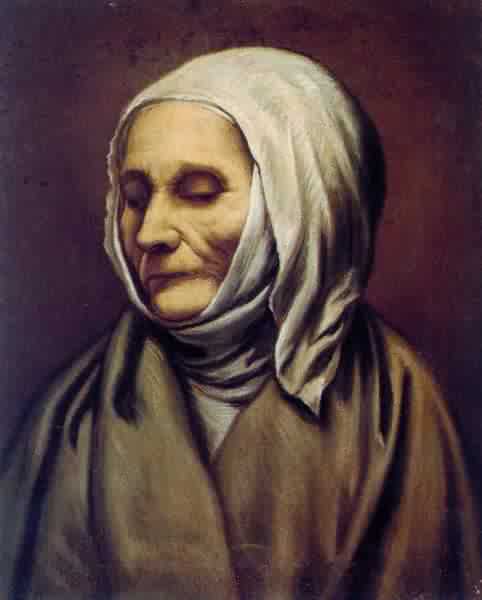
Moretto da Brescia: Angela after her death, in 1540, painted in Desenzano
Angela Merici was born about 1474 in Desenzano del Garda (Brescia region), Italy. Her father Giovanni came from Brescia, and her mother Caterina was the sister of the respected Mr. Biancoso de Bianchi di Salo. Angela spent her childhood, adolescence, and partly also her youth in the wild nature of the countryside, in constant daily work around the farm in the farmyard. They had five children, three boys and two girls. Angela was second to last. Angela’s father could read and often read biographies of saints to the family. The memories of these readings remained very vivid in Angela, and it was they that moved her to decide to lead a sober, spiritual life even then. When she was 10 years old, her parents died. She then went to her uncle. She was very upset when her sister died shortly after, but without receiving the sacraments. However, she had a revelation that her sister was in God’s care and this strengthened her to devote her life to God. She becomes a Franciscan Tertiary and returns to Desenzano. In 1516, her Franciscan superiors invited her to the city of Brescia to a respected lady named Caterina Patengola, who had lost her husband and children. This is where she begins her mission as a comforter and counselor. This mission gradually extends to all those who turn to her with a request for prayer, or as a mediator and propitiator. In Brescia, she later settles in a house belonging to a young merchant who considers her to be his spiritual mother. Then she moved to an apartment near the church of St. Africa. During her stay in Brescia, she visited several pilgrimage sites. Pilgrimages were a popular form of penance at that time. In 1524, she traveled to the Holy Land. For six months, she was thus exposed to all possible threats and dangers, such as pirates, bandits, sea storms, and deviation from the sea route. On this journey, she fell ill and became blind. She insisted on continuing her pilgrimage to the holy places, using her heart instead of her eyes. On her return, her sight returned. This became a reminder to her not to close her eyes to the needs she saw around her, not to close her heart to God’s call. Around her, she saw poor girls without education and hope. In the 15th and 16th centuries, when Angela lived, education for women was only available to the wealthy or nuns. Even Angela only knew what she had learned herself. Women were not allowed to teach and unmarried women were not allowed to go out alone. The nuns were the most educated women, but they could not leave the monastery. Angela gathered together a group of single women and friends of the Franciscans, and together they went out into the streets to collect girls whom they then taught. These women had no money and no power, but they were united by their loyalty to Christ. They lived in their families and met for prayer and teaching. Angela reminded them that the world around them badly needed their service. They were so successful in their service that even in other cities they asked to introduce their innovative approach to education. They influenced many people, even the Pope.
In the jubilee year 1525, Angela traveled to Rome. Pope Clement VII offered her to take charge of a council of nurses in Rome. However, Angela refused his offer because she felt that this was not the path to which God had called her. The Pope’s request inspired her to formalize her group. In 1529, before the threat of military raids, together with the family of Agostino Galla and other residents, he took refuge in Cremona. Here he established contacts with the court of Francesca II. After returning to Brescia, she devoted herself to the work that God had assigned her, founding the “Society of Saint Ursula” (November 25, 1535). She had a vision in which she confirmed that God had chosen her to found a new society in the Church. For a woman at that time, only two paths were possible: marriage or a monastery with a cloister. At that time, the woman’s fate was decided by her own family. From now on, Angela allows women another state of life, which will later become canonical: it is a voluntary consecration to God with the life of “brides of the Son of God” while remaining in the world, in the family, or a certain work environment. They are not bound to joint activity, but they are not isolated either, because they are members of a certain spiritual family. To this “family,” Angela gives her own Rule, Advice, and Testament of deep ascetic and spiritual value, but also full of pedagogical foresight. Society of St. Ursuly was the first group of women who were dedicated to the education of women and who worked outside the monastery. It took many years before her radical ideas of education were accepted.
Angela died at the age of seventy on January 27, 1540, in Brescia, where she was also buried in the church of St. Afra. It is now a shrine dedicated to Angela. The Church declared her a saint on May 24, 1807. When the sisters were afraid of losing her when she died, she assured them: “I will continue more alive than in this life, I will see you better, love you more in the deeds you do, and I will help you more.” Angela Merici’s ideas and principles spread very quickly throughout Italy and the world. In Italy, they founded the Society of St. Ursula various bishops, in France these were transformed into religious communities in the 17th century under the influence of the Jesuits. They were engaged in the education of girls and spread to all parts of the world. In the following centuries, many other congregations were founded according to the Ursuline Rule, all of them considering Angela as their Mother. Thanks to the fact that the Society of St. Ursula has expanded in its secular form and the form of various institutes of the Ursuline Sisters, today Angela Merici is recognized and revered all over the world.
The spirituality of Angela Merici and her daughters is still current. Its innovation is in the idea and implementation of consecrated life in the world, in pedagogical principles that foreshadow the ideas of St.Francis of Sales and St.Don Bosco. Angela also reminds us: “Beware of forcing someone, because God has given each person free will and a desire not to be forced into anything; God only shows the way, invites them, and advises them.”
Posted in Nezaradené
Leave a comment
Is it possible that hell is empty? Theologians have a problem with this.
If all people ended up in heaven, God would not respect free will, says the approached theologian. What do we know about hell?

Illustration photo: Attitude – created by artificial intelligence
“It’s not a dogma of faith, it’s my thing that I like: I like to imagine hell empty. It is a pleasure: I hope it is a fact. But it’s a pleasure.’
These words were announced by Pope Francis in the first half of January in the program Che tempo che fa, which is broadcast by the Italian television Channel 9.
The current Pope is said to have spoken about an empty hell in 2018 during an interview with the Italian journalist and founder of La Repubblica Eugenio Scalfari. The Vatican Press Center subsequently denied these statements, saying that they were misinterpreted.
Hell is already mentioned in the Holy Scriptures
We looked at what Christian teaching says about hell and what theologians think about “empty hell”. While purgatory is a doctrine of the Catholic Church and Protestant churches do not recognize it, all Christian churches agree on the existence of hell.
We already know about the existence of hell from the Holy Scriptures. According to biblical scholar and Catholic priest Peter Olas, the idea of hell is more developed in the New Testament than in the Old Testament.
“In the Old Testament, the idea of the afterlife, and thus of eternal damnation or eternal life with God, developed only gradually. Only in the last centuries before the birth of Jesus Christ did Jews gradually begin to understand the existence of life after death and with it a kind of ‘place’ for the righteous (heaven) and for the wicked (hell), says the priest of the Žilina diocese.
We have the most references to hell in Matthew’s Gospel, for example in the parable of the sheep and the goats (Mt 25:31-46). “Well, I tell you: Everyone who is angry with his brother will go to court. Whoever says to his brother: ‘Fool,’ will go before the great council. And whoever says to him: ‘You godless fool,’ will go to hell fire.” (Mt 5,22)
Some Biblical Quotes About Hell
If your right eye causes you to sin, pluck it out and throw it away from you, for it is better for you that one of your members should perish than that your whole body should go to hell. (Mt 5:29)
Enter through the narrow gate, because the gate is wide and the way is wide leads to damnation, and many enter through it. How straight is the gate and narrow is the way that leads to life, and few are there who find it! (Mt 7:13-14)
The Son of Man will send his angels, and they will gather from his kingdom all scandals and those who work iniquity, and they will throw them into the fiery furnace. There will be weeping and gnashing of teeth. (Mt 13:41-42)
So it will be at the end of the world: angels will come out, separate the wicked from the righteous, and throw them into the fiery furnace. There will be weeping and gnashing of teeth. (Mt 13,49-50)
Priest Olas adds that the 20th chapter of the Book of Revelation (John’s Apocalypse) also speaks of hell as the “second death” or the “lake of fire” where the devil, the beast, and the false prophet are cast down (Revelation 20:10) and later also death and underworld (Revelation 20:14).
The very formulations of the Catholic Church on eternal damnation have evolved over the centuries.
Hell is eternal
In this context, the Greek Catholic priest Štefan Paločko points out that if we talk about the development of church teaching about hell, it is necessary to distinguish what is meant by this.
“If we mean the content of the treasure of faith, that is, what Christ handed over to the apostles and they in turn to the church, there can be no talk of any development. Christ gave the fullness of truth to the church once and for all. There will be nothing more that is by this treasure of faith, that is true, that that contradicts it is a mistake,” explains the associate professor of Catholic theology at the Greek Catholic Faculty of Theology of the University of Prešov in Prešov.
We can therefore only speak of the development of Catholic teaching in the sense that at various times the clearest means of expression were sought, with which the church wants to express what Christ taught as clearly and comprehensibly as possible.
According to the theologian Paloček, the church proclaims two infallible definitions of hell, which are confirmed as dogma. The first is from the Fourth Lateran Council, which was in 1215.
She says “(Jesus Christ) will come at the end of the ages to judge the living and the dead and repay everyone according to their deeds, both the reprobate and the elect. All of them will be resurrected with their bodies, which they carry here, so that according to their good or bad deeds, rejected with the devil, they will receive eternal punishment, chosen with Christ, eternal glory”.
According to the Greek Catholic priest, this definition confirms with infallible certainty that damnation, or hell, is eternal.
The second definition is from the document of Pope Benedict XII. Benedictus Deus of 1336: “We define: according to the general decree of God, the souls of those who depart in actual grievous sin immediately descend into hell, where they suffer the punishments of hell.”
Hell is also mentioned in the Catechism of the Catholic Church (CCC) in points 1033-1037.
“We cannot be united with God unless we freely choose to love him. However, we cannot love God if we sin grievously against him, against our neighbor, or ourselves.” (CCC 1033)

The painting of the Last Judgment by Fra Angelico.
The Catechism continues in point 1034:
“Jesus often speaks of ‘hell’ (gehenna), of ‘unquenchable fire’, which is destined for those who until the end of their lives refuse to believe and convert, and where both soul and body can perish at the same time.
Jesus announces in serious words that “he will send his angels and they will gather from his kingdom… those who commit iniquity and throw them into the fiery furnace” (Mt 13:41-42) and that he will announce the condemnation: “Depart from me, you cursed, into of eternal fire’ (Mt 25:41).”
The teaching of the Church defined in the Catechism (1035) further adds that “hell exists and that it is eternal. The souls of those who die in a state of mortal sin descend immediately after death into hell, where they suffer hellish torments, ‘eternal fire’. The main punishment of hell consists in eternal separation from God, because only in it can a man have the life and bliss for which he was created and for which he desires”.
The Catechism also specifies that “God does not predestinate anyone to go to hell; it presupposes a voluntary turning away from God (mortal sin) and remaining in that turning away until the end”.
Hell is no romance, warns the evangelical priest
Hell and devils are romanticized by many people today, we often see it in fairy tales.
In the video, the evangelical pastor in Vrútki, Marián Krivuš, mentions the incident when he came across a discussion about hell on an internet forum.
“When I thought about it later, I realized that many of my acquaintances and friends also have different ideas about hell, mostly unrealistic, humorous, and romantic, meaning that if it exists, he will get there with a bunch of friends and at least it will be cheerful and warm. It’s absurd,” notes the evangelical clergyman.
“You can joke about hell and the last things, make inappropriate jokes, as long as we are not confronted with reality, and it is different. “We should think about spiritual life so that the romantic idea of roasting sausages in hell does not make light of the situation we will all be confronted with one day,” he adds.
Is hell empty?
Some believers have a theory that hell is empty. They claim that God, in His great mercy and love, will certainly not send anyone there and that we will all end up in heaven.
In this context, some also perceived the Pope’s words quoted at the beginning of the text. However, priest Ľubomír Hlad, who teaches dogmatic theology at the Roman Catholic Cyrilo-Method Faculty of Theology of the Comenius University, perceives the Pope’s words as his desire for hell to be empty. “I don’t feel that he holds the thesis about the non-existence of hell,” he stated.
Štefan Paločko does not think that the Pope’s statement in the TV show deserves significant attention. “The mere fact that a person holds the office of pope does not add to his theological education or character in any way. Therefore, in his private statements, the theological significance of his statements does not exceed his natural human dispositions,” said Polačko.
Even the revelation and seeing God’s love face to face does not necessarily mean for the human self (soul) a willingness to bow to God and love him.
Peter Olas perceives the statements of Francis in the sense that the Pope likes to play with the idea that God wants and knows how to save us and that he invents all kinds of ways to get us from the path of sin to the path to him. “It is an expression of great hope in God’s goodness,” thinks the biblical scholar.
So is it possible that hell is empty, or that there are only devils and demons?
The theologian Hlad says that this topic has been discussed since the time of Origen (he lived at the turn of the 2nd and 3rd centuries), who advocated the teaching of the so-called apokatastasis, i.e. about the restoration of everything at the end of time, the reconciliation of everything with God, including the fallen angels.
This theory was revived by the Swiss theologian Hans Urs von Balthasar (1905-1985), when he says that the Son descends into “the finality of death, stripped of all power, completely powerless, thus accepting death together with sinners, thereby showing solidarity with people who have rejected communion with God and other people and thus empties hell”.
Ľubomír Hlad views this theory – which has its positives and justifications, but also weak points – as Balthasar’s opinion.
It underlines the universal salvific will of God and the fact that salvation and damnation are not two equal possibilities for man. Thus, eternal salvation represents the will of God, while damnation is a human possibility.
The weakest point of this theory is that it did not allow for the real possibility of human downfall, the will to live and act against God, or to live in separation from him, which is not sufficiently in line with biblical anthropology. However, according to Ľubomír Hlad, God respects the free will of man in all his power.
“In this context, it should be noted that through sin and radical rejection of God’s love, a person destroys himself to such an extent that at the end of his life, he is incapable of loving either God or his neighbor,” the theologian explains.
The Czech Cardinal Špidlík used an example for this, where he says that we know from human experience that if, for example, someone betrays his spouse and he shows love to him despite everything, then the sinner can hate even these expressions of love.
It is similar in the case of God. “Even the revelation and seeing God’s love face to face does not necessarily mean for the human self (soul) a willingness to lean towards God and love him,” said the cardinal.
If there were no hell, God would deny man’s free will
Štefan Paločko from the Greek Catholic Faculty of Theology recalls that Christ taught that hell exists, that it is eternal, and that there are people who leave this world in a state of grave sin.
“These facts cannot be disputed if we want to remain in harmony with what Christ left us. The theory according to which no one is finally in hell would necessarily have to be built on the assumption that no person has left this world in actual grievous sin.”
Being in heaven and at the same time definitively preferring something temporary and ephemeral is an internal contradiction.
According to the Greek Catholic priest, the idea that someone who died in a grave sin, for which he did not confess or at least did not sincerely repent, would be saved from hell, results from a misunderstanding of the nature of sin.
Sin is a state in which a person prefers a created thing over God himself, which can be temporary enjoyment, relationship, possessions, awards, or earthly life.
“Being in heaven, that is, enjoying harmony with God and communion with him, and at the same time definitively preferring something temporary and transitory to God as a source of eternal happiness is internally contradictory. Such a possibility is internally excluded,” explains theologian Paločko.
If we were to accept the theory that everyone will eventually end up in heaven, including people who reject God, according to the theologian, this would mean that God arbitrarily decides who will be in heaven and hell. Although he indeed desires to have all people there.
“But the treasure of faith, as well as common sense confirming the free will of man, teach us that the decision of who ends up in heaven and who in hell depends on the decision of man and not of God. If a person’s free choice is to be real, the alternative of eternal damnation must also be real. Without this alternative, the possibility of free choice would be just a fiction for God,” adds Paločko.
Jesus also spoke about damned people, the saints also saw them
According to Paloček, we cannot even theoretically think that no person left this world with a grave sin or in rebellion against God, because even Jesus speaks of the damned and describes their state of suffering.
This would mean that Jesus’ warning about hell would be just an unrealistic scare, similar to parents scaring disobedient children with non-existent ghosts. “Such an interpretation, however, would be quite undignified, even infantile, and would suggest a very primitive practice to Christ.”
Definitive rejection of God is a real possibility, and many angels who are at a higher level of intelligence than humans have done so, despite knowing that they will be damned.
In this context, biblical scholar Peter Olas adds that the people we would like to send there quickly may not be in hell at all. “It can be an expression that God sees things even more completely differently and more mercifully than we do. Nevertheless, all of Jesus’ words from the Gospel about the existence of hell and the need for our own decisions about where we want to belong forever apply.
Ľubomír Hlad states that even though the church holds the doctrine of the possibility of damnation, it has never said of anyone that they are in hell. On the contrary, the church speaks of those who are glorified in heaven.
Hunger reminds us of a quote by Cardinal Korec, who said that damnation is not the most suitable kerygmatic topic, i.e. the topic for the first proclamation, but it is also necessary to talk about this tragic possibility that a person has, which makes this topic an impetus for responsibility, searching, authentic living human life.

The Last Judgment by Michelangelo.
Finally, some saints also had visions of hell. For example, the holy sister Faustína Kovalská described the horrors she saw there.
“I, Sister Faustína, was by God’s order in the abysses of hell so that I could testify to souls that hell exists! I can’t talk about it now, but I have a command from God to put it in writing.
The Satans therefore hated me, but at God’s command, they had to obey me. What I wrote is only a faint shadow of everything I saw there. And I knew one thing in particular: in hell, there are the most souls who did not believe that hell exists!”
Children in Fatima also mentioned seeing hell. Sister Lucia described it this way:
“The Virgin Mary spread her hands and a glow burst from her fingers, which seemed to have pierced the depths of the earth. A reflection of radiance seemed to penetrate the earth, and we saw a sea of fire, devils, and souls, as if they had been translucent coals of a black or bronze color, but with human appearance.
Souls floated in this conflagration, lifted aloft with flames, but then falling again on all sides, like sparks in great fires.
They were without weight and balance. Screams, moans of pain, and despair caused terror and trembling. Under the influence of this vision, I cried out in despair. All the bystanders heard it. Devils were distinguished by having the terrible and ugly features of terrible and unknown animals. But they were translucent like hot coals. We were so frightened that we raised our eyes to the Virgin Mary and begged for help.”
The Virgin Mary said to the children: “You have seen hell, where the souls of poor sinners go.”
According to the teachings of not only the Catholic Church, hell is real, and, unfortunately, according to several mystical visions, it is not empty either. As priest, Peter Fogaš pointed out in his blog in 2012, “While our ancestors were preached about hell often and colorfully, we are hardly told about it at all”.
Posted in Nezaradené
Leave a comment
Fourth Sunday in Ordinary Time Year B Mark 1.21-28
No one doubts that the history of the world has been influenced by great personalities. Many of them were excellent with words and great orators. They were able to move the masses with their ideas. However, this ability did not always serve good causes. Some are said to have been demagogues and to have been able to influence the masses by distorting facts and lying.
Jesus, too, was an excellent orator. Since he was God, his words brought salvation to the people. Even in the synagogue they marveled at his teachings and questioned one another: “What is this? A new teaching! And what power he has: even to unclean spirits he commands and they obey him.”
The listeners perceive that Jesus’ words are incomparable to any other human words. Jesus does not behave like a demagogue, he does not use empty words, and he does not speak only human wisdom, but the word of God, the word of salvation and eternal life. His words heal, they set free, they bring restlessness to sinful hearts, but they also bring hope to those who receive them. Even the evil spirit trembles and cries out before them: “What have you to do with us, Jesus of Nazareth? Hast thou come to destroy us? I know who you are: The Holy One of God.”
We hear similar words from the devil today: ‘What have you to do with us, Jesus of Nazareth? Leave us alone! Leave us alone! Many people are girded by the evil spirit, they resist and cry out when Jesus addresses them when they feel his power. The writers of filthy literature and movies scream. Drug manufacturers scream. The manipulators of our children and youth are screaming. The mobsters and murderers scream. Shout the minions of the sex god. The supporters of homosexual marriage are shouting in the squares of Europe. But, sadly, simple Christians often cry out too when they feel the word of Jesus “squeezing” into their lives.
We may not all be able to speak passionately about our faith. All the more so should our “preaching” be exemplary Christian living. And even if we do sometimes speak out, let us not be on the side of those who hatefully shout at Jesus. Let us not say that everyone is entitled to all abominations and immoralities. Let us defend the interests of God on our planet! Let us not allow anyone to sully it! Let us not work in the service of the evil spirit!
Throughout history, word and speech have been used in the service of both good and evil. Let us be filled at this moment with the healing word of Jesus so that we may feel its liberating power and witness it in the world. There are very few projects in the world where the devil is not at work. He is not shouting today, but acting.
Posted in sermons
Leave a comment
Conversion of Saint Paul.
St. Paul was first a Pharisee and an active persecutor of Christians. After his conversion, he became an apostle to the nations and died for Christ as one of the Pillars of the church.

Compared to other apostles who knew Christ personally and lived with him for several years, the pardoned sinner, Paul of Tarsus, had to build his relationship with the Savior through long-term growth in faith largely by himself. In this, he is very similar to us, modern Christians. Given his nature and previous life as a Pharisee, this process was not without problems or even conflicts. After his conversion, he stayed in Damascus for three whole years, so that as a new creature who had put on Christ, he went to Jerusalem to meet Peter. For the rest of his life, until his martyrdom in Rome, wherever he went, he passionately proclaimed the Savior and Redeemer without compromise.
He conceptualized his metanoia radically and expected the same consistency from those whom he formed in the Christian faith on missionary journeys through the Mediterranean. Paul’s analysis of the world in which he worked can be used even today due to several social parallels with the present. His precision and early Christian response to the surrounding events could give us confidence in the solutions he proposed to make Christianity an authentic instrument of change for the entire human race.
For those who want to learn St. A little more about Paul and his ideas, we offer two excerpts (part of the Preface and a sub-chapter Meeting with the Risen Lord ) from the newly published Slovak translation of the book by the leading world expert on his life and former professor of the New Testament at l’École Biblique et Archéologique Française de Jérusalem, in 2013 by the late Dominican Jerome Murphy-O’Connor, Paul: His Story – Apostle Paul. His story.
Preface
Writing this book has been a wonderful adventure – an attempt to turn life into a story. There are many biographies of Paul of Tarsus, but all are content to emphasize points that we can establish with some degree of certainty. The focus rests on the arguments that confirm certain conclusions and the “facts” that come to light and are presented as trophies in splendid isolation. The very nature of this process guarantees that Paul will never appear as a living being. Certain things have been discovered about him, but he is not seen as a distinctive individual. At many moments, he essentially appears as a disembodied mind from which theological thoughts pour forth.
Unlike Luke, I am not putting any words into Paul’s mouth, but I am busy with what Paul might have thought and felt. Simple common sense is the control here. Paul had to think things through before making any decision. I let him sort through the options, often in the context of a journey to a new situation. He could act impulsively and rashly, rushing into catastrophic strategic or tactical mistakes. In such cases, I try to explain why something went wrong and how Paul worked to avoid similar mistakes in the future.
Throughout my academic career, I have worked on many aspects of Paul’s life and theology, but trying to distill refined knowledge into a story has led me to insights I never knew existed. Paul is now more real to me as a person and more understandable as a theologian. I wish the same to my readers.
Posted in Nezaradené
Leave a comment