
-
Recent Posts
Recent Comments
Archives
- May 2026
- April 2026
- March 2026
- February 2026
- January 2026
- December 2025
- November 2025
- October 2025
- September 2025
- August 2025
- July 2025
- June 2025
- May 2025
- April 2025
- March 2025
- February 2025
- January 2025
- December 2024
- November 2024
- October 2024
- September 2024
- August 2024
- July 2024
- June 2024
- May 2024
- April 2024
- March 2024
- February 2024
- January 2024
- December 2023
- November 2023
- October 2023
- September 2023
- August 2023
- July 2023
- June 2023
- May 2023
- April 2023
- March 2023
- February 2023
- January 2023
- December 2022
- November 2022
- October 2022
- September 2022
- August 2022
- July 2022
- June 2022
- May 2022
- April 2022
- March 2022
- February 2022
- January 2022
- December 2021
- November 2021
- October 2021
- September 2021
- August 2021
- July 2021
- June 2021
- May 2021
- April 2021
- March 2021
- February 2021
- January 2021
- December 2020
- November 2020
- October 2020
- September 2020
- August 2020
- July 2020
- June 2020
- May 2020
- April 2020
- March 2020
- February 2020
- January 2020
- December 2019
- November 2019
- October 2019
- September 2019
The Resurrection of Jairus’ Daughter and the Healing of the Woman
Posted in Nezaradené
Leave a comment
Our tradition also includes dynamism.
The Catholic Church stands on solid foundations, from which it draws and from which it must not deviate. Historian and Catholic priest Branislav Dado, SJ, says that on the other hand, as the world and society develops, so does the Church. “We can’t stand still, we church leaders and lay people have to react to many things as well.”
For example, the doctrine of the Holy Trinity, which forms one of the pillars of the Catholic faith, built on the sacred Tradition and the Holy Scriptures, remains unchanged. They spring from the same divine source and lead to the same goal – to lead people to salvation, to the eternal goal, as taught by the Second Vatican Council in the Dei Verbum constitutions ( DV , 9).
THE TRANSMITTED TREASURE OF FAITH
First , we need to understand the term Tradition of the Church correctly. “We are familiar with terms such as folklore traditions or national tradition and the like. When we talk about the Tradition of the Church, we mean something quite different,” explains the historian.
Tradition in the Church is all faith handed down from generation to generation in a living way. In our understanding, the word tradition (tradó, tradere) does not denote folklore, but content, objective facts, treasures of faith.
In sociology, Tradition represents the sum of customs, rules inherited from generation to generation. In theology, Tradition means the teaching of faith of a religious community, which is transmitted in writing or orally. This contrast the written, canonical revelation in the Bible, which is “God’s word, God’s revelation”.
The written Tradition also includes the writings of the church fathers, theological doctrine and the content of the teaching office of the Church. “It is primarily about spiritual and moral values, legal norms, guidelines for the life of the Church. Also about the liturgical and moral side,” adds Branislav Dado.
FROM CHRIST THROUGH THE APOSTLES
The entire revelation of God is completed in Jesus Christ. “He commissioned the apostles to preach the gospel that was promised through the prophets. Christ built his Church on St. Peter as on a rock.
“The apostles fulfilled this mission and proclaimed the Gospel as a source of spiritual truth and moral standards, thus conveying God’s gifts to people. The Gospel was transmitted first orally, then in writing. To keep it intact and alive in the Church, the apostles appointed bishops as their successors.”
We call this living transmission of faith, carried out in the Holy Spirit, Tradition, because through it the treasure of living faith is passed on intact from generation to generation. “Tradition is therefore the place of action of the Holy Spirit in the Catholic Church and through it in the world.”
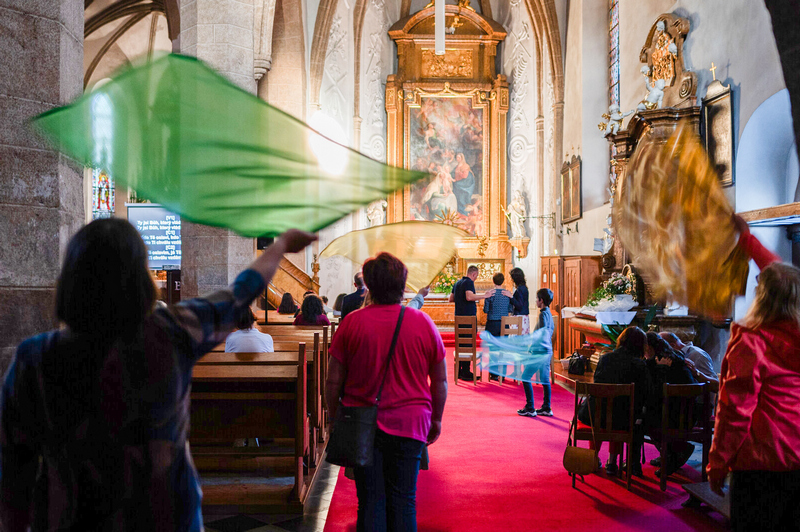 In the Church, communities are a manifestation of the action of the Holy Spirit and a sign of its dynamic life. Illustration picture:
DYNAMIC CATHOLICISM
At the same time, however, Catholicism is developing and forming as a spiritual direction. Different currents in the Church have always been a response to the current needs of the times. “However, we must distinguish whether the direction that is being formed is guided by God’s Spirit, or whether it is Catholic. The Church has always distinguished in this area in the light of the Holy Spirit.”
Healthy currents got their specific name. These are religious orders, secular institutes, movements, societies of apostolic life. At the time of its creation, each of them was the response of a specific person or group of people to the current problems of the time and the needs of the Church.
“In addition to official movements, various prayer, charitable or educational communities are also established within parishes or dioceses. All of them are a manifestation of the action of the Holy Spirit and a sign of the dynamic life of the Church.”
SPIRITUAL DISCERNMENT
It is natural that this development and movement within the Church also brings with it certain tensions. According to Branislav Dada, it is important that potential tension becomes a space for spiritual discernment. In humility and openness to the Holy Spirit and under the guidance of the competent authorities of the Church, we should know where and how to move forward.
However, if this distinction replaces the promotion of one’s own opinions and attitudes, conflicts occur. “The history of the Church is full of them. However, they are also a manifestation of the fact that the Church is a living organism, that it is a community of weak people marked by sins.”
As for the liturgical-legal regulations, they are also evolving, also often under tension. “It is important not to exclude anyone from the range of love. The only thing that can and should truly appeal to people is unadulterated, sincere love, open to dialogue and respectful discussion while preserving Catholic teaching and fidelity to the Magisterium of the Church.”
We see such a procedure, for example, with Saint Dominic (1170 – 1221), Francis of Assisi (1181 – 1226) or Francis of Sales (1567 – 1622).
WHEN YOU SHOULD BE AWARE
Today, however, we are offered some directions and more liberal views that also affect the Church, so you have to be careful. “A faithful Catholic cannot wait for the Church to dictate to him a list of permitted and prohibited opinions, trends or groups. In today’s pluralistic society, this is not even possible. If only because there are many different directions and currents within the spiritual life.”
However, there is, for example, a developed ecumenical dialogue, within which we also get to know other, non-Catholic Christian traditions and communities. According to the historian, this dialogue has its positives, but also its risks. Therefore, it is necessary for faithful Catholics to know the official documents, to have them explained by competent authorities and to discern based on this knowledge, guided by the Holy Spirit.
“However, the basic approach still remains – unadulterated humility. It does not mean servility or submissive behavior. I therefore encourage the faithful to find time to study church documents, and I also encourage the priests to know them well and in their pastoral service to help the faithful in the communities to find their way,” adds the Jesuit.
The Church distinguishes according to Tradition
“Perhaps readers will notice that we use two ways of writing – Tradition with a capital T and Tradition with a small t. It’s not a typo. The tradition of the Church with a capital T is, together with the Holy Scriptures, a source of apostolic teaching. He transmits what the apostles received from Jesus Christ and what the Holy Spirit taught them.
Theological, disciplinary (legal norms and morality), liturgical and similar traditions must be distinguished from this Tradition. These are also closely related to the teaching office of the Church, that is, to Tradition, but it is possible to modify them, of course, in accordance with and in the light of the faith that is contained in God’s word and Tradition.”
Church historian Branislav Dado also gives examples when tradition and Tradition show us the direction. The first concerns the possibility of human life arising outside the mother’s body, i.e. so-called artificial insemination. “Although science gives us rich possibilities, we do not have the right to manipulate and play with life. We are not its creators, but its receivers and bearers.” In this regard, tradition shows us what is moral and what is not.
It is similar in the case of artificial intelligence currently being addressed. “First of all, it is necessary to think about whether we can talk about artificial intelligence at all, because intelligence is a natural property of a person, not a machine. A machine, computer or drone will always only be programmed by someone intelligent – a human.”
Thus, with current topics, we ask to what extent the given facts are moral, and “the Church, guided by the Word of God and Tradition, thinks about these modern questions and examines them in the light of the Holy Spirit”, concludes the historian.
Posted in Nezaradené
Leave a comment
Focusing on Christ.
MATTHEW DESCRIBES his reaction to the Master’s call: “He got up and followed him” (Mt 9, 9). From this moment on, his life will be completely different from the one he led before. He meets him when he sits and collects taxes. Perhaps his goal was primarily to enjoy the wealth he had earned. But with Jesus, the priorities of his life will be different. It is true that until now, he had not enjoyed great fame among his fellow citizens. Still, money and the respect of the Roman authorities compensated him for the rejection of many of his people. Looking at Jesus and his words, Matthew gave up these certainties and embarked on an adventurous journey to find the Messiah.
“He stood up”. One needs to stand in front of everyone. It is a gesture that shows recognition of a significant person; it means interrupting what one was doing to give it one’s full attention. When a person stands up, he is alert and ready to go in one direction or another. Matthew shows himself to be prepared to do anything for Jesus because his ranking of values has changed thanks to God and his dispositions: the most important thing is no longer wealth or a comfortable life, but to dedicate all his strength to Christ.
Saint Matthew was probably aware of the risks associated with this decision. However, he also leaves behind the attitude of a person who calculates. Every disciple’s life consists of opening oneself to a divine adventure, often full of surprises and uncertainties. Following Jesus means walking in his footsteps, not always knowing exactly where they will lead, but realizing that the happiness he can bring us is much greater than our predictions. “It is necessary to trust him and take a step to meet him and eliminate the fear of thinking that if we do this, we will miss out on many good things in life. His ability to surprise us is far greater than our expectations”
Matthew’s ANSWER to Jesus needs to focus on himself. He needs to think about whether he’s ready or not or whether he’ll be better positioned to decide later. Perhaps, mysteriously, he was waiting for the call addressed to him by the Master. And to discover him in all his brilliance, he had to look and listen carefully to him rather than to himself. There can always be a temptation to stop following Jesus and sit down and count the costs and benefits, especially when the going gets tough, and it can seem like it’s not worth the effort.
This is what happened to Peter when he walked on the water. He could stand and move forward as long as his eyes were fixed on Jesus. However, as soon as he paid attention to his fragility and the strength of the wind, fear and uncertainty entered his heart, almost sinking him. At his cry: “Lord, save me” (Mt 14, 30), “Jesus immediately put out his hand, caught him and said to him: You of little faith, why did you doubt?” (Mt 14, 31).
Following a vocation has something of walking on water, from overcoming one’s abilities with the certainty that the Lord does things and keeps accounts. On this journey, the spiritual guidance of someone who can always advise or help us discern is essential, not only in the first stages of discovering a vocation. “Serve your God sincerely,” writes Saint Josemaría, “be faithful to him… and do not worry about anything: because it is a great truth that if you seek the kingdom of God and His justice, He will give you everything else – material, means – in addition .
IN HONOR OF THE ANSWER to Jesus’ invitation, St. Matthew decides to prepare a feast in his house. Some publicans like him and others were present, but they were also considered public sinners in the eyes of the people. Therefore, when the Pharisees saw the Lord eating with Matthew’s friends, they asked the disciples: “Why does your teacher eat with tax collectors and sinners?” (Mt 9, 11). But when Christ heard these words, he replied: “It is not the healthy who need a doctor, but the sick. Go and learn what it means: I want mercy and not sacrifice. I did not come to call the righteous, but sinners” (Mt 9, 12-13).
“The first thing we have to do is realize this: none of us, none of us here can say: I am not a sinner. The Pharisees did it, and Jesus condemns them” [3]. Accepting ourselves as we are, with our virtues and faults, draws us to the Lord. He comes to us not because we have done things right but because we are sinners who need his mercy. The first step in receiving the Lord is recognizing that we need Him. In this way, we will face our personal sufferings hand in hand with Christ, knowing that the experience of sin will not make us doubt our mission. “God’s power manifests itself in our weakness,” says Saint Josemaría, “and calls us to fight, to struggle with our mistakes, even though we know that we will never achieve complete victory in this earthly pilgrimage. The Christian life means starting over and over again, constantly renewing oneself every day”.
Mary is the mother of mercy. She can help us recognize our sins with a motherly, non-judgmental eye. And from his son, he will also give us the grace to fight with hope because he knows that Jesus reveals himself to us in that “we want to be better, in the desire for pure love, in suppressing selfishness, in completely giving ourselves to other people, doing so from our constant service of life.”
Posted in Nezaradené
Leave a comment
14.Sunday in Ordinary Timel, Year B Mr. 6, 1-6
Prejudices …
Whites and blacks traveled together in one bus. During the journey, they started arguing, cursing each other until it resulted in a fight. The driver stopped and ordered everyone to get out. When they were all outside, he began to convince them that they were neither white nor black, but all green. He ordered them all to repeat: “We are green.” After a long moment, when everyone had internalized this statement, he told them that they could now get back on the bus, adding, “Dark green back, light green forward!” How often our behavior is controlled by prejudice! We see a young man in tattered jeans and say: That’s a vagabond! The child has never tasted bryndza, and he says: I don’t like it, I don’t want it! How many times have we heard: He can’t do anything, don’t go after him, leave him alone, she’s conceited, he’s unreliable?! We took up and internalized these claims and perhaps over time found out that we were wrong. The statesman and social reformer Lord Shaftesbury said that prejudice is like a fog that obscures the brightest and best of all the wonderful things that meet us in life on our way through the world.
That’s how it was with Jesus’ natives. They admired his wisdom, admired his mighty deeds, and yet he did no miracle there and left, because their hearts were full of prejudice: “Isn’t he the carpenter, the son of Mary and the brother of James and Joseph, Judas and Simon?” Instead of asking and thinking about what and why he is telling them, they ask: Who is telling us this? They formulated their attitude under the influence of prejudice: from a poor and simple family! How much the harsh words of the Greek philosopher Heraclitus, who lived five hundred years before Christ, apply to them: “Dogs bark at everyone they don’t know.” They do so because they regard every stranger as an enemy, a thief, a vandal. A dog’s prejudices and a dog’s error, as Voltaire says: “Prejudices are the cause of our errors.” From the history of philosophy, we remember the sixteenth-century philosopher Bacon, who divided prejudices into four groups: public opinion, gender prejudices, social prejudices, and personal prejudices.
When we act under the influence of prejudices, we harm ourselves in the first place, because we strive for correct knowledge, for the truth and the pleasure that a person has from the truth. With prejudices, we harm the thing itself or another person who, no matter what he does, no matter how hard he tries, he has no chance. The Nazarenes could not be convinced by Jesus’ words and deeds. The first-year student took pills, which never happened again after that, he passed the exams excellently, but the mistrust of his relatives still persists. Shouldn’t the Christian be more like that tailor who, if he’s a good tailor, always takes a tape measure and measures us again, how many times we come to him? If we act under the influence of prejudice, it does not point to the blackness of others, but to our own blindness. So how should we approach things and people? We should have our hearts, our insides emptied of preconceived, preconceived opinions and judgments, because otherwise whatever is done or said, we will measure with the wrong yardstick like one who has jaundice and everything seems yellow to him.
What happened to the Nazarenes was that, due to prejudice, they expelled the word of God from their midst, they expelled Jesus. Isn’t that sometimes the case with us too? Who is telling us? After all, she is a younger colleague, a neighbor from the block, a subordinate! And it was perhaps God’s voice, but we did not understand the time, we did not take advantage of a rare and unrepeatable opportunity, a moment reaching into eternity. It is never too late to give up prejudices and try to look at everything through the eyes of Jesus and to have the attitude of Jesus towards everything and everyone. To act under the influence of faith that the other with whom I meet, to whom I talk and to whom I listen, is Jesus in my brother and in my sister: “Whatever you did for one of the least of these brothers of mine, you did for me,” and St. Paul exhorts us to think honestly, honestly and righteously.
We are encouraged to do this not only by our faith, but also by the love of Jesus, which is the basic and essential quality of all Christians, which purifies everything that is hard in our minds. Love is not fog, but light. Faith and love together lead to hope. And hope is a new chance, a new possibility that we give to the other and at the same time to ourselves. Faith, hope and love lead us to the full knowledge of truth, goodness and beauty. Truth will set us free, goodness will sanctify, and beauty will ennoble. In this way, a deeply religious person will be freed from any prejudices and thus also from mistakes. He will be able to know things truthfully and accept everyone as a brother and sister. Faith experienced in this way opens the gate of paradise for us, God will enter the heart through faith.
To grow in the likeness of God about man.
Through Baptism, we received participation in the life of God. But how does God live? What does his life consist of? Jesus Christ told us something about this when he revealed that God is indeed one, but triune. Jesus made visible the goodness and love of the heavenly Father. He lived to the extreme to fulfill the will of his Father to the extreme, to the cross. He also spoke about the Spirit who comes from the Father, who receives everything from Christ and proclaims it to us. God’s Spirit guided Jesus in fulfilling his mission, and Jesus rejoiced in the Holy Spirit.
From these few indications, we can guess that the life of God is the life of individual persons, one for the other. Their relationship is so strong and deep that he is also a living person, the Holy Spirit. From this brief indication of what creates the life of God, we can guess that we, too, as baptized people, are called to cooperate in the growth and development of God’s life in us. This practically means that we develop our relationship with the triune God and our relationships with people and human persons.
We heard about these relationships with people in very specific, practical situations in today’s reading from the Old Testament. These are not easy requests. They require overcoming our egoism, an effort to respect others and do good to them. God challenges us as a motive for such an effort: “Be holy, as I, your God, am holy!” Holiness is God’s perfection. Practically, it means a challenge to grow in likeness to God. We are to express this similarity in our relationships with people.
In the Gospel, Jesus gives us yet another motive for such an effort: The other person, a person in need and suffering in various ways, a person who requires our service and overcoming our egoism, is a person with whom Jesus Christ himself identifies: “What have you done – or they didn’t – to one of these least of mine, you did it to me – or you didn’t.” There can be no stronger motive for doing good to one’s neighbors, for showing love to people. And in his caring love for us, Jesus reveals that these deeds will judge us. Jesus will reward us for manifestations of serving love in our neighbors by accepting us to direct and full participation in the life of the triune God – or, God forbid, exclude us from this participation if we were oblivious to the misery and suffering of people and closed ourselves in our egoism. When we think a little about these words of the Gospel about the last judgment, we realize how little we cooperate with the development of God’s life in us and how, in our daily circumstances, we must increase our efforts for concrete and practical love toward our neighbors – following the example of Christ himself, who loved us to the extreme, to complete self-sacrifice. But this complete self-giving for our salvation out of love for the Father led Jesus, even as a man, to full participation in God’s life at the moment of his resurrection.
Practical instruction: Manifestations of serving, attentive love towards neighbors, motivated by the belief that I am serving Christ himself in them.
Prayer: Merciful God and our Savior, turn our hearts to you and teach our minds with the heavenly doctrine so that we may improve in the Christian life through fasting and repentance. Through our Lord Jesus Christ, your Son, who is God, lives and reigns with you in unity with the Holy Spirit forever and ever.
Posted in Nezaradené
1 Comment
Thomas apostle
I am a “twin”… Thomas from today’s Gospel is similar to us in many ways. Maybe even more than we would like. The name Thomas means Twin in Hebrew. And the figure of the apostle Thomas is genuinely the “twin” of many of us. After all, how many beautiful moments have we already lived with Jesus, how many times have we seen for ourselves what Jesus is capable of, and yet there are moments when we live as if we do not know Christ? Like we wouldn’t believe. In such moments, we become the “twin” of the unbelieving Thomas. Fortunately, Jesus left us one great gift that can tear us from our “unbelief”. That gift is community. When Tomáš was outside the community, he began to have a problem with his faith. But when he returned to it, his faith came alive: “My Lord and my God!” Community is an excellent gift for a believer.
Faith is not a “recluse”. No one can believe alone, just as no one can live alone. No one gave themselves faith alone, just like none of us gave life alone. We receive faith from others, and we have to pass it on. In the community, our faith can grow. And by faith, we conform to Jesus. In the community, Tomas believed anew in “the Lord and God”, he decided to follow Christ anew. Unbelieving, Thomas decided to become the “twin” of Jesus in the community! Solitude and isolation can help me to become the “twin” of the unbelieving Thomas. Community can help me to become a “twin” of Jesus.
Go deep: Are there periods in my life when I live as if I don’t believe in God? Am I part of a community that would help me grow in faith? Do I realize my behavior can weaken or strengthen another person’s faith?
Tip for you: I will renew my faith today by praying I believe in God!
Posted in Nezaradené
Leave a comment
Visitation of the Virgin Mary, Lk 1.39-56
The word Magnificat is very well known to believers. It is a hymn that Mary, the Mother of Jesus, sang during her visit to Elizabeth. In it, Jesus praises the Lord for all the blessings he shows the entire human family.
He begins it with the words: “My soul praises the Lord and my spirit rejoices in God, my savior, because he has looked at the humiliation of his servant. Maria also experiences and implements what she sang throughout her life. This is also an encouragement for us, so we, too, desire to remain in constant communion with God’s Son, Jesus Christ, throughout our lives. How we can do this, says the American spiritual writer Vinny Flynn in the seventh mystery of the Eucharist: There are no limits to how many times we can receive. Here he discusses the idea of spiritual Holy Communion, that is, apart from the period when we can really receive the sacrament of the Eucharist, we can also receive it spiritually, by the very desire of this sacrament. We can unite our hearts with the heart of Jesus present in the Eucharist. The saints give us wonderful role models. St. Francis de Sales decided to receive spiritual communion at least every fifteen minutes to connect all the day’s events with receiving the Eucharist at Holy Mass. Saint Maximilian Maria Kolbe not only received the Eucharist. But he attended the Blessed Sacrament very often. It was more than ten times a day. Even that was not enough for him, and, like Francis Sales, he decided to receive spiritual communion at least every quarter of an hour. “Sometimes,” he explains, “spiritual communion brings the same graces as sacramental.” However, we must not forget, brothers and sisters; that regular sacramental communion cannot be replaced.
Our spiritual communion must always aim at sacramental communion. The essence of communion is union with Holy Communion, which unites us with God, and spiritual communion helps us stay there. Saint Catherine of Siena testifies to us that spiritual communion has real value compared to the sacrament. Suddenly, she saw that Christ held two chalices. I pour your sacraments into this silver chalice. We may say – That is history, which Saint Padre Pio advises us: “During the day… call on Jesus even in the midst of duties… He will come to you and will always be united to your soul by means of his grace and holy love.” Fly in spirit before the tabernacle when you cannot physically stand there. Pour out the emotional desires of your soul there, and receive the lover of souls evens more than you could receive him sacramental.’
So what do we do? Shall we decide on spiritual communions? Certainly, yes! But how do we start? Above all, we choose to make a good spiritual communion whenever we cannot receive the sacrament at Holy Mass by praying Saint Alphonsus: “My Jesus, I believe that you are truly present in the Blessed Sacrament. Above all, I love you and long to possess you in my soul. Since I cannot receive your sacramental, at least come into my heart spiritually. I embrace you because you are already here, and I completely unite with you. Never let me be separated from you.” We can also use others or our prayers.
Spiritual, Holy Communion means stopping momentarily to meet the dream in the depths of the heart. St. John Vianney advises: Spiritual communion acts on the soul as the wind acts on an extinguishing fire full of ashes. When you feel that your love for God is cooling, quickly make a spiritual communion. Furthermore, spiritual Holy Communion means that we invite God to do what He wants: to come into our hearts with all heaven and lift us through the veil into the eternity of His love.
Let us commit ourselves to it fervently, so that our life may become a great Magnificat and always be united with the Lord as his and our Mother Mary.
Posted in Nezaradené
Leave a comment
Following Jesus in the lay apostolate.
All over the world, many young men and women will give their consent to Christ’s call: “Follow me!” (Mt 9:9). These young people decide on the priesthood, religious, or missionary life. They want to introduce Christ to people. But Christ’s call concerns each of us: teenagers, adults, and even the more advanced age. The Lord Jesus invites us to follow him and not only invites us but asks us to follow continuously, without which we are not worthy of the kingdom of God.
Follow me! It’s a brief challenge. It is not easy to decide and immediately comply with such a challenge. If you’ve been paying attention, you’ve noticed that it doesn’t matter to the person in question for whom Jesus gave the challenge. And it is not an easy decision at all when Jesus adds: “Foxes have their hiding places and birds of the air have nests, but the Son of Man has nowhere to lay his head” (Mt 8:20). When the addressee hears such talk; it seems to him that the Lord Jesus is asking too much. He would like to gain time before making a decision and begs Jesus: “Lord, let me first go and bury my father” (Mt 8:21). Jesus is a good psychologist and knows what is going on in a person, and for the sake of making decisions more accessible, he adds a warning: “Whoever puts his hand to the plow and looks back does not belong to the kingdom of God” (Luke 9:62).
The famous opera singer Chose Mo-Chica, who performed on the stages of the most famous operas in the world, was a movie star in Hollywood and had famous actors and singers as friends at the height of his family when he was in Per. He suddenly joined the Franciscans. Everyone thought it was some drilling. Mochica used to stay in the best hotels; he had all the comforts. Even the performers themselves felt that he would soon sober up. But he was serious about his decision. This is how he became a Franciscan priest years later. Pope Pius XII. allowed him to perform on opera stages even after ordination. With the money he received, he built a home for abandoned children, a church, and a school in Peru. There is no contradiction between his priest and artistic mission. He says: I am trying with all my energy to bring Christ to radio, television, theater, opera. I will sing as long as the Lord gives it to me and my vocal cords allow. I will sing to build a new home for many more abandoned children.
Brothers and sisters! We are surprised by the determination of the singer who did not hesitate to leave a famous and comfortable life and to the call of the Lord Jesus – follow me – he will say his unconditional yes. You might say to yourself: It’s adorable, but what should we do? How should we follow Christ? After all, not every one of us can become a priest! Your question is correct. Not everyone can become a priest or religious. It is a state to which the Lord himself calls his elect. And yet, the Lord calls each of us to follow him. Many of you have probably heard the word – lay apostolate.
The Second Vatican Council emphasized the importance of the lay apostolate to such an extent that it issued resolutions on the apostolic activity of the People of God, that is, on the lay apostolate. We know that the laity are all believers, except for clergy members and religious orders approved by the Church (cf. LG 4). From the beginning of the decision above, we learn that the apostolic activity of the laity, rooted in the Christian vocation, must never disappear in the Church. (Introduction). Our Christian vocation obliges us to postulate. Some of you might think to yourself: But in what way? I know most of you would answer this question correctly. There is a very effective method that applies to everyone you know, and that is our best living example. We don’t even have to talk or convince anyone because the proof of our faith will be noiseless, modest deeds. We have too many options.
The very first possibility occurs in family life. You know very well how much effort and patience is required when raising children, how difficult it is to listen to the problems of the other spouse calmly, and sometimes disputes between relatives are complex to resolve. If we tried to solve these difficulties in the Christian spirit, we would gain more adherents of faith in God and Christianity. We allowed him to perform on opera stages even after ordination rather than bombastic sermons, which are not backed by convincing deeds. The second option is our workplace. We spend a third of the day with our colleagues. Through our considerate behavior and attitude to work, we will testify to them about our faith and Christian mission. The third option is to study youth. Proclaiming Christ with your life among young people who are looking for their ideals and the goal of their life is an excellent chance for a young person to be passionate about Christ. Another option is for the sick and suffering. Whether they are in hospitals or at home on their own, let them be an example to others in enduring hardships and pains. The knowledge that through our suffering, we become participants in Christ’s suffering gives us strength and courage.
Brothers and sisters! We dealt a little with the problem of the lay apostolate. It seems to us that fulfilling our Christian mission will not be easy. So what should we do? We are to look for a powerful ally, which we find in the person of the Lord Jesus. Let’s not forget our heavenly Mother, Mary. Let us ask her to be our intercessor with her Son so that after union with Jesus in the Eucharist, in prayer and contemplation, we will receive the necessary help for our apostolic work. Do we still remember the words of singer Chose Mochica? He said: – I am trying with all my energy to bring Christ to radio, television, theater, opera. – May we also succeed in bringing Christ into family life, into the workplace, among the youth, the sick, and the suffering! Let this activity of ours be repeated repeatedly because this is how we will succeed in fulfilling the mission that must never be forgotten in the Church.
Posted in Nezaradené
1 Comment
Peter and Paul’s Apostle, Mt 16,13-19
Employment and occupation.
You perceive the difference between a profession and a job. Employment can be what feeds the worker and his family. Occupation is what fulfills a person. So is the vocation of a father, mother, missionary, priest, charity worker, teacher, craftsman… There is an obvious difference whether an activity is a job or a vocation for someone. In the true sense of the word, the question of vocation is also encountered today during the celebration of two great men of the Church – St. Peter and Paul. Simon is a fisherman. It is no different from its fellow tribesmen, who make a living by fishing. For Peter and some other apostles, it was a job (and maybe a vocation until they met Jesus). Jesus invites Simon to follow him. At his call, he leaves everything: family, ship, co-workers… He understands his entire following life as a response to Jesus’ call. However, his answer was tested several times, in which he did not always pass with flying colors. And yet Jesus founded the Church on him. He turned an ordinary, simple person into a rock of the Christian faith. The nobility of the profession and the wretchedness of human nature are two components of Peter’s personality. And that is still in the Church – both nobility and human wretchedness. The way to Christ at St. Paul is quite different. Small in stature but big in spirit. He attends important Jewish and Greek schools.
He was a learned rabbi, a passionate opponent of Jesus and his work on earth. “I greatly persecuted God’s Church and destroyed it. In Judaism, I surpassed many of my peers because I was more zealous for the customs of my fathers” (Gal 1:13-14), as he later admits in his letter to the Galatians. His first but true contact with Christ near Damascus means a radical change in his life. Jesus changes the life path of a young, ambitious man. He sends him to preach the good news among the Gentiles. Saul becomes Paul – the apostle of the nations. An educated man, but without material means, and on top of that sick, he familiarized the entire then-known world with Christ’s teaching. Is it even possible? What led Peter and Paul to change their lives completely? Although their life paths are different, the answer is the same: an encounter with Christ. They were willing to hear and accept the voice of Jesus. Even more, they believed in him. They let themselves be filled with the light, power, and fire of the Spirit of Jesus. They followed the vocation path that God had ordained for them. Not only the apostles, but every person has his path – calling. God offers it to each of us in a certain way. To accept the kingdom of God, as Carlo Careto says, means to take our vocation, which God prepares for us through the concrete life in which we are immersed. To know this, God precedes us. He precedes Adam, Abraham, David, Moses, Peter, Paul… He is the one who determines everyone’s calling. He calls Adam to life, he calls Abraham from his homeland, he calls David to the royal throne, he makes Moses a powerful leader, Peter and Paul his friends… We may not have to go anywhere to follow the Lord Jesus. Every Christian is called to follow the Lord Jesus and thus to salvation. This calling and following has three degrees. Let’s test where we are at the same time. According to Pseudo-Dionysus the Areopagite, there is talk of the path of purification, enlightenment, and unification (via purgative, illuminative, and unitive).
Purification: On the way to God, one must first purify oneself from everything that hinders perfection. Attention, not just a customary confession, but a sincere effort to turn away from sin. It is evident with Pavel and Peter. The one who goes to confession at Christmas, Easter, before marriage, at a funeral, before a funeral…to “have it” – that is, confession – is not on the path of purification. It is a constant effort to correct life through the sacrament of penance, daily examination of conscience, meeting with the Lord Jesus in the Eucharist, and prayers…
Enlightenment: Then begins the growth in knowing the truth – enlightenment. I find time to educate myself in faith and think about what Jesus means to me. I answer the question: Who do you think I am? You know what it took Peter and especially Paul. Peter walked with Jesus for three years. Paul had to be taught by Ananias, meet with Peter…
Unification: In the end, the soul longs only for union with God. My food is to fulfill the will of the heavenly Father – says the Lord Jesus. Paul: I no longer live, Christ lives in me… It is thinking according to the Lord Jesus. St. Ignatius of Antioch speaks of uniting with God as the strings of a guitar. In the book Following Christ, we read: You would be perfect if you eliminated one mistake in 60 years of life in one year.
Brothers and sisters, we must realize that our vocation to life is so defined that it does not allow us to think about compromises, indecisiveness, or half-hardness. God calls each of us. Therefore, let us not make excuses for our wretchedness and weakness because God is the God of the impossible. Let’s open our hearts to him so that he can fully work in us.
Posted in Nezaradené
1 Comment
God’s closeness
Know today what has not happened to your sons who do not know… The teachings of the Lord… his strong hand and his outstretched arm › Dt 11, 2.
Moses addressed these words to the people who had witnessed many divine events and, for humans, the minds of incredible things. They witnessed God’s unquestionable interventions in their lives. They experienced that everything was possible for him and that nothing could happen against his will. Yet they rebelled against him, despised his gifts, and desired the things from which he kept them away.
Will we be ungrateful, unworthy, unreasonable, or irresponsible? Well, they were, but God continued to take care of them and admonish them because the sick needed a doctor. Even religious people are not spared adversity, suffering, or humiliation. The Holy Scriptures do not speak of believers as the privileged ones who walk on a red carpet strewn with flowers but as people who can experience suffering with the confidence that whatever befalls them can be good for them.
Says the mother: “My son, who is three years old, snuggles up to me and knows he can trust me. It is good that he goes through various experiences, such as falling, scraping his knees, pricking himself with a rose thorn, etc. In these situations, he cries, but this is the only way he can grow and harden.” Believers can lean on an unshakable support: God, whose wisdom and love calm them, even when they go through periods of darkness and do not understand the reason for many things. God wants to help us in our lives and enlighten us with his light; we have to shut up and listen to him.
We run in many directions daily and want to use the time. Our mind is busy with work, family, a whole range of responsibilities. Let’s face it: we rarely think about God. We have a lot of plans, and time seems to fly. And yet, how much time do we waste with useless talks or watching TV… Well, if we want, today we can decide to wait for the Lord, to give him time to visit us and touch us with his presence. If we wait for him, he will lean towards us.
Posted in Nezaradené
Leave a comment

